You have identified a high-potential 3D printer model, negotiated a competitive unit price, and planned your launch campaign. Then customs flags your container because the power supply lacks an FCC mark. Six weeks of delay. Thousands in demurrage fees. A retail partner who cancels their order.
Certification is not a checkbox exercise — it is the difference between a smooth market entry and a compliance disaster that erases your margin. For distributors importing 3D printers from Shenzhen-based manufacturers like Precise3D, understanding exactly which certifications are mandatory, which are strategic, and how to verify them before shipment is essential operational knowledge.
This guide maps the certification landscape across the three largest consumer 3D printer markets — the European Union, North America, and select Asian markets — with real costs, timelines, and what to demand from your OEM partner.
The Certification Landscape: Mandatory vs. Strategic
Not all certifications carry equal weight. Your first task is separating the non-negotiable — marks without which your shipment will not clear customs — from the strategic certifications that build buyer confidence and unlock premium retail channels.
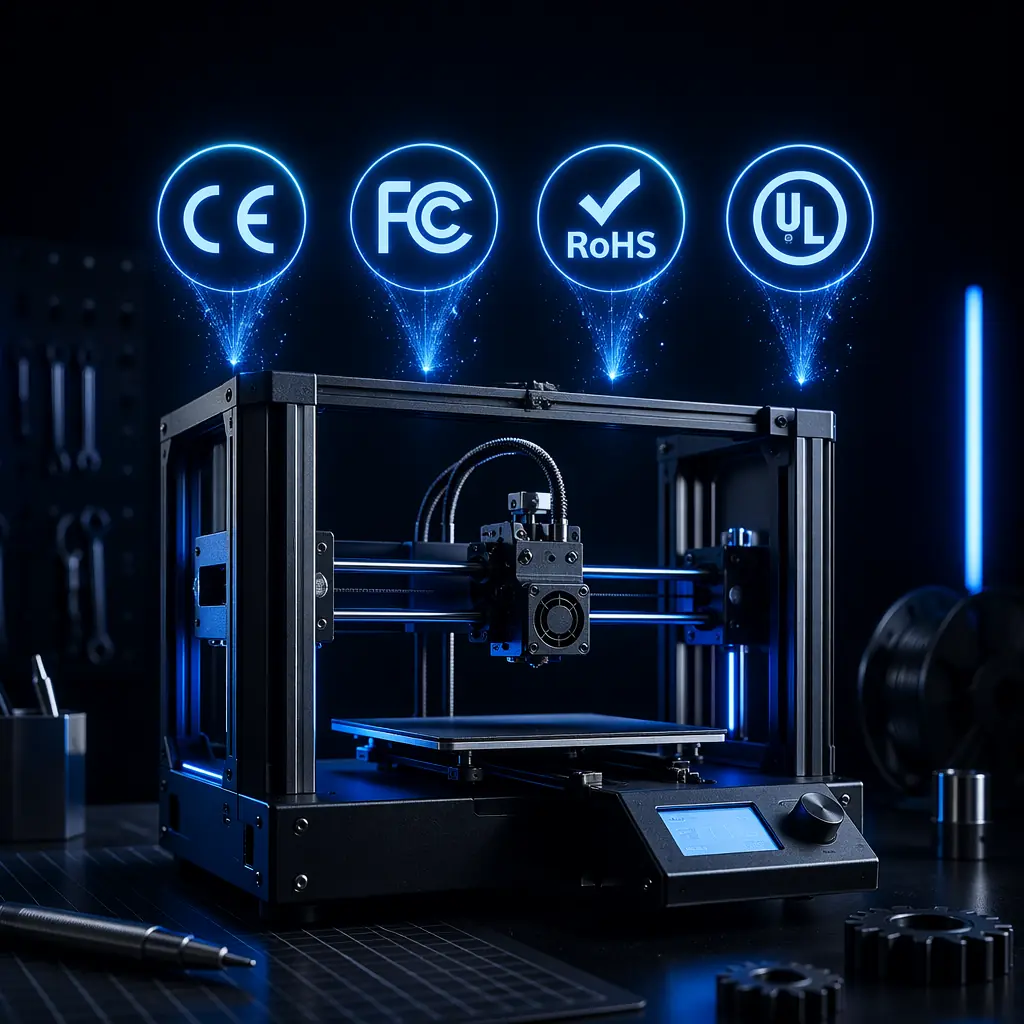
At Precise3D, every printer in our product catalog ships with CE, FCC, and RoHS certification as standard. This is non-negotiable for a manufacturer serving 50+ countries — and it should be non-negotiable for any OEM you evaluate. If a factory cannot produce valid CE and FCC test reports within 24 hours of your request, walk away.
CE Marking: The European Gateway
The CE mark is mandatory for any electronic product sold in the European Economic Area. For 3D printers, the applicable directives depend on the product's features, but the most common framework is:
Real timeline:
A complete CE compliance package for a new 3D printer model takes 4–8 weeks from prototype to final test report. The EMC radiated emissions test alone costs approximately $2,500–$4,000 at an accredited lab. A manufacturer who quotes CE compliance in "a few days" is either lying or recycling another model's certificates — both are red flags.
Distributor action item:
Demand the EU Declaration of Conformity (DoC) for each model you import. This is a legal document — not a marketing brochure — and must list the exact directives, harmonized standards applied, and the authorized representative within the EU. Without a valid DoC, your importer of record bears full liability if any compliance issue arises. Learn more about OEM verification in our 10 Questions to Ask Before Choosing a 3D Printer OEM Partner.
FCC: The North American Requirement
In the United States, the Federal Communications Commission (FCC) regulates all electronic devices that emit radio frequency energy — which, for a 3D printer, includes stepper motor drivers, heated bed PWM controllers, and Wi-Fi modules.
Most consumer 3D printers fall under FCC Part 15 Subpart B as unintentional radiators. If the printer includes Wi-Fi, it must also comply with Part 15 Subpart C For distributors evaluating this area, our factory QC audit guide covers it in depth. as an intentional radiator. The testing is conceptually similar to CE EMC but uses FCC-specific limits and lab accreditation requirements.
Cost and timeline:
FCC testing runs $1,500–$3,000 For distributors evaluating this area, our shipping from China guide covers it in depth. and takes 2–4 weeks. The FCC Supplier's Declaration of Conformity (SDoC) is the primary compliance path — the manufacturer self-declares based on test lab results. The FCC ID label must be permanently affixed to the product exterior.
One critical nuance:
Canada requires ISED certification (formerly IC) which is similar For distributors evaluating this area, our fume extraction compliance guide covers it in depth. to FCC but requires separate registration. If you distribute in both the US and Canada, your OEM must hold both certificates. Precise3D's standard compliance package covers both, but always confirm this before placing your first container order.
RoHS: The Universal Baseline
RoHS (Restriction of Hazardous Substances) is the most globally pervasive certification. While originating in the EU, variants are now enforced across the UK (UK RoHS), China (China RoHS), California (SB 20/50), UAE, and a growing list of other jurisdictions. The core requirement is universal: 3D printers must not contain more than 0.1% by weight of lead, mercury, hexavalent chromium, and certain flame retardants in any homogeneous material.
For a 3D printer with 200+ electronic components soldered across multiple PCBs, RoHS compliance is effectively a supply-chain management exercise. Every capacitor, connector, and solder joint must be sourced from RoHS-compliant suppliers, and the OEM must maintain traceable documentation for each batch.
At Precise3D's ISO 9001-certified facility For distributors evaluating this area, our food-safe regulations guide covers it in depth., RoHS compliance is built into component procurement — not applied retroactively via testing. Every supplier delivers with RoHS certificates on file, and our in-house QC team performs spot XRF (X-ray fluorescence) testing on incoming PCB batches. This is the standard you should expect from any manufacturer you partner with.
UL / ETL Listing: The Retail Enabler
Unlike CE and FCC, UL (Underwriters Laboratories) and ETL (Intertek) listings are not legally mandated in the United States. But in practice, they are mandatory for any distributor who wants to sell through major retail chains, Amazon's higher-tier categories, or institutional channels like schools and government procurement.
The UL certification path for a 3D printer is significantly more expensive and time-consuming than CE/FCC:
- UL 60950-1 or UL 62368-1 — safety standard for IT and audio/video equipment, applied to 3D printer electronics
- Cost: $8,000–$15,000 for initial certification of a new model
- Timeline: 8–16 weeks including sample submission, testing, and factory inspection
- Ongoing: Quarterly or annual factory surveillance audits by UL representatives, costing $1,500–$3,000 per visit
ETL listing (by Intertek) is functionally equivalent to UL listing for retail acceptance but historically has a faster turnaround and slightly lower cost. Both marks are Nationally Recognized Testing Laboratory (NRTL) certifications accepted by OSHA. Many distributors choose ETL for their first container order and upgrade to UL once sales volumes justify the investment.
Precise3D holds UL and ETL listings For distributors evaluating this area, our import tariffs and HS codes guide covers it in depth. for our Pro X1 flagship model, with certification for the Creator C1 currently in the final factory inspection phase. When evaluating an OEM partner, ask which specific models carry UL/ETL — not the company, the individual SKU. A manufacturer who says "we are UL certified" without specifying model numbers is being evasive.
Regional Certifications: Korea, India, and Beyond
Expanding beyond EU and North America multiplies the certification burden. Two markets with high 3D printer demand and strict local requirements deserve special attention:
If your distribution strategy includes these markets, discuss them during OEM negotiations — not after you have signed the distribution agreement. The right OEM partner will have experience navigating these regional requirements and may already hold certifications for neighboring markets that can streamline the process.
What Your OEM Partner Should Provide (Checklist)
Before you wire the deposit on your first container, your OEM partner must deliver the following documentation package. Accept nothing less:
- CE Declaration of Conformity — signed, dated, listing all applicable directives and harmonized standards per model
- CE test reports — EMC radiated and conducted emissions, LVD safety, RED (if Wi-Fi equipped), from an ISO 17025-accredited lab
- FCC SDoC and test reports — Part 15 Subpart B (and Subpart C if Wi-Fi), from an FCC-recognized accredited lab
- RoHS test reports — per-component or per-assembly, within 12 months of the shipment date
- UL/ETL certificate — model-specific, unexpired, with the most recent factory surveillance report
- Product label artwork — showing all certification marks in their correct size, location, and format
- User manual compliance section — safety warnings, disposal instructions (WEEE symbol for EU), and FCC Part 15 statement
If any of these is missing or a document is "being renewed," delay the shipment. A missing certificate is a customs liability; a valid certificate arriving a week late saves you from a six-week port hold.
Building a Compliant Product Line
Certification is not a one-time cost — it is an ongoing operational commitment that scales with your product line. The smartest distribution strategy layers certifications progressively: start with the mandatory CE/FCC/RoHS baseline for your flagship model, add UL/ETL once you have proven market demand, then expand regionally (KC, BIS) as sales data identifies high-opportunity markets.
Partnering with a manufacturer that already carries CE, FCC, RoHS, and UL/ETL across its core product line eliminates 80% of the compliance timeline and cost on day one. Our distributor maintenance guide covers what happens after certification — keeping your customers' printers running and your support costs low.
Your OEM relationship is the single biggest variable in your compliance strategy. Choose a partner who treats certification as a core manufacturing deliverable, not an afterthought. The difference shows up on your first customs clearance — or your first port detention notice.
Reviewed by the Precise3D engineering & OEM team. Compliance files that accompany the catalog are auditable at the certification register.
Certified From Day One
Get the Full Compliance Documentation Package
Every Precise3D printer ships with CE, FCC, and RoHS certification. UL/ETL listings available for qualifying distributors. Request the complete documentation set for your target markets.