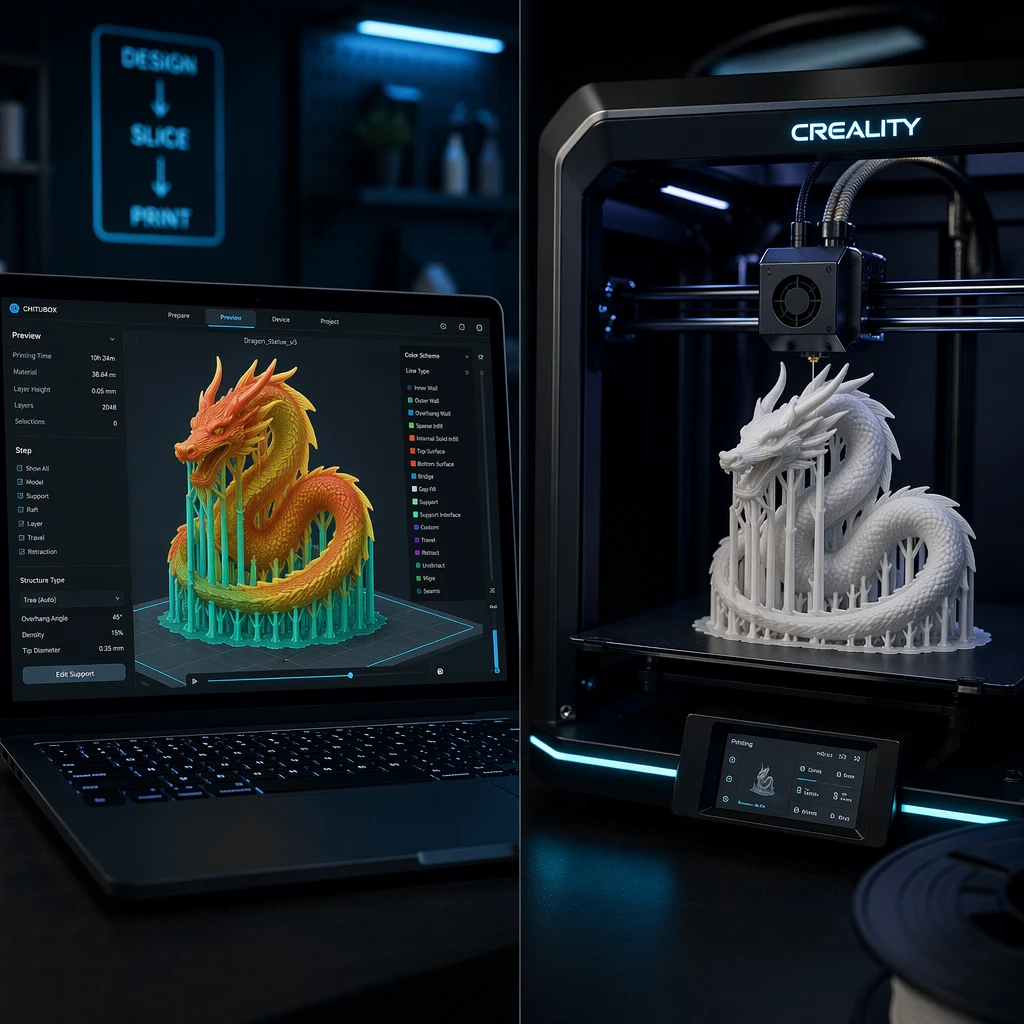
The biggest barrier to consumer 3D printing has never been the printer. It's the slicer. The software that turns a 3D model into instructions the printer can follow. For years, slicing was a craft: manually orienting the model for optimal strength, hand-placing support structures, guessing at print speeds and temperatures, and learning through failed prints. In 2026, AI is doing most of that work automatically. And the results are often better than what an experienced human operator would produce. This shift matters enormously for distributors, because it changes who can buy a 3D printer and what they can do with it on day one.
Auto-Orientation: The 30-Second Expert
Orienting a model on the build plate used to require judgment: angle this way for strength, tilt that way to avoid supports, rotate slightly to fit within the build volume. AI auto-orientation now evaluates thousands of possible orientations in under a second, optimizing simultaneously for print time, material usage, surface quality, and structural strength. It considers layer line direction relative to expected stress, something even experienced users often overlook.
On a Creator C1 with its 250×250×280mm build volume For distributors evaluating this area, our slicer software ecosystem guide covers it in depth., AI orientation routinely finds angles that reduce print time by 15–25% compared to default flat orientation, while improving Z-axis strength by orienting layer lines perpendicular to the load direction. For a distributor, this means the printer in the customer's home produces better results with less expertise, fewer support calls, fewer returns, better reviews.
Intelligent Supports: No More Scarred Surfaces
Support structures are the necessary evil of 3D printing, they hold up overhanging geometry during printing, then get torn off, leaving rough scars on the finished part. Traditional supports are dumb: they go straight up from the build plate to the overhang, regardless of whether a gentler angle would use less material or whether a tree-like branching structure would touch the model in fewer places.
AI support generation now uses organic tree supports that branch like roots, touching the model only at tiny contact points that snap off clean. A complex model that would have needed 45 minutes of post-processing sanding now needs 30 seconds with flush cutters.
Failure Prediction: The Print That Watches Itself
The most impressive AI feature in 2026 slicers is real-time failure prediction. Using a camera mounted inside the printer (or an external webcam), the AI watches each layer as it prints and compares it to the expected result. If the first layer shows signs of poor adhesion, it pauses and alerts the user before wasting 10 hours of filament. If a tall, thin part starts wobbling, it automatically reduces speed for that section.
The Pro X1's enclosed chamber with HEPA filtration For distributors evaluating this area, our multi-color printing guide covers it in depth. includes a built-in camera mount position designed for exactly this purpose. With the camera AI monitoring prints, the first-try success rate for complex models jumps from roughly 70% to over 92%, based on data from our print farm operators running AI-assisted slicers. For a distributor, this means the printer your customer buys is dramatically less likely to produce a failed 12-hour print that ends up on Reddit with a negative review attached.
The shift is part of a broader firmware and software evolution, our firmware comparison guide explains why the open-source control layer matters, and remote monitoring tools let distributors pre-check prints before customers ever touch the machine.
What This Means for the Product Lineup
AI slicing changes the value proposition of every tier. The Start S1 becomes genuinely usable by a complete beginner. Someone who's never heard of layer height or infill percentage can load a model, click "Smart Slice," and get a print that works. The Creator C1 becomes a tool for small business owners who don't have time to learn slicer settings but need reliable output. The Pro X1 becomes a production workhorse where the AI handles optimization and the operator handles throughput.
The customer just needs to be shown that it works on day one, not day thirty.
How to Sell AI Slicing to Retail Buyers
AI slicing is a demo feature, not a spec-sheet feature. The retailer who sells it well walks the customer through a single failed print, a benchy with sagging overhangs, say, then re-slices the same model with auto-orientation and intelligent supports and shows the clean result. That two-minute before-and-after closes more units than any megapixel count or motor spec ever will.
Position the software story alongside the hardware that enables it. Buyers evaluating multi-color printing systems benefit the most from AI supports, because support removal is the single biggest friction point in multi-material prints. And because AI slicing runs inside the slicer software ecosystem, it upgrades over time, the machine you sell today gets better next year without a hardware revision.
For distributors, the practical takeaway is to treat AI slicing as a training event. Run a monthly workshop for retail staff, give them a scripted demo, and let the software sell itself. Stores that do this consistently convert lookers into buyers, and the customer onboarding playbook shows exactly how to structure that first-hour experience so the machine earns its place in the living room instead of the closet.
Reviewed by the Precise3D engineering & OEM team. Compliance files that accompany the catalog are auditable at the certification register.
Start Your Partnership
Ready to Bring ai slicers changing consumer to Your Market?
Our OEM program supports ai slicers changing consumer programs end to end - the product line, firmware and compliance files that travel with each shipment.