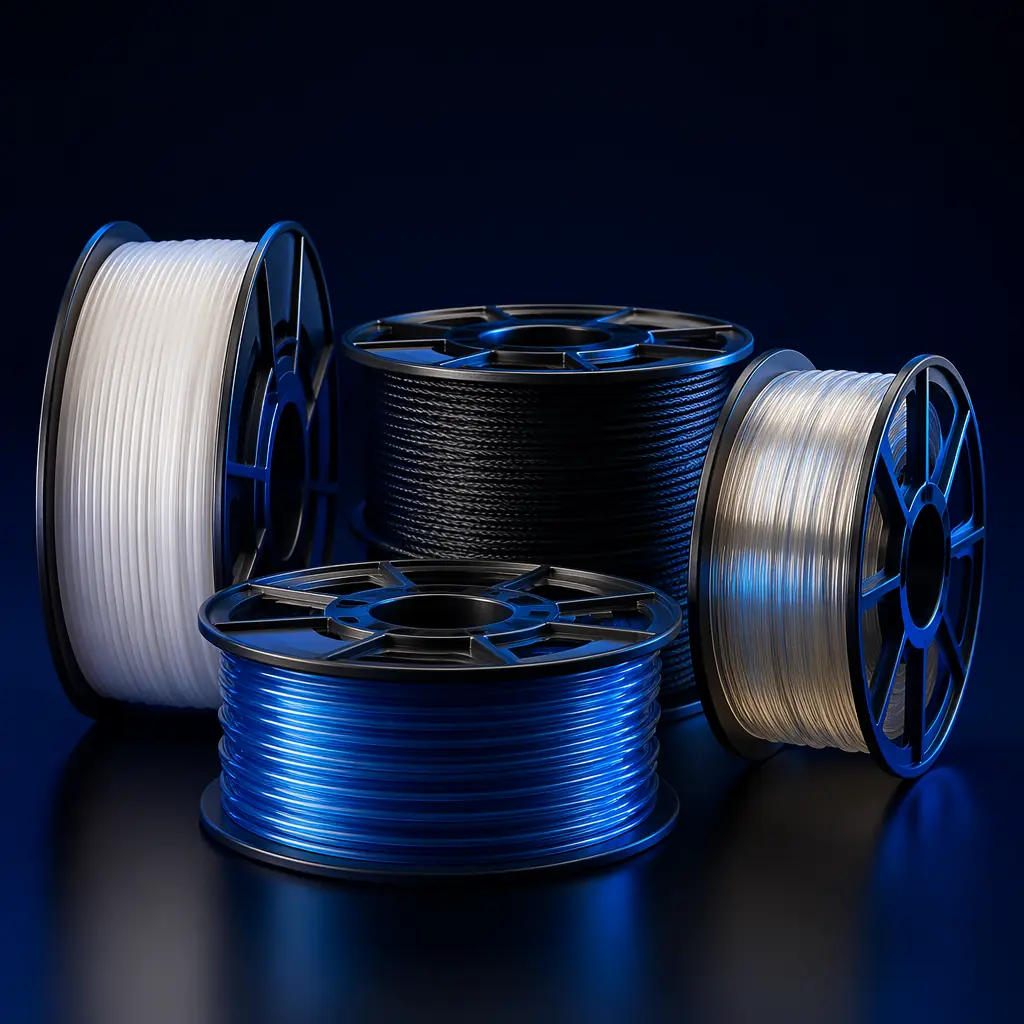
Every 3D printer you sell is a recurring revenue opportunity, but only if you stock the right consumables. PLA and PETG drive volume; engineering filaments drive margin. The distributor who understands this distinction captures 2–3× higher customer lifetime value per printer sold.
At Precise3D, our OEM partners who bundle engineering filament starter kits with every F-Series printer see 38% higher repeat consumable orders within the first 6 months compared to those who ship with standard PLA alone. This post is a practical guide to building a high-margin filament portfolio, what to stock, how to price it, and how to position each material to your buyers.
The Filament Hierarchy: From Commodity to Premium
Not all filaments are equal, not in margin, not in customer stickiness. Understanding the hierarchy is the foundation of a profitable consumables strategy.
The economics are straightforward: engineering filaments carry 2–4× the absolute margin per kilogram compared to PLA. A distributor selling 50 kg/month of PLA at 25% margin generates roughly $250 in profit. The same volume in nylon generates over $1,100. The difference compounds across your installed base.
The trade-off is market size. PLA represents approximately 60% of consumer FDM filament volume in 2026. Engineering filaments are a smaller market. But they are also growing faster, with nylon and TPU demand up 28% YoY in the North American enthusiast and small-business segment. Pairing the right printer hardware with the right filament portfolio turns this niche into a defensible margin moat.
Filament-by-Filament Stocking Guide
Here is a practical breakdown of each engineering filament. What it is, who buys it, and how to sell it.
TPU (Thermoplastic Polyurethane), The Flexible Workhorse
TPU is the most accessible engineering filament. Anyone with a direct-drive extruder can print it, and the results are immediately impressive. Typical hardness ranges from Shore 85A to 95A . Roughly the flexibility of a phone case to a shoe sole.
Who buys it:
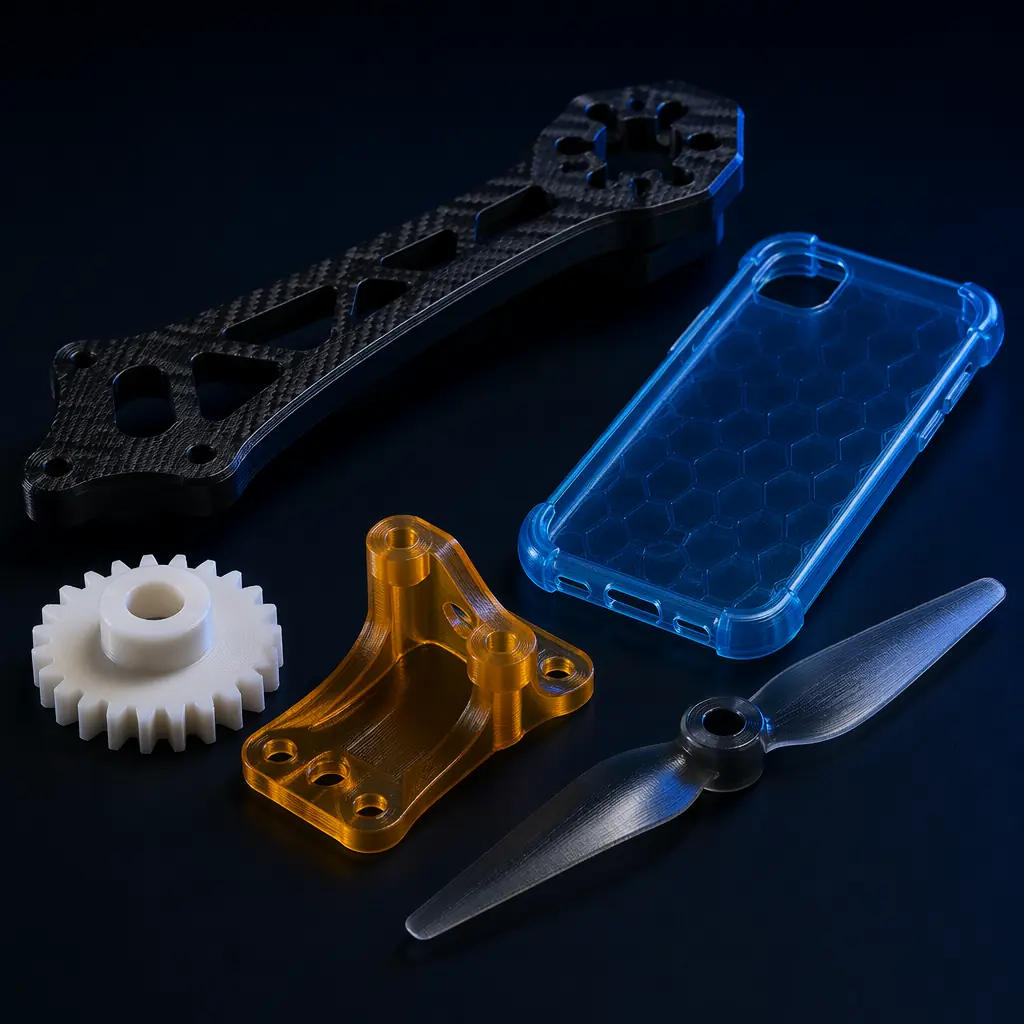
Drone racing enthusiasts (impact-resistant frames), phone case makers (custom-fit protection), RC hobbyists (tires and gaskets), and prototyping engineers (soft-touch grips, seals). The drone segment alone drove an estimated $45M in TPU filament sales in 2025.
Stocking recommendation:
Carry Shore 95A as your baseline, it prints reliably on most direct-drive FDM systems at 220–240°C nozzle / 40–60°C bed. Add Shore 85A as a premium variant for customers demanding softer parts. One spool of TPU per 3 printers sold is a safe starting ratio; adjust upward if your customer base skews toward functional printing.
Nylon (PA6 / PA12), The Engineering Standard
Nylon delivers the best balance of strength, impact resistance, and heat tolerance among affordable engineering materials. Tensile strength reaches 50–70 MPa for PA6, comparable to injection-molded ABS, with an operating temperature ceiling of 120–150°C, far above PLA's 55°C glass transition.
Who buys it:
Mechanical engineers (functional prototypes and end-use parts), automotive hobbyists (under-hood components), competitive roboticists (gears and structural brackets). Nylon users typically consume 3–5 spools per month . Significantly higher than PLA users because project complexity drives repeat use.
Critical caveat:
Nylon is hygroscopic, it absorbs moisture from ambient air within 24–48 hours. Stock it in vacuum-sealed bags with desiccant. Every nylon spool you sell should be accompanied by a drying recommendation: 70°C for 6–12 hours before printing. This single piece of advice reduces customer returns by an estimated 60% based on support data from our distribution partners.
Carbon Fiber Reinforced Nylon (PA-CF / PA-GF), The Premium Tier
PA-CF is the fastest-growing segment in engineering filaments, with estimated market growth of 35% CAGR through 2028. The addition of chopped carbon fiber (typically 15–20% by weight) increases stiffness by a factor of 2–3× compared to unfilled nylon while dramatically reducing warping, solving nylon's biggest printability challenge.
Who buys it:
Drone frame builders (stiffness-to-weight optimization), competitive shooting sports (custom firearm accessories), industrial designers (presentation-grade functional prototypes), and anyone who has graduated from standard nylon and wants the next step up.
Hardened nozzle required:
Carbon fiber is abrasive. Any printer sold with PA-CF must use a hardened steel or ruby-tipped nozzle. Standard brass nozzles wear from 0.4mm to 0.6mm+ within 500g of filament. This is an upsell opportunity: every PA-CF spool can be paired with a $15–25 hardened nozzle, adding 100% margin on a zero-inventory accessory.
Polycarbonate (PC), Heat Resistance Specialist
PC is the filament for applications where PLA and PETG melt. Its glass transition temperature of 110–115°C means parts can withstand boiling water and direct sunlight without deformation. Tensile strength reaches 60–70 MPa.
Who buys it:
Automotive enthusiasts (interior components that sit in hot cars), lighting fixture makers (LED heat exposure), and functional prototyping for real-world environmental testing. PC requires a 260–280°C nozzle and 100–110°C bed . An all-metal hot end and enclosed chamber are prerequisites.
Stocking note:
PC is a lower-volume item. Carry 1 spool per 10 FDM printers in your installed base. It functions primarily as a credibility signal. Having PC on your shelf tells buyers you are a serious engineering supplier, even if most of them never buy it.
Pricing Strategy: Per-Kilogram vs. Per-Spool Psychology
Consumer filament pricing psychology is different from industrial pricing. The numbers matter, but so does the packaging.
The 500g spool is an underused lever. Engineering filament at $35/500g feels accessible; the same filament at $70/kg triggers price resistance. Run both SKUs. The customer who buys 500g of nylon today will buy 1kg next month once they have validated it works on their machine.
A structured starter pack, one 500g spool each of TPU, Nylon, and PA-CF at a 15% bundle discount . Has a 45% attach rate to new printer sales when offered at checkout among our top-performing distribution partners. That is an extra $25–40 in high-margin revenue For distributors evaluating this area, our flexible filaments guide covers it in depth. per unit, with a follow-on consumable pipeline built in.
Printer Compatibility: What Needs an Upgrade
Engineering filaments reward printer quality. The F-Series platform from Precise3D is engineered for the full range, but your customers need to know what hardware matters:
This table is your upsell roadmap. A customer buying nylon should also be offered a hardened steel nozzle ($15), a dryer box ($45), and a vacuum storage kit ($25). The combined accessory order often exceeds the filament spool price, and accessories carry 50–70% margins For distributors evaluating this area, our filament stocking guide guide covers it in depth. because customers value convenience over price comparison.
How to Train Your Sales Team on Filaments
Most distributor sales teams default to selling printers and treating filament as an afterthought. This is leaving money on the table. A product specialist who can diagnose a customer's application and recommend the right filament For distributors evaluating this area, our carbon fiber filaments guide covers it in depth. closes both the printer and the consumables in a single conversation.
Three training principles for your team:
- "What are you making?" beats "What's your budget?", The application determines the filament. A customer building drone parts needs TPU or PA-CF regardless of price sensitivity. Train your team to lead with application discovery.
- Give them a decision tree, not a catalog.. "If the part needs to flex → TPU. If it needs heat resistance → PC. If it needs to be strong and lightweight → PA-CF." A 4-branch decision tree covers 90% of engineering filament inquiries. Print it as a desk card for every sales rep.
- One successful print converts a customer for life., Include a pre-sliced test model on a USB card with every engineering filament sale. A 20-minute print that succeeds on the first try is worth more than 10 pages of marketing copy. The customer who successfully prints nylon once will never go back to PLA-only thinking.
Supply Chain: Stocking and Shelf Life
Engineering filaments require more disciplined inventory management than PLA. Here are the operational rules:
- Nylon and PC: Stock in factory-sealed vacuum bags with silica gel. Shelf life unopened: 12–18 months. Once opened, usable window is 2–4 weeks before moisture degrades print quality unless actively dried.
- TPU: More forgiving. Shelf life 18–24 months sealed, 3–6 months opened. TPU absorbs moisture more slowly than nylon but still benefits from dry storage.
- PA-CF: Same moisture sensitivity as nylon but with a critical additional requirement: store flat, not on edge. The carbon fiber content makes the filament more brittle; a spool stored on its edge can develop micro-fractures that cause mid-print breaks.
- Turn rate target: Engineering filaments should turn over within 90 days. If a spool sits for 6 months, discount it 25% as a "sample grade" product and use it to drive trial adoption.
Sourcing from a manufacturer that ships factory-direct reduces the supply chain by 1–2 intermediate handlers, cutting lead time and exposure to humidity during transit. Our OEM fulfillment program For distributors evaluating this area, our nylon filament guide covers it in depth. ships engineering filaments in nitrogen-flushed packaging from our Shenzhen facility, arriving at your warehouse in printing-ready condition.
The 2026 Engineering Filament Market Outlook
The trend line is unmistakable. Consumer FDM printer buyers are getting more sophisticated, and they are printing more functional parts. Data from our distribution network shows that in H1 2026, engineering filament orders grew 31% year-over-year For distributors evaluating this area, our polycarbonate filament guide covers it in depth. across our partner base, while standard PLA grew 8%.
Three forces are converging:
- Printer capability is democratizing: All-metal hot ends and direct-drive extruders, once reserved for $800+ machines, are now standard on sub-$300 printers. The hardware barrier to engineering filaments is collapsing.
- Online communities drive material curiosity: Reddit's r/3Dprinting (2.4M members) and r/functionalprint (850K members) generate thousands of posts monthly showcasing nylon and TPU prints. Each post is free marketing for the filaments those creators used.
- Small business adoption: Etsy sellers, prototyping shops, and local manufacturing services are moving beyond PLA. A print farm operator who upgrades 20% of their machines to engineering-capable hardware immediately becomes a recurring high-value consumables buyer.
The 2026 distributor who treats filament as a strategic product line, not a convenience add-on, will capture disproportionate share of the most valuable segment of the 3D printing consumables market.
Ready to build your engineering filament portfolio? Contact our B2B team for bulk pricing, private-label options, and distributor starter kits.
Reviewed by the Precise3D engineering & OEM team. Compliance files that accompany the catalog are auditable at the certification register.
Start Your Partnership
Ready to Bring engineering filaments to Your Market?
Our OEM program supports engineering filaments programs end to end - the product line, firmware and compliance files that travel with each shipment.