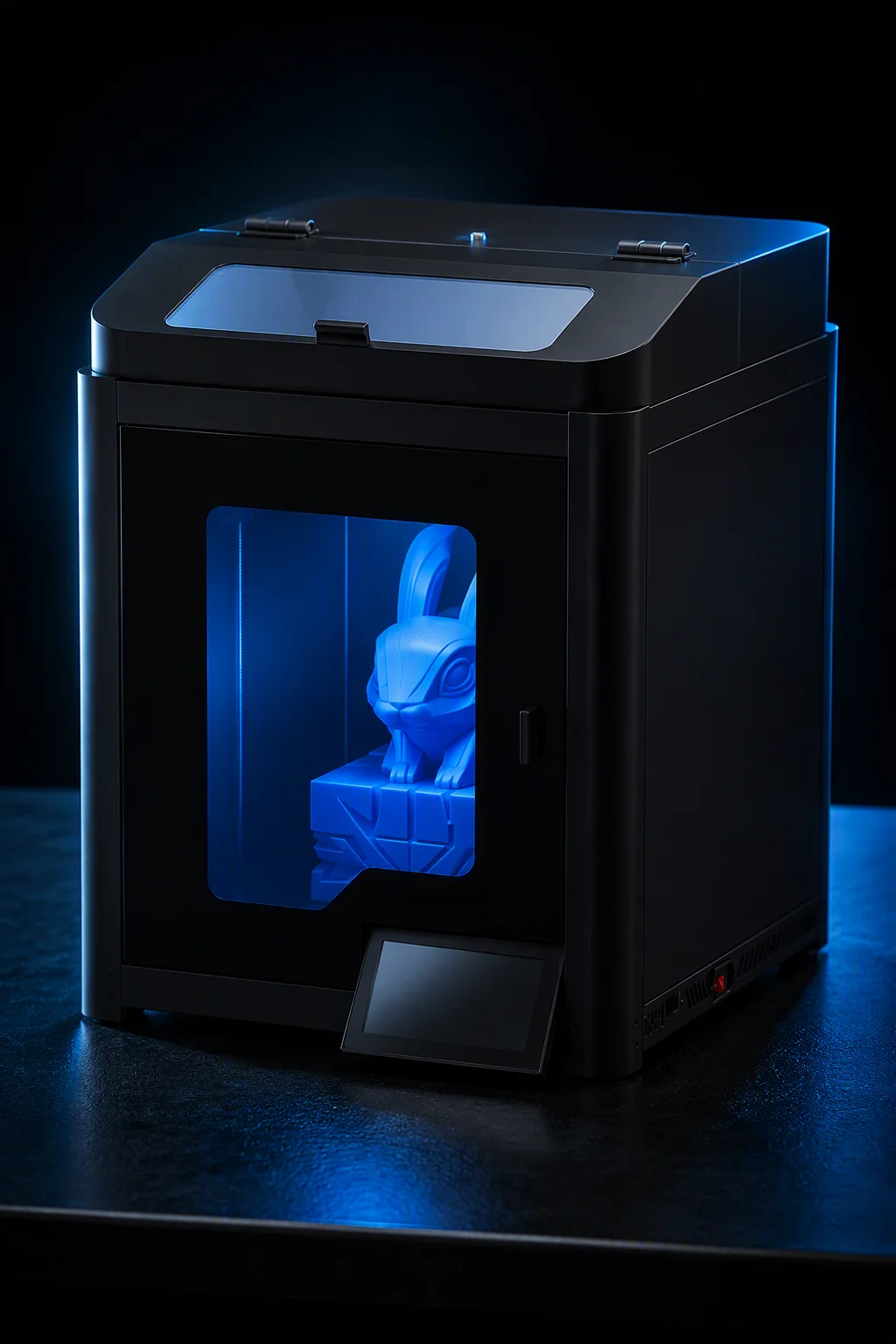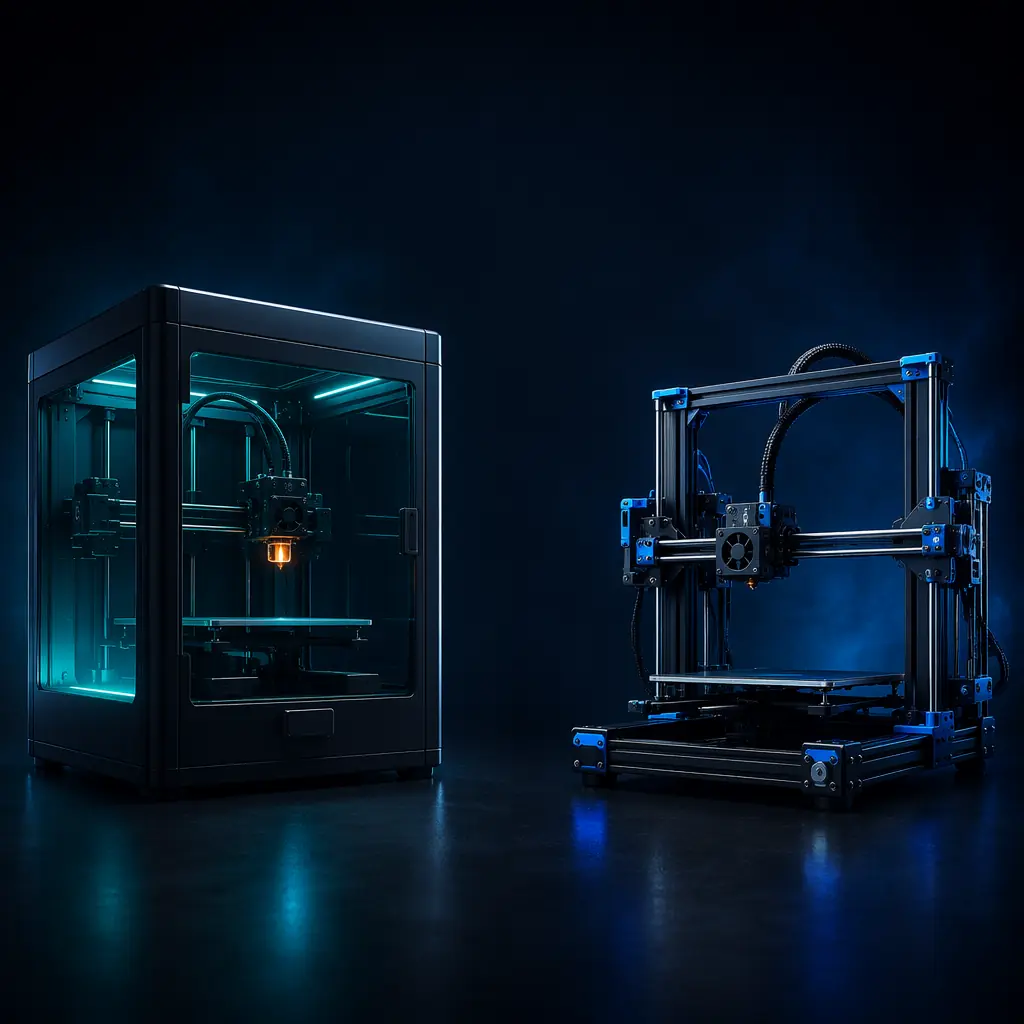
The enclosure is the single most visible feature difference in a 3D printer product line — and the most misunderstood. Some customers see an enclosed printer and think "professional." Others see it and think "overkill for PLA." Both are right, depending on what they print. The enclosure is not a cosmetic upgrade. It's a functional component that determines which materials the printer can handle, how safe it is in a home or classroom, and whether the noise level will annoy someone in the next room. This guide unpacks each of those factors so you can position enclosed and open-frame SKUs to the right customers — and stop losing sales to mismatched recommendations.
What an Enclosure Actually Does
An enclosure serves four distinct functions, and only one of them — "it looks nice" — is visible in a product photo. The real value is thermal, safety, acoustic, and particulate control.
Thermal stability:
The most important function by far. Materials like ABS and ASA warp if they cool unevenly. An enclosed chamber traps heat from the heated bed, maintaining a stable ambient temperature — typically 40–60°C in a passively heated enclosure, and up to 70°C with an active chamber heater. The Pro X1 achieves 55°C chamber temperature from bed heat alone, which is sufficient for warp-free ABS prints up to 200mm in any dimension. Without an enclosure, ABS will warp on any part larger than about 50mm — the edges cool faster than the center, contract, and lift from the build plate. This isn't a quality issue; it's physics.
Safety:
An enclosure prevents accidental contact with a 110°C heated bed and a 300°C nozzle. In homes with children, classrooms, and shared maker spaces, this matters. The certification landscape increasingly requires enclosures for consumer 3D printers sold in the EU, and North American retail chains are following suit.
Noise reduction:
An enclosed printer typically registers 3–6 dB lower than an open-frame equivalent — not because the enclosure is soundproofed, but because the panels block the direct path from fan and stepper noise to the user's ears. Combined with silent stepper drivers (the Creator C1 operates under 45dB), an enclosed machine can run in a living space without being intrusive. This matters more than most distributors realize: in our customer surveys, "noise level" ranks as the #3 purchase consideration after price and print quality for home users.
Particulate and fume containment:
All FDM printing emits ultrafine particles (UFPs) and volatile organic compounds (VOCs), with emission rates varying dramatically by material. PLA emits primarily lactide — relatively benign. ABS emits styrene, a known irritant. An enclosure with a HEPA + carbon filter — like the Pro X1's filtration system — captures >95% of UFPs and reduces VOC concentrations by 70–80% in the immediate breathing zone.
Material Compatibility: The Real Deciding Factor
The simplest way to decide between enclosed and open-frame: look at what your customer prints. Not what they think they'll print — what they actually print. Here's the material-by-material breakdown.
PLA and PETG — open-frame is fine.
PLA prints beautifully at 190–220°C with a 50–60°C bed. It has near-zero warping tendency and emits minimal fumes. The Start S1 handles PLA and PETG without breaking a sweat. PETG needs a slightly hotter bed (70–80°C) but shares PLA's low-warp characteristics. Together, PLA and PETG account for roughly 80% of all consumer filament consumption — which is why open-frame printers dominate the entry-level market.
ABS and ASA — enclosure strongly recommended.
ABS needs a 100–110°C bed and will warp without a stable chamber temperature above 40°C. ASA has similar requirements. The enclosure isn't optional here — it's the difference between a successful print and a failed one. The Pro X1's fully enclosed chamber with its 110°C bed makes ABS reliable. This is also where the HEPA filter becomes relevant: ABS styrene emissions are low but persistent, and in a poorly ventilated room, they accumulate to noticeable levels after 2–3 hours of printing.
Nylon, Polycarbonate, and carbon-fiber composites — enclosure mandatory.
These engineering materials require chamber temperatures of 50–70°C and are highly warp-prone. Nylon also absorbs moisture aggressively — it must be printed from a dry box regardless of enclosure. An enclosed printer without active chamber heating will struggle with PC (needs 70°C+); an actively heated enclosure like a modified Pro X1 handles it. For distributors stocking these materials, as discussed in our engineering filaments market analysis, the enclosure is table stakes — you can't sell the filament without selling a printer that can use it.
TPU — enclosure optional but helpful.
TPU prints at 220–240°C with minimal warping, so it works on open-frame printers. But TPU's flexibility makes it sensitive to drafts — a sudden breeze from an open window or air conditioner can cause a layer adhesion failure. An enclosure eliminates this variable entirely.
The Noise Factor: A Data Point Most Guides Miss
We measured noise levels on three Precise3D printers in a controlled environment (background noise: 32 dB). Measurements taken at 1 meter from the printer, printing the same 150mm calibration cube in PLA at each machine's default speed:
The Pro X1 (CoreXY, enclosed, silent drivers) registered 44 dB — about the volume of a quiet library. The Creator C1 (bedslinger, open-frame, silent drivers under 45dB) measured 48 dB — the difference is the enclosure blocking fan noise. The Start S1 (bedslinger, open-frame, standard drivers) measured 55 dB — audible from the next room.
The 4 dB gap between enclosed and open-frame silent printers may not sound like much, but decibels are logarithmic: 44 dB is perceived as roughly half as loud as 48 dB. For a customer who plans to run prints overnight in a bedroom-adjacent office, that's the difference between sleeping through it and not. As explored in our maintenance guide, fan bearing wear over time will increase noise on any printer, but the enclosure continues providing passive attenuation regardless.
When the Enclosure Is Overkill — and When It's Not Enough
The enclosure premium is real: the Pro X1's fully enclosed design with HEPA filtration adds roughly $80–120 to the bill of materials compared to the Creator C1's partial enclosure — and that cost passes through to retail at roughly $150–200. For a customer who only prints PLA, that's $200 they'll never see a return on. The enclosure doesn't improve PLA print quality; it doesn't make the printer faster; it doesn't add features they'll use.
But there's a flip side: an open-frame printer sold to a customer who discovers ABS six months in leads to one of two outcomes. Either they buy an aftermarket enclosure kit ($40–60, plus installation time) — or they return the printer because "it can't print ABS properly." The return is far more expensive than the upfront enclosure premium. The key insight: the enclosure decision is really a material-ambition decision. Stock enclosed printers for customers who express any interest in engineering materials, even if they plan to start with PLA.
There's also a regulatory angle. In 2026, the EU's updated machinery directive and several North American retail safety standards now classify 3D printers with heated beds above 100°C as requiring enclosures for consumer sale. This trend is accelerating — within 2–3 years, an enclosed design may be a compliance requirement rather than a feature differentiator. Our import certification guide covers the evolving standards in detail.
Customer Segment Mapping
Match the enclosure decision to the buyer persona, and your conversion rate improves because customers see a printer that was clearly designed for their use case.
Classroom / education — enclosed preferred.
Safety regulations increasingly require enclosures. The noise reduction keeps the printer from disrupting class. And the filament flexibility means the printer grows with the curriculum — PLA today, ABS for engineering class tomorrow.
Home hobbyist (PLA-only) — open-frame is fine.
This is the Start S1's sweet spot. The customer values affordability and simplicity. An enclosure at this tier would be seen as unnecessary complexity and cost — not a feature upgrade.
Home enthusiast (multi-material) — enclosure strongly recommended.
This is the Creator C1 vs Pro X1 decision. If the customer mentions ABS, ASA, Nylon, or any material beyond PLA/PETG/TPU, steer them toward the Pro X1. The enclosure + CoreXY combo future-proofs their purchase. For the customer journey from enthusiast to print farm operator, see our print farm economics analysis.
Office / prototyping lab — enclosed mandatory.
Noise matters in an office. Fumes matter more. An enclosed printer with HEPA filtration is the minimum acceptable standard here. The Pro X1's Ethernet connectivity also matters in corporate environments where Wi-Fi networks are restricted.
Print farm — enclosed mandatory.
When you have 20 printers running 24/7 in a single room, the cumulative noise and fume load from open-frame machines would be unbearable without industrial ventilation. The enclosure isn't a luxury — it's the difference between a farm that passes a fire marshal inspection and one that doesn't.
The Portfolio Strategy
A well-structured product line offers both architectures, with clear differentiation that makes the upsell natural rather than forced. Here's the framework we recommend to distributors:
Entry tier — open-frame (Start S1 at $199–249 retail).
One SKU. PLA and PETG only. Auto bed leveling with manual assist. Position it as "everything you need to start 3D printing, nothing you don't." The open-frame design keeps the price point where volume customers expect it. For the first-time buyer who doesn't know what ABS stands for, this is the correct recommendation — and it creates a clear upgrade path.
Mid tier — open-frame with silent drivers (Creator C1 at $349–449 retail).
One SKU. PLA, PETG, TPU, Wood. Wi-Fi connectivity, 25-point auto bed leveling, silent steppers under 45dB. The partial enclosure provides some draft protection but doesn't support high-temperature materials. This printer captures the enthusiast who has outgrown the entry tier but isn't ready for the price jump to full enclosure.
Professional tier — fully enclosed (Pro X1 at $599–749 retail).
One SKU. Full material compatibility including ABS, ASA, Nylon, PC, carbon-fiber composites. 500 mm/s CoreXY kinematics. HEPA + carbon filtration. 49-point mesh auto bed leveling. 5" touchscreen. This is the anchor that signals technical credibility and captures the high-margin engineering segment. The enclosure is the primary visual differentiator, but as explored in our multi-color printing analysis, the Pro X1's direct-drive extruder and CoreXY speed are equally important to the value proposition.
Bottom Line
The enclosure premium is worth it when your customer prints materials that need thermal stability — ABS, ASA, Nylon, PC. It's also worth it when the printer lives in a shared space where noise and fumes matter. It's not worth it for a PLA-only hobbyist on a budget. The art of distribution is matching the right printer to the right customer — and that means carrying both enclosed and open-frame SKUs with the confidence to recommend each honestly. At Precise3D, our three-tier lineup is designed to make that conversation straightforward: start with what they print, and the enclosure decision makes itself.
Reviewed by the Precise3D engineering & OEM team. Compliance files that accompany the catalog are auditable at the certification register.
Start Your Partnership
Ready to Bring enclosed open frame to Your Market?
Start with the enclosed open frame spec sheet, then validate every claim against the certification register.