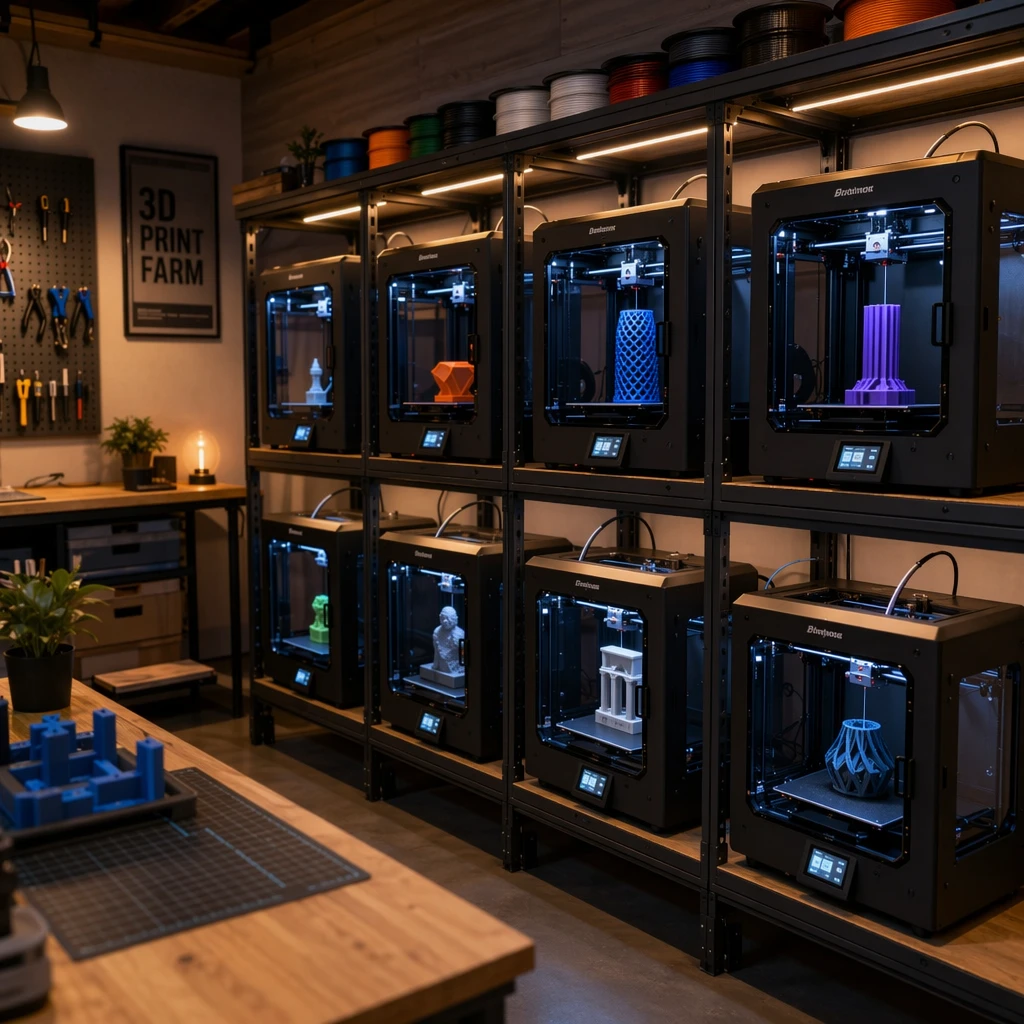
Every month, someone in a 3D printing forum asks: "Can I actually make money with a print farm?" The answers range from "I quit my job after 6 months" to "it's a race to the bottom." Both are true, depending on what you print, which machines you run, and how you structure the business. Here's the math, based on data from operators running Precise3D machines across 15 countries.
The Unit Economics: One Printer, One Month
Let's start with a single Pro X1 running 20 hours per day (allowing 4 hours for cooldown, bed cleaning, and filament changes). At 300mm/s average print speed with a 0.4mm nozzle and 0.2mm layers, a realistic sustainable setting, not peak benchmark, it extrudes roughly 25 mm³/s of PLA. Over 20 hours, that's 1.8 kg of filament consumed and approximately $45–90 in sellable prints, depending on the product category.
Monthly breakdown for one Pro X1:
A single Pro X1 generates roughly $1,140/month gross profit For distributors evaluating this area, our TCO/ROI calculator guide covers it in depth.. At a retail price of approximately $700–800, the machine pays for itself in under one month. The real surprise is electricity: at under $5/month, it's essentially a rounding error. The bottleneck is not power, it's throughput and product pricing.
Scaling: Where the Math Changes
A 10-machine farm running Pro X1 units changes the equation in three ways. First, the printer cost shifts from retail to volume distributor pricing . At 10+ units, the per-machine cost drops 15–20%. Second, labor becomes a real line item: someone needs to pull prints, swap filament, and do basic maintenance. Assume 2 hours/day at $20/hour. Third, failure recovery time matters, the Pro X1's resume-on-power-loss and 49-point auto bed leveling For distributors evaluating this area, our energy and operating costs guide covers it in depth. mean fewer failed prints eating into margin.
10-machine monthly numbers:
Margins compress slightly at scale (labor and space enter the picture), but absolute profit jumps to over $10,000/month For distributors evaluating this area, our remote monitoring guide covers it in depth.. The capital investment, roughly $7,000 for 10 printers at distributor pricing, recovers in under 3 weeks. The limiting factor at this scale is rarely the machines. It's sales channels: Etsy saturation, Amazon PPC costs, and the customer acquisition treadmill.
Enclosure Economics: The Hidden Multiplier
The Pro X1's fully enclosed chamber with HEPA filtration For distributors evaluating this area, our farm management software guide covers it in depth. isn't just a safety feature, it's an economic multiplier. Open-frame printers are limited to PLA and PETG in practice, even if they technically support ABS. Enclosed machines unlock engineering materials that command 2–3× the price per print. A functional ABS bracket for a drone sells for $12–18; the equivalent PLA decorative bracket sells for $5–7. Same print time, same filament cost within 20%, but 2.5× the revenue. For a 10-machine farm, that's the difference between $10K/month and $18K/month in profit, purely from material capability.
The other enclosure advantage is unattended printing. The Pro X1's HEPA filter and enclosed chamber For distributors evaluating this area, our scaling print farm operations guide covers it in depth. mean you can run ABS and nylon overnight without ventilation concerns. A machine that prints 20 hours/day instead of 12 because you trust it unattended doubles output with zero additional capital.
What the Smart Operators Are Doing in 2026
The operators who log every failed print and correlate it to specific machines spot problems before they cost real money.
Financing and Cash Flow for Farm Launches
The unit economics above assume you buy printers with cash. Most distributors launching a farm do not, and the financing structure changes the math substantially. A 12-month equipment lease at a typical 8% APR adds roughly 9% to the effective monthly cost per printer. Still profitable at the utilization rates in this guide, but it erodes margin in months one through six when utilization is ramping. Negotiate a seasonal payment schedule if you can; printer demand spikes before holiday retail seasons, and a payment plan that matches revenue keeps the farm cash-flow positive.
Budget the non-obvious costs too: energy consumption and operating costs are the line items most first-time operators underestimate, and the TCO and ROI calculator guide walks through a full five-year model including depreciation, spare parts, and maintenance labor.
Finally, plan the scale-up trigger in advance. Define the utilization and margin thresholds at which you add the next batch of machines, and use the farm scaling guide to structure staffing and workflow before you cross them. Farms that scale on a schedule, not on impulse, are the ones that survive the margin squeeze when print pricing softens.
Reviewed by the Precise3D engineering & OEM team. Compliance files that accompany the catalog are auditable at the certification register.
Start Your Partnership
Ready to Bring print farm economics to Your Market?
Distributors selling print farm economics build margins with OEM & white-label hardware - request the program sheet and volume pricing.