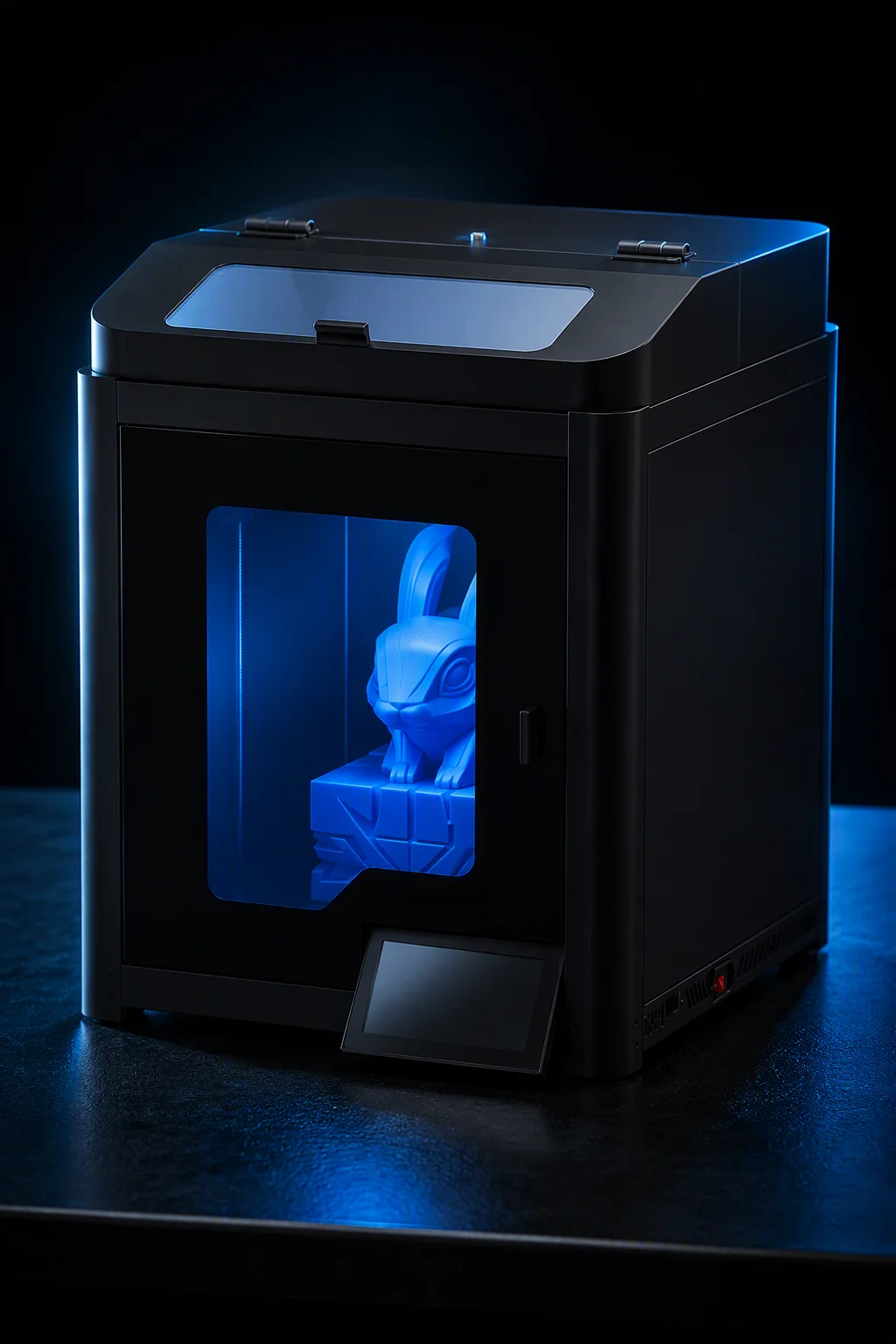
Consumer 3D printing crossed an inflection point in 2025. Unit shipments passed 4.5 million worldwide, average selling prices dropped below $350 for entry-level machines, and for the first time, mainstream retailers — not just specialist hobby shops — started stocking printers on physical shelves. The same shift that happened with drones in 2016–2019 and electric scooters in 2019–2022 is now happening in 3D printing. And every wave creates its own distribution economy.
The distributors who entered early — the ones with warehouse space, a local sales team, and a clear OEM partnership — are now doing $2–5 million in annual revenue with 25–35% gross margins. This guide walks through exactly what it takes to join them, broken into the seven decisions that determine whether a distribution business makes money or burns cash.
1. Size Your Market Before You Size Your Order
The first mistake new distributors make is ordering a container of printers before understanding who will buy them and why. The global consumer 3D printer market splits into four distinct buyer segments, and each requires a different product mix:
Your target region determines which segments dominate. A distributor in Germany or the Netherlands will find heavy demand from engineering and education buyers who expect CE certification and local-language support. A distributor in Southeast Asia will see more hobbyist and print farm demand, with price sensitivity driving the purchasing decision. Before you order a single unit, identify which two segments your regional market actually contains — and build your initial order around those. For a complete walkthrough of product-to-market mapping, see our portfolio strategy guide.
2. Choose Your Business Model: Branded vs White-Label vs Hybrid
Three distribution models exist, and the one you pick determines your margin structure, marketing budget, and dependency on your OEM partner:
Branded reseller is the lowest-barrier entry point. You buy Precise3D products at distributor pricing, sell them under the Precise3D brand, and benefit from our existing marketing assets, product documentation, and brand recognition. The trade-off: you're building equity in someone else's brand alongside your own distribution business. Most of our 200+ partners started here.
White-label gives you full brand ownership. Your logo on the printer body, boot screen, packaging, and manuals. You set the MSRP, you own the customer relationship entirely, and your margin jumps 8–15 points. The trade-off: higher upfront investment (branded packaging tooling starts at $8,000), higher minimum order quantities (typically 200+ units), and you carry the marketing burden. Established electronics distributors who already have a regional brand — think of a consumer electronics chain in Brazil or an online retailer in Australia — choose this path because they're monetizing their existing audience.
Hybrid is what most distributors graduate to after 2–3 years. You carry Precise3D-branded printers for the volume segment and launch a house brand for your premium filament, spare parts, and accessories — capturing 60–80% margin on consumables while leveraging OEM recognition on the hardware. Our engineering filaments guide details the recurring revenue math.
3. Legal Setup, Certifications, and Import Compliance
This is the section most startup guides gloss over — and the one that kills distribution businesses in their first year. Every country has its own regulatory framework for importing electronic devices with heating elements, moving parts, and mains power connections.
The baseline requirements for importing consumer 3D printers into most markets:
Precise3D ships all printers with CE, FCC, and RoHS compliance pre-certified at the factory level. For distributors entering markets with additional requirements — UL listing for US big-box retail, KC for Korea, BIS for India — we provide full technical documentation packages and testing samples to support your local certification process. The timeline and cost estimates above assume your OEM partner supplies compliant hardware from day one; if they don't, double both numbers. For the complete certification playbook, read our compliance guide for distributors.
On the legal side, you'll need a registered business entity in your target market, a customs broker relationship (or an in-house import specialist for high volume), and product liability insurance. Most Precise3D distributors operate as an LLC or equivalent limited-liability structure. Product liability coverage of $1–2 million is standard for consumer electronics distribution; annual premiums typically run $1,200–3,000 depending on your region and volume.
4. Inventory Planning: What Your First Order Should Look Like
The single largest capital decision you'll make is your initial purchase order. Order too little and you can't meet demand — customers wait, lose interest, and buy from a competitor. Order too much and your working capital sits on a warehouse shelf while you pay storage fees. Here's what a balanced first order looks like, built from actual Precise3D distributor onboarding data:
Add ocean freight + insurance (~$1,400 for a shared container from Shenzhen to most major ports), import duties (typically 0–5% on 3D printers under most HTS classifications), and inland transport (~$600–1,200 depending on distance from port to warehouse), and your delivered cost lands around $24,000–25,000. At the blended margins in the pricing table above, this inventory represents roughly $35,000–38,000 in retail value — enough to generate positive cash flow from month one if your sales channels are active. For the complete logistics breakdown, see our shipping and import guide.
5. Pricing Strategy: The Difference Between Revenue and Profit
Most new distributors price by gut feel: "I paid $420 landed, I'll sell it for $699. That's a 40% margin." But true margin calculation includes warranty reserves, marketing spend, sales commissions, and payment processing fees — costs that don't appear on the invoice but absolutely appear on your P&L. A printer with a $420 landed cost and a $699 MSRP sounds like $279 of profit. After all operating costs, the real number is closer to $132. Here's the full cost stack:
This is why pricing discipline matters. Dropping your MSRP from $699 to $599 to match a competitor doesn't reduce your profit by $100 — it reduces it by $100 out of the $132 that was actually yours. Your net margin collapses from 23% to 5.6%. One warranty return at the lower price point wipes out the profit from 15 sales. Our complete pricing strategy guide covers MSRP setting, MAP enforcement, regional adjustments, and bundling tactics in full detail — read it before you set your first price tag.
6. Building Your Sales Channels
A distributor who relies on a single sales channel is one algorithm change away from zero revenue. The distributors in Precise3D's network who sustain 20%+ year-over-year growth maintain three to four active channels, typically in this mix:
E-commerce (your own site):
The highest-margin channel because there's no platform fee eating 8–15% of every sale. A Shopify or WooCommerce store with payment processing costs you ~3% instead of Amazon's 15%. The trade-off: you drive your own traffic, which requires either SEO investment or paid ads. Distributors who publish technical content — comparison guides, material deep-dives, print farm case studies — consistently see 40–60% of their traffic from organic search within 12 months. Every blog article on the Precise3D site, including the ones linked throughout this guide, earns 60–70% of its traffic from Google — the same pattern works for distributor domains.
Marketplaces (Amazon, regional equivalents):
Lower margin but unmatched reach. A Precise3D distributor in Germany listing on Amazon.de typically sees 60% of first-year revenue through the marketplace. The key is protecting your pricing across channels — if your own site sells at $899 and Amazon shows $849 from another reseller, you lose both the sale and the brand perception. MAP enforcement, which Precise3D maintains across all authorized channels, is the mechanism that prevents this race to the bottom.
B2B / Institutional:
The highest-value channel but the slowest to develop. Universities, fabrication labs, and engineering firms buy in volume (5–30 units per order) at negotiated pricing with multi-year support expectations. A single university contract can be worth $30,000–80,000 annually. The sales cycle runs 3–6 months and requires relationship-building — attending education technology trade shows, offering demos to department heads, and providing curriculum integration support.
Retail partnerships:
Getting onto the shelf at a physical electronics retailer transforms your business from online-only to omnichannel. It also imposes the strictest requirements — UL/ETL certification, retail-ready packaging, barcode compliance, and vendor onboarding paperwork that can take 8–12 weeks. The margin is lower (wholesale to retailer at 15–20% below MSRP), but the volume and brand credibility make it worth pursuing after your first year of profitable operation.
7. After-Sales: The Infrastructure That Separates Survivors from Casualties
3D printers are electromechanical devices that operate at 200–300°C for thousands of hours. Things break. A distributor who treats after-sales as an afterthought will drown in returns, chargebacks, and one-star reviews within six months. A distributor who treats after-sales as a competitive advantage will convert one-time buyers into repeat customers who reorder filament every month.
The minimum viable support infrastructure for a 3D printer distributor includes:
What a Successful First Year Looks Like
Let's put the numbers together. A branded-reseller distributor launching with the initial order described above, operating in a mid-sized market with three active sales channels, can expect:
The numbers that stand out: even the conservative scenario turns a profit in year one on a $25,000 initial investment. The realistic target — which requires active marketing, responsive support, and consistent inventory management — delivers a 150–380% return on invested capital within 12 months. And year two compounds: your customer base generates filament reorders without additional acquisition cost, your SEO content matures and drives organic traffic, and your institutional relationships start bearing fruit.
The distributors who succeed are the ones who treat this as a business from day one — registered entity, proper insurance, documented processes, and an OEM partner who treats their success as shared. The ones who treat it as a side hustle with a Shopify store and a prayer are the ones wondering why their garage is full of unsold printers six months later. If you're evaluating OEM partners now, start with our 10 questions to ask before choosing an OEM. The quality of your OEM relationship determines your ceiling — choose carefully.
Reviewed by the Precise3D engineering & OEM team. Compliance files that accompany the catalog are auditable at the certification register.
Start Your Partnership
Ready to Launch Your 3D Printer Distribution Business?
Join our network of global distributor network. We'll help you build your initial order, navigate certifications, and set up your support infrastructure. Factory-direct pricing, dedicated account management, and 15 years of OEM expertise.