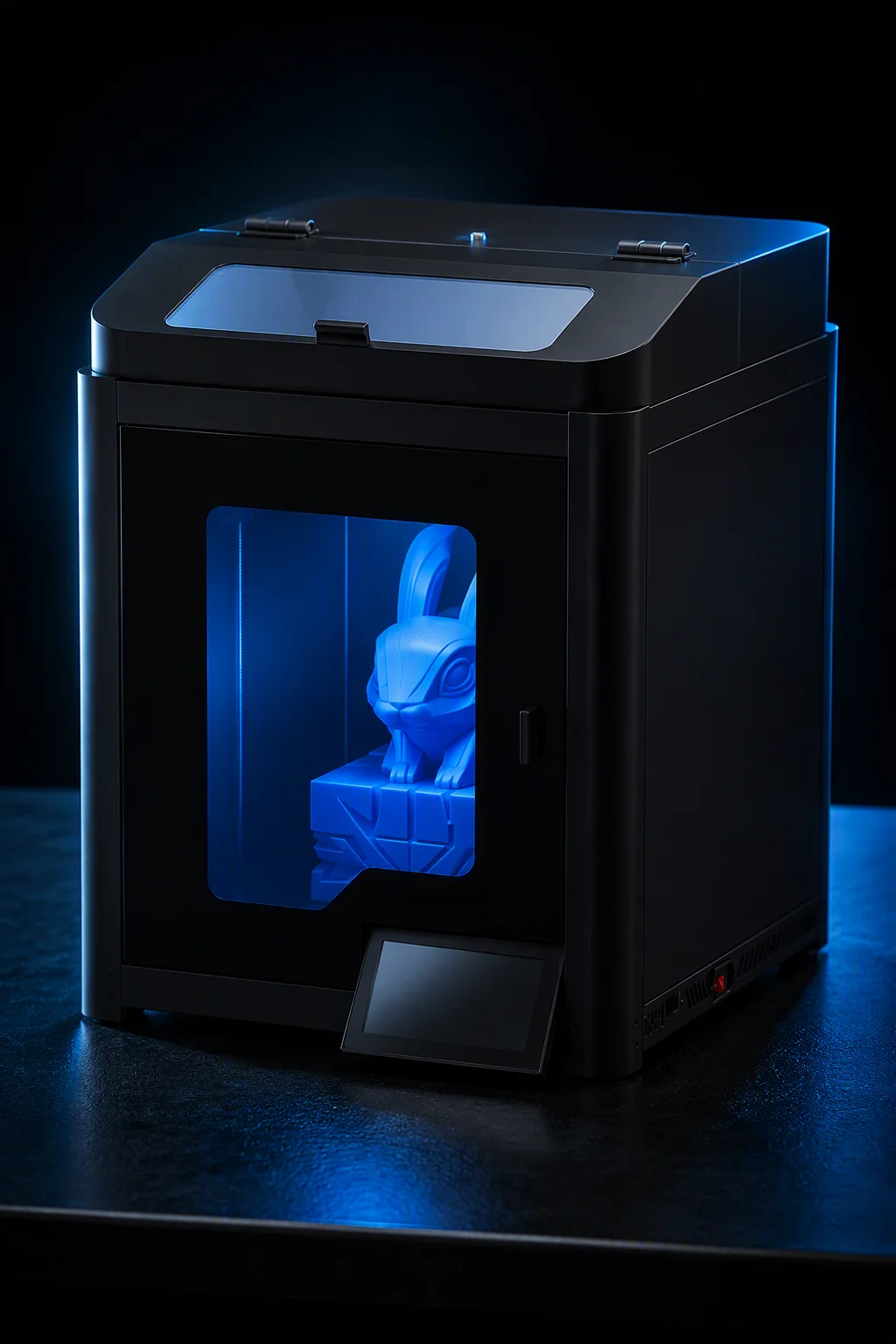
A distributor who stocks only the cheapest printer competes on price until margin hits zero. A distributor who stocks only the most expensive printer starves for volume. The distributors we've watched build seven-figure businesses over three years share one pattern: they treat their product line as a portfolio — deliberately mapping each printer tier to a customer segment with its own margin structure, buying cycle, and repeat-purchase behavior. Here's how to build that portfolio, using real numbers from Precise3D's three-tier product line as the framework.
The Three-Tier Portfolio Model: Why Every Distributor Needs All Three
The consumer 3D printer market has matured into three clearly defined tiers, each serving a distinct buyer with different price sensitivity, technical expectations, and lifetime value. A distributor stocking only one tier leaves two revenue streams on the table:
Annual value includes filament reorders, spare parts, and accessory purchases — the full customer relationship, not just the printer sale. A customer who buys a Start S1 and prints 0.5 kg/day generates roughly $120/year in filament margin. A Pro X1 customer printing 1.8 kg/day of engineering materials generates $450+/year. The portfolio effect compounds: a distributor serving all three tiers captures customers as they upgrade, rather than losing them to a competitor who stocks the next tier. For the full margin picture, see our pricing strategy guide.
Tier 1: The Entry-Level Engine — Volume, Acquisition, and the Upgrade Path
The entry-level printer is your customer acquisition machine. It brings people into the ecosystem at a price point where the purchase decision takes hours, not weeks. But it only works as a strategy if you treat it as a loss leader for the relationship — not as a standalone profit center.
The Precise3D Start S1 at $199–249 occupies the sweet spot of the entry market: pre-assembled (not a kit), prints in 10 minutes out of the box, and handles PLA, PETG, and TPU — the three filaments that cover 85% of hobbyist use cases. Its 220×220×250 mm build volume fits a basketball-sized object, which covers the vast majority of consumer prints. At 6.8 kg, it ships economically in volume.
At $51 net margin per unit, the Start S1 won't pay your rent. But that's not its job. Its job is to put a Precise3D printer on a customer's desk, where it prints 15 kg of filament in the first three months. At $8/kg distributor margin on PLA/PETG, that's $120 in consumables margin — more than double the printer margin — within 90 days of the sale. One in four of those customers will upgrade to a Creator C1 or Pro X1 within 18 months, generating a second printer sale with a pre-existing relationship. The entry-level printer is a customer acquisition cost of negative $51: you get paid to acquire a customer who generates recurring revenue.
The entry channel mix typically looks like this: 40% retail shelf (consumer electronics stores, hobby shops), 35% e-commerce (Amazon, regional marketplaces), 25% education (school STEM programs, library makerspaces). For retail, the Start S1's compact box (38×38×28 cm) and 6.8 kg weight make it the only tier that works on a shelf — a Pro X1 box at 62×58×48 cm and 22 kg is a pallet item, not a display product. For the full logistics picture, see our shipping and import guide.
Tier 2: The Prosumer Core — Your Margin Engine
The prosumer tier is where most distributors build their business. These customers know what they want, comparison-shop across 3–5 brands, and make their decision based on specs and reviews — not price. They're willing to pay $450–550 for a printer that delivers measurable advantages in speed, precision, and material capability.
The Creator C1 at $449–549 is Precise3D's prosumer workhorse. Its 250×250×280 mm build volume, 300 mm/s print speed, 25-point auto bed leveling, and 4.3" color touchscreen put it squarely in the segment where customers cross-shop against brands like Bambu Lab and Creality. The partial enclosure and silent drivers under 45 dB make it suitable for classroom and office environments — a market the open-frame Start S1 can't serve because of noise and fume concerns.
At $144 net margin per unit on a $499 MSRP, the Creator C1 earns nearly 3× the profit of a Start S1 — and its customers buy more filament, more consistently. The average Creator C1 owner prints 1.1 kg/day across PLA, PETG, and occasional ABS, generating $200–280/year in consumables margin. The printer itself turns a healthy profit, and the consumables stream makes the customer relationship worth $350–450/year total.
The Creator C1's channel mix skews differently from the Start S1: 45% education (university labs, vocational schools, STEM programs), 30% SMB/professional (design studios, architecture firms, small-batch manufacturing), 25% advanced hobbyist (the upgrade path from the Start S1). Education buyers are the highest-value segment because they order in batches of 10–20 units with predictable annual refresh cycles — one university fabrication lab with 15 Creator C1s generates $2,160/year in printer margin plus $3,000+/year in filament. For education-specific bundling strategies, read our guide to print farm economics which covers the institutional buying model in detail.
Tier 3: The Professional Flagship — Low Volume, Highest Lifetime Value
The professional tier is where profit per customer peaks. These buyers aren't hobbyists — they're running print farms, engineering prototypes, or manufacturing jigs and fixtures. They make purchasing decisions based on reliability, material capability, and throughput, and they're willing to pay $800+ for a machine that delivers all three.
The Pro X1 at $799–899 is Precise3D's flagship. Its CoreXY kinematics, fully enclosed chamber with HEPA filter, 300°C nozzle (enabling nylon, polycarbonate, and carbon-fiber-filled filaments), 110°C bed, and 500 mm/s print speed make it a production tool, not a hobby device. The 49-point auto bed leveling mesh and dual-gear direct drive extruder deliver the consistency that print farms depend on — when you're running 20 machines 24/7, a 2% failure rate costs you 14 hours of lost production per month.
A single Pro X1 sale earns $309 — more than six Start S1 units combined. The consumables economics are even more dramatic: Pro X1 customers print engineering materials (nylon, PC, CF-filled) at 1.5–2.5 kg/day, generating $450–900/year in filament margin at $12–18/kg distributor pricing. One print farm customer running 20 Pro X1s generates $9,000–18,000/year in filament revenue alone — a recurring annuity that compounds with every new machine they add. For a full breakdown of how print farms calculate their ROI, see our print farm economics analysis.
The professional channel mix is the narrowest but deepest: 50% print farms and service bureaus, 30% engineering and manufacturing (prototyping labs, jig/fixture production), 20% advanced education (university research labs). These buyers don't discover you on Amazon — they find you through industry trade shows, direct outreach, and referrals from other print farm operators. One print farm customer is worth 50 entry-level retail customers in lifetime margin, but they require a different sales motion: spec sheets, sample prints, volume pricing tiers, and dedicated account management. For guidance on building that OEM relationship, read our OEM partner evaluation checklist.
The Optimal Portfolio Mix: What 200+ Distributors Actually Stock
Theory is useful, but what do active distributors actually carry? We analyzed the inventory patterns of Precise3D's 200+ global distribution partners and found three dominant portfolio structures:
Consumer-First is the default starting portfolio for new distributors entering a market. Lead with the Start S1 to build brand awareness and install base, carry enough Creator C1s to capture the upgrade path, and keep a handful of Pro X1s for the early-adopter professional buyers who find you through word of mouth. This portfolio generates high unit velocity but lower average margin per sale — expect 18–24% blended net margin in year one.
Balanced Growth is where the most profitable distributors land by year three. The Creator C1 becomes the volume leader (highest absolute margin contribution), the Start S1 continues as the acquisition channel, and the Pro X1 contributes disproportionate profit from a small unit count. A distributor selling 200 units/month in this mix — 70 Start S1, 90 Creator C1, 40 Pro X1 — generates roughly $25,000/month in printer margin plus $18,000–22,000/month in consumables. That's a $500K+/year business with a single brand.
Professional-Led is rare — only 8% of our distributors operate this model — but it's the highest-margin structure when the market supports it. These distributors sell primarily to print farms, engineering firms, and advanced manufacturing. They stock Start S1s only as samples for potential Pro X1 buyers to see the brand's quality at a low commitment. The blended net margin runs 30–35%, but unit velocity is lower and the sales cycle is 3–6 weeks instead of same-day. This model works in markets with strong manufacturing sectors: Germany, Japan, South Korea, and the US Midwest. For a competitor comparison between printer architectures, read our CoreXY vs Bedslinger guide.
Market Segment Mapping: Which Printer Goes Where
Beyond the portfolio percentages, you need to map each printer to specific sales channels and customer types. The same printer performs differently depending on who's selling it and to whom:
The channel mapping reveals an important constraint: you can't serve all channels with one model. A print farm won't buy a Start S1, and a retail customer won't spend $899 on a Pro X1 they've never seen in person. The portfolio approach isn't about selling more products — it's about being the right answer for every customer who enters your funnel, regardless of which door they came through.
Inventory Planning: How Much to Stock of Each Tier
Stocking the wrong mix is expensive. Overstock Pro X1s and you tie up $480/unit in working capital for machines that sell slowly. Understock Start S1s and you lose e-commerce sales to competitors who can deliver in two days. Here's a data-driven stocking formula based on Precise3D distributor data:
The working capital math reveals why most new distributors start Consumer-First: a $3,750 reorder for 30 Start S1s is manageable, while a balanced portfolio requires roughly $14,000 in working capital for a single restock cycle across all three tiers. This is where pricing strategy intersects with cash flow — a distributor who prices too low can't afford to restock, and a distributor who prices too high can't sell through inventory fast enough to justify the next order.
When to Add or Drop a Tier
Your portfolio isn't static. Market conditions, competitive pressure, and your own growth trajectory determine when to expand or contract your product line. Here are the signals from Precise3D's most successful distributors:
Add the Creator C1 when:
Start S1 customers start asking "what's the next step up?" — this usually happens around month 6–8 of active distribution. If 15%+ of your Start S1 support tickets mention speed or material limitations, your market is ready for the prosumer tier. The Creator C1's partial enclosure and 300 mm/s speed directly address the two most common Start S1 complaints: noise and print time.
Add the Pro X1 when:
You have at least three Creator C1 customers asking about nylon, carbon fiber, or high-temperature materials. The Pro X1's 300°C nozzle and 110°C bed are specifically designed for engineering materials that entry and prosumer printers can't handle. If a local manufacturing company approaches you about prototyping or jig production, that's your Pro X1 entry signal. For the compliance requirements that professional buyers expect, read our certification guide.
Drop the Start S1 when:
Your blended net margin exceeds 28% and Start S1 units represent less than 15% of total profit contribution. At that point, the customer acquisition argument weakens — you're spending operational overhead on a product that doesn't move the needle. Most distributors never drop the Start S1 entirely (it remains the best entry point for new customers), but they reduce its SKU count and shift marketing spend toward the Creator C1 and Pro X1.
Never drop the Creator C1.
Of the 200+ distributors we've tracked, zero who carried all three tiers have ever dropped the middle tier. The Creator C1 is the portfolio's keystone: it captures the upgrade from Start S1, serves the education market that buys in volume, and acts as the bridge product for customers considering the Pro X1. Without it, you have a gap between $249 and $799 that competitors fill. For a comparison of how the Creator C1's architecture competes, read our enclosed vs open-frame analysis.
Reviewed by the Precise3D engineering & OEM team. Compliance files that accompany the catalog are auditable at the certification register.
Build Your Portfolio
Ready to Stock the Full Precise3D Line?
Get distributor pricing across all three tiers, volume discount schedules, and dedicated portfolio planning support from our distribution team.