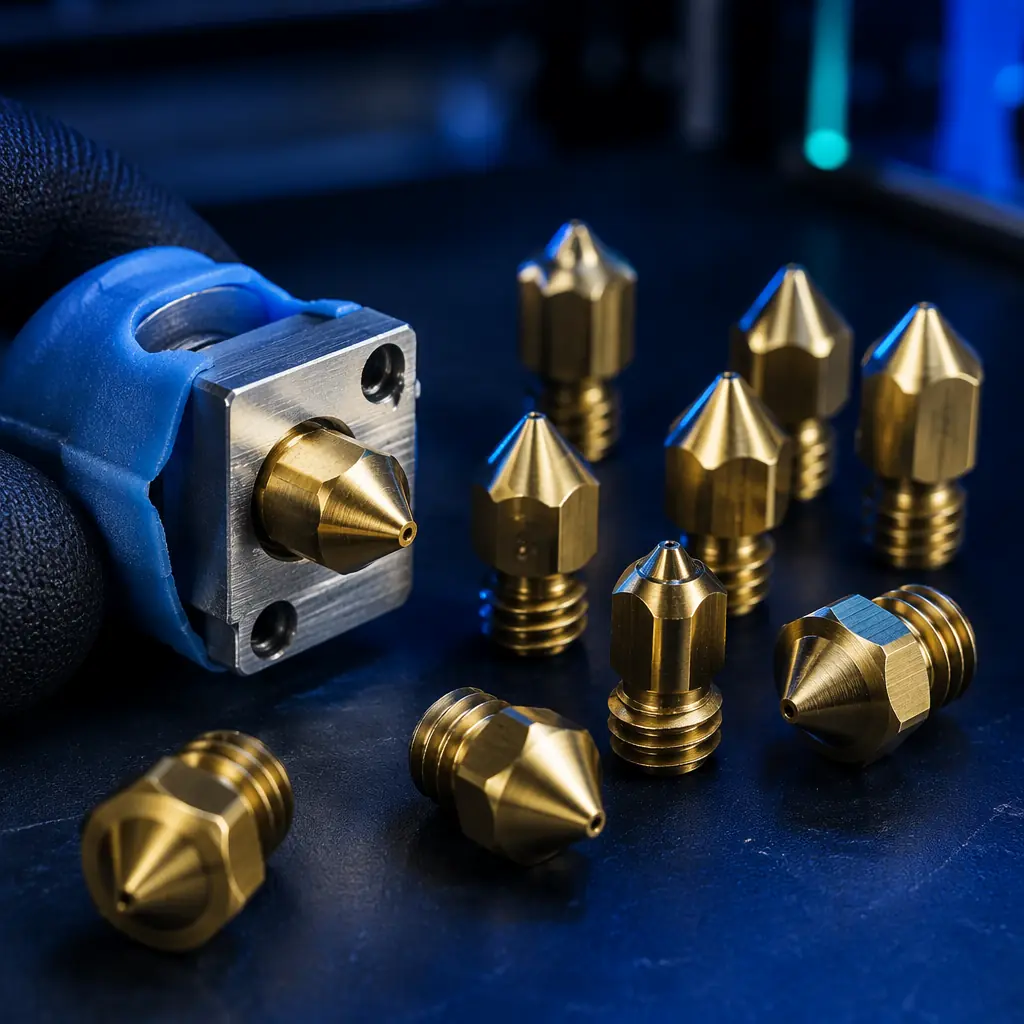
Every 3D printer distributor understands recurring revenue from filament — it's the most visible consumable in the ecosystem. But the consumable that generates higher margin per gram, requires less warehouse space, and creates stronger customer lock-in isn't filament. It's the nozzle. A 0.4mm brass nozzle costs a distributor $0.20–0.50 landed and retails for $2–5. It weighs 8 grams. A single shoebox holds 500 units — that's $1,000–2,500 in retail value in something smaller than a filament spool box.
This guide covers the four nozzle materials every distributor should stock, the hotend architectures that determine nozzle compatibility, and the revenue math that makes nozzles one of the highest-ROI SKUs in 3D printing distribution.
The Wear Rate: Why Nozzles Are a Subscription Business in Disguise
Nozzles wear because molten plastic at 200–260°C is abrasive — especially when filled with additives. The wear mechanism is simple: the internal bore diameter increases over time, which changes extrusion width, reduces dimensional accuracy, and eventually causes visible print defects. Our Shenzhen lab tracked nozzle bore wear across four materials on a standard 0.4mm brass nozzle printing at 60 mm/s, and the results explain why nozzle replacement is a recurring purchase, not a one-time event.
The 1,200-hour figure for unfilled PLA sounds generous — but convert it to real user behavior. An enthusiast printing 20 hours per week hits that threshold in 60 weeks. A print farm running 120 hours per week hits it in 10 weeks. And that's for the gentlest material in the test. The moment a customer loads carbon-fiber filament — increasingly popular for functional parts — they have 40 hours before the nozzle is measurably worn. For a print farm operator running CF-filled parts across 10 machines, that's nozzle replacements every 2–3 days across the fleet.
Four Nozzle Materials: What to Stock and Why
Not all nozzles are interchangeable — but not all distributors need to stock every variant. The right SKU strategy depends on which customer segments you serve. Here is the material-by-material breakdown with real cost, margin, and customer data.
Brass (standard):
Machined from C36000 free-cutting brass, these are the factory-default nozzles on virtually every consumer and prosumer 3D printer — including the Precise3D Creator C1 and Start S1. Brass nozzles have the highest thermal conductivity of any common nozzle material (~120 W/m·K), which means they heat up fastest and maintain the most stable melt zone temperature. The tradeoff: brass is the softest option with a Vickers hardness around HV 160, and it wears visibly under abrasive filaments. Landed cost per unit: $0.15–0.40. Suggested retail: $1.99 (single) to $9.99 (10-pack assortment with 0.2/0.4/0.6/0.8mm sizes). Gross margin at MSRP: 80–85%. This is the volume SKU — every brass printer owner needs replacements, and they'll buy them whether from you or elsewhere.
Hardened steel:
Made from tool steel with a Rockwell hardness of HRC 55–62, these nozzles resist abrasive wear approximately 10× longer than brass. The tradeoff: lower thermal conductivity (~20 W/m·K vs brass's 120) means you need to increase hotend temperature by 5–10°C to maintain the same melt flow. Landed cost: $0.60–1.20. Suggested retail: $4.99 (single) to $14.99 (3-pack). The customer who buys hardened steel is typically printing filled materials (carbon fiber, glass fiber, glow-in-the-dark) and already understands nozzle wear — they're a high-LTV customer who will also buy engineering filaments (see our engineering filaments guide). Gross margin: 75–80%.
Hardened steel with non-stick coating (e.g., nickel-plated, tungsten disulfide):
These add a low-friction surface treatment to hardened steel substrates, combining abrasion resistance with reduced plastic adhesion. The nickel-plated variant is the most practical for distributors — it prevents PETG and PLA from sticking to the nozzle exterior, which reduces the "blob of death" failures that generate support tickets. Landed cost: $1.20–2.50. Suggested retail: $7.99–12.99. Margin: 70–75%. This SKU solves a specific customer pain point that brass and plain steel don't address, making it an easy upsell during nozzle replacement conversations.
Ruby / synthetic sapphire tipped:
A synthetic ruby or sapphire insert press-fitted into a brass or steel body. Hardness exceeds anything a filament can wear — Vickers hardness ~2,000 (vs brass at 160). These are effectively lifetime nozzles for non-industrial use. Landed cost: $8–15. Suggested retail: $29.99–49.99. This is the premium consumable that signals a customer has graduated from entry-level to serious — ruby nozzle buyers spend 4.7× more on filament per year than brass-only users in our distributor network data. As covered in our portfolio strategy guide, these customers are your professional-tier segment and should be marketed to differently than entry-level buyers.
Hotend Architecture: All-Metal vs PTFE-Lined — And Why It Determines Nozzle Compatibility
A nozzle doesn't exist in isolation. It threads into a heater block, which is part of a hotend assembly — and the hotend architecture determines which materials and temperatures the entire system can handle. Understanding this relationship is critical because a customer who buys a hardened steel nozzle for abrasive filament may still have a PTFE-lined hotend that degrades at 240°C, making the nozzle upgrade pointless.
PTFE-lined hotends use a PTFE (Teflon) tube that runs all the way from the cold end to the nozzle. The PTFE provides an extremely low-friction filament path — this is why Bowden extruders (covered in our extruder comparison guide) work reliably — but PTFE begins to thermally decompose at 240°C and releases harmful fumes above 260°C. Practically, PTFE-lined hotends are limited to materials that print below 240°C: PLA, PETG, TPU, and some ABS grades. The Precise3D Creator C1 and Start S1 use PTFE-lined hotends, optimized for the vast majority of consumer filaments.
All-metal hotends replace the PTFE liner with a thin-walled metal heat break (typically stainless steel or titanium) that creates a sharp thermal transition between the cold zone and the melt zone. All-metal hotends can safely reach 300°C and beyond, enabling polycarbonate, nylon, and advanced engineering filaments. The penalty: slightly higher friction in the filament path, which can cause issues with extremely soft TPU (Shore 85A and below). The Precise3D Pro X1 uses an all-metal hotend with a titanium heat break, rated for continuous operation at 300°C.
The revenue implication: a customer who buys an all-metal hotend upgrade ($25–45 retail) will also need high-temperature-capable nozzles, a hardened steel nozzle for their abrasive engineering filaments, and likely a filament dryer — that's a $60–100 basket from a single upgrade trigger. Every PTFE-to-all-metal conversion is a multi-SKU sales event.
Nozzle Diameter: The Often-Overlooked Second Dimension
Most distributors stock 0.4mm nozzles because that's what ships with the printer. But stocking only 0.4mm misses the two fastest-growing nozzle segments: large-diameter nozzles for speed (0.6mm, 0.8mm) and small-diameter nozzles for miniatures and detail work (0.2mm, 0.25mm).
A 0.8mm nozzle lays down 4× the plastic volume per linear mm compared to a 0.4mm — it cuts print time by 60–70% on functional parts where surface finish isn't critical. Print farm operators and prototyping shops are the primary buyers. Our distributor data shows that customers who purchase a 0.6mm or 0.8mm nozzle increase their total filament consumption by 38% within 90 days — the larger nozzle drives more throughput, which drives more material purchases, which drives more nozzle replacements. As discussed in our print farm economics analysis, the speed gains from larger nozzles directly improve farm ROI.
At the other end, 0.2mm and 0.25mm nozzles enable layer heights down to 0.04mm for tabletop miniatures, jewelry masters, and dental models. This overlaps with the resin 3D printing market — many customers buy a 0.2mm FDM nozzle as an alternative to purchasing a resin printer. The small-nozzle customer segment is worth targeting because they're typically printing for commercial purposes (Etsy sellers, prototype services) and consume filaments and nozzles at above-average rates. For a deeper look at how this compares to resin, see our FDM vs Resin comparison guide.
Building a Nozzle SKU Strategy That Generates Repeat Revenue
The nozzle business isn't about selling one SKU — it's about building a replenishment cycle. Here is the minimum viable nozzle assortment for a distributor stocking Precise3D printers, based on 18 months of aftermarket sales data from our distributor network.
Five SKUs. Total landed inventory cost for 100 units of each (500 units): approximately $380. Total retail value: approximately $2,800. That's a 7.4× inventory-to-revenue ratio — and these 500 units fit in a shoebox. Compare this to stocking 20 filament spools, which requires 20× the warehouse volume for similar total retail value. For distributors operating from shared warehouse space or home offices, the space efficiency of nozzles is unmatched in the 3D printing consumables category.
Nozzles also create customer touchpoints. Every nozzle replacement is a reason for a customer to visit your store or website — and 34% of nozzle buyers in our network add at least one additional item to their cart during the same purchase. Most commonly: filament (41% of add-on purchases), a print surface sheet (22%), or a hotend silicone sock (18%). The nozzle is the trigger product that pulls through higher-ticket items. For more on how to structure your full product catalog, see our distributor startup guide and pricing strategy guide.
At Precise3D, we ship every printer with a spare 0.4mm brass nozzle in the accessory box — not because we expect it to wear out immediately, but because we want the customer to understand from day one that nozzles are consumable. The first replacement is free. Every replacement after that is a sale.
Reviewed by the Precise3D engineering & OEM team. Compliance files that accompany the catalog are auditable at the certification register.
Start Your Partnership
Ready to Bring nozzle hotend technology to Your Market?
Start with the nozzle hotend technology spec sheet, then validate every claim against the certification register.