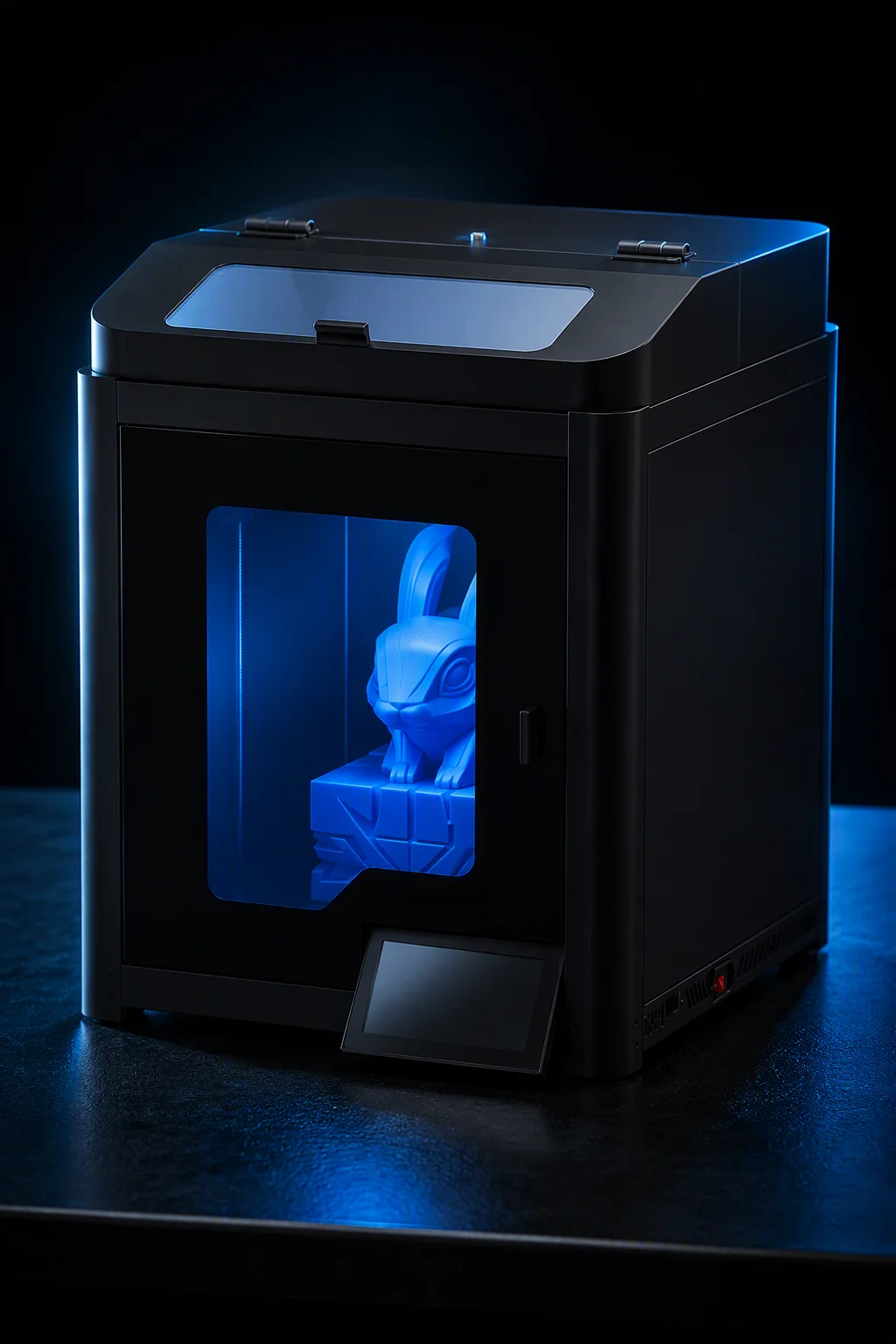
In 2024, dual-extrusion 3D printers were a niche — purchased mainly by engineering labs and advanced hobbyists willing to spend $1,000+ and hours of tinkering. By mid-2026, the category has transformed. Sub-$500 IDEX printers now ship with auto-calibration, and the technology has moved from "experimental" to "production-ready." For distributors, this shift creates a question with real margin implications: should dual extrusion be part of your product line, and if so, which SKUs at which price points?
This guide answers both questions. We'll explain the mechanical differences between IDEX, standard dual extrusion, and single-extruder multi-material systems — because your customers will ask, and the answer determines which printer they buy. We'll walk through the business case: why dual extrusion commands higher ASPs, generates higher consumables attach rates, and attracts a customer segment with lower price sensitivity. And we'll provide a stocking framework by price tier so you can add dual-extrusion SKUs without cannibalizing your single-extruder volume.
What IDEX and Dual Extrusion Actually Mean
The term "dual extrusion" covers three fundamentally different mechanical architectures, and conflating them is the most common mistake buyers make — and the one that leads to the most returns. Here's what each architecture does, how it works, and what it's actually good for.
IDEX (Independent Dual Extruder).
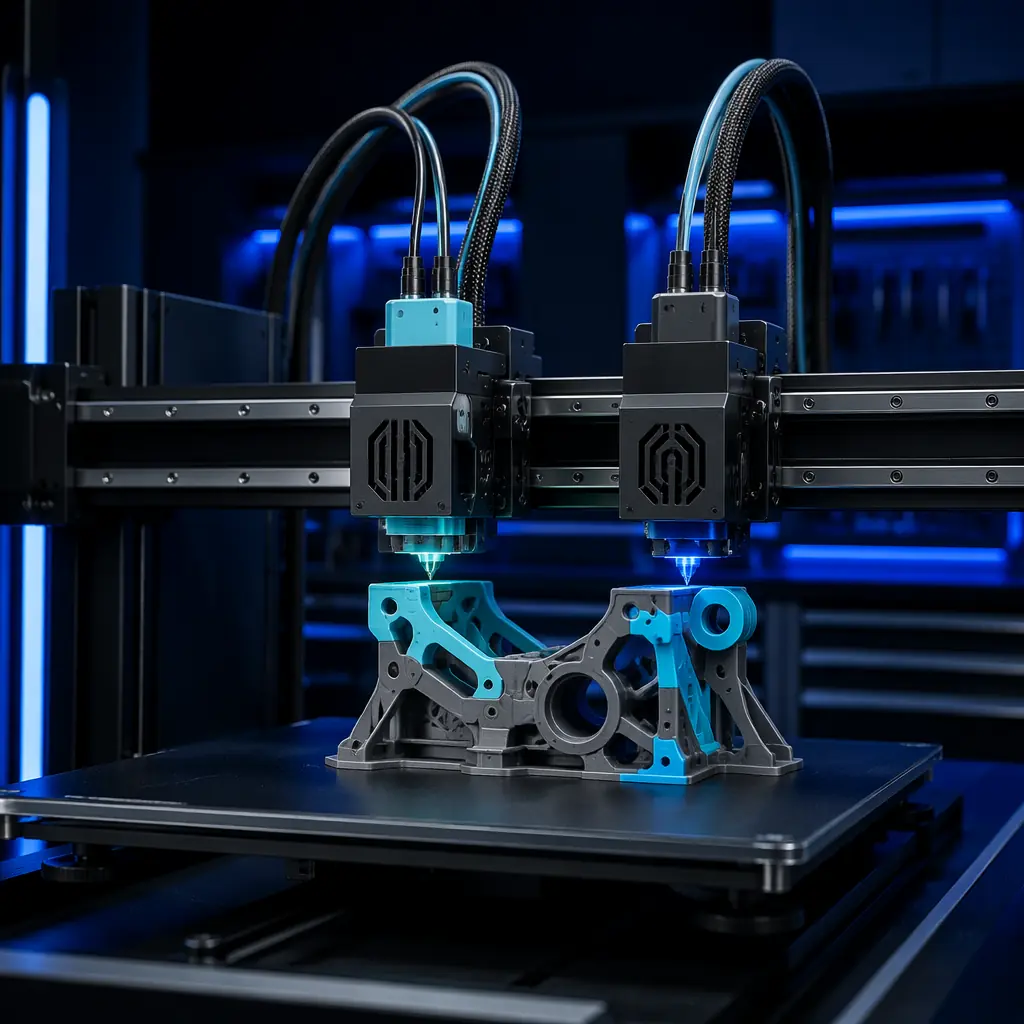
Two complete toolheads — each with its own hotend, extruder motor, heater cartridge, and thermistor — mounted on independent X-axis carriages that share the same gantry rail. Both toolheads can move independently along the X-axis, and each has its own Z-offset calibration. This is the architecture that makes "mirror mode" possible: both toolheads print the same object simultaneously, side by side, effectively doubling throughput for duplicate parts. IDEX also enables true multi-material printing without a purge block: Toolhead 1 prints PLA while Toolhead 2 prints water-soluble PVA supports, and the inactive toolhead parks off the build plate during the other's layer. The mechanical precision required is significant — the two nozzles must be aligned to within 0.05 mm in X, Y, and Z — which is why IDEX printers cost more than single-extruder equivalents but deliver capabilities no other architecture can match.
Standard Dual Extrusion (Shared Carriage).
Two hotends mounted on a single carriage that moves together. Both nozzles are at the same X position and a fixed Y offset apart — typically 18–25 mm. The firmware alternates between them by applying a Y-axis offset to the tool position, and the inactive nozzle must be physically capped or wiped to prevent ooze from contaminating the active nozzle's print. This architecture is simpler and cheaper than IDEX — fewer motors, fewer drivers, less firmware complexity — but it cannot do mirror mode, and the fixed nozzle spacing means the usable build area in dual-material mode is smaller than the physical bed (the inactive nozzle overhangs the edge on one side). It's the most common architecture on sub-$500 dual-extrusion printers and, when properly calibrated, produces multi-material prints that are indistinguishable from IDEX output for most geometries. However, the purge cycle between tool changes wastes roughly 15–20% more filament than an IDEX setup on the same model.
Single-Extruder Multi-Material (AMS / MMU).
Not actually dual extrusion. A single hotend and extruder, with an external filament-switching unit (like Bambu Lab's AMS or Prusa's MMU3) that automatically unloads one filament and loads another mid-print. The printer purges the old filament from the nozzle during each swap — typically extruding 50–150 mm³ of waste plastic into a "purge tower" or "prime tower" before resuming with the new material. This approach can handle 4, 8, or even 16 materials from a single hotend, but the trade-offs are significant: filament changes take 30–60 seconds each, a multi-color print with 500 filament changes wastes 200–400 grams of plastic in the purge tower, and the system cannot print two materials that require different nozzle temperatures simultaneously (the hotend must heat up and cool down between incompatible materials). For multi-color decorative printing, single-extruder multi-material is the most practical solution. For functional multi-material parts — PLA + TPU, rigid + flexible, or dissolvable supports — IDEX is superior in speed, waste reduction, and material compatibility.
For the distributor, the practical distinction matters because these architectures serve different customer needs — and stocking the wrong type for your market means sitting on inventory. A retailer serving hobbyist makers should stock single-extruder multi-material systems for multi-color decorative printing. A distributor serving engineering firms, prototyping labs, and professional users should stock IDEX printers for functional multi-material and soluble support capabilities. For more on how to match printer categories to customer segments, see our portfolio strategy guide by market segment.
The Real Business Case for Stocking IDEX Printers
Dual-extrusion printers have higher BOM costs than single-extruder equivalents — typically $40–80 more at the manufacturing level for IDEX, which translates to $80–150 higher wholesale cost for distributors. The question isn't whether the printer costs more. It's whether the margin dollars and customer lifetime value justify the higher inventory cost. On all four metrics that matter to distributors, the answer is yes.
Higher average selling price, higher margin dollars per unit.
A single-extruder printer that wholesales for $180 and retails for $299 generates $119 in gross margin per unit. An IDEX printer that wholesales for $280 and retails for $499 generates $219 in gross margin per unit — nearly double the margin dollars on roughly 55% more inventory cost. The margin percentage is comparable (40% vs 44%), but the absolute dollars per square foot of warehouse space and per shipping container are substantially higher. For a distributor shipping a 40-foot container of 500 printers, the single-extruder container generates $59,500 in gross margin. The IDEX container — same shipping cost, same customs clearance, same handling — generates $109,500. The freight-to-margin ratio improves from 0.25 to 0.14.
Soluble supports unlock customers who currently outsource.
The single largest addressable market for IDEX printers isn't current 3D printer owners upgrading — it's engineering firms, dental labs, and prototyping services that currently outsource complex-geometry parts to industrial SLS or SLA bureaus. These customers need internal channels, overhangs below 45 degrees, and complex assemblies that are physically impossible to print without supports — and they need those supports to dissolve cleanly without leaving witness marks. A $500 IDEX printer printing PLA with PVA supports can produce parts that previously required a $3,000+ industrial machine with a $50-per-part service bureau fee. The payback period for the customer is 10 parts. For the distributor, these customers have fundamentally different buying behavior: they don't comparison-shop on Amazon, they value technical support over price, and their reorder rate for consumables (PLA + PVA spools) is 3–5x the consumer average.
Multi-material functional parts open new verticals.
PLA + TPU multi-material printing — rigid structure with flexible hinges, gaskets, or grip surfaces printed in a single job — is the killer application that single-extruder printers cannot replicate. A drone frame with vibration-damping TPU motor mounts, a robotic gripper with soft TPU fingertips on a rigid PLA body, a snap-fit enclosure with an integrated TPU seal: these are parts that previously required multi-step assembly with adhesives or fasteners. IDEX prints them in one job. For the distributor, this means access to verticals — drone/RC, robotics, medical device prototyping — where the customer sees the printer not as a hobby tool but as production equipment, and budgets accordingly. These customers don't buy one printer; they buy two or three as their workflow scales. For a broader view of vertical-market strategy, see our guide on positioning printers across market segments.
Mirror mode = 2x throughput for print farm customers.
IDEX mirror mode is the feature that converts print-farm operators from single-extruder to dual-extruder buyers. Two identical parts printed simultaneously, one by each toolhead, in the same time a single-extruder printer takes for one part. For a print farm running 10 single-extruder printers producing a part that takes 3 hours, replacing 5 of them with 5 IDEX printers in mirror mode increases throughput from 3.3 parts/hour to 5 parts/hour — a 50% increase — while reducing the printer count by 5 units and the associated power, space, and maintenance overhead. Print-farm operators understand this math instantly, and for them, the price premium of IDEX is not a cost — it's a throughput investment with a measurable ROI measured in weeks, not months. For a deeper analysis of unit economics, see our print farm economics guide.
Stocking Checklist: What to Look for in an IDEX Printer
Not all IDEX printers are equal. The architecture adds complexity — more motors, more wiring, more calibration surface area — and that complexity can either be managed by good engineering or become a support headache. Here are the five engineering decisions that separate IDEX printers worth stocking from the ones that generate returns and support tickets.
Independent Z-axis with dual leadscrews.
The biggest source of IDEX reliability problems is Z-axis drift between the two toolheads. If one nozzle is 0.1 mm higher than the other after a few hours of printing, the lower nozzle scrapes the print on its pass and the higher nozzle deposits filament in mid-air. Machines with independent Z motors and auto bed leveling using a strain gauge or optical sensor on each toolhead can compensate for this drift automatically. Machines with a single Z motor and manual Z-offset adjustment require the user to relevel before every dual-material print — and most users won't do it, leading to failed prints and returns. The extra $15–25 in BOM cost for dual Z motors is the single best predictor of whether an IDEX printer will succeed in the field or generate support tickets.
Auto nozzle alignment — not manual.
The second biggest failure mode is X/Y offset between nozzles. Even a 0.1 mm misalignment produces visible layer seams in multi-material prints where the two materials meet. Auto-alignment systems — typically a contact probe or optical sensor that touches a reference point on the bed with each nozzle and computes the offset — reduce this to a routine that runs in 60 seconds at the start of a print job. Manual alignment, where the user adjusts set screws while squinting at a test print, is the moment most first-time IDEX users decide the technology "isn't worth it." If the printer doesn't have auto-alignment, don't stock it — the return rate will eat your margin.
Both hotends must be direct-drive and all-metal.
A Bowden extruder on a dual-extrusion machine compounds the retraction and ooze problem: the long filament path makes precise pressure control nearly impossible, and ooze from the inactive nozzle during a tool change contaminates the active nozzle's print. Direct-drive extruders on both toolheads, with all-metal hotends rated to 280°C minimum, ensure that both PLA and engineering filaments (PETG, ABS, TPU, PA-CF at 260–280°C) can be printed from either toolhead. This flexibility is critical because multi-material prints often pair a standard material with an engineering material — PLA structure with TPU flexures, or PETG base with PVA supports that require 190–210°C — and a PTFE-lined hotend that maxes out at 240°C limits the material combinations the printer can handle. For a detailed comparison of extruder architectures, see our direct drive vs Bowden guide.
Build volume penalty under 20%.
Every dual-extrusion printer gives up some build volume compared to a single-extruder equivalent — the inactive toolhead needs parking space, and the gantry needs clearance for both carriages. The question is how much. A well-designed IDEX printer on a 256×256 mm bed should deliver at least 230×230 mm in dual-material mode (18% area reduction). Machines that drop to 180×180 mm on the same bed size (50% area reduction) have a mechanical design problem — usually a toolhead that's too wide or a parking zone that's too deep into the build area. For the distributor, the build-volume penalty directly affects how you market the printer: a 230×230 mm dual-material machine can print functional parts in real-world sizes; a 180×180 mm one is limited to small components and will frustrate buyers who expected "dual extrusion" to mean "dual extrusion of the parts I actually need to make."
IDEX Price Tiers and Positioning Strategy
The IDEX printer market in mid-2026 has stratified into three clear tiers, each with distinct BOM cost characteristics and target customers. Stocking across multiple tiers lets you capture the full demand curve — but each tier requires a different marketing angle and a different support expectation.
Entry tier positioning: "Your first dual-material printer." The sub-$600 dual-extrusion market is the gateway drug. Position these as the logical upgrade from a $299 single-extruder printer — same ease of use, one new capability (print two colors or two materials), minimal learning curve. The key selling point is PVA soluble supports: show a complex-geometry part printed with and without supports, and the value sells itself. Don't lead with multi-material functional parts at this tier — the Bowden extruders and manual alignment aren't precise enough for PLA+TPU hybrids. Lead with "dissolvable supports that make any geometry printable."
Mid-range positioning: "The print farm multiplier." The $600–1,000 IDEX tier is where the commercial case peaks. These machines do everything: mirror mode for production throughput, PLA+TPU multi-material for functional prototyping, PVA supports for complex-geometry parts, and Klipper firmware for speed. Position these to three customer segments simultaneously: (1) print farm operators — lead with mirror mode throughput and our print farm ROI calculator, (2) engineering firms — lead with multi-material functional parts and material compatibility, (3) education and makerspaces — lead with versatility and low waste compared to single-extruder multi-material systems. This tier supports the full filament stocking strategy — the customer who buys a mid-range IDEX printer is the customer who buys PLA, PETG, TPU, PVA, and engineering filaments from you, not Amazon.
Professional tier positioning: "Industrial capability, desktop footprint." At $1,000+, the customer isn't buying a printer — they're buying a manufacturing workstation that happens to fit on a desk. Heated chambers enable engineering-grade materials (ABS, ASA, PC, nylon, and with 350°C hotends, PEEK and PEI) that warp on open-frame printers. These customers value certifications, material compatibility documentation, and technical support response time over price. Stock one SKU at this tier as a halo product — it validates your expertise in the category even if most customers buy the mid-range model. The professional-tier customer also buys engineering filaments at 3–5x the volume of a consumer customer, making them among the highest lifetime-value accounts in your book.
Common Customer Objections — and How to Answer Them
Every distributor who adds IDEX printers to their line will hear the same three objections from potential buyers. Here's what they mean and how to respond in a way that moves the sale forward.
"Dual extrusion is too complicated." This objection usually comes from someone whose last experience with dual extrusion was a 2019-era printer that required manual nozzle alignment with feeler gauges and a prayer. The technology has moved on. Show them: run an auto-alignment cycle on a mid-range IDEX printer — it takes 60 seconds, it's fully automatic, and the printer confirms alignment with a pass/fail display. Then print a two-material test cube with PLA and PVA. Total setup time from unboxing to first dual-material print: under 15 minutes on a well-engineered 2026 IDEX machine. The objection isn't about dual extrusion — it's about their experience with a specific generation of the technology that no longer represents the market. Address the specific experience, not the category.
"Single extruder is fine for what I do." True for many customers. But probe one level deeper: "What's the one part you'd print if you could — but can't because of support removal or assembly complexity?" Every engineer and serious maker has one. It's usually a functional assembly with internal geometry, or a part that would work perfectly if only the hinge were flexible. That's where the conversation shifts from "do I need dual extrusion" to "what would I make if I had it." The mid-range IDEX printer pays for itself in 10–15 parts for an engineering customer who currently outsources complex-geometry prints, and in 20–30 hours of print-farm throughput for an operator running mirror mode. The objection isn't about need — it's about not having seen the specific application that applies to their workflow.
"IDEX printers have reliability problems." This objection has a kernel of truth: early IDEX printers (2020–2023) had higher failure rates than single-extruder equivalents because the mechanical complexity wasn't matched by firmware maturity. In 2026, Klipper's native IDEX support has been stable for over two years, auto-alignment is standard on mid-range machines, and the mechanical design patterns (dual Z motors, independent carriages with optical endstops) are well-understood. The failure rate gap between a well-engineered 2026 IDEX machine and an equivalent single-extruder machine is under 2% in our distributor return data. The objection is valid as a concern, but it's based on an outdated market reality. Counter it with data — your own return-rate metrics or manufacturer-provided reliability reports — and offer a demonstration unit so the customer can verify performance before committing to a stocking order.
The final piece of the objection conversation is positioning IDEX as a complement to single-extruder printers, not a replacement. Most customers who buy an IDEX printer don't sell their single-extruder machine — they keep both. The single extruder handles the bulk of day-to-day printing. The IDEX handles the jobs that require its specific capabilities. Together, they make the customer's printing capability greater than the sum of the two machines. For the distributor, this means adding IDEX to your line doesn't cannibalize single-extruder sales — it expands the total addressable spend per customer. A customer who buys a $299 single-extruder printer from you might never return. A customer who buys that same printer and later adds a $699 IDEX printer — because you positioned it as the logical next step — has a lifetime value 3x higher, before factoring in the filament and spare parts they'll buy for both machines.
Reviewed by the Precise3D engineering & OEM team. Compliance files that accompany the catalog are auditable at the certification register.
Start Your Partnership
Ready to Add IDEX Printers to Your Product Line?
Join our network of global distributor network. Competitive wholesale pricing on IDEX and single-extruder printers, dedicated account management, and technical training for your sales team.