
Why Resin Breaks Your Inventory Rules
A distributor's warehouse logic is built on SKUs that do not change. A nozzle bought this year is the same nozzle next year. A spool of PLA left on a shelf for eighteen months prints essentially as it did on delivery. Filament is hygroscopic, so it degrades with moisture, but that is reversible and there is a whole corrective workflow for it — our filament drying and storage guide covers the drying cycle that brings a wet spool back.
Resin does not come back. A photopolymer that has separated, absorbed moisture or lost initiator activity cannot be dried, re-rolled or rehabilitated. It is expired, and the only question is whether the distributor discovers that fact in the warehouse or the customer discovers it at the printer.
That single asymmetry has three commercial consequences worth stating plainly. First, resin cannot be bought on the same bulk-discount logic as filament, because a volume discount that leaves stock sitting for a year is not a discount. Second, every resin SKU needs a date attached to it from the moment it arrives, which means lot tracking has to exist at goods-in rather than being reconstructed later. Third, the write-off is real and should be visible in the P&L rather than hiding inside a shrinkage line.
Distributors who treat resin as an ordinary consumable typically discover the problem in the worst possible order: a customer complains about failed prints, the distributor tests a new bottle from the same lot and finds it performs fine, and both parties spend weeks chasing a machine fault that does not exist. The old stock was the fault all along.

What Actually Degrades — the Chemistry in Plain Terms
Three mechanisms account for almost all resin degradation, and each produces a different failure signature at the printer. Knowing which one is happening tells the distributor whether the stock is recoverable or a write-off.
Pigment settling and separation
Resin is a suspension. Pigment particles, fillers and in some formulations ceramic or metallic powders are dispersed in a liquid oligomer, and that dispersion is not thermodynamically stable. Left undisturbed for long enough, the heavier fraction settles. What the customer sees is a clear or pale layer on top and a dense, intensely coloured layer at the bottom of the bottle.
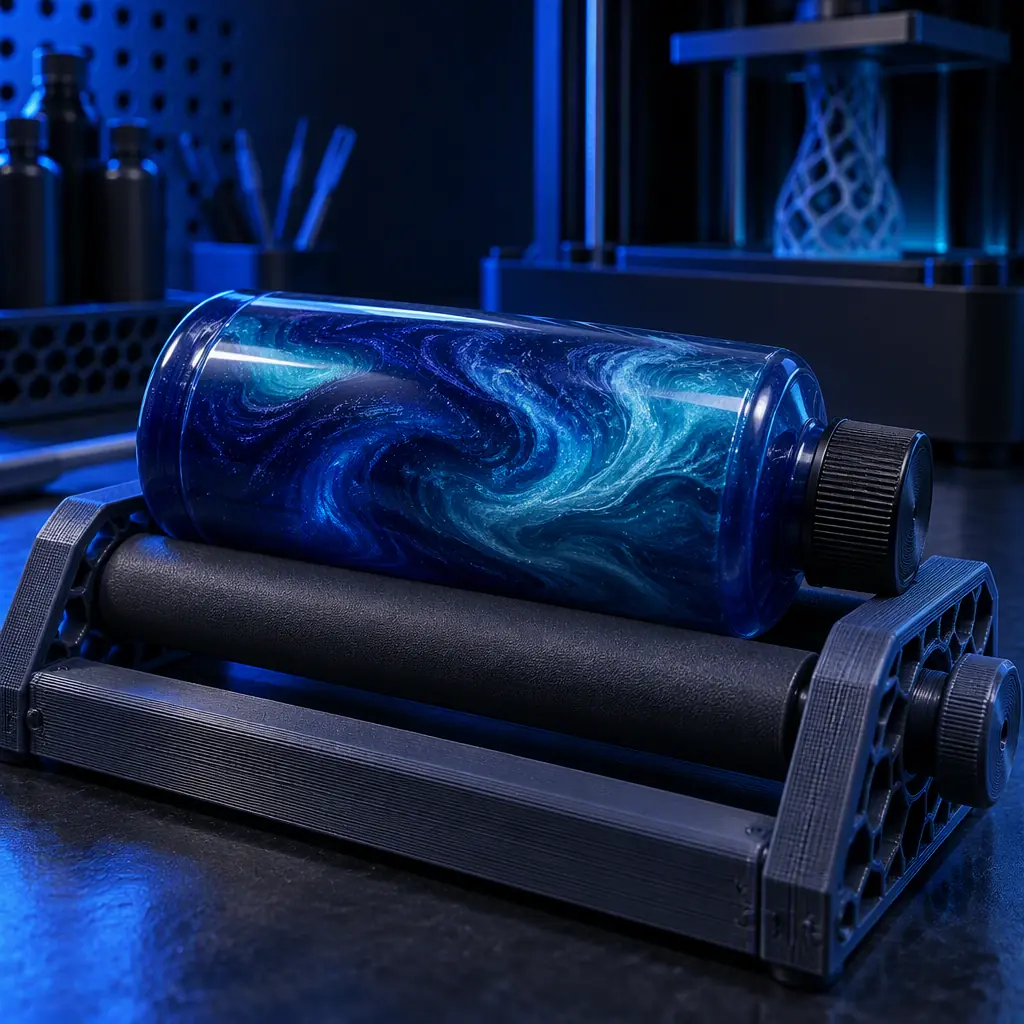
This is the most forgiving failure mode, because it is mechanical rather than chemical. Thorough mixing — not a gentle swirl but several minutes, ideally with a roller mixer or a magnetic stirrer, and long enough that no colour gradient remains anywhere in the bottle — restores the suspension. The trap is that a partially mixed bottle prints with visible colour banding and inconsistent cure depth, so the customer concludes the printer is at fault. Advising customers to shake before every pour is the single highest-value piece of resin documentation a distributor can ship.
Photo-initiator fatigue
The photo-initiator is the component that converts absorbed light into the radicals that drive curing. It is consumed during printing and degrades passively on exposure to any ultraviolet source, including the fluorescent lighting in a workshop and the small amount of UV that passes through some translucent bottles.
A resin that has lost initiator activity does not fail dramatically. It under-cures. Layers come out mechanically weaker than they should be, fine features lose definition, and the part passes visually while failing a functional test a week later. This is the most dangerous degradation mode because the failure appears downstream of the print, in a part that has already been handed to a customer.
Moisture uptake and viscosity creep
Many resins are mildly hygroscopic, and absorbed atmospheric moisture interferes with the cure chemistry while also altering viscosity. The customer-visible symptom is a resin that has thickened slightly, prints with more layer-line evidence, and needs longer exposure to hold dimensions. In a warm, humid warehouse this happens faster than the printed shelf life suggests.
Because the failure signatures overlap, the practical diagnostic is the bottle rather than the print. Separation, a colour gradient, a viscosity noticeably different from a fresh bottle of the same SKU, or a visible film at the surface are all reasons to quarantine a lot before it reaches a customer.
What you're looking for: Ask for the lot number and the date the bottle was opened before shipping a replacement part. If the lot is more than a year old, or the bottle has been open for several months in a warm room, test a fresh bottle of the same SKU on the same machine first. If the fresh bottle prints correctly, the fault is the stock, not the printer, and the fix costs a bottle rather than a warranty visit.
Shelf Life by Resin Class — a Working Table
Manufacturers publish a shelf life on the bottle, but that number assumes unopened stock held under ideal conditions. The table below reflects the practical working ranges distributors should plan around, stated in two parts because sealed and opened stock behave differently.
Two patterns in that table should drive purchasing. Water-washable and flexible formulations are the shortest-lived and should never be bought in depth, because the volume discount will not survive the write-off. Biocompatible and dental resins are regulated products where the lot date is a compliance matter, not a convenience — a distributor supplying a dental lab with out-of-window resin is creating a traceability problem the lab's own quality system will eventually surface.
Resin also ages faster in the printer's vat than in the bottle. An open vat exposed to ambient light, oxygen and repeated thermal cycling accumulates partly cured material and debris, and most operators should expect to filter and top up rather than top up indefinitely. The wash and cure bundle strategy covers the post-processing side of that workflow, and the resin troubleshooting guide covers the failure signatures when vat life has run out.
Storage Conditions That Measurably Extend Life
The published shelf life assumes conditions that most warehouses do not meet. Four controls account for most of the difference between a resin that is still good at the end of its window and one that is unusable halfway through it.
- Temperature stability. The ideal band for most photopolymers is roughly 15–25°C, and stability matters as much as the absolute value. A rack beside a roller door that swings between 8°C in winter and 35°C in summer subjects the stock to repeated thermal cycling, which accelerates both separation and viscosity drift. Air-conditioned or internal storage is worth more than any other single measure.
- Darkness. Resin should be stored in its original opaque bottle, in a closed cabinet, away from windows and away from the resin printer itself. A vat of resin sitting in front of a UV-lit window is curing slowly, all day, every day.
- Seal integrity and headspace. Once opened, the bottle should be resealed promptly with minimal headspace. Decanting into smaller opaque containers as a bottle empties is a cheap improvement, because it reduces the air volume the resin equilibrates against.
- Humidity control. Sustained relative humidity above roughly 60% is the threshold at which moisture uptake becomes a practical concern. A sealed cabinet with desiccant is sufficient for most warehouse environments.
None of those controls is expensive, and together they are the honest basis for the attach-sale discussed later in this guide: a storage solution that demonstrably pays for itself in preserved stock is an easy conversation with a customer who has already written off a shelf of separated bottles.
FIFO Rotation and Lot Tracking for Resin SKUs
Resin is the one consumable class where first-in-first-out is not a preference but a requirement, and it only works if the date information exists at the point stock is received.
Record four fields against every resin lot at goods-in: the manufacturer's production date, the manufacturer's best-before date, the goods-in date, and an internal shelf-life date calculated from whichever of the first two is earlier. Label the physical bottle with the internal date in a form a warehouse operative can read at a glance, because a customer-facing bottle with only a manufacturer's batch code is effectively undated.
Then enforce three physical rules in the pick path. New stock goes behind old stock on the same shelf, never in front of it. The pick face is dated, so an arriving customer order takes the oldest usable bottle rather than the most convenient one. And any lot within three months of its internal date moves to a quarantine or clearance zone rather than continuing to sit in the pick face, where it will eventually be sold at full price to a customer who will discover the problem for you.
Cycle counting matters more for resin than for any other category. A quarterly count that includes a date check catches an ageing lot while it can still be sold at a discount rather than written off entirely. This is also the discipline that feeds the wider SKU economics in our inventory and SKU planning guide, where resin sits alongside the shorter-life consumables that should be planned on demand rather than held in depth.
The Write-Off Arithmetic
Expired resin is a real cost, and the reason it gets ignored is that it usually arrives as a series of small events rather than one visible loss. Making the arithmetic explicit is what changes purchasing behaviour.
Consider a distributor holding 200 litres of resin across a range of SKUs. If the average landed cost is $18 per litre, the stock position is $3,600. Should 12% of it expire undiscovered over a year — a conservative figure for a warehouse without date discipline — the loss is $432, which is the entire gross margin on roughly 24 litres of resin sold at typical channel margins.
That comparison is the useful one, because it reframes the controlling action. Selling 24 additional litres to cover the write-off is a far harder task than implementing a date label and a pick-face rule. The cheapest way to improve resin margin is not to negotiate a better purchase price; it is to stop buying volume the channel cannot move before the material expires.
There is a second, less visible cost that does not appear in the shrinkage line at all: the support time consumed by failures caused by aged stock. A customer running separated resin reports banded, weak or dimensionally inconsistent parts, opens a ticket, tests a replacement bottle, and possibly receives a warranty visit before anyone thinks to ask for the lot date. Two or three of those per quarter across a customer base will cost more in engineer hours than the write-off did in material.
The arithmetic therefore points to a simple purchasing rule: buy resin to the demand the channel can demonstrate over the next two quarters, not to the discount tier that a supplier is offering on a larger drop. Volume pricing on a perishable SKU is only a discount if the stock clears inside its window.

Turning Storage Discipline Into an Attach-Sale Bundle
Everything above is also a product conversation. A customer who has just lost a shelf of separated resin is unusually receptive to buying the conditions that prevent a repeat, and the distributor is the only party in the chain positioned to make that argument credibly.
The bundle that works attaches three things to every resin reorder: a dark sealed storage cabinet sized to the customer's consumption, a roller mixer or stirrer appropriate to their volume, and a dated lot label system with a printed rotation policy. For customers running dental or jewellery workflows, add a documented storage log, because their own quality system will need one.
The attach rate is highest when the bundle is presented at the point of the first resin order rather than after a failure, and it pairs naturally with a consumables programme. Our consumables subscription guide covers the mechanics of recurring resin supply, and the storage bundle is what makes a subscription safe to offer: the customer receives resin on a schedule sized to their consumption, and stores it correctly between deliveries. Sizing the subscription correctly is the difference between a programme that builds loyalty and one that quietly builds the customer's own write-off problem.
None of the controls in this guide is technically difficult. What they require is that resin be treated as a dated, perishable, chemistry-sensitive product rather than as generic stock — from goods-in labelling through pick-face rotation to the storage hardware sold alongside it. The distributors who make that shift stop paying for resin twice.