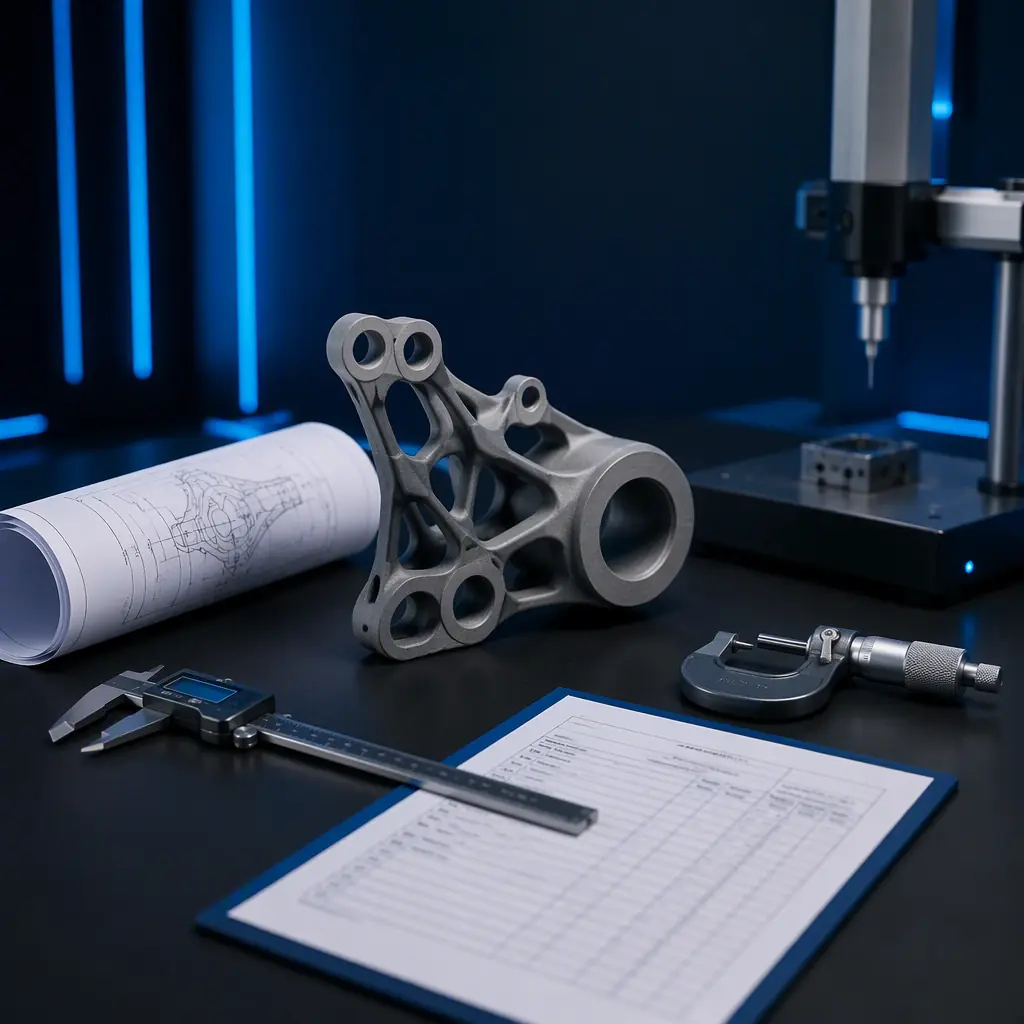
Approving a Printed Part Is a Procurement Decision, Not a Printing Decision
The question a buyer actually has to answer is not “can this part be printed?” Almost anything can be printed. The question is whether a printed component can be released into a product with the same confidence the buyer would place in a moulded or machined equivalent — and that is an approval question answered with evidence, not with a sample that looked good on a desk.
The gap is that the evidence a buyer needs is rarely volunteered. A supplier shows a printed part and quotes a price. What the buyer needs to see is the chain behind the part: what material was certified, what was tested, at what scale, on which orientation, with what spread, and what record will exist for the next order. When those five links are missing, the buyer is being asked to accept a part on trust, and a competent buyer will not.
This guide sets out the evidence package a buyer should demand before approving a printed part as an end-use component, the acceptance thresholds that make the decision objective, and the volume bands at which printed end-use parts genuinely compete with established processes.
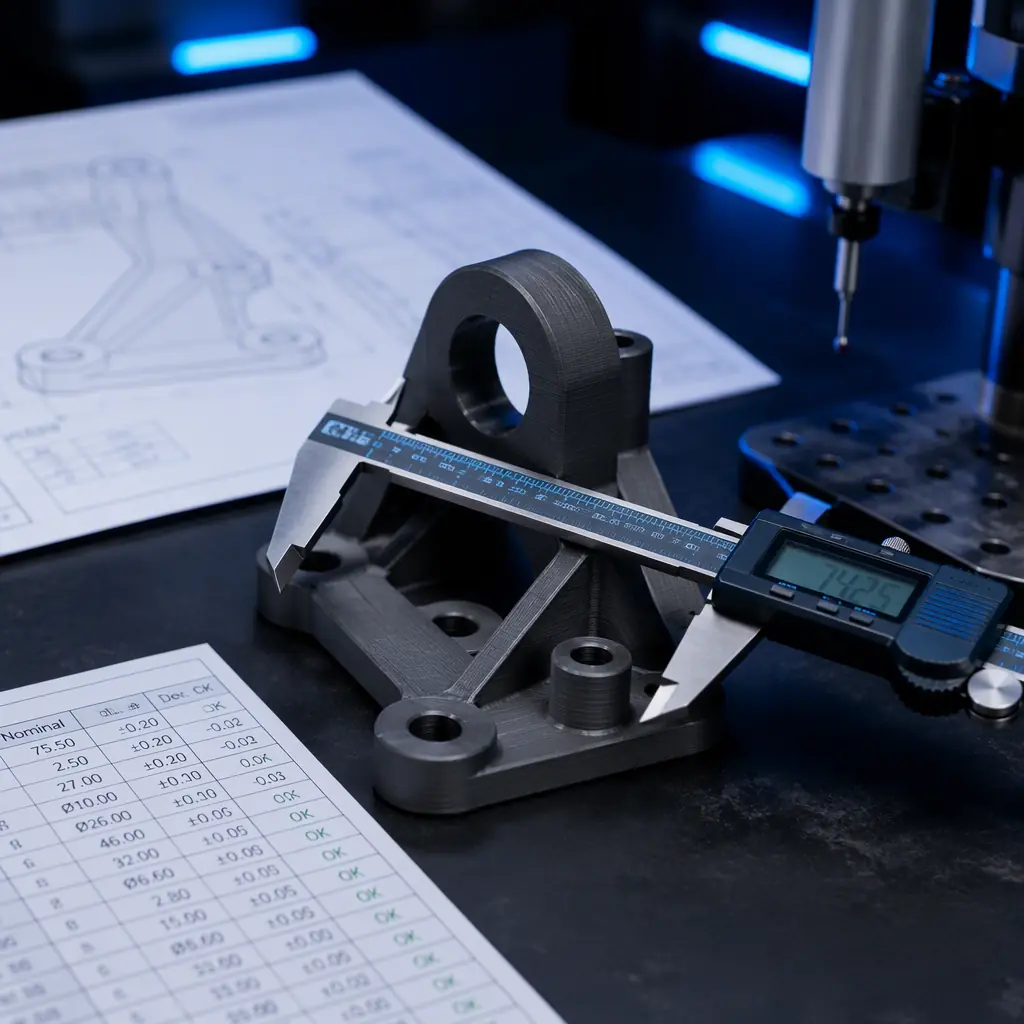
What an End-Use Part Has to Survive That a Prototype Does Not
A prototype is evaluated once, under supervision, in a controlled situation. An end-use component faces a different set of conditions over its service life, and the approval process has to test for those rather than for appearance.
- Sustained load. A prototype is handled; a production part carries a load continuously, often at temperature, sometimes for years. Creep and fatigue matter as much as yield strength.
- Environmental exposure. UV, humidity, solvents, cleaning agents and thermal cycling all degrade polymers in ways a benchtop evaluation never reveals.
- Assembly and installation forces. The highest stress a part usually experiences is the day it is installed, not the day it is used.
- Unit-to-unit consistency. A single good part is not evidence; the buyer is purchasing the distribution of outcomes across a production run.
- Traceability. When a field failure occurs, the buyer needs to know which material lot and which build the part came from.
This is precisely the difference between demonstrating a design and demonstrating a process, and it is the reason the qualification question sits next to the scale-up question. The transition mechanics are covered in our prototype to production scale-up guide; this guide is about the evidence that closes the approval.
The Five-Gate Qualification Protocol
The protocol below is ordered deliberately. Each gate is cheap relative to the one after it, so a part that cannot pass an early gate is rejected before expensive testing is funded. A supplier that can produce all five artifacts is a supplier who can be relied on for repeat orders.
Gate 1 — Material Certification
The first failure point is a supplier printing a certified-grade material that was never actually certified, or substituting a generic equivalent when the specified lot ran out. The buyer should require the material grade by name and the certificate of analysis for the lot used on the approval parts, and should confirm the grade is the one the test data refers to. A datasheet for a product family is not a certificate for the lot that made the part.
Gate 2 — Coupon Testing in the Correct Orientation
Material datasheets report properties from optimally oriented specimens. Printed parts do not have that luxury. For FDM, strength in the Z direction typically measures 40–60% of the XY value because the interlayer bond is the weak link. Powder-bed processes are far closer to isotropic, but not perfectly so: SLS PA12 is commonly in the region of 0.9× across orientations, and MJF typically 85–95%.
The coupon data has to be generated at the orientation the part will actually be built in, using the standard methods — ASTM D638 for tensile, D790 for flexural, D256 for impact, D695 for compressive. A supplier who can only offer vendor datasheets rather than tested coupons has not tested anything. The full set of applicable methods is covered in our mechanical testing guide, and where internal integrity rather than surface properties is the risk, the inspection options are set out in our non-destructive testing guide.

Gate 3 — Part-Level Testing
Coupon data establishes what the material can do; part testing establishes what the design does with it. The tests should mirror the service conditions the buyer identified in the first step, and they should include the installation event, because that is often the highest load the part will ever see.
- Functional test at the intended load, with the intended fixture, measuring deflection or failure mode.
- Overload test to identify the margin between working load and failure.
- Environmental exposure matched to service: thermal cycling, humidity soak, UV exposure, or chemical contact as applicable.
- Assembly simulation repeating the installation action enough times to expose a design that only survives being fitted once.
- Failure-mode review to confirm the part fails safely rather than suddenly, where that distinction matters.
Environmental and life testing is where printed parts most often fail a buyer's expectations, because degradation mechanisms that are negligible in a prototype appear over a service life. The test programmes that map to outdoor and corrosive service are covered in our salt spray and corrosion testing guide.
Gate 4 — Process Capability, Not a Single Good Part
This is the gate buyers most often skip and the one that most often predicts a field problem. A sample part proves the design; a capability run proves the process. The buyer should require a production-condition run — typically thirty units or more — with the critical dimensions measured on every unit and the spread compared against the drawing window.
What you're looking for: A supplier who cannot answer this has not run the capability study. A process spread comfortably inside the drawing window means volume is predictable; a spread comparable to the window means a known scrap fraction that has to be priced in; a spread wider than the window means the process cannot meet the drawing and the design or the process must change. The measurement methods behind this gate are covered in our part metrology guide.
Where the part is subject to a formal approval framework, capability evidence is the backbone of the submission. The elements of that framework are set out in our PPAP and production part approval guide.
Gate 5 — Traceability
Traceability is what makes the other four gates reproducible rather than anecdotal. The buyer should confirm that each delivered part can be traced to a material lot, a build record, a frozen process profile and the inspection data for its batch. Without it, a repeat order is a new development project, and a field failure is an unresolvable question.
- Material lot recorded per build, so a bad lot can be isolated.
- Process record frozen and version-controlled: geometry, orientation, parameters, post-processing, inspection plan.
- Inspection data retained per batch, not discarded after shipment.
- Change control so a supplier cannot quietly alter material, orientation or post-processing between orders.
Change control is the quiet one. An unannounced switch from one material lot to another, or a rotation of the build orientation to improve plate utilisation, can move a part's strength by tens of percent while every dimension still passes. The reason orientation is a controlled parameter rather than a manufacturing convenience is set out in our print orientation and build direction guide.
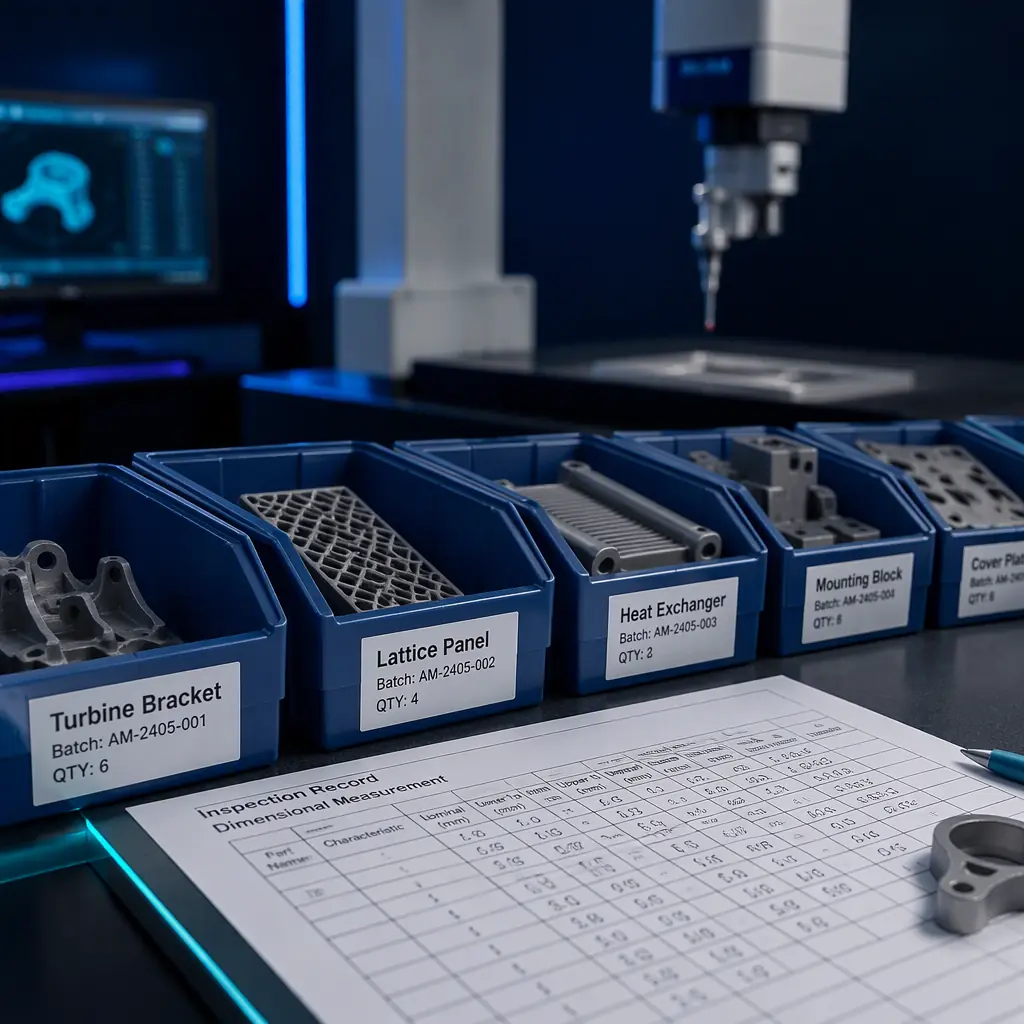
The Volume Bands Where Printed End-Use Parts Actually Win
Qualification is only half the decision. The other half is whether printing is the right process at the annual volume the buyer needs, and this is where marketing claims usually stop and arithmetic has to start.
The bands move with part complexity, not just volume. A part with internal channels, lattice structure or organic geometry that would require a complex tool can stay economic to print well past the nominal crossover, because the tooling cost that printing avoids is large. Conversely a simple bracket at 20,000 units is not a printed part. The comparison framework for that decision is covered in our CNC machining versus 3D printing guide and in more detail for the moulding case in our injection moulding versus 3D printing guide.
What you're looking for: Printing is insensitive to volume and highly tolerant of change; tooling is the reverse. If the buyer expects design revisions during the first year, the case for printing is stronger than the volume alone suggests. If the design is frozen and volumes are rising, the case for tooling strengthens with every order.
Precise3D on End-Use Part Qualification
At Precise3D we treat the qualification package as part of the product. Our engineering team supports the five gates directly: material documentation by lot, coupon testing at the build orientation, part-level testing against the customer's service conditions, a production-condition capability run before any volume commitment, and a retained process record that makes a repeat order reproducible rather than re-developed.
Our Pro X1 and OpenSource1 platforms deliver a 500×500×500 mm build volume at up to 600 mm/s with a 320°C hotend and a closed, heated chamber that keeps engineering polymers dense and dimensionally stable across long runs. Every unit ships with CE LVD (EN 62368-1:2014+A11:2017) and RoHS (EU 2015/863) documentation. Our 3,500 sqm Shenzhen production network applies a documented control plan at incoming and outgoing QC, which is what allows a qualification package to be issued rather than promised.

Reviewed by the Precise3D quality and engineering team. Strength ratios and volume bands given here are industry-typical figures provided for guidance and are not a specification or a quotation. Whether a printed component is suitable for a given application depends on the specific material, geometry, load case and regulatory context; qualification testing on the actual part remains the only basis for release.
Releasing a Printed Component?
Need a Qualification Package for an End-Use Printed Part?
Send us the drawing, the service conditions and the annual volume. We will run the coupon and capability work, document the process record and deliver the evidence set your approval process requires.