
Why “Weather-Resistant” Is Not a Specification
Every datasheet and every sales page uses the phrase; very few actually measure it. Weather resistance is an umbrella term covering UV radiation, temperature cycles, humidity and salt — and a material can be excellent at one and poor at another. Salt fog is the harshest of the common exposures because it attacks the layer interface, not just the surface.
- UV degrades the surface. Embrittlement, chalking and colour shift on the outer layer.
- Moisture swells and hydrolyses. Water ingress can soften a polymer and accelerate fatigue.
- Salt is the accelerant. In a salt-laden atmosphere, ionic attack concentrates at stress points and at layer lines.
So the honest position is not to call a part weather-resistant, but to say which test it passed and for how long. Choosing a material for a specific outdoor duty is the groundwork for this, covered in our outdoor weather-resistant printing guide.
How a 3D Printed Part Corrodes Differently
A polymer datasheet quotes a clean, moulded specimen. A printed part is a stack of bonded layers with surface roughness and internal porosity, and that structure changes how moisture gets in.
The consequence is that a part that looks fine on the surface can hold salt inside a layer groove and slowly degrade from within. That is precisely why a salt spray test on the actual printed geometry — not a smooth moulded coupon — is the meaningful data point. The surface finish that dominates moisture retention is discussed in our Ra/Rz surface roughness guide.

Tracking the Standard: ASTM B117
Neutral salt spray (or salt fog) is the workhorse corrosion test. ASTM B117 exposes specimens to a continuous 5% sodium chloride mist at 35°C and records the time to onset and to a defined failure criterion.
- 5% NaCl solution, atomised into a fine mist, at a controlled 35°C chamber temperature.
- Continuous exposure for a set duration — commonly 24h, 96h, 240h or 480h — matched to the duty.
- An acceptance criterion set in advance: no visible corrosion, no cracking, no dimensional change, no loss of a coating.
The result is reported as “no failure after X hours to ASTM B117”. A manufacturer that quotes a number without the standard and the hours is quoting nothing. Whether the parts are destined for a washdown, a marine install or a coastal site, the same discipline applies, and the marine story is detailed in our marine and boating guide.
What you're looking for: If there is no ASTM B117 or equivalent result on the actual printed geometry, you are quoting a claim you cannot defend. Run a salt-spray test on the real part — with its layer lines and roughness — and report the standard and the exposure time. A material that survives 24 hours but cracks at 240 is fine for a brief exposure and wrong for a coastal installation, and only a timed result tells you which.
Materials That Actually Survive a Salt-Fog Cabinet
Not all polymers are equal under salt fog. The choice is driven by chemistry: hydrophobic, chemically inert and low water-absorption materials win, while hygroscopic materials that soak up moisture degrade fastest.
Reinforced and engineering grades — PEEK, PEI and similar — are stronger but cost and print difficulty are higher, and the trade-off matters for a distributor deciding what to stock. Read more in our PEEK/PEI/PPSU industrial materials guide.
Coatings and Post-Processing That Close the Gap
For materials that are strong but not inherently salt-tolerant, the answer is a barrier coating or a surface treatment. This is where a printed part can be made to behave like a protected one.
- Epoxy or polyurethane seal coat. Fills the layer lines and capillary paths, dramatically slowing ingress.
- Electroplating / metalising. A metallic layer that shields the polymer and resists atmospheric corrosion.
- Vapour smoothing. Reduces roughness and closes surface porosity, though it does not add a chemical barrier.
- Powder coating / paint. A thick, inert top coat that protects against UV and moisture.
The metal-finish route is a genuine option for parts that need a corrosion barrier plus a premium appearance, and it is covered in our electroplating and metalising guide. Adhesives and sealants for bonding the same parts are their own topic in our adhesives, sealants and coating guide.

Reading the Result: Time to the Right Criterion
A salt spray report is only as useful as the criterion you set. The two most common mistakes are to report a pass without defining the failure, and to quote an exposure time that does not match the duty.
- Define “failure” up front. Is it first visible corrosion, a 2mm pit, a coating blister, or a measured property loss?
- Match the duration to the duty. A 24h result supports a sheltered part; a coastal or marine part usually needs 100-500h.
- Test the real part. Same layer orientation, same roughness, same coating as production — not an idealised coupon.
- Document the method. Standard, concentration, temperature, duration and criterion belong in the report.
When a part is destined for a cleanroom or a washdown, salt fog is not the only environmental question; ESD and chemical resistance matter too, and we cover that in our ESD control guide.

Building a Durability Claim You Can Defend
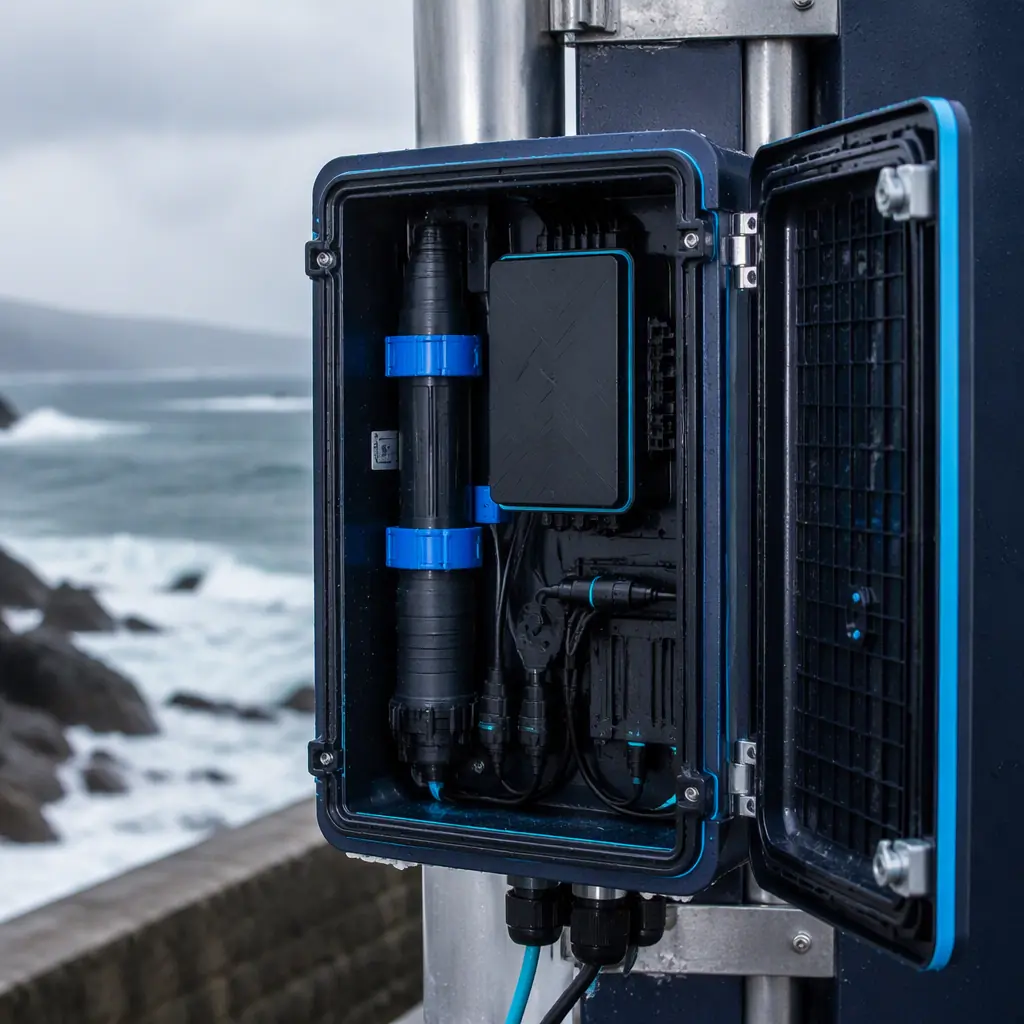
The commercial value of a salt spray test is that it turns a vague attribute into a verifiable statement. “Suitable for coastal exposure” is a hope; “no failure after 240h to ASTM B117 on the printed geometry” is a spec a buyer can evaluate, compare and trust.
- Quote the test, not the adjective. Standard + hours + criterion.
- Price the protection. A coating or a high-grade material is a cost you should charge for.
- Scope the claim. Running a part in plain outdoor air is not the same as running it in coastal salt fog.
- Keep the evidence. A dated test report on the actual part is what closes a defence when a field part is challenged.
How Precise3D Approaches Environmental Durability
At Precise3D we run a 3,500 sqm Shenzhen production network with a documented control plan at incoming and outgoing QC, and our process is built to produce a consistent surface and a dense internal structure that resists ingress. Calibration against an artifact, controlled printing conditions and first-article records support a claim that a part is built to survive, not just to look right.
Our OpenSource1 and Pro X1 platforms deliver a 500×500×500 mm build volume at up to 600 mm/s with a 320°C hotend and a closed, heated chamber that keeps engineering polymers dense and well-fused. Every unit ships with CE LVD (EN 62368-1:2014+A11:2017) and RoHS (EU 2015/863) documentation. Where a customer needs a coastal or washdown part, we can advise the right material and finish and supply the test evidence to back the durability claim.
Reviewed by the Precise3D quality and engineering team. Salt spray resistance is a measured property of the printed geometry under a defined standard; always quote the test method, concentration, exposure duration and the acceptance criterion, and match the duration to the intended duty. A material datasheet alone does not establish the durability of a printed part.
Back the Claim With a Test
Need a Part Rated for Salt Spray & Coastal Duty?
The right material, the right finish, and the ASTM B117 evidence to back it. Production on demand for distributors and OEMs who need a part that survives the environment.