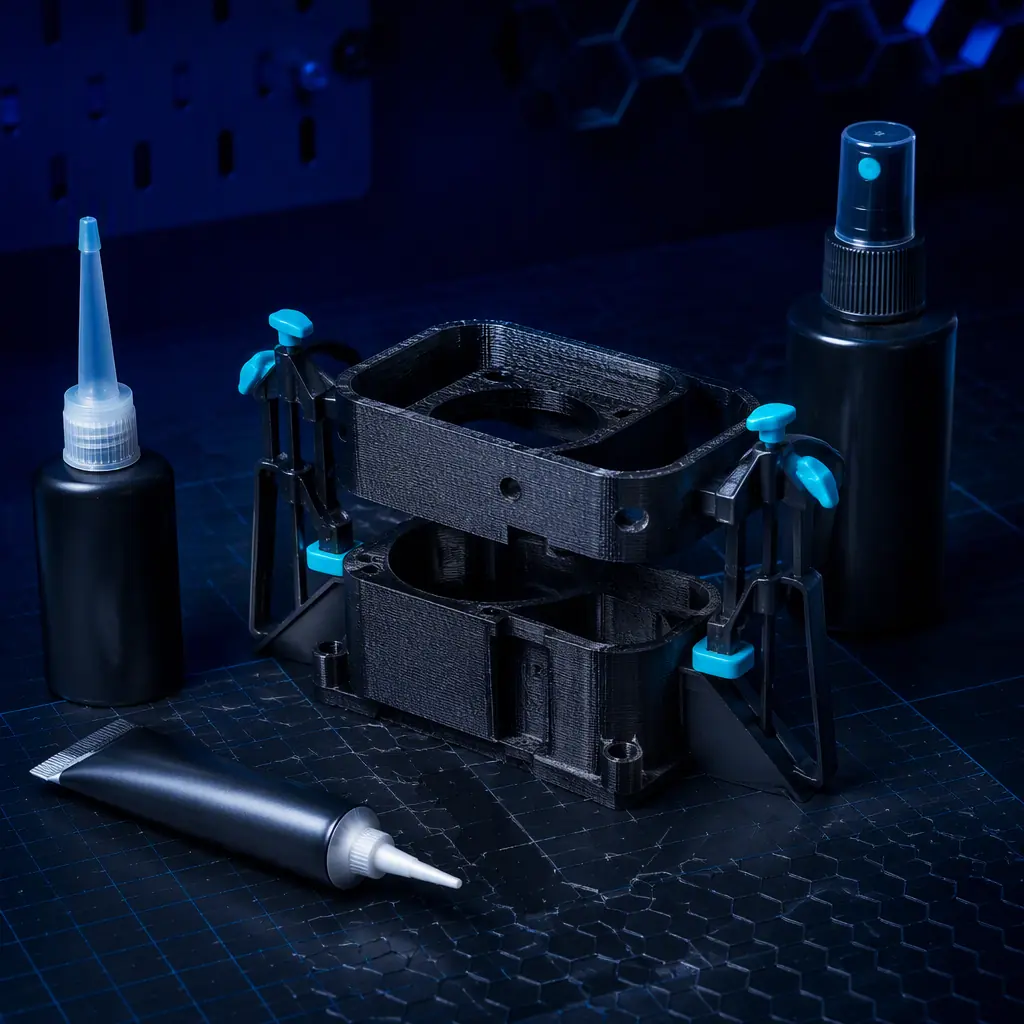
The Finishing Step Is the Recurring Sale
A customer who buys one printer needs a handful of rolls of filament. The same customer who builds an assembly out of three printed housings needs adhesive, a gap-filling sealant and a conformal coating, and needs them again on every batch. The finishing category is where the margin is: the consumables that join, seal and protect printed parts are small, high-margin, repeat-purchase items. But they only ring up if the shop actually knows how to choose and apply them. For the print-quality preparation that comes before finishing, our post-processing & finishing guide is the essential companion read.
Choosing the Bond: Adhesive Chemistry vs Printed Material
The strongest joint is the one matched to the printed substrate and the load it carries. Two-part epoxies give the best structural strength and the longest open time; cyanoacrylates (instant glue) bond fast but are brittle and thin; polyurethane adhesives stay flexible and grip tough-to-bond materials; hot-melt is quick but low-strength; threaded/riveted mechanical joints avoid adhesive entirely for a serviceable, high-load joint. Because printed polymer surface energy is low and layer lines add roughness, surface preparation matters more than the chemistry.
For the mechanical-joint alternative and the fasteners that carry real load, our heat-set inserts & threaded fasteners guide covers the bolt-in route.
Surface Preparation: Where Most Bonds Fail
A printed part wants to shed the adhesive. Printed polymer is low-energy and the layer lines hold dust and release residue. The fix is always the same: abrade the bond area (120–220 grit), degrease, and, where the application justifies it, treat with a primer, a flame treatment, or a low-pressure plasma to raise surface energy. A clean, roughened bond line can lift a lap-shear strength number dramatically versus an unprepared one, and it is the step most small shops skip. For the build-side rules that affect how a surface prints, our design-for-AM rules guide is the read.
Sealants: Filling the Gap the Part Does Not Need
A sealant is a gap-filling material applied to stop a leak, not to carry structural load. Printed parts can be porous on the shell or at layer boundaries, and a two-piece printed enclosure needs a gasket, RTV or a bead of flexible sealant at the parting line. Selecting the sealant comes down to what it contacts: silicone RTV for temperature and weather, a polyurethane or MS for a flexible watertight seal, a gasket sheet or O-ring for a reusable face seal. For the wet/outdoor side of printed parts, our outdoor & weather-resistant printing guide is the relevant read.
Conformal Coatings: Protecting the Electronics Inside
Where a printed enclosure carries a PCB, a conformal coating protects the board from moisture, dust, humidity and corrosion. Acrylic coatings are cheap and easy to strip; silicone offers the widest temperature range and moisture protection; urethane is tough and abrasion-resistant; parylene is a vapour-deposited, pinhole-free film for the highest-value boards. Coating thickness typically lands between 20 and 75 µm, and the board is usually masked first at connectors and test points. For the printed electronics context, our electronics manufacturing & SMT guide sits alongside.
What you're looking for: A load-bearing joint on PA/PETG/PC → a 2-part structural epoxy with abraded, degreased surface; a printed enclosure that must hold a fluid or keep weather out → a flexible PU/MS or RTV gap seal at the parting line; an electronics cavity → a conformal coating at 25–75 µm with connectors masked. Match the material system to the environment it will actually see.
Distributor Economics: The Finishing Account
Bonding-and-finishing consumables attach to a printer sale at high margin and high frequency. An account starts with a printer and a modest consumables bundle, then grows into an adhesives, sealants and coatings line that repeats on every production batch. For the surrounding hardware bundle and the account model, our consumables & accessories bundling and our post-processing & finishing guide are the reads.
The entry plan:
(1) Stock a bonding-and-finishing starter bundle: a structural 2-part epoxy, a flexible gap sealant, a conformal coating and the abrasion/degrease supplies. (2) Carry a bath unit or a vented spray station for the coating step. (3) Pitch the assembly customer on the finished product. A printed enclosure that is bonded, sealed and coated to survive its end-use. (4) Convert the one-off into a standing finishing consumables order. For the wider tooling angle across a production floor, our manufacturing tooling guide rounds out the spread.
Bonding, sealing and coating turn a printed part into a product, and they are the recurring, high-margin half of an additive sale. At Precise3D, our chamber-heated, hardened-nozzle FDM platform delivers strong, precise parts made for the finishing workstream, build the print, close the joint, seal the part, protect the board.
Reviewed by the Precise3D engineering & OEM team. Compliance files that accompany the catalog are auditable at the certification register.
Enter This Vertical
Ready to Supply the Finishing Bundle to This Market?
Join our network of global distributor network. Chamber-heated, hardened-nozzle printers plus a bonding-and-finishing consumables bundle, adhesives, sealants and conformal coatings engineered for printed parts. Everything you need to open the finishing account.