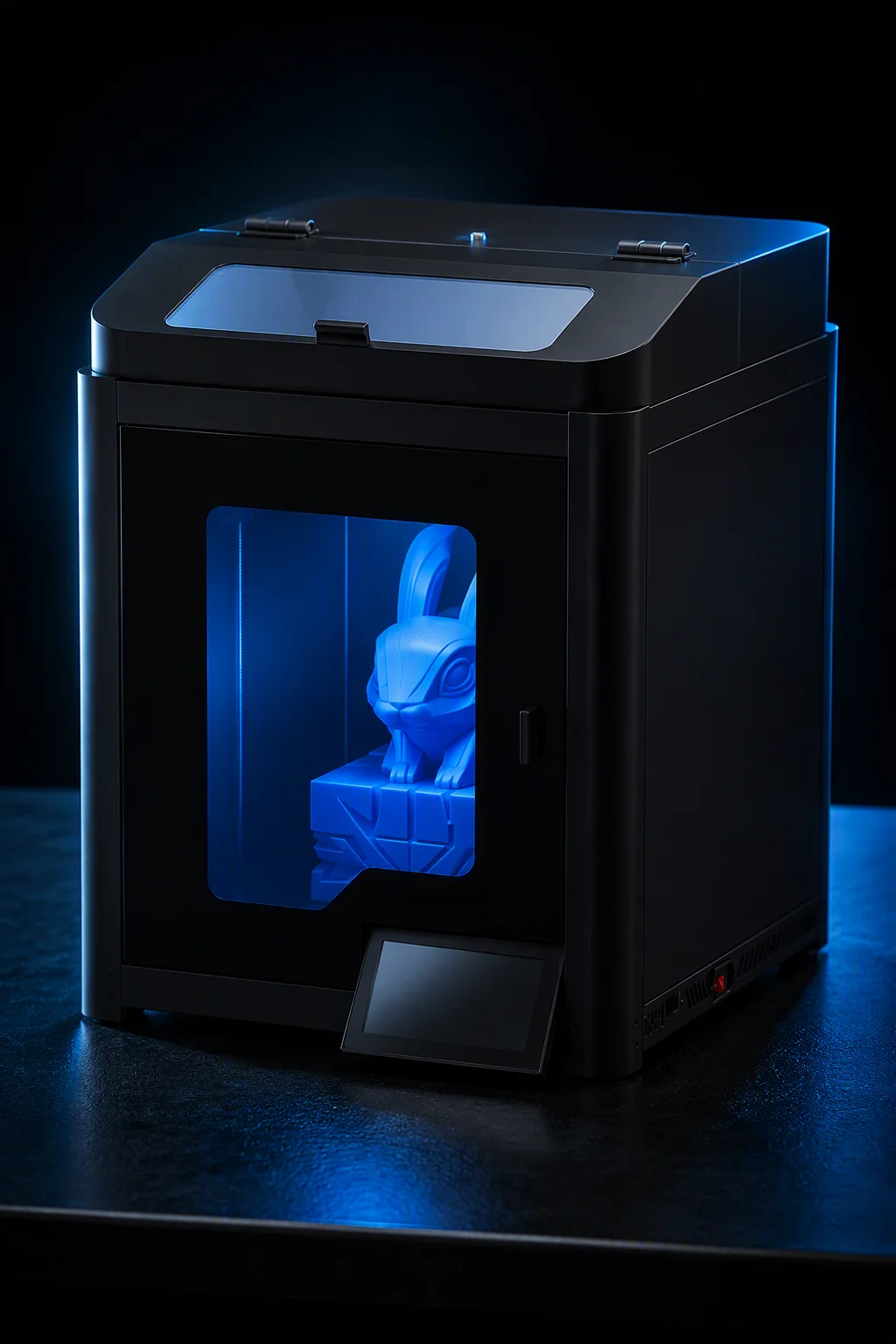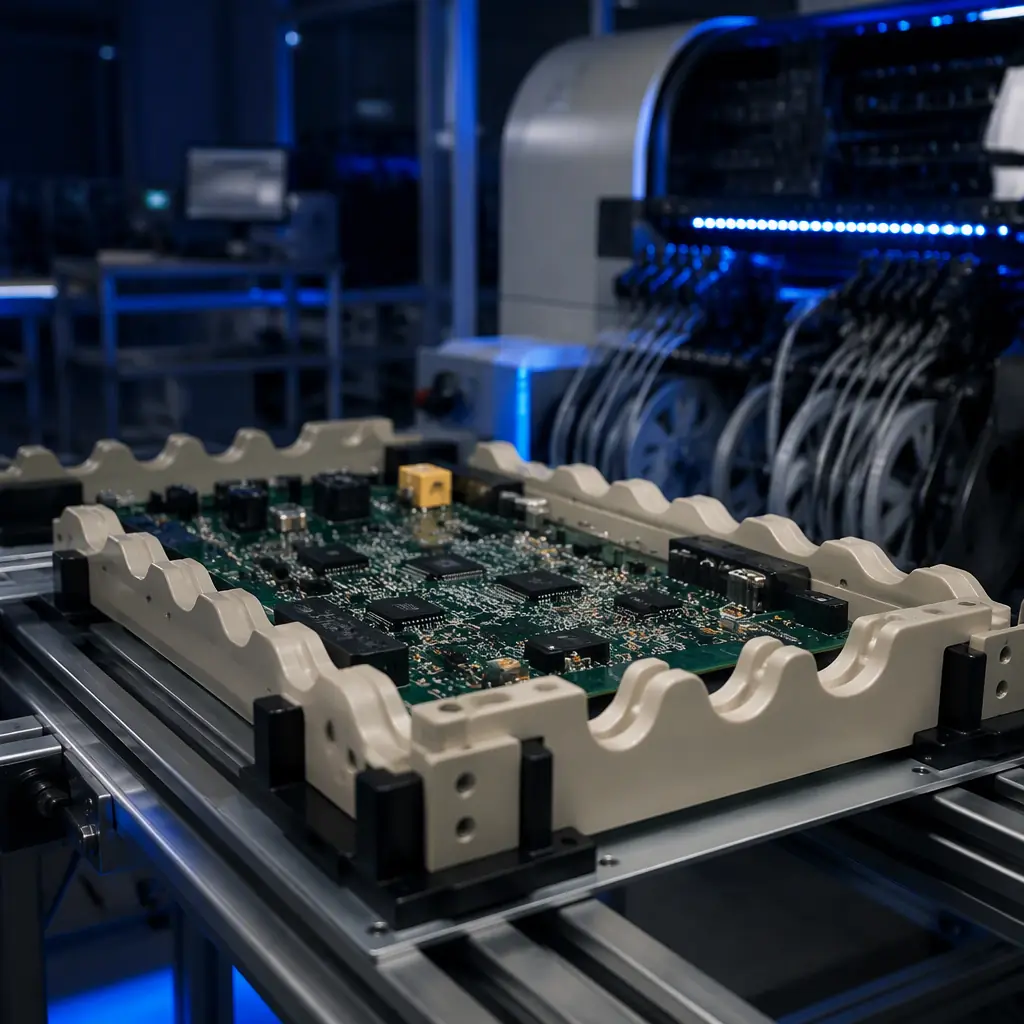
An EMS (electronics manufacturing services) plant in Guadalajara was spending $14,000 per year on machined aluminum wave-solder pallets, waiting 3-4 weeks per revision. It switched to in-house printed pallets in glass-filled PPS: 41 pallets printed for $2,300 in material, each revision turned around in 48 hours instead of a month, and the tooling engineer now iterates pallet designs weekly instead of quarterly. Electronics manufacturing — SMT lines, wave and selective soldering, PCB handling, and test fixtures — is a tooling-intensive industry where almost every fixture is custom, low-volume, and constantly revised. For 3D printer distributors, it is one of the highest-frequency industrial buying verticals in existence.
Why Electronics Manufacturing Is a Tooling-Hungry Vertical
Three structural facts make EMS and contract manufacturers exceptional 3D printing customers. First, tooling volume: a single SMT line runs 20-60 fixtures at any time (solder pallets, stencil fixtures, press-fit tooling, test nests), and every new product introduction (NPI) generates a new set. A mid-size EMS runs 100-300 NPIs per year. Second, revision velocity: PCB designs change weekly during NPI, and machined tooling that costs $400-1,500 and takes 3-4 weeks simply cannot keep up — printed tooling turns in 1-3 days. Third, material certification matters: pallets must survive 260°C wave-solder exposure and ESD requirements govern everything that touches boards. A distributor who understands these constraints sells into a perpetual, design-locked relationship. For the wider custom-manufacturing economics, see our manufacturing tooling guide.
The Application Clusters That Buy
The buyers are tooling engineers, process engineers, and NPI managers. The six clusters that actually purchase:
1. Wave and selective solder pallets. The flagship application. Pallets mask and support PCBs through the solder wave, protecting bottom-side components and edge connectors. They must survive repeated 260°C solder exposure and 2,000-10,000 thermal cycles. Glass-filled PPS and PPSU are the proven materials; a single line keeps 10-30 pallets in rotation, and each revision is a new order. Material longevity data lives in our PEEK/PEI/PPSU industrial materials guide.
2. ESD-safe PCB handling. Magazine racks, transfer trays, board separators, and in-process carriers. These must be static-dissipative (surface resistivity 10^6-10^9 Ω/sq), and carbon-loaded ESD PETG or ABS prints this range natively. A 10-line EMS cycles thousands of trays; replacement demand is constant because trays get dropped, warped, and contaminated.
3. Reflow and press-fit fixtures. Reflow oven carriers, heat-sink placement fixtures, press-fit tooling for compliant-pin connectors, and BGA rework templates. These sit at the boundary of thermal and mechanical duty — high-temp resin or PPS handles the oven side, glass-filled nylon the press-fit side. For the fixture-design process around precision placement, see our rapid prototyping guide.
4. Custom pick-and-place tooling. Vacuum nozzle adapters, feeder body repairs, tape-cover peelers, and fiducial alignment fixtures. These are small, cheap to print, and endlessly customized to specific component types — a distributor's easiest entry point into an account.
5. Test and inspection fixtures. ICT (in-circuit test) nest housings, probe holder blocks, AOI (automated optical inspection) board locators, and functional-test brackets. Test engineers iterate constantly; printed fixtures collapse the iteration cycle from weeks to days. The dimensional accuracy requirements for probe alignment are covered in our tolerances & dimensional accuracy guide.
6. Conformal coating and cleaning masks. Masks that protect specific board areas during conformal coating application and wash fixtures for cleaning processes. Chemical resistance to solvents and coating materials is the deciding property — PP and PPSU excel here.
Materials That Survive the Solder Line
Electronics manufacturing is the most material-strict vertical in 3D printing. The map distributors should stock:
Two traps: (1) "high-temp filament" is not the same as solder-line material — standard PC and ABS warp or delaminate at wave-solder temperatures, so pallets require PPS/PPSU-class materials, not consumer grades; (2) ESD claims must be verified by surface-resistivity measurement (per ANSI/ESD S11.11), not assumed from the spool label. For the compliance and documentation expectations of industrial buyers, see our certification & compliance guide.
Economics: Machined Tooling vs Printed Tooling
The comparison that closes EMS accounts:
For the distributor, EMS accounts are attractive because the purchase is systemic: once a tooling engineer validates printed PPS pallets, every future NPI and revision flows through the same material and printer supply. A mid-size EMS can consume $8,000-25,000/year in high-temp filament and tooling-grade resin alone. The ROI case for pitching this is in our TCO/ROI calculator guide.
The Distributor Playbook: Entering Electronics Manufacturing
The winning playbook has five moves:
1. Anchor on solder pallets, expand from there. The pallet application is the credibility builder — it proves you understand 260°C, thermal cycling, and process chemistry. Win the pallet cluster first, then expand into handling, test, and tooling.
2. Stock PPS and PPSU with data. Keep pallet-grade material in stock with published thermal-cycling and chemical-resistance data. The tooling engineer's first question is "how many cycles will it survive?" — have the answer printed. Our engineering filaments guide has the comparison data.
3. Offer a pallet-design service. EMS tooling engineers are overworked; a design-and-print service that turns a board outline into a validated pallet in 3 days is a differentiator worth $200-600/job. The service model that supports this is in our after-sales support strategy.
4. Sell the revision-speed story. NPI schedules are the pain point: machined tooling blocks the NPI critical path, printed tooling unblocks it. Lead every demo with the "3-week quote vs 48-hour print" comparison and a real pallet in hand.
5. Bundle a thermal-validation package. Offer documented print profiles plus thermal-cycling test coupons with each pallet-grade spool. It justifies premium pricing ($180-260/kg vs $60-90 for consumer grades) and makes switching costly. For the quality-control mindset of EMS buyers, see our factory audit & QC checklist.
Common Pitfalls in Electronics Manufacturing
Five mistakes account for most failed EMS initiatives: (1) selling consumer-grade materials for solder-line duty — one melted pallet on a live wave line is a $50,000 process incident and the account is gone; (2) ignoring ESD verification — unverified "ESD" filament fails audit and damages boards; (3) skipping thermal-cycling data — EMS buyers will ask for cycle-life evidence, and a distributor without it loses to one with it; (4) undersizing pallet frames — solder pallets flex under board weight and heat, so frame design (3-4 mm walls, ribbing) matters as much as material; and (5) treating revisions as losses — pallet revisions are the recurring-revenue engine, not a cost to minimize. For the surface-finish and post-processing considerations of tooling parts, see our post-processing & finishing guide.
Getting Started: The First 90 Days
A 90-day entry plan: Month 1 — stock pallet-grade PPS/PPSU and ESD PETG with published data sheets, and identify 8-12 target accounts (regional EMS/CM plants, box-builders, PCB assembly shops) within a 3-hour drive. Month 2 — run two pilot pallet projects at cost-plus-10% to build thermal-cycle evidence and a photo library; document cycle counts and surface-resistivity measurements. Month 3 — convert pilots to full accounts with design-service retainers, publish one case study with measured numbers ("41 pallets in year one; pallet lead time 3 weeks → 48 hours"), and begin exhibiting at regional SMTA/IPC events where tooling engineers gather. If you already serve PCB or component markets, our packaging industry guide shows how EOAT and gripper demand follows the same tooling-driven buying pattern.
Reviewed by the Precise3D engineering & OEM team. Compliance files that accompany the catalog are auditable at the certification register.
Enter Electronics Manufacturing
Ready to Supply SMT Tooling?
Get wholesale pricing on industrial printers, pallet-grade PPS/PPSU and ESD-safe material lines with thermal-cycling data, and the design-service playbook that wins EMS accounts.