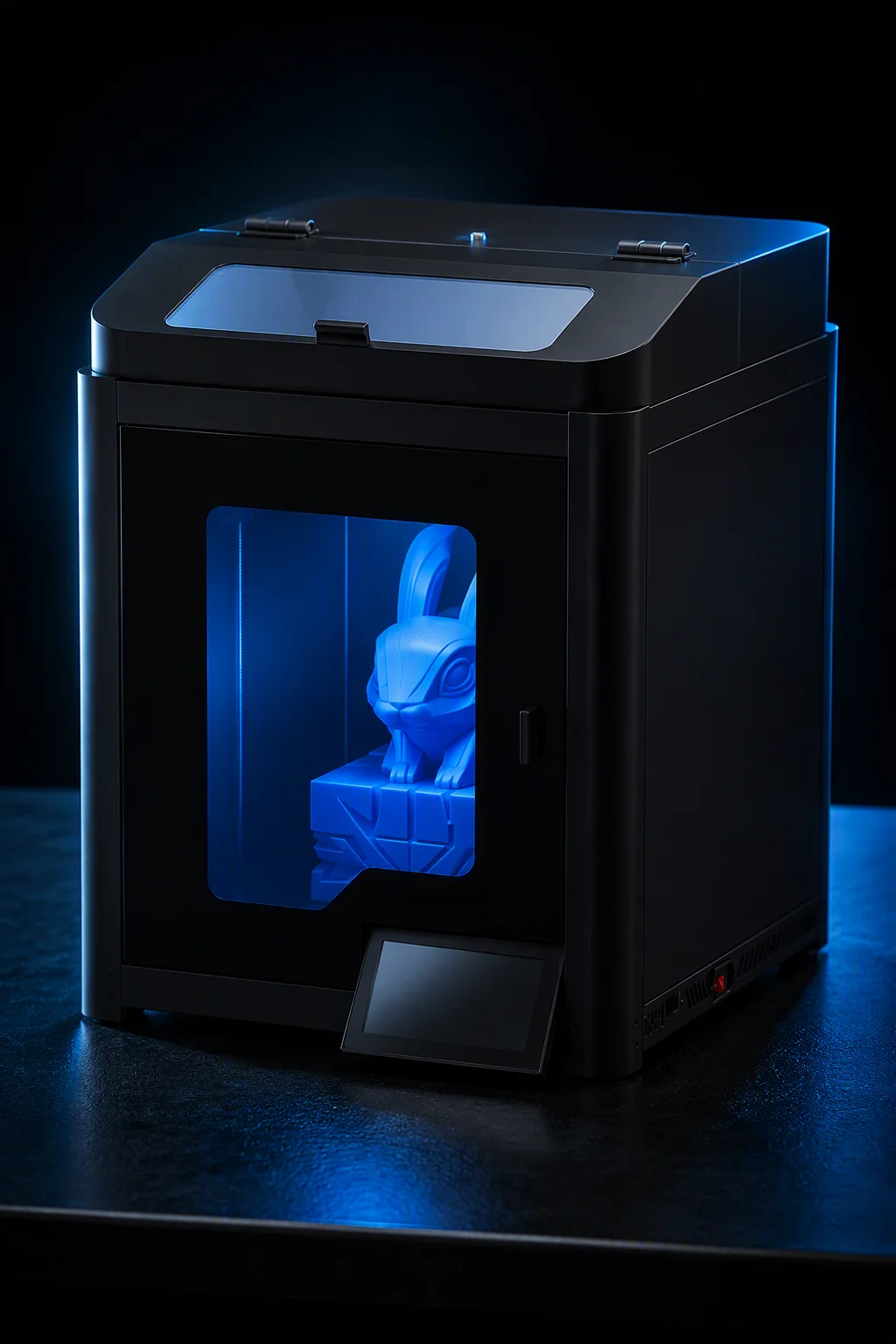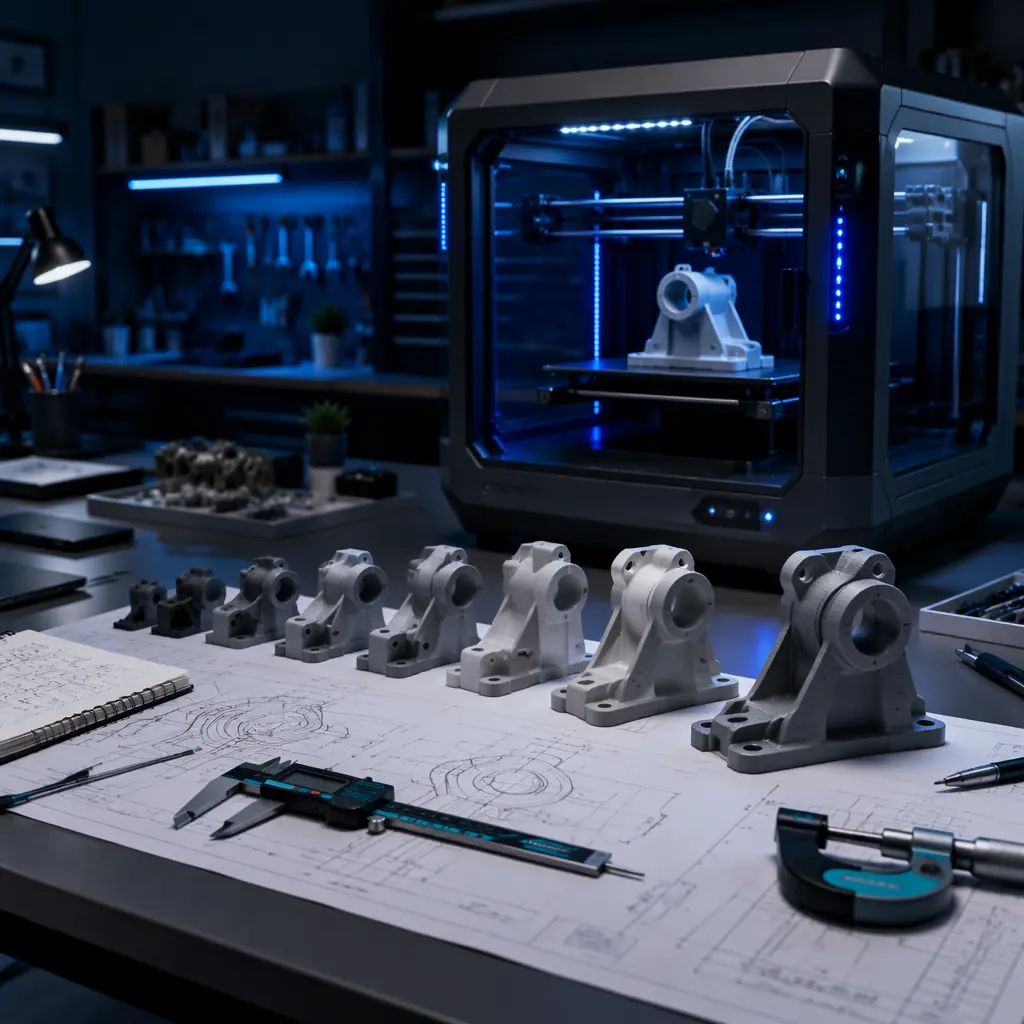
R&D departments are the most overlooked customer segment in consumer 3D printer distribution. The industry narrative focuses on hobbyists, educators, and print farm operators — but engineering teams inside manufacturing companies represent a higher-value, higher-volume, lower-churn opportunity that most distributors never pursue. A mid-sized automotive supplier with 12 mechanical engineers runs 3–5 prototype iterations per week. At an outsourced CNC cost of $1,200 per iteration, that department spends $14,400–$24,000 per month on prototypes. A single $699 enclosed-coreXY printer with engineering-grade filament capability replaces 70% of those iterations at a payback period of under three weeks.
The challenge is not the technology — most R&D engineers already know what a 3D printer can do. The challenge is that procurement departments treat 3D printers as consumer toys, not as engineering tools that replace a five-figure monthly outsourcing line item. This guide provides the business case, technical benchmarks, and vertical-specific objection handling that distributors need to close R&D accounts.
The ROI Argument That Procurement Understands
Procurement managers do not evaluate 3D printers. They evaluate line items. Your job is to frame the printer as a cost-reduction tool that replaces an existing expense — outsourced prototyping — not as a new equipment purchase competing for budget against CNC machines and injection molding tools.
The numbers are so stark that the sale should be easy — but it is not, because procurement is not the user. The engineer who wants a printer cannot sign a PO, and the procurement manager who signs POs does not understand why a "toy" costs $899. Your pitch must bridge this gap with a one-page savings analysis that procurement can drop into their own internal justification workflow. For the complete financial modeling toolkit, see our TCO and ROI calculator guide.
The Print-Quality Benchmarks R&D Engineers Actually Check
R&D engineers evaluate 3D printers differently than consumers. They do not care about Benchy print speed or multi-color capability. They care about three things: dimensional accuracy, material properties of printed parts versus injection-molded equivalents, and surface finish sufficient for functional testing. If your demo cannot speak to these three metrics with real data, you will lose the room.
Dimensional accuracy.
The standard test: print a 20mm calibration cube, measure X/Y/Z dimensions with digital calipers, report deviation. Consumer-grade printers typically deliver ±0.1–0.2mm on XY and ±0.05–0.1mm on Z. For most mechanical prototyping — mounting brackets, enclosure components, jig bodies — this is more than adequate. The moment you claim "industrial precision," the engineer will ask for a CMM report. Do not overpromise. For printers in the $500–$1,000 range, the honest capability is ±0.15mm on XY, ±0.05mm on Z after proper calibration. If the application requires ±0.05mm or better across all axes, the customer needs a $3,000+ printer, not a consumer-grade machine — and a honest distributor who says so earns more trust than one who overpromises.
Material properties.
The most common procurement objection is: "3D printed parts are weaker than machined parts." The technically accurate response: FDM parts achieve 60–85% of injection-molded strength in XY orientation, with Z-axis strength at 40–60% due to interlayer adhesion. For functional prototyping — fit checks, form validation, limited mechanical testing — this is sufficient. For end-use load-bearing parts, it is not. The distributor who explains this honestly, with numbers, gets asked to quote a higher-end printer for the remaining 15% of use cases. The distributor who says "it is just as strong" loses all credibility when the first Z-axis layer delamination happens. For the complete material selection framework, our engineering filaments guide covers mechanical properties across PLA, PETG, ABS, nylon, and PC.
Vertical-Specific Pitch Decks
R&D teams in different industries have fundamentally different prototyping workflows and procurement triggers. A one-size-fits-all pitch fails because an automotive supplier's prototype looks nothing like a medical device startup's prototype.
Automotive R&D
Automotive suppliers prototype jigs, fixtures, mounting brackets, connector housings, and airflow ducts. The winning pitch: "Your CNC shop charges $1,800 and takes 8 days for a bracket that our $899 printer produces overnight for $3.50. Here are five brackets we printed from your STEP file — measure them yourself." Bring printed samples of their actual parts to the meeting. Nothing closes an automotive R&D deal faster than the engineer holding a bracket they designed 18 hours ago, checking fit on the actual assembly, and realizing they could have iterated three more times before the CNC quote even arrived. For more on automotive-specific applications, see our automotive 3D printing guide.
Consumer Electronics R&D
Consumer electronics teams prototype enclosures, button mechanisms, PCB mounting frames, and wearable device housings. Their key requirements are fine detail resolution (small features on handheld devices), multiple material options for different use cases (rigid PLA for enclosures, flexible TPU for grips and buttons), and surface finish sufficient for stakeholder reviews. The winning pitch: "Print your enclosure design at 9 PM, have it on the CMO's desk for the 10 AM review tomorrow. Three iterations this week instead of one." Consumer electronics R&D values speed above all else — their competitive advantage is time-to-market, and a desktop 3D printer compresses the prototyping phase from weeks to hours.
Medical Device R&D
Medical device R&D teams prototype surgical instrument handles, diagnostic device housings, and patient-specific anatomical models from CT/MRI data. Requirements are more stringent: biocompatible materials (or at least sterilizable for non-patient-contact testing), documentation trail for FDA submission, and surface finish that does not harbor bacteria in crevices. The winning pitch for non-implantable device prototyping: "Iterate your handle ergonomics five times this week with real surgeons handling real prototypes — not CAD screenshots. Each iteration costs $4 and prints overnight." Medical R&D teams value iteration count because surgeon feedback after handling a physical prototype is qualitatively different from feedback on a rendering. For the full medical applications landscape, see our medical 3D printing guide.
The R&D Account Sales Cycle
R&D accounts follow a different sales cycle than consumer or education accounts. The timeline is longer, the stakeholders are more technical, and the close depends on a successful trial, not a compelling demo.
The sample print (Stage 2) is the fulcrum of the entire deal. If the engineer holds their own part, printed to dimension, looking professional — they become your internal champion. Procurement objections about "consumer-grade quality" evaporate when the engineering lead walks into the meeting holding a functional prototype they printed themselves. For the complete B2B sales methodology, see our B2B sales demo playbook.
Handling the Three R&D Procurement Objections
"We already have a prototyping vendor." Response: "And they do great work for final-stage prototypes that need CNC surface finish. But how many early-stage iterations are you NOT doing because each one costs $1,200 and takes a week? Our customers typically keep their CNC vendor for final validation but move 70% of early-stage form-and-fit iterations in-house. The CNC vendor gets better-prepared designs with fewer revision cycles, and your team gets to iterate daily instead of weekly. Both vendors win."
"Our engineers need professional-grade equipment." Response: "Let us print your most demanding part. You specify the material, the tolerances, and the surface finish requirement. If the printed part does not meet your spec, we shake hands and I leave. If it does, we talk about putting a trial unit in your lab. No cost, no commitment." This objection is almost always surmountable with a sample print — the skepticism is about consumer 3D printing, not about your specific printer, and a physical part changes the conversation.
"3D printed parts are not strong enough for functional testing." Response: "For end-use load-bearing parts, you are right — injection molding or CNC is the right answer. But what percentage of your prototypes are load-bearing versus form-and-fit? Our customers report that 60–80% of their prototyping volume is dimensional validation, assembly fit checks, and stakeholder reviews — all of which a printed part handles perfectly at 0.3% of the cost. For the 20% that truly need machined strength, keep your CNC vendor. For the 80% that just need to exist in physical form by tomorrow morning, use a 3D printer."
Reviewed by the Precise3D engineering & OEM team. Compliance files that accompany the catalog are auditable at the certification register.
Partner With Precise3D
Get the R&D Account Sales Kit
Every Precise3D distributor receives our R&D vertical pitch decks for automotive, electronics, and medical device accounts — including the one-page savings analysis template, sample part print guidelines, and the trial unit program structure. Start closing engineering accounts this quarter.