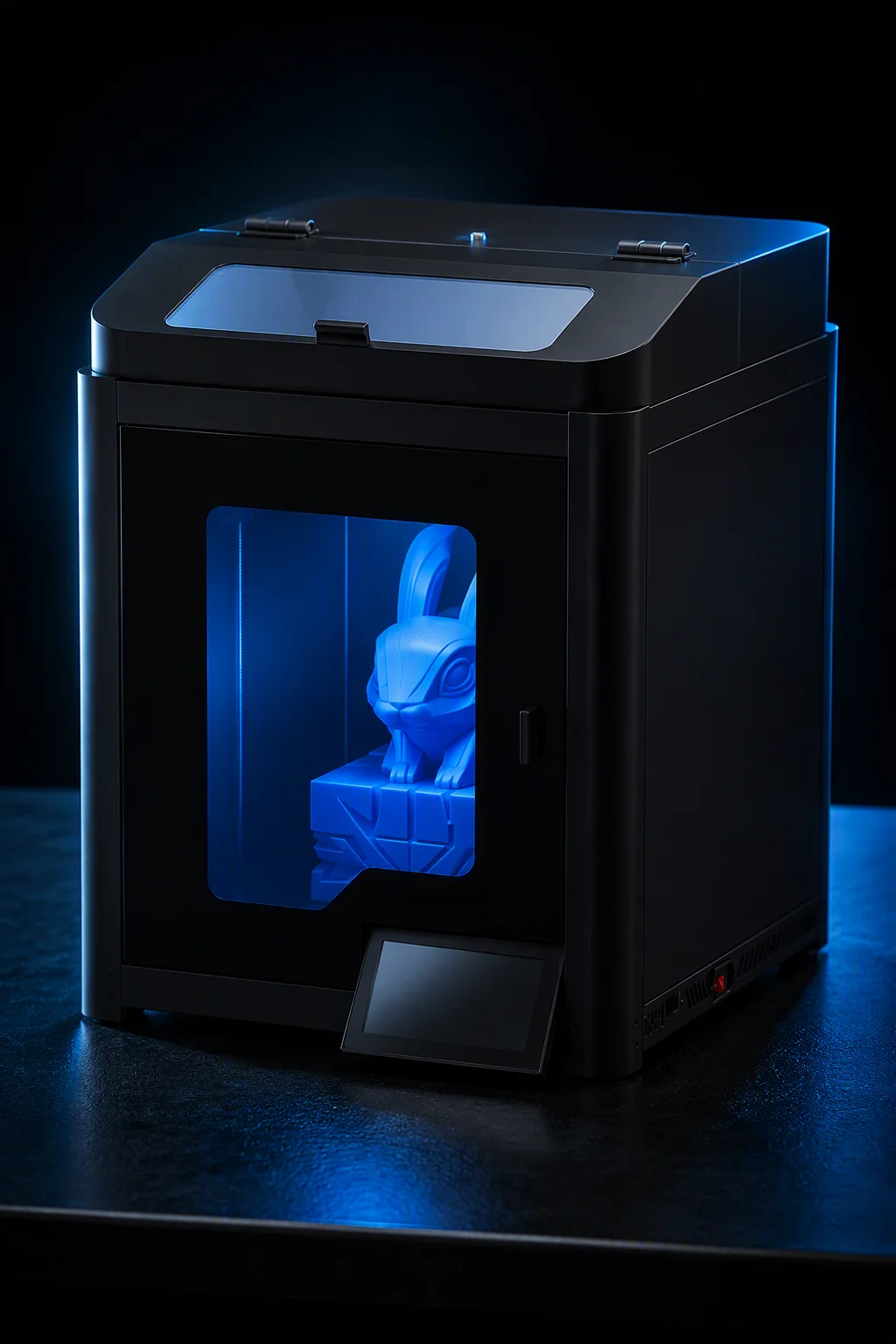
A beverage bottler in Texas changed its bottle design in 2025 and discovered its case packer's grippers could not handle the new shoulder profile. The OEM quoted $18,000 and 9 weeks for new end-of-arm tooling. A local distributor printed TPU-lined vacuum grippers matched to the new bottle in four days for $1,100 total — and the line never stopped. That single job led to a $46,000/year account covering grippers, star wheel inserts, and conveyor change parts across three plants. Packaging is the most practical, fastest-ROI industrial market for 3D printing: the parts are low-volume, geometry-heavy, and every minute of line downtime carries a hard dollar cost.
Why Packaging Is the Easiest Industrial Print Sale
Three features make packaging the most accessible industrial vertical for a distributor. First, printability: most packaging parts — grippers, guides, change parts, star wheels — are single-material, mechanical-geometry parts with no electronics, no sealing, and modest tolerance requirements (±0.2-0.5 mm is usually acceptable). Second, urgency: packaging lines run at 100-600 packages/minute; downtime is measured in dollars per minute, so a 4-day printed part beats a 9-week machined part regardless of price. Third, constant motion: every product change, bottle redesign, or line reconfiguration generates new part demand — the market never stops renewing itself. For the wider opportunity in production-line tooling, see our manufacturing tooling guide.
The buyers are also accessible: packaging machinery OEMs, systems integrators, and plant maintenance teams all have budget lines for tooling and change parts, and all of them already buy from distributors.
The Six Highest-ROI Applications
Focus the pitch on six applications where printed parts consistently beat machining or OEM supply:
1. End-of-arm tooling (EOAT). Custom gripper frames, vacuum cups, and adaptive fingers for robotic case packers, palletizers, and cartoners. EOAT is the single largest printed category in packaging — every new product SKU can demand a new tool.
2. Vacuum grippers and cups. TPU-printed vacuum cups and gripper pads with custom lip profiles grip odd-shaped products (glass bottles, flexible pouches, produce) that standard cups drop. Printed TPU cups cost $8-30 versus $60-200 for specialty molded cups, and survive 200,000-500,000 cycles.
3. Star wheels and timing screws. Bottle and container handling star wheels, and timing screw segments for fillers and cappers. Printed in food-contact-safe materials with a smooth finish, these replace $2,000-8,000 machined parts at 10-15% of the cost, and adapt to new container geometries in days.
4. Conveyor change parts. Guides, rails, side-flex chains, gate paddles, and diverters. Every SKU change can require guide reconfiguration; printed PETG or PP guides are dimensionally stable, low-friction, and cheap to iterate.
5. Spare and obsolete parts. Gears, cam followers, lever arms, and guards for aging lines where OEM spares are discontinued or quoted at absurd premiums. This is a fast-growing aftermarket stream — see our spare parts aftermarket guide for the model.
6. Fixtures and gauges. Inspection fixtures, changeover gauges, and line-side organizers. Low drama, high volume, and a reliable recurring order base.
Materials for Packaging Tooling
Packaging is a forgiving materials market — the same three filaments cover 90% of jobs:
Two practical notes: (1) food-contact claims require food-safe grades and appropriate post-processing (no porous surfaces, verified materials) — know the difference between a food-safe material and a food-safe printed part; (2) PA-CF wears brass nozzles, so quote the job with a hardened-steel nozzle in the printer bundle. For the full TPU and flexible materials picture, see our flexible filaments guide; for carbon-fiber grades, our carbon-fiber filament guide.
The Economics: Printed vs Machined vs OEM
The numbers that close packaging deals:
Price is not the primary argument — time is. A line running 200 packages/minute at $0.02/package gross margin generates $240/hour. Nine weeks of waiting on an OEM part with interim losses is measured in tens of thousands of dollars; the printed part pays for itself in the first shift. For the financial framework to put in front of a plant manager, see our TCO/ROI calculator guide.
How Distributors Sell Into Packaging: Three Routes
There are three distinct routes to packaging revenue, and the best distributors run all three:
Route 1 — The OEM channel.
Packaging machinery OEMs prototype EOAT and change parts for every new machine. Sell them a printer + PA-CF/TPU material program, and position yourself as their rapid-change-part partner for field retrofits. OEM accounts are the largest and stickiest, but require the longest sales cycle and the most application engineering support. For the qualification process OEMs apply to suppliers, see our OEM partner evaluation guide.
Route 2 — The integrator channel.
Systems integrators configure lines and are always chasing custom tooling. They buy printers and print services on a project basis and refer you into end-user plants. Integrator relationships convert fastest and multiply your reach.
Route 3 — The plant-direct route.
Line operators and maintenance teams buy urgent replacement parts and change parts directly. This is the print-service entry: a 24-48 hour part service with a documented quality sheet, converting into printer sales once the plant sees 5-10 jobs. The maintenance relationship that sustains plant accounts is covered in our maintenance guide.
The Distributor Playbook and Margin Structure
The proven model:
1. Carry a three-material packaging kit. TPU 95A, PA-CF, and food-safe PETG or PP. Bundle with a hardened nozzle set and a profile sheet for each material — the profile sheet is your credibility anchor with engineers.
2. Offer print service first, hardware second. Most plants will not buy a printer until they have seen 5-10 printed parts work in production. A $250-800 print service fee per job, with a 24-hour SLA, converts into a printer sale in 6-12 months at 3-5x the service revenue.
3. Build a change-part library. Catalog every printed part by machine model and SKU. When a customer's bottle changes, you already have the star wheel file with the right pitch — and the reorder is a 20-minute print. The library turns one-time jobs into recurring revenue.
4. Bundle training for plant engineers. A half-day EOAT design workshop creates internal champions who generate part demand for years. For the training program model, see our customer training guide.
For the QC and inspection discipline that keeps plant engineers trusting printed parts, see our factory audit & QC checklist and our filament quality evaluation guide.
Common Pitfalls in the Packaging Vertical
Watch for five recurring failures: (1) printing food-contact parts from non-food-safe grades — one contamination incident ends the account and risks regulatory exposure; (2) undersizing TPU wall thickness — a 1 mm vacuum cup lip collapses under production vacuum; design for 2-3 mm and verify cycle life; (3) ignoring wear on PA-CF parts in abrasive environments — abrasive product (glass, ceramics) can wear printed surfaces; recommend the right material and finish per application; (4) competing with metal machining on high-volume parts — printed parts win at low volume and high geometry complexity, not at 10,000-piece annual demand; position accordingly; and (5) quoting without a lead-time SLA — packaging buyers buy speed, so promise and deliver a documented turnaround. For the motion-system and robotics context these lines run on, see our robotics & automation guide.
Getting Started: The First 90 Days
Month 1 — assemble the three-material packaging kit, print sample EOAT and star wheel demonstrators, and target 10 accounts: beverage/food plants, packaging machinery OEMs, and integrators in your region. Month 2 — launch the 24-48 hour print service with two pilot plants; document each job with a quality sheet (material, print profile, cycle-life note). Month 3 — convert pilots to printer + material contracts, publish a case study with a quantified downtime number ("replaced a 9-week OEM gripper in 4 days"), and begin the change-part library. Packaging pairs naturally with adjacent automation demand — see our consumer electronics guide for the parallel opportunity in device manufacturing lines.
Reviewed by the Precise3D engineering & OEM team. Compliance files that accompany the catalog are auditable at the certification register.
Enter the Packaging Vertical
Ready to Sell 3D Printing to Packaging Lines?
Get wholesale pricing on industrial printers, TPU and carbon-fiber nylon material programs with profile sheets, and the change-part workflow that wins plant accounts.