The Pet Food Aftermarket
Pet food creates a uniquely abrasive and oily parts environment. A single plant runs twin-screw extruders, kibble-forming dies and rolls, drying and flavour-coating drums, bucket elevators, screw and vibratory conveyors, and multi-head weighing and bagging lines that handle tonnes of meat, bone, grain, fat and flavour slurry every shift. Ground bone and abrasive meal grind down metal and polymer surfaces, while animal fat, oils and cleaning chemistry attack seals and housings. The result is constant, forecastable wear. Plant managers budget for it, but the OEM channel is slow, expensive and frequently uses proprietary tooling. High wear, strict food-safety compliance, zero tolerance for downtime and a fragmented spare-parts market is precisely where a 3D printing distributor thrives.
The food-safety angle is a strong door-opener too. For a deep dive on what materials are genuinely safe for food-contact surfaces and how the regulatory picture works, see our food-safe 3D printing regulatory guide . Pet food plants respond well to a supplier who can speak their HACCP, allergen and washdown-compliance language.
Extrusion & Kibble-Forming Parts
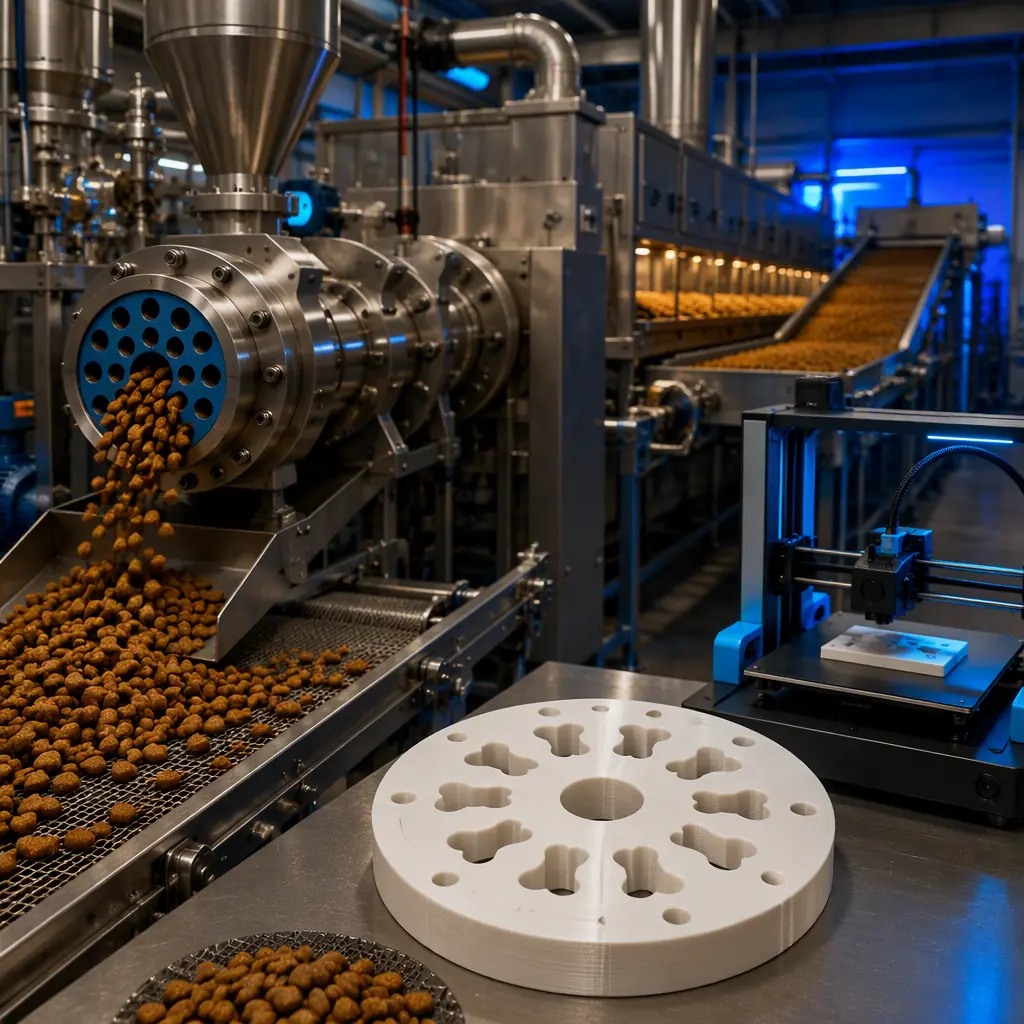
Extrusion and forming are the highest-value parts targets in a pet food plant. The classic parts are extruder die plates and die holes, knife holders and blades, forming rolls and pre-conditioner paddles, sieve and screen assemblies, and steam-condensate parts. Many are metal or filled-plastic originals that print well and last comparably in moderate-temperature, dry duty. A sloped die plate with precise holes, for instance, prints cleanly in a rigid, filled material and wears like the original without the tooling wait. High volumes and repeat orders drive the recurring revenue.
Just as important, a large share of forming spares are airflow and texture parts: deflector vanes, anti-clog plates, cutters and end-caps. These are low-volume, high-value parts on a short repeating cycle. For the abrasion and chemical material science, our pumps & valves guide and our polypropylene filament guide cover it in depth.
Conveying, Drying & Cooling Components
Bucket elevators, screw and vibratory conveyors, dryers and cooling beds move product between stages, generating a steady stream of replaceable parts. The winners are conveyor flights and paddles, bucket-elevator buckets, dryer trays and screens, fan and air blades, and anti-bridging fins. Because these are frequently UHMWPE or filled-nylon originals, they print exceptionally well and last comparably; the volume is what matters, a single plant may run 6–14 conveying and drying stations, each needing periodic wear-part replacement. For the wider material-handling application, see our warehouse automation & material handling guide and our engineering filaments guide.
Packaging & Filling Wear Parts
Multi-head weighers and bagging lines run oily, abrasive product, so filler and dosing spouts, bag clamps, check-weigher guides, form-fill-seal jaws and guides, and packer seals are high-consumption parts bought on a standing schedule. Printed versions in food-safe PP or rigid TPU handle the oily, abrasive environment well and are far cheaper than the OEM spare with a long lead time. Because many of these touch the product or the process environment, the food-safe compliance question from our food-safe printing guide applies directly, and our consumables & accessories bundling guide shows how to package the recurring parts sale.
Materials: Abrasion-, Heat- & Food-Safe
This vertical teaches you to think like a materials and compliance engineer. The parts sit in constant abrasion, moderate heat, oil and sanitizer, and any part touching the product stream is a food-contact surface. Build the recommendation matrix: food-safe PP or PETG for anything touching product; PA-CF for stiff structural guides; rigid TPU for anything that must flex, seal or take a hit; PC for impact and thermal shock; and UHMWPE-compatible HDPE for classic low-friction wear strips. See our nylon filament guide, our polycarbonate filament guide, and our heated chamber guide for the temperature-control angle.
What you're looking for: Abrasion → filled nylon or rigid TPU; heat/oil → food-safe PP or PETG; impact/flex → PC or PA-CF; and match or exceed the original's durometer, food-safety designation and dimensional tolerance.
Distributor Economics: High-Value Recurring Spares
Unlike consumer printer sales, pet food manufacturing is a pure aftermarket, recurring-revenue vertical. The hardware sale opens the relationship; the parts orders are the business. A single pet food plant can generate $4,000–11,000/year in printed spares once you are trusted. Because extruder dies, conveyor flights, dryer trays and filler spouts are replaced on a maintenance calendar, not once. The cadence is monthly-to-quarterly, and the margin is excellent: you set the part price, typically at 40–60% off the OEM spare, and your material cost is a fraction of it. That means distributor gross margins of 55–72% on printed parts.
The entry plan:
(1) Run a chamber-heated printer with a hardened nozzle for filled materials and a food-safe rigid-TPU / PP setup. (2) Print a demo kit of the fastest-moving spares. An extruder die, a conveyor flight, a dryer tray, a filler spout. (3) Approach local pet food plants, and their MRO resellers. (4) Lead with time-to-part (48-hour turnaround vs. 4–8 weeks) and the fact that a stopped line costs the plant far more than the part. For positioning a distributor business around a recurring parts model, our after-sales support strategy and our consumables & accessories bundling guide are the relevant reads.
Pet food manufacturing is quiet, technical and remarkably sticky, once a plant validates a printed part and its food-safe, abrasive-resistant material, it orders the same part on schedule for years and won’t switch. At Precise3D, our chamber-heated, hardened-nozzle FDM platform with food-safe, carbon-fibre, rigid-TPU and PC material compatibility is built for precisely this: tough, hygienic, wear-ready parts that keep the line running, delivered on a 48-hour turnaround.
Reviewed by the Precise3D engineering & OEM team. Compliance files that accompany the catalog are auditable at the certification register.
Enter This Vertical
Ready to Supply Wear-Ready Spares to Pet Food Manufacturers?
Join our network of global distributor network. Chamber-heated, hardened-nozzle printers with food-safe, carbon-fibre, rigid-TPU and PC capability, plus a demo kit of the fastest-moving extrusion and packing spares, everything you need to open the high-value pet food aftermarket.