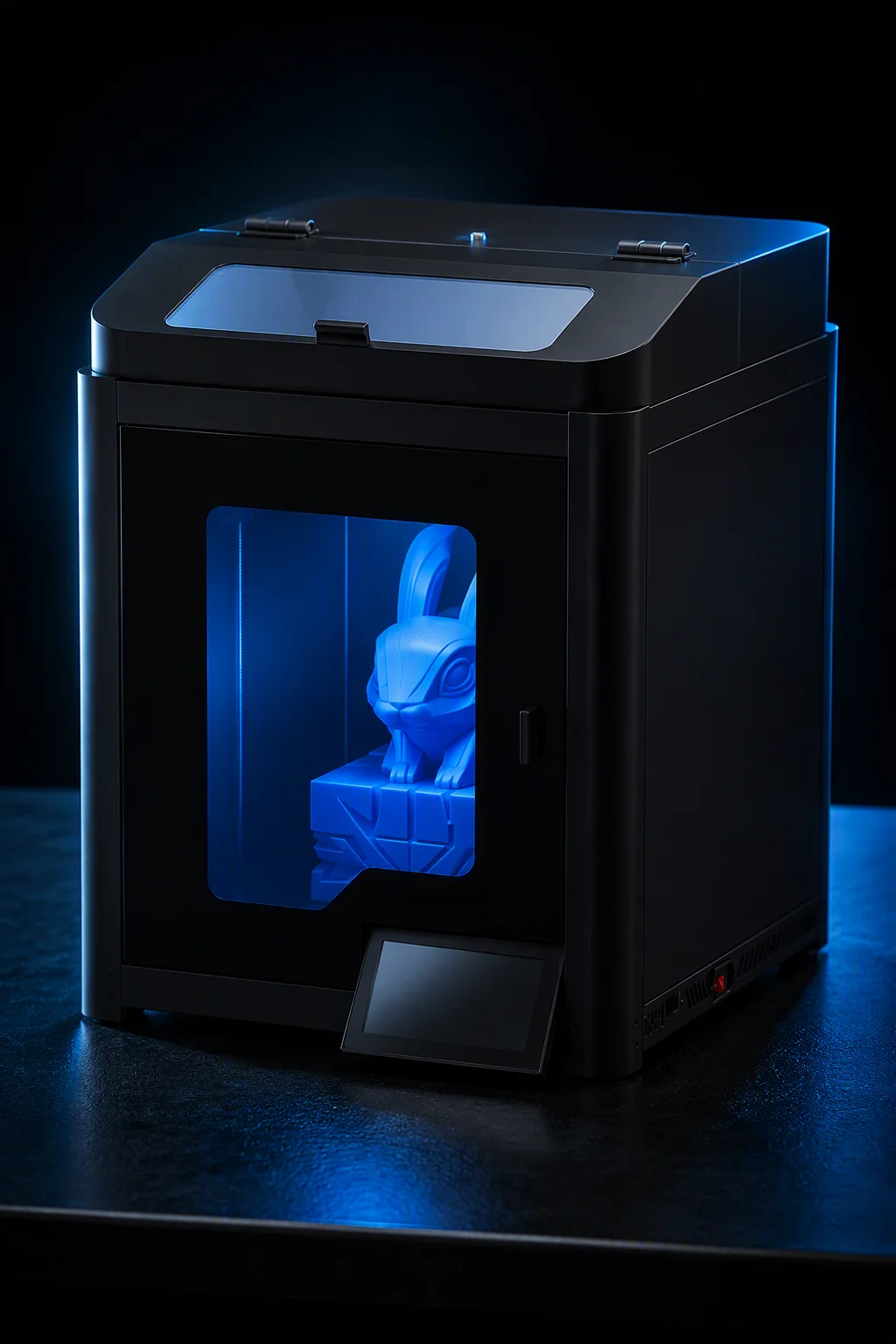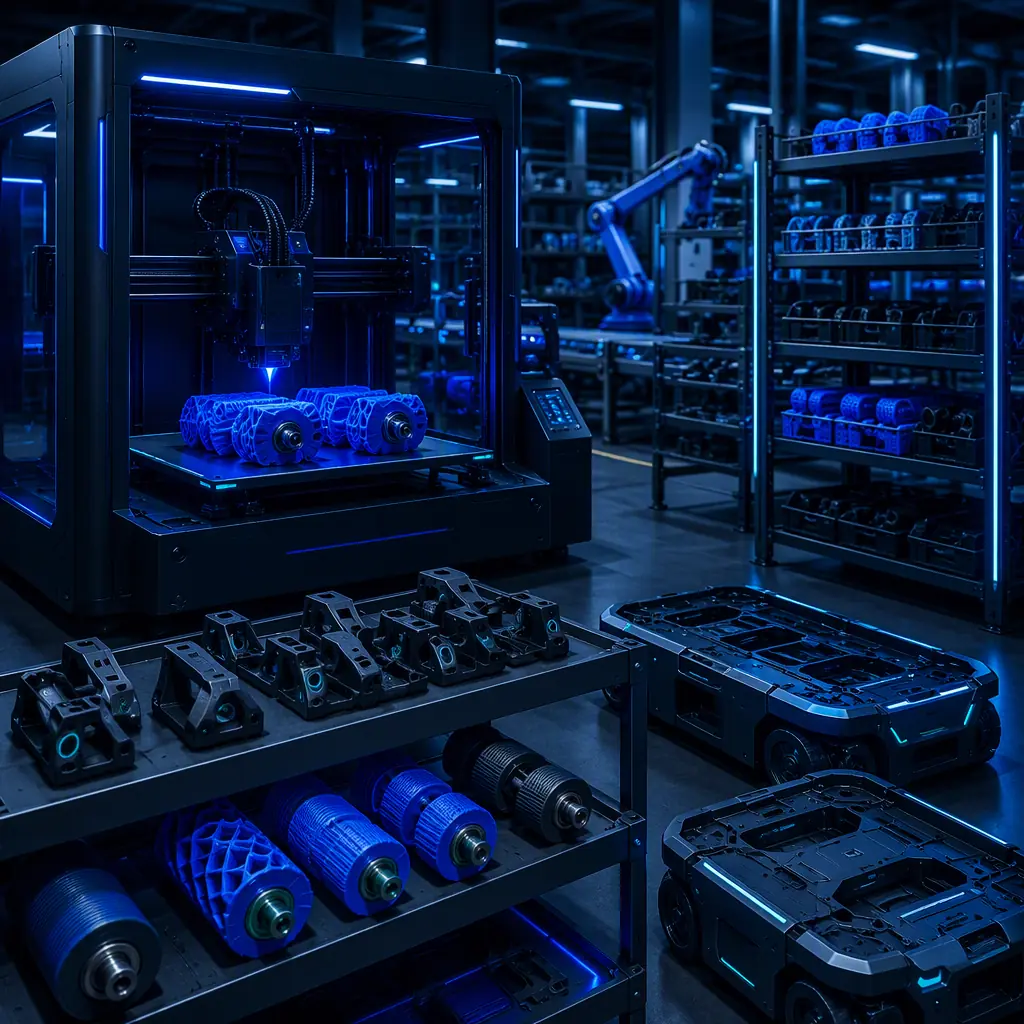
A warehouse automation integrator in the Netherlands serving e-commerce distribution centers was losing 2-4 weeks per conveyor customization because every sensor bracket, guide rail, and divert mechanism had to be machined or ordered from the OEM. After installing a fleet of FDM printers in their integration shop, the company now prints custom conveyor brackets, AGV payload trays, and end-of-arm gripper fingers in 1-3 days for $10-80 in material: integration lead times dropped from 6-8 weeks to 2-3, and the team shipped 40% more conveyor lines per quarter without adding staff. Warehouse automation is one of the most throughput-obsessed verticals in 3D printing — every minute of conveyor downtime costs order throughput, every custom bracket is a bottleneck, and every AGV needs a growing catalog of printed payload and mounting parts. For distributors, it is a parts-plus-service market where uptime math, not part price, closes the sale.
Why Warehouse Automation Is a Structural 3D Printing Buyer
Three facts make warehouse automation customers exceptional. First, customization at scale: no two distribution centers are identical, so integrators customize conveyor guards, sensor mounts, and pick stations on every project — printed parts compress that customization from weeks to days. Second, downtime economics: a conveyor line handling 10,000 parcels per hour loses $500-3,000 per hour of downtime, so same-day printed replacement parts are worth far more than their material cost. Third, the AGV/AMR parts flywheel: autonomous mobile robots need payload trays, sensor brackets, and docking guides that are constantly revised — a printed-parts catalog grows with every fleet deployment. The robotics account dynamics behind this flywheel are covered in our robotics & automation guide.
The Applications That Actually Buy
Five clusters generate repeat orders. The buyers are warehouse integrators, conveyor OEMs, AGV/AMR manufacturers, 3PL operators, and in-house automation teams.
1. Conveyor components. The flagship application. Sensor brackets, guide rails, divert paddles, roller spacers, and end-stops printed for integration and replacement. These parts must hold sensors in precise registration with the product stream, and printed tolerances of ±0.2-0.3 mm are sufficient for most conveyor systems. The dimensional control discipline is covered in our tolerances & dimensional accuracy guide.
2. AGV and AMR components. Payload trays, battery covers, sensor mounts, docking guides, and navigation-marker brackets for autonomous mobile robots. Weight is the currency here — printed parts save 30-50% versus machined aluminum on non-structural components, extending battery life on every shift. The wider UAV and mobile-platform opportunity is detailed in our drone & UAV manufacturing guide.
3. End-of-arm tooling (EOAT). Gripper fingers, vacuum-cup adapters, and suction manifolds for robotic picking cells. Custom fingers sized to specific SKU geometries are printed in hours and replaced as the product mix changes — a consumable model that never stops. The tooling discipline is detailed in our manufacturing tooling guide.
4. Pick stations and operator interfaces. Pick-to-light brackets, bin dividers, workstation organizers, and label-holder fixtures. These are short-run, high-customization parts where printed production runs of 20-200 units beat fabricated metal on lead time and cost.
5. Spare and replacement parts. Rollers, bushings, gear covers, and latch components for legacy conveyor lines. Every warehouse has years of installed equipment with discontinued parts; printed replacements keep lines running without OEM lead times. The material choices that keep these parts durable are covered in our engineering filaments guide.
Materials and Finish for Warehouse Automation
Warehouse parts must survive continuous duty, abrasion, and occasional impact. The map distributors should stock:
Two traps: (1) wear is the silent killer — conveyor rollers and guide surfaces see continuous abrasion, so nylon or glass-filled materials with low coefficient of friction are required, not PETG for every application; (2) gripper compliance is a design service — TPU finger geometry must match the SKU being picked, so distributors must offer design support for custom EOAT, not just material. The finishing and surface treatments that extend part life are covered in our post-processing & finishing guide.
Economics: Machined/Fabricated vs Printed
The comparison that closes warehouse automation accounts:
The distributor math is attractive because the purchase is systemic: once an integrator validates a printed parts workflow, every conveyor project and every AGV deployment flows through the same printer, filament, and design support. A mid-size integrator can consume $12,000-30,000/year in filament, TPU, and printed production parts — before counting the printer itself. For building this ROI case, use our TCO/ROI calculator guide.
The Distributor Playbook: Entering Warehouse Automation
The winning playbook has five moves:
1. Anchor on uptime, not part price. The pitch is "same-day replacement parts that keep your line running" — cost savings are the confirmation, uptime is the decision. Bring the hourly-downtime math to every presentation.
2. Offer print-to-production service. Integrators do not want to run a print farm in-house. A distributor offering parts-on-demand service (customer sends a worn part or drawing, distributor prints and ships a production-grade replacement in 1-3 days) turns a printer sale into a recurring service line. The service economics are developed in our after-sales support strategy.
3. Speak the throughput language. Warehouse managers quote in parcels-per-hour and picks-per-hour, not in part prices. Provide throughput-impact estimates and MTBF data for every replacement part — the operator's own productivity metrics become your sales collateral.
4. Stock the automation material set. PETG, nylon, glass-filled nylon, TPU, and PC-ABS are the true margin engine, plus design support for custom EOAT. An integrator completing 10-20 projects per year consumes 50-100 kg of filament annually; a filament-plus-design subscription locks the account.
5. Build the installed-base flywheel. Every completed parts catalog becomes an asset: build a database of print-tested conveyor and AGV components (with the customer's permission) and offer print-on-demand across the integrator's entire installed base. One validated integrator recruits the next — warehouse automation teams talk constantly at MODEX, ProMat, LogiMAT, and regional intralogistics events.
Common Pitfalls in Warehouse Automation Accounts
Five mistakes account for most failed initiatives: (1) selling the wrong material for wear applications — PETG rollers on a high-cycle conveyor fail within weeks, while nylon lasts for years; (2) ignoring the compliance angle — some conveyor lines serve food or pharmaceutical facilities, so food-safe or ESD-safe materials must be part of the offering; (3) underselling design support — integrators want custom EOAT and brackets, not just a printer, so in-house design capability is the differentiator; (4) underselling the consumable model — the printer is the foot in the door, but filament contracts, TPU, and parts-on-demand retainers are where margin compounds; and (5) neglecting the spare-parts channel — the installed base of legacy conveyors is often bigger than new projects, so a distributor must serve the replacement market, not just new builds. The discipline of documenting measurable outcomes mirrors what we teach for end-use parts in our end-use functional parts guide.
Getting Started: The First 90 Days
A 90-day entry plan: Month 1 — stock PETG, nylon, glass-filled nylon, TPU, and PC-ABS with full data sheets, plus a small EOAT demo kit, and identify 10-15 target accounts (warehouse integrators, conveyor OEMs, AGV/AMR manufacturers, 3PL operators, in-house automation teams) within a 3-hour drive. Month 2 — run two pilot parts-on-demand projects at cost-plus-10% to build documentation evidence and a parts library; document uptime impact and throughput gains. Month 3 — convert pilots to full accounts with filament-and-design subscriptions and parts-on-demand retainers, publish your first co-branded case study with measured numbers ("conveyor sensor bracket: $350 machined → $22 printed, same-day delivery, line downtime reduced 3 hours/week"), and exhibit at a regional intralogistics or automation event. If you already serve robotics or manufacturing accounts, our robotics & automation guide and electronics manufacturing tooling guide show how the same parts-plus-service logic transfers directly to warehouse automation.
Reviewed by the Precise3D engineering & OEM team. Compliance files that accompany the catalog are auditable at the certification register.
Enter the Intralogistics Market
Ready to Supply Warehouse Automation Teams?
Get wholesale pricing on large-format FDM printers, PETG and nylon engineering filament lines, TPU for custom grippers, and the parts-on-demand service playbook that wins warehouse automation accounts.