Assembly jigs and fixtures — the most commonly discussed 3D printed tooling category — are well understood. Most distributors already sell printers into that application. But jigs and fixtures are the entry-level tooling segment with the lowest margin per printer sold. The higher-value tooling applications — injection mold inserts, EDM electrodes, and CNC workholding — are underpenetrated because they require the distributor to understand manufacturing engineering workflows, not just 3D printer specs. This guide bridges that gap. For the automotive jigs and fixtures angle, see our automotive jigs and fixtures guide. This guide covers what comes after.
Category 1: 3D Printed Injection Mold Inserts — The $50K/Year Opportunity
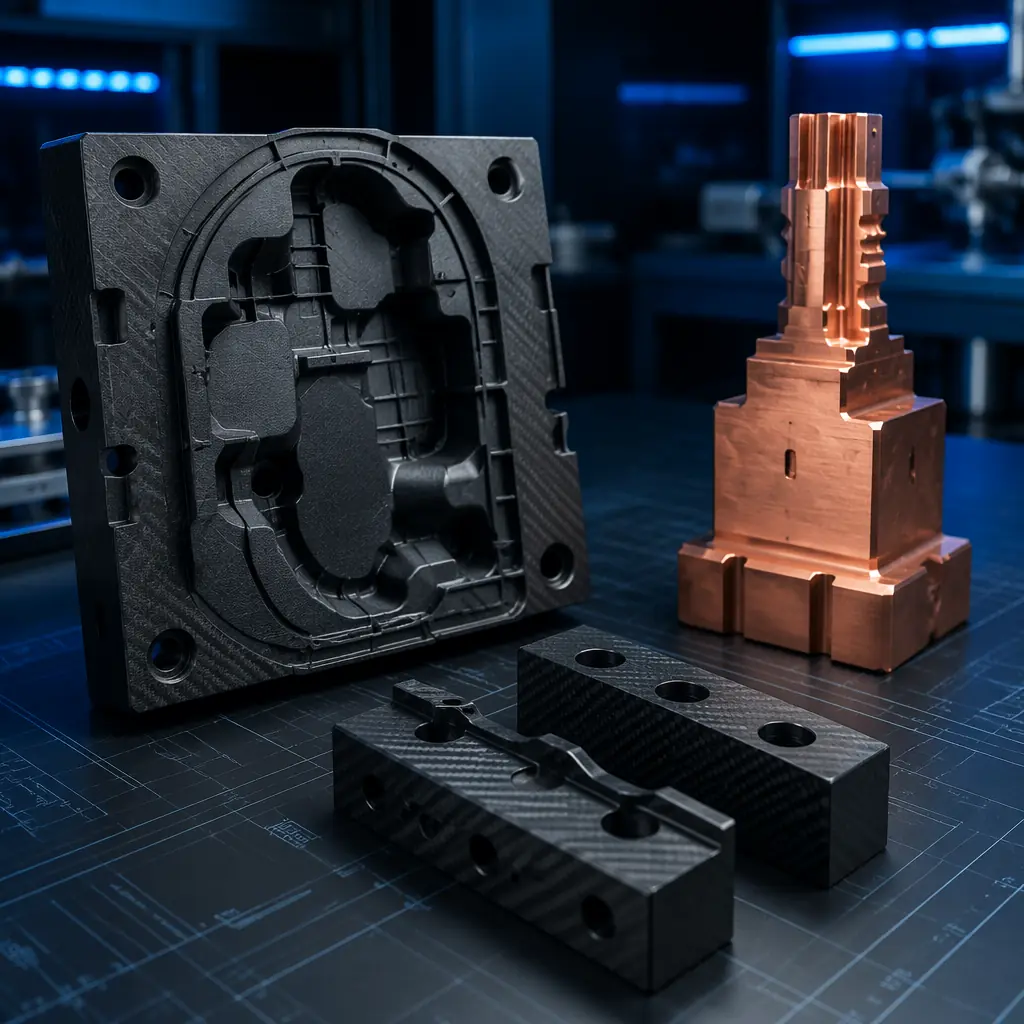
Conventional injection mold tooling is machined from P20 or H13 tool steel at a cost of $8,000–$50,000 per mold and a lead time of 6–12 weeks. For production runs below 5,000 parts — which describe the vast majority of injection molded components across all industries — steel tooling is economically irrational. A 3D printed polymer mold insert (typically carbon-fiber-filled nylon, PEI, or PEKK) can produce 50–500 parts before degrading, at a printed cost of $40–$200 per insert and a lead time of 4–24 hours. The math for a manufacturer producing 2,000 units of a custom plastic housing: a steel mold costs $12,000 and takes 8 weeks, while 10 printed PA-CF inserts at $80 each cost $800 total and take 2 days of printing. The per-part tooling amortization drops from $6.00 to $0.40. The distributor's printer — a $5,000 enclosed FDM machine with a hardened nozzle — paid for itself on this single project before the steel mold would have even arrived.
The distributor's sales conversation for injection mold inserts is not about 3D printing — it is about tooling cost and lead time. The target buyer is not a 3D printing enthusiast or an R&D manager; it is a tooling engineer or manufacturing engineering manager who spends $50,000–$200,000/year on outsourced mold tooling. The pitch: "What if you could get functioning mold inserts for prototype and bridge-tooling runs in 24 hours, for $80 each, instead of 8 weeks and $12,000?" For the industrial materials that enable this, see our industrial materials guide.
Category 2: 3D Printed EDM Electrodes — Replacing Graphite Machining
Electrical Discharge Machining (EDM) uses shaped electrodes — typically graphite — to erode metal workpieces into complex geometries. Graphite electrodes are machined on 3-axis or 5-axis CNC mills, a process that takes 4–40 hours per electrode and generates conductive graphite dust that contaminates the machine tool and requires specialized extraction. A single complex injection mold cavity can require 3–8 graphite electrodes at a total machining cost of $3,000–$15,000.
3D printed EDM electrodes — printed in conductive PLA or graphene-filled filament, then electroplated with copper — can replace graphite electrodes for roughing and semi-finishing EDM operations. A printed-and-plated electrode costs $15–$40 in materials and prints in 2–6 hours, compared to $400–$2,000 and 8–40 hours for a machined graphite electrode. Conductivity is lower than copper or graphite (printed electrode resistivity ~0.1–1.0 Ω·cm vs. graphite's 0.001 Ω·cm), which limits printed electrodes to roughing operations where material removal rate is the priority and surface finish is secondary — but roughing accounts for 60–80% of total EDM time on a typical mold. The distributor's angle: sell the printer into the EDM department of a mold shop, not the prototyping lab. For the calibration and precision requirements, see our advanced calibration guide.
Category 3: 3D Printed CNC Soft Jaws — Custom Workholding Overnight
CNC machine vises use replaceable soft jaws — typically aluminum or mild steel — that are machined to match the contour of the specific part being held. A machine shop producing 30 different part numbers per month might need 30 pairs of custom soft jaws, each machined from billet aluminum at $80–$200 per pair and a lead time of 2–5 days if outsourced, or consuming in-house CNC capacity if machined internally.
3D printed soft jaws in carbon-fiber-filled nylon or PET-CF can hold parts for CNC machining operations with cutting forces up to approximately 500N of clamping force — sufficient for aluminum and plastic machining with light-to-moderate cuts. A printed soft jaw pair costs $6–$12 in filament, prints in 3–6 hours, and can be designed in the morning and installed on the CNC vise by the afternoon shift. The limitation is clamping force: printed polymer jaws cannot match the 5,000N+ clamping force of machined steel jaws for aggressive steel cutting — but for the 70% of CNC work that involves aluminum, brass, and plastic parts with finish-pass-level cutting forces, printed soft jaws are a direct replacement. A machine shop spending $3,000/month on outsourced soft jaw machining replaces that with a $3,000 printer and $200/month in filament — ROI in 6 weeks. For print farm operations at scale, see our print farm operations guide.
The Tool Room Buyer: A Different Sales Conversation
Selling printers to tool rooms is fundamentally different from selling to prototyping labs or education buyers. The tool room buyer evaluates purchases on three criteria, in descending order of importance:
1. Process reliability: "Will this printer produce dimensionally accurate parts every time, or will I spend my morning recalibrating it?" The tool room does not tolerate hobbyist-grade reliability. This is where a printer with auto bed leveling, an enclosed chamber, and a direct-drive extruder for consistent material feed becomes the sales differentiator — not print speed or color capability.
2. Material capability: "Can it print the materials I need — carbon-filled nylon for mold inserts, conductive filament for electrodes, PET-CF for soft jaws — and can you provide the validated print profiles for each?" The distributor who arrives at a tool room with printed sample parts in the exact materials the buyer needs, with documentation of dimensional accuracy and surface finish, closes at 3x the rate of the distributor who brings a spec sheet. For the full materials framework, see our engineering filaments guide.
3. Total cost of ownership: "What does this printer cost me per year, including consumables, maintenance, and operator time?" Tool room buyers calculate TCO instinctively because their entire department is a cost center measured on tooling amortization. The TCO calculation they respond to: "$5,000 printer + $3,000/year filament + $500/year maintenance = $8,500 first-year TCO vs. $50,000–$200,000/year outsourced tooling." For the TCO framework, see our TCO and ROI calculator guide.
The Distributor's Tool Room Bundle
The minimum viable tool room 3D printing offering:
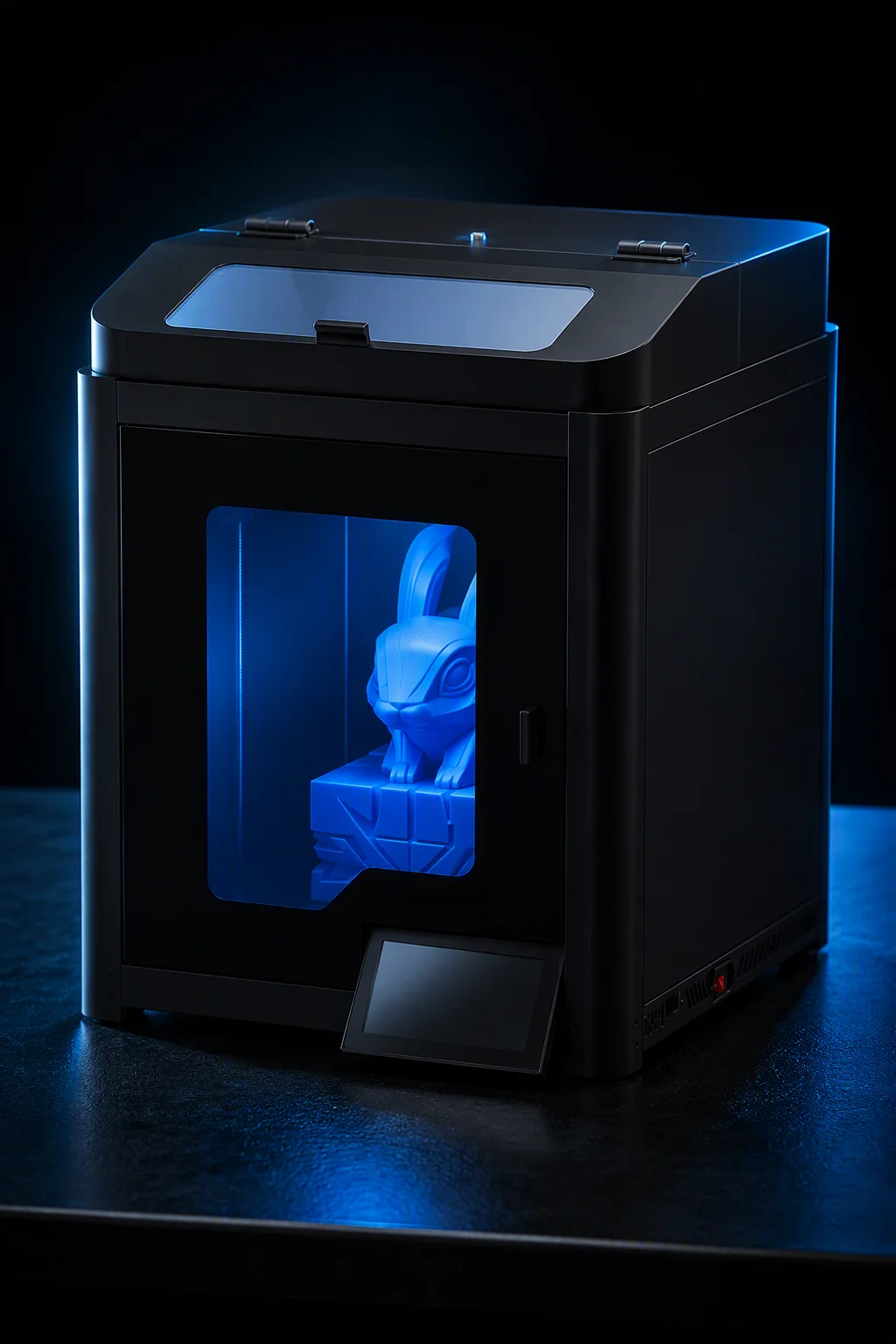
- One enclosed FDM printer with hardened steel nozzle (required for abrasive CF-filled filaments), direct-drive extruder, and auto bed leveling. Retail price $3,000–$8,000. Capable of 300°C hotend and 100°C bed for engineering materials.
- Three filament SKUs: PA-CF (mold inserts and soft jaws, $60–$90/kg), conductive PLA or graphene-filled PLA (EDM electrodes, $80–$120/kg), and PET-CF (higher-temperature soft jaws, $50–$80/kg). Initial inventory: 5 spools per SKU.
- Sample part kit: One printed mold insert, one copper-plated EDM electrode, and one pair of soft jaws — professionally finished, dimensionally verified, with a one-page spec sheet showing printed vs. design dimensions. This kit is what the buyer physically holds during the sales conversation.
- Validated print profiles for each material on the specific printer model, with documented dimensional accuracy (±0.1mm or better) and surface finish data. Pre-configured slicer profiles on a USB drive.
- Electroplating starter kit for EDM electrodes: copper sulfate solution, DC power supply, conductive paint for electrode surface. The distributor does not need to sell electroplating equipment — just the consumables and instructions that make the printed electrode functional.
Total initial investment: $4,000–$10,000 including demo printer, filament inventory, and sample parts. Average tool room customer value: $8,000–$25,000 for the first printer sale plus $3,000–$8,000/year in recurring consumable revenue. Payback period for the customer: 3–8 weeks on outsourced tooling cost savings. For the broader sales strategy, see our B2B sales playbook.
Reviewed by the Precise3D engineering & OEM team. Compliance files that accompany the catalog are auditable at the certification register.
Manufacturing Tooling
Sell 3D Printers Into Tool Rooms — Not Just Labs
Precise3D's enclosed FDM printers with hardened steel nozzles and engineering-grade material profiles are ready for injection mold inserts, EDM electrodes, and CNC workholding. Request a tool room distributor pack with sample part specifications and validated print profiles.