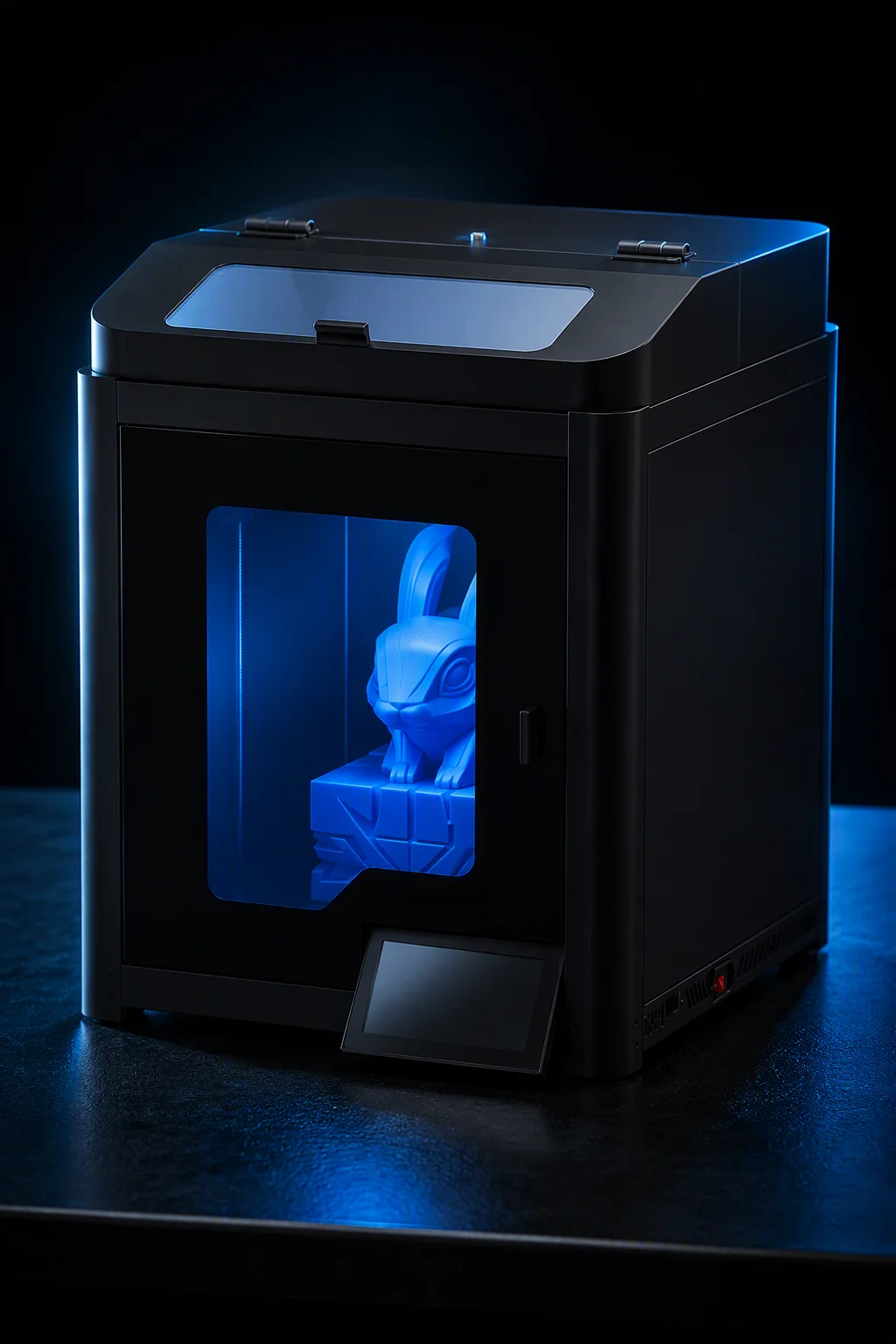
The prototyping market for 3D printers is saturated. Every distributor sells to design firms and R&D labs. But the end-use parts market — where the 3D printer produces components that ship to paying customers — is growing at 23% annually and remains underserved by distribution channels. The customers are not new: they are the same small-to-medium manufacturers already buying filament from you. They just do not know their printers can do this.
This guide is built from interviews with 40+ Precise3D distribution partners who have successfully transitioned customers from prototyping-only to mixed prototyping-and-production workflows. The average revenue per customer increases 3.4x when a buyer moves from prototyping-only to including end-use part production — because end-use parts consume 5–15x more filament and create recurring material revenue.
What Qualifies as an End-Use Part — And What Does Not
Not every 3D-printed object is an end-use part. The distinction matters because it determines the material, the printer configuration, the quality control process, and ultimately the sale. An end-use part is a component that performs a mechanical, structural, or functional role in a product shipped to a paying customer. It is not a prototype, not a visual model, and not a test coupon.
The shift from prototype to end-use part is not a printer upgrade — it is a material upgrade and a process discipline. The same $800 printer that makes visual models in PLA can produce functional brackets in PETG-CF. The limiting factor is rarely the printer. For the complete material selection framework, see our engineering filaments guide and filament quality evaluation guide.
The Material Science Behind Functional Parts
The single biggest barrier to selling end-use parts is material anxiety: the fear that a 3D-printed part will fail in service. This anxiety is rooted in early FDM experiences with PLA — a material that creeps under load, softens at 55°C, and degrades in UV exposure. But the material landscape has transformed in the last three years. Engineering filaments now offer mechanical properties that rival injection-molded thermoplastics in many applications.
Carbon-fiber-filled nylon (PA6-CF, PA12-CF):
The workhorse of functional parts. Tensile strength 110–130 MPa, heat deflection temperature 150–180°C, and 85–92% Z-axis strength retention when printed in a heated chamber at 45–60°C. Suitable for brackets, mounts, jigs, and functional prototypes that experience mechanical load. Requires a hardened steel nozzle (brass wears out in 500g of CF filament). Our carbon fiber filaments guide has the full mechanical property tables.
Polycarbonate (PC) and PC blends:
Impact resistance 15–25x that of PLA. Flame retardant grades achieve UL94 V-0 at 1.5mm thickness, making them viable for electronics enclosures and aerospace interior components. Requires enclosure temperature ≥50°C and bed temperature ≥100°C. The heated chamber guide covers the thermal management needed to print PC successfully.
PEI (Ultem 9085/1010):
The highest-performance FDM material accessible to desktop-class enclosed printers. Continuous service temperature 170°C, FST (flame/smoke/toxicity) certified for aerospace interiors, chemical resistance to most solvents and fuels. At $150–250/kg, it is a premium material — but selling one PEI-capable printer with 5kg of filament generates more margin than selling five PLA-only printers.
Flexible TPU (85A–95A shore hardness):
The hidden gem of end-use parts. TPU gaskets, vibration dampeners, protective bumpers, and flexible couplings are produced in quantities of 10–500 per week and have zero competition from CNC machining (TPU cannot be machined). Selling a dedicated TPU printer for a customer's flexible parts line is a recurring revenue play: TPU wears nozzles faster and customers buy replacement parts through you. See our filament stocking guide for TPU inventory recommendations.
What you're looking for: The customer who can name 3–5 specific parts that fail predictably is your end-use parts candidate. They have already done the hardest work — identifying the application. Your job is to match the material to the failure mode.
Design for Additive Manufacturing: The Rules That Make Parts Production-Ready
A part designed for injection molding will fail when 3D printed — not because the printer is inadequate, but because the design assumes isotropic material properties and uniform cooling that FDM does not provide. Converting a customer from prototyping to production requires teaching them (or their design team) the 4 rules of Design for Additive Manufacturing (DfAM):
1. Print orientation determines strength. A bracket printed flat on the bed has Z-axis layer lines running perpendicular to load, creating the weakest orientation. The same bracket printed on its side with layers parallel to the load direction is 3–5x stronger. This single design decision often determines whether a part survives in service. Orientation optimization typically adds 10–30% to print time — a trade-off that pays for itself in zero field failures.
2. Overhangs need support or redesign. Anything beyond 45° from vertical requires support material in FDM. For end-use parts, support removal scars the surface and creates stress concentrations. The DfAM solution is to design self-supporting geometries — chamfers instead of fillets on underside edges, teardrop shapes for horizontal holes, and splitting complex geometries into bolt-together sub-components that print flat.
3. Wall thickness matters more than infill. A common beginner mistake is setting infill to 100% for "maximum strength." In reality, increasing the number of perimeter walls from 2 to 4 provides more strength improvement than increasing infill from 20% to 100% — because bending stress concentrates at the outer fiber. The rule of thumb for functional parts: 4–6 walls, 30–50% gyroid infill, and never 100% infill (it causes dimensional distortion from thermal expansion). Our advanced calibration guide covers wall optimization settings for 12 printer models.
4. Clearance = 0.2–0.3mm for mating parts. FDM cannot hold the zero-clearance press fits that machined parts use. Design mating features with 0.2mm radial clearance for PLA/PETG and 0.3mm for higher-shrinkage materials like ABS and PC. Alternatively, design in heat-set threaded inserts (pressed in with a soldering iron) for reliable threaded connections — a technique that dramatically increases the perceived quality of functional parts. The post-processing guide covers insert installation and other finishing techniques that elevate print quality to production standard.
Quality Control for Production Parts: The Framework That Convinces Engineers
Manufacturing engineers are trained to distrust 3D-printed parts because they associate FDM with hobbyist variability. The way to overcome this is not to argue — it is to demonstrate a quality control process that looks familiar to them. Every component manufactured on a CNC machine has an inspection report. Your end-use printed parts should too.
Presenting this QC framework to a manufacturing engineer changes the conversation from "3D printing is unreliable" to "here is how we control variability." It speaks their language. The certification and compliance guide covers formal quality management systems for distributors supplying regulated industries.
End-Use Part Applications by Industry
Different industries have different readiness levels for 3D-printed end-use parts. The key to selling production printers is matching the application to the industry's regulatory and performance comfort zone.
- Manufacturing tooling and fixtures: The highest-volume end-use category. Assembly jigs, CMM holding fixtures, soft jaws for vises, go/no-go gauges, and ergonomic aids. Zero regulatory barriers, immediate ROI (a $3 printed fixture replaces a $200 machined one), and the customer already understands the value. This is the gateway application for every end-use parts sale. See our manufacturing tooling guide.
- Aftermarket and replacement parts: Legacy equipment with discontinued spare parts. A motor mount for a 15-year-old conveyor system, a knob for a discontinued lab instrument, a cable guide for an obsolete packaging machine. These parts have zero design cost (reverse-engineered from the broken original) and the alternative is scrapping a $50,000 machine for want of a $5 part. The value proposition writes itself.
- Custom medical and dental devices: Surgical guides, dental aligner models, prosthetic sockets, orthotic insoles. These are regulated (FDA Class I/II in the US, CE marking in the EU) and require medical-grade materials and documented QC processes. But the margin structure is exceptional — a $15 printed surgical guide bills at $300–800. Our dental lab guide covers the specific workflow for that vertical.
- Drones and UAV components: Lightweight brackets, camera mounts, antenna holders, and landing gear. Weight reduction is the primary value driver — every gram saved extends flight time. CF-PA parts at 1.2 g/cm³ replace aluminum equivalents at 2.7 g/cm³, cutting component weight by 55% while maintaining adequate strength for non-structural applications. The aerospace and defense guide covers UAV-specific applications.
The Sales Conversation: From "Can It Do That?" to "Here Is What We Print"
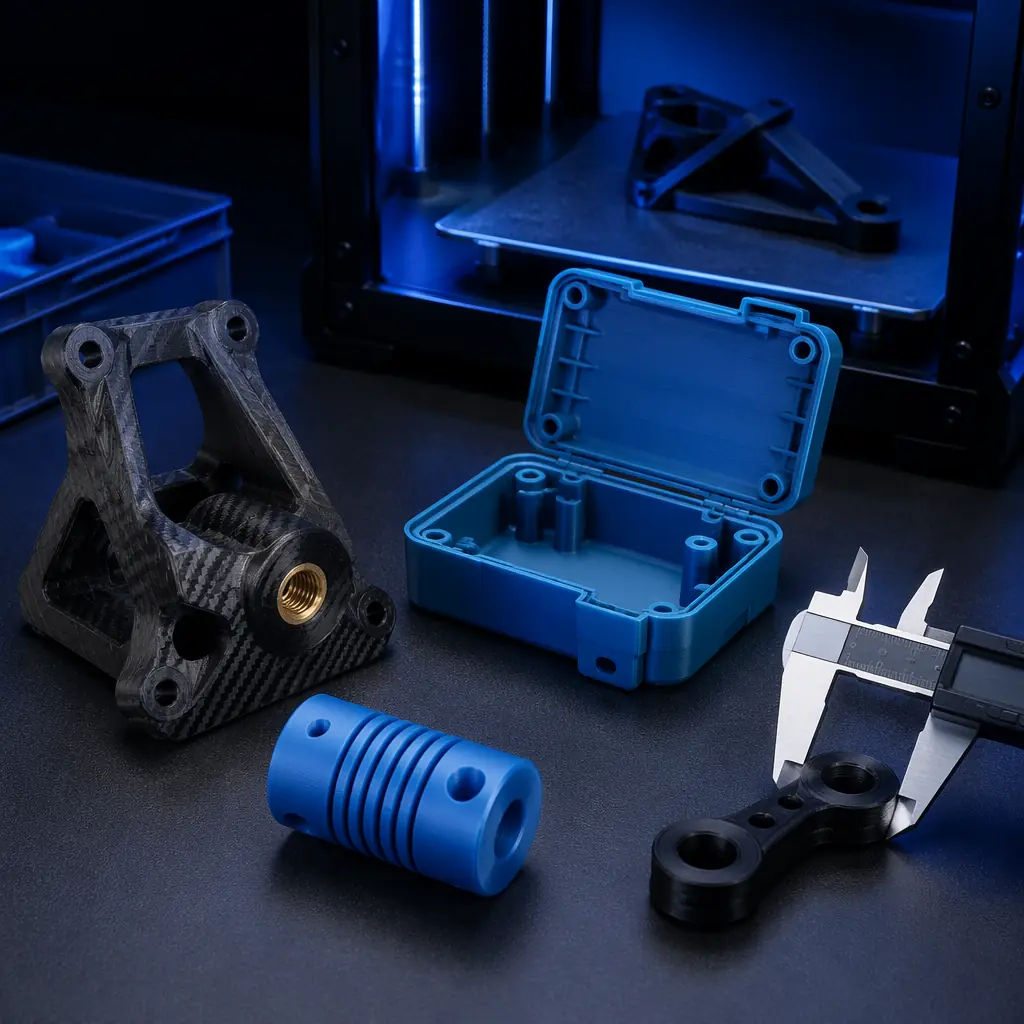
The most effective way to sell end-use part capability is not to describe it — it is to show it. Keep a physical sample kit of end-use parts in your showroom or sales bag: a CF-PA bracket with visible layer structure but flawless function, a PC electronics enclosure with snap-fit lid, a TPU flexible coupling that has survived 10,000 cycles. When the customer asks "can a 3D printer really make something strong enough to use?" you hand them the part and let them try to break it.
The second most effective technique: ask them to bring you a broken part from their facility. Print the replacement while they watch. Nothing converts a skeptic faster than seeing their own problem solved in real time. For the complete B2B sales methodology, see our B2B sales demo playbook and rapid prototyping sales guide.
The end-use parts market is not a future opportunity — it is happening now, in the same factories and workshops that already buy filament from you. The distributors who win this market are the ones who stop selling printers and start selling production capability. A $1,500 printer is a $1,500 sale. A $1,500 printer positioned as a production tool that replaces $25,000/year in outsourced parts is a partnership — and partnerships generate recurring revenue for years, not a one-time margin on a box.
Reviewed by the Precise3D engineering & OEM team. Compliance files that accompany the catalog are auditable at the certification register.
Sell Production, Not Prototypes
Precise3D Distributor Partnership — Printers, Materials & QC Frameworks for End-Use Part Production
Every Precise3D distribution partner receives our end-use parts application playbook, material selection matrix for 18 engineering filaments, QC checklist templates, and physical sample kits. Our enclosed CoreXY printers ship production-ready for CF-PA, PC, and PEI — the materials that turn prototypes into products. Contact us to discuss partnership terms and receive your sample kit.