Ask any distributor what their highest-margin filament SKU is, and the answer increasingly involves carbon fiber. Filled filaments — materials reinforced with chopped carbon fiber, glass fiber, or aramid (Kevlar) — have become the fastest-growing segment in the FDM consumables market. They command $50 to over $100 per kilogram, roughly 2–4x the price of standard PLA or PETG. But the real profit driver isn't the filament itself: it's the hardened nozzle replacement cycle that every filled-filament customer enters the moment they load their first spool.
This guide covers the filled filament landscape from a distributor's perspective: which fiber grades deliver which mechanical properties, which printer hardware is compatible (and which isn't), what stocking mix makes sense for different customer segments, and how to build a recurring revenue model around the nozzle-and-filament bundle. If you're already stocking engineering filaments, filled materials are the natural next tier up.
What "Filled" Actually Means — And Why It Matters for Mechanical Properties
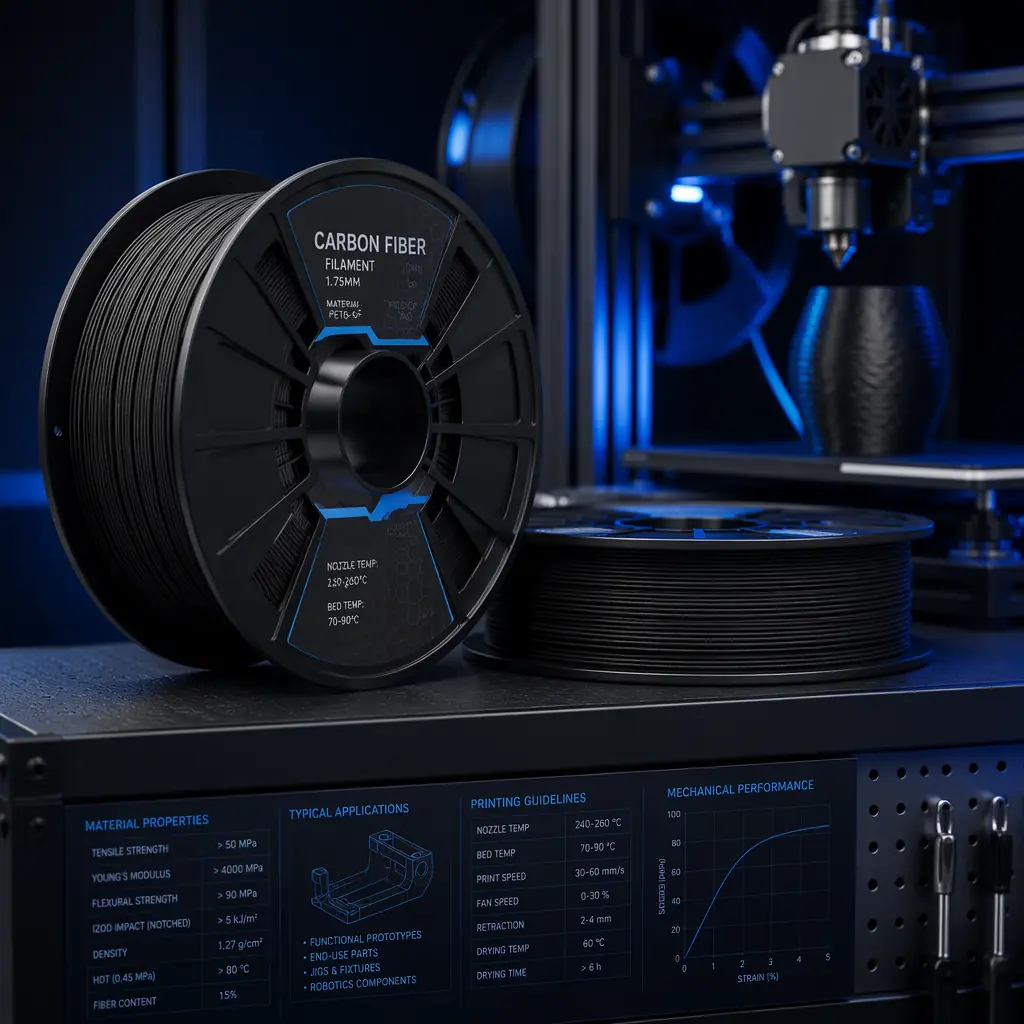
A filled filament is a standard thermoplastic base (typically PLA, PETG, ABS, Nylon, or PC) that has been compounded with 10–30% by weight of short reinforcing fibers — usually 0.1–0.3 mm in length. These fibers don't dissolve or melt during printing; they remain suspended in the polymer matrix, distributing stress across the printed part. The result is a dramatic improvement in stiffness (flexural modulus), tensile strength, and dimensional stability — at the cost of some impact resistance and a mandatory hardened nozzle requirement.
The three primary fiber types distributors encounter are:
- Carbon Fiber (CF) — Highest stiffness-to-weight ratio. Increases flexural modulus by 200–400% over the base polymer. Electrically conductive in some formulations. Most common fill type, found in PLA-CF, PETG-CF, ABS-CF, PA-CF (Nylon), and PC-CF. Price range: $55–120/kg.
- Glass Fiber (GF) — Lower stiffness gain than CF (150–250% improvement) but significantly cheaper. Non-conductive, making it suitable for electrical enclosures and insulators. Common in PA-GF (Nylon) and PP-GF. Price range: $35–70/kg.
- Aramid / Kevlar Fiber — Specialty fill for impact resistance and abrasion resistance rather than stiffness. Used in applications requiring toughness over rigidity. Price range: $80–150/kg. Niche market, stock selectively.
The Hardened Nozzle Requirement — A Distributor's Built-In Upsell Engine
Every filled filament is abrasive. Chopped carbon and glass fibers act like micro-sandpaper inside the hotend. A standard brass nozzle will wear from a 0.40 mm orifice to 0.55+ mm within 250–500 grams of filled filament — that's roughly one spool. The symptoms show up as "mysteriously" widening extrusion width, dimensional inaccuracy, and eventually complete print failure. Customers who don't understand this burn through a spool, get frustrated, and blame the filament or the printer.
This is where the distributor's recurring revenue play works. Every filled filament customer needs:
- Hardened steel nozzles — $8–25 each, replaced every 2–4 spools of filled filament (500g–1kg intervals). A customer printing 2 spools/month of PA-CF goes through 6–12 nozzles/year.
- Ruby-tipped or tungsten carbide nozzles — $40–90 each for premium users, lasting 8–12 spools. Higher upfront cost but lower total cost of ownership for high-volume users.
- Spare heater blocks and thermistors — Abrasive filament particulate can migrate into threads and connections over time.
Bundle a 1kg spool of PETG-CF with two hardened steel nozzles and you've turned a $55 filament sale into an $85 transaction with a 2-month repeat window. For a deeper dive into nozzle economics, see our nozzle and hotend revenue guide.
Which Customer Segments Buy Filled Filaments — And What They Actually Print
Filled filaments are not for the casual hobbyist printing articulated dragons. The customers who buy them are solving specific engineering problems, and they're willing to pay for performance. Here are the four segments that matter for distributors:
1. Engineering Prototyping Teams — R&D departments in automotive, aerospace, and industrial equipment companies use PA-CF and PC-CF for functional prototypes that must survive thermal and mechanical testing. These customers order 5–10 spools at a time and care about batch-to-batch consistency. They'll pay a premium for datasheets with actual test values, not marketing numbers. Read our guide to selling to R&D teams for the full playbook.
2. Drone and UAV Builders — The PLA-CF and PETG-CF segment is dominated by the FPV drone community. They print camera mounts, antenna holders, and frame components where weight reduction matters. PLA-CF is popular here because it prints easily on open-frame printers while delivering noticeably stiffer parts than unfilled PLA. These customers are brand-agnostic and price-sensitive — stock 2–3 brands of PLA-CF at $45–55/kg retail.
3. Manufacturing Tooling — Injection mold insert prototypes, assembly jigs, and EDM electrode holders printed in PA-CF or PEI-CF. These customers need high-temperature stability and dimensional accuracy. They're the highest-value segment: a single manufacturing engineer's PO can be $500–2,000 for an initial stock-up order. Build relationships here, not just transactions.
4. Print Farm Operators — As print farms scale, they discover that PLA-CF and PETG-CF parts command 2–3x the per-part price of standard PLA while using the same printer fleet. The catch is the accelerated nozzle replacement schedule. A 50-printer farm running filled filaments 30% of the time consumes roughly 150 hardened nozzles per year. See print farm operations at scale for the full nozzle logistics breakdown.
Stocking Strategy: The 80/20 Mix That Covers 90% of Inquiries
You don't need to stock every filled filament variant. The market clusters around a handful of workhorse materials. Here's the efficient starter portfolio for a distributor:
Start with PLA-CF and PETG-CF — together they cover 70% of filled filament inquiries. Add PA6-CF once you have 3+ engineering customers asking for it. PC-CF and PA-GF are expansion SKUs for established accounts. Kevlar-filled and exotic blends (PEEK-CF, PEI-CF) should be special-order only unless you have a confirmed recurring customer — these spools can sit on the shelf for 6+ months.
Every filled filament SKU should come with a recommended nozzle accessory card in the box or on the product page. For PLA-CF and PETG-CF, recommend hardened steel ($12–18). For PA-CF and PC-CF, recommend tungsten carbide or ruby ($50–80). Customers who don't buy the nozzle with their first spool will be back in 2 weeks — either to buy the nozzle (after ruined prints) or to return the filament (blaming you). The card prevents both outcomes.
Printer Compatibility: What You Need to Tell Customers Before They Buy
Not every 3D printer can handle filled filaments, and the compatibility conversation is your most important value-add as a distributor. The checklist is short but non-negotiable:
- Hardened nozzle installed — Brass will be destroyed within one spool. Hardened steel is the minimum; tungsten carbide or ruby for production volumes.
- All-metal hotend — Nylon-based filled filaments (PA-CF, PA-GF) print at 260–290°C. PTFE-lined hotends degrade above 240°C and release toxic fumes. All-metal is mandatory for anything beyond PLA-CF.
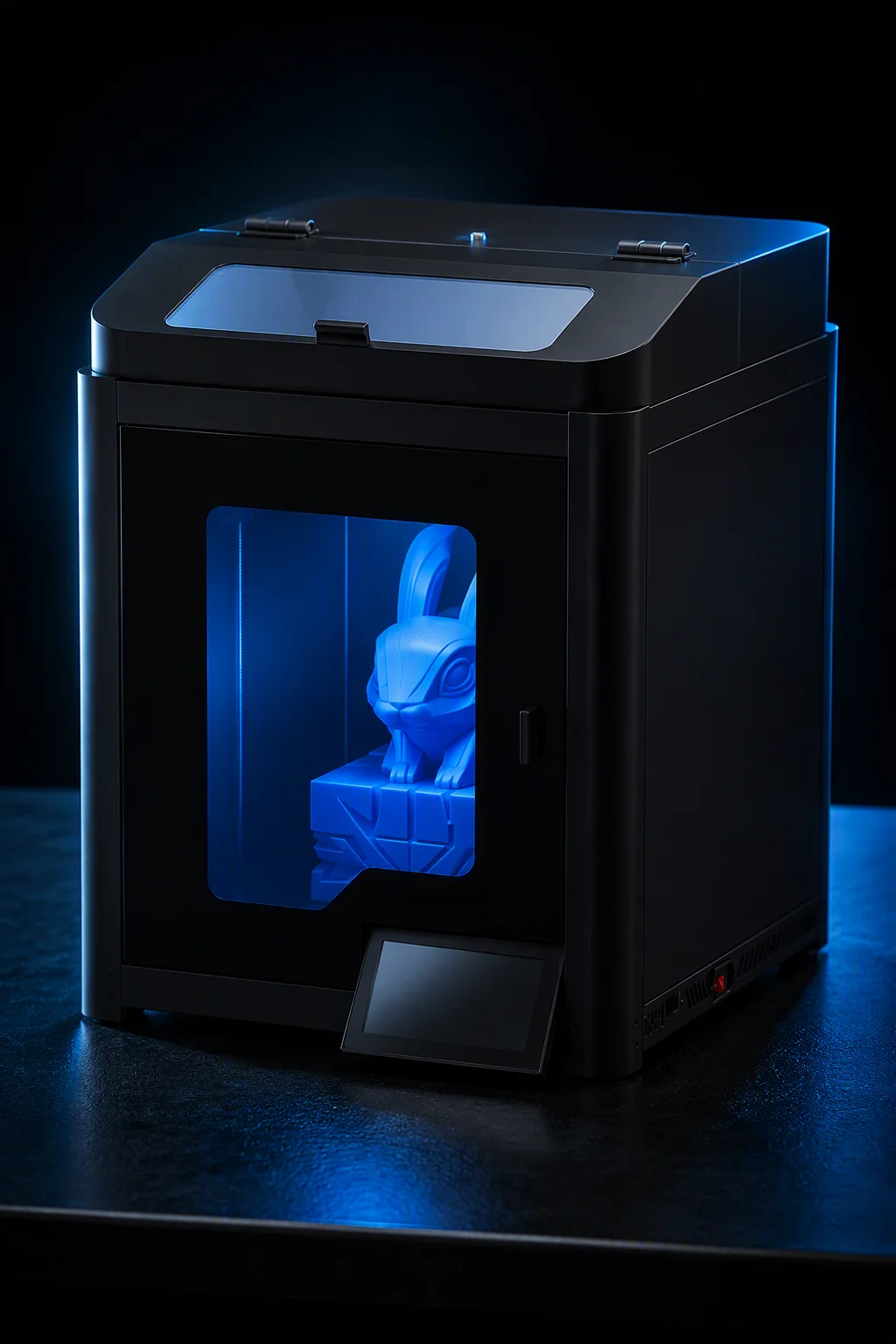
- Enclosed chamber recommended — Nylon and polycarbonate-based filaments warp without active chamber heating. PLA-CF and PETG-CF can print on open-frame printers with a draft shield.
- Direct drive extruder preferred — Filled filaments are stiffer than unfilled counterparts. Bowden setups can struggle with retraction and stringing. Direct drive provides better control. See our extruder architecture comparison for details.
- 0.4 mm minimum nozzle diameter — 0.4 mm is standard; 0.6 mm is actually preferable for filled filaments as it reduces clogging risk. 0.2 mm nozzles will clog within minutes on any filled material.
Why Filled Filaments Are a Strategic Category — Not Just Another SKU
There's a structural reason filled filaments are more profitable than standard materials, and it goes beyond higher per-unit margins. Filled filaments create lock-in. A customer who builds their workflow around PA-CF for functional prototypes can't easily switch back to unfilled Nylon — the mechanical properties aren't equivalent. Once they've validated their parts with a specific filled filament brand and grade, they'll reorder the same SKU indefinitely. This is the opposite of the PLA market, where customers treat filament as a commodity and price-shop between brands week to week.
Additionally, filled filament customers are less price-sensitive than any other filament segment. A drone builder who's invested $800 in their quad will pay $55 for PLA-CF that saves 15 grams of weight. A manufacturing engineer who's printing injection mold inserts for a $50,000 mold will pay $120/kg for PA-CF without blinking — the alternative is a $5,000 metal insert. Position filled filaments as engineering solutions, not consumables, and your margin conversation changes completely.
The category is also growing faster than standard filaments. Market data from 3D printing industry reports shows filled filament sales growing at 25–35% YoY compared to 8–12% for standard PLA/PETG. Distributors who establish filled filament inventory now capture customers who will be ordering larger volumes in 12–18 months as they scale from prototyping to low-volume production.
Reviewed by the Precise3D engineering & OEM team. Compliance files that accompany the catalog are auditable at the certification register.
Distribution Partnership
Stock Premium Filled Filaments With Factory-Direct Pricing
We supply PLA-CF, PETG-CF, PA-CF, and PA-GF in bulk with OEM/white-label options and bundled hardened nozzle kits. MOQ starts at 20 spools per SKU with 7-day lead time from Shenzhen.