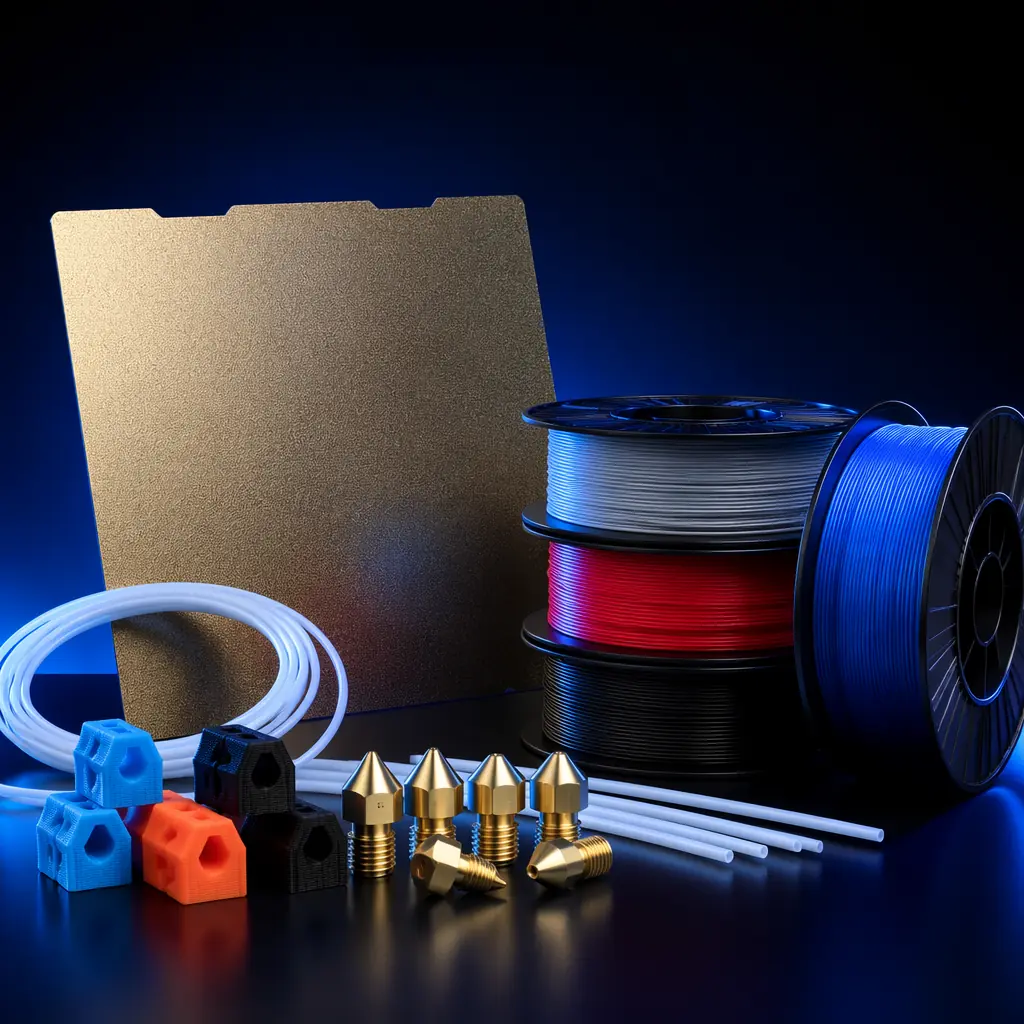
Here's the number that separates profitable 3D printer distributors from those running on fumes: a standalone printer sale earns 18–25% margin. The same printer sold with a consumables and accessories bundle earns 35–45% blended margin — and converts a one-time transaction into a relationship that generates revenue every 90 days. The difference is not the printer. The difference is what's inside the second box.
Most distributors treat accessories as an afterthought — a checkbox on the product page, a "customers also bought" widget, maybe a spare nozzle tossed in the shipment as goodwill. That approach leaves 60–70% of the available margin on the table. This guide lays out the bundling strategy that turns every printer SKU into a channel for consumables revenue, with tier-by-tier bundle designs, pricing psychology that makes customers opt in willingly, and the replenishment cycle mechanics that keep them coming back.
Why Accessories Bundling Is Your Highest-Margin Revenue Stream
The economics are stark. A Precise3D Start S1 at wholesale carries roughly a 20% margin for the distributor. A hardened steel nozzle kit at wholesale carries 60%. A PEI build plate carries 55%. A 4-spool filament sampler carries 45%. When you bundle them together, the blended margin pulls upward dramatically — and the customer perceives the bundle as a convenience, not an upsell, because they need these items to use the printer.
Consider the math on a single $400 printer sale:
- Printer only: $400 retail, $320 wholesale cost, $80 margin, 20% margin rate
- Printer + $95 accessories bundle: $495 total retail, $364 total cost (printer at $320 + accessories at $44), $131 margin, 26.5% blended margin
- The accessories alone contribute $51 margin at 54% — that is 39% of the total profit on 19% of the revenue
Scale this across 200 printer sales per month and the accessories line alone generates $10,200 in additional gross profit — $122,400 annually — without acquiring a single new customer. This is not theoretical. Distributors who implement structured bundling report 22–35% increases in average order value within the first quarter. The nozzle and hotend consumables category alone represents a $15–45 annual replenishment cycle per active printer — and that cycle starts the moment the customer burns through their first brass nozzle.
The Anatomy of a High-Conversion Accessories Bundle
Not all bundles convert equally. A bundle thrown together from random SKUs performs worse than no bundle at all — it creates decision fatigue and makes the customer question whether they're being sold items they do not need. The bundles that convert at 40%+ attach rate follow three principles.
Principle 1 — Immediate consumability.
Every item in the bundle must be something the customer will use within the first 30 days of owning the printer. A spare hotend assembly is a great accessory but a terrible bundle item for an entry-level buyer — they will not need it for 6–12 months. A nozzle variety pack, by contrast, gets used in week one when the customer wants to try printing with different layer heights. The 30-day rule is the single biggest predictor of whether a bundle drives repeat purchases: if the customer uses the bundle items quickly, they run out quickly, and they come back to reorder.
Principle 2 — Perceived discount without margin destruction.
The bundle price should be 10–15% below the sum of individual MSRPs. This creates a clear "I am saving money" signal without eating into the distributor's actual margin, because the bundled items carry 45–60% margin individually. Even at a 15% bundle discount, the blended margin on accessories stays above 40%. The key psychological mechanism: customers anchor on the individual prices they see listed on your site, then evaluate the bundle against that sum — not against your wholesale cost.
Principle 3 — Single-SKU simplicity.
The bundle is one product with one SKU, one price, one inventory line. This matters more than most distributors realize. A bundle presented as "add these 5 items to cart" converts at 8–12%. The same items presented as one pre-configured bundle with one "add to order" button converts at 25–40%. The difference is cognitive load: five decisions versus one. Pre-configuration removes the mental math and lets the customer evaluate a single value proposition.
Tier-by-Tier Bundling Strategy: Entry vs Prosumer vs Professional
Different customer segments consume accessories at different rates and value different items. A one-size-fits-all bundle leaves money on the table at both ends: entry-level buyers feel upsold, professional buyers feel underserved. The solution is a three-tier bundle architecture that matches bundle contents to the printer tier and the customer's usage pattern.
The Starter bundle targets the customer who just bought their first 3D printer. Every item is consumable within 60 days: the brass nozzles wear out, the PLA spools get printed, the PEI sheet eventually loses adhesion. The bundle price of $49 against individual MSRPs of roughly $58 creates a clear save-$9 signal. At 55% margin, this bundle generates $27 in gross profit — on top of the printer margin. And because the customer burns through these items fast, they are back on your site within 8 weeks. That is when the real monetization begins: the second order is typically 2–3× larger than the first because the customer now knows what they consume.
The Pro bundle is designed for the customer who prints regularly and experiments with materials — the kind of user who burns through a brass nozzle in two weeks and wants to try PETG and TPU. The hardened steel nozzles last 4–5× longer than brass but still wear — and when they do, the customer comes back specifically to you because they trust the bundle quality. The engineering filament sampler serves double duty: it satisfies immediate curiosity and creates demand for reorders when the customer finds a material they want to print more of.
The Enterprise bundle targets print farm operators and educational institutions running 5–50+ printers. These customers consume filament by the case and nozzles by the dozen. The bundle is priced as a bulk discount but still carries 58% margin — higher than Starter because the volume discounts on wholesale cost are proportionally larger at these quantities. The filament dryer in this bundle is strategic: it is a durable good that locks the customer into your ecosystem. Once they own your dryer, they are statistically 3× more likely to reorder filament from you rather than shop competitors — the compatibility heuristic kicks in.
Pricing Psychology: How to Price Bundles So Customers Feel They Are Winning
The most profitable bundle is the one the customer chooses voluntarily — not the one they feel pushed into. Pricing psychology makes the difference between a 12% attach rate and a 40% attach rate, even when the bundle contents are identical.
The decoy effect in action.
Always present three options: printer only, printer + Starter bundle, printer + Pro bundle. The printer-only option anchors at the lowest price point. The Pro bundle anchors at the highest. The Starter bundle sits in the middle and becomes the obvious choice for most buyers — it is only $49 more than the printer-only option but delivers clearly more value. This is not manipulation; it is choice architecture. Customers who see three options feel they made an informed decision. Customers who see one bundle feel they are being upsold.
Savings framing vs cost framing.
Present the bundle as "Save $9 vs buying separately" rather than "Add for $49." The former triggers loss aversion — the customer perceives they are avoiding a loss by not buying individually. The latter triggers cost evaluation. In A/B tests across e-commerce platforms, savings framing outperforms cost framing by 18–26% on bundle attach rates. Apply this consistently: on the product page, in the checkout flow, in email follow-ups.
The "already spending" heuristic.
When a customer has committed to a $400 purchase, an additional $49 feels psychologically small — roughly 12% of the primary purchase. Behavioral economists call this the relative spending threshold: once a customer crosses the major purchase decision, smaller add-ons are evaluated less critically. The bundle should be presented immediately after the printer selection, before the customer enters payment details, while the spending threshold is still anchored at $400. The pricing and margin strategy behind this positioning is well-documented: the bundle is not an upsell, it is a completion of the purchase.
The Consumables Replenishment Cycle: Turning One-Time Buyers Into Repeat Customers
The bundle is not the end of the revenue stream — it is the beginning. Every item in a well-designed bundle has a predictable consumption rate, and those rates create natural reorder triggers.
These consumption rates create a natural reorder calendar. A customer who bought the Starter bundle with a brass nozzle 5-pack and 2 PLA spools will exhaust their nozzles in roughly 200–400 print hours — about 8–12 weeks for a casual user, 3–4 weeks for an enthusiast. The PLA spools deplete even faster. The PEI build plate lasts longer but eventually loses adhesion, especially if the customer prints PETG without a release agent.
The key to capturing these reorders is timing. Send a reorder reminder email at 70% of the estimated consumption window — not at 100%. At 70%, the customer still has some stock, so the email feels helpful ("You are probably running low on nozzles — reorder before you run out") rather than pushy. At 100%, the customer is already out of stock and may have already ordered from a competitor out of urgency. The window between "running low" and "ran out" is where reorder capture rates are highest — typically 25–35% for well-timed email campaigns.
For print farm customers, automate this entirely. Set up a subscription SKU: "Farm Replenishment — Monthly" at a 10% discount off individual bundle pricing. The discount is offset by the predictability — you can bulk-order wholesale with confidence, improving your own margins. A 50-printer farm on a $249 monthly subscription generates $149,400 in annual recurring revenue at 58% margin — $86,652 in gross profit from one customer relationship. The post-processing consumables can be layered into the same subscription model, creating an even stickier relationship.
Real Numbers: What a $400 Printer Sale Looks Like With and Without Accessories
Let us ground this in actual numbers. The table below compares three scenarios for a distributor selling 200 printers per month — the minimum scale where structured bundling becomes a competitive advantage.
The difference between Passive Bundling and Structured Bundling is $23,808 per year in additional gross profit — from the same 200 monthly printer sales, with the same customer acquisition cost, using the same warehouse and shipping infrastructure. The only variable that changed is whether the accessories are presented as a structured, tiered, pre-configured bundle versus an optional add-on.
And this does not include replenishment revenue. In the Structured Bundling scenario, roughly 25% of those 80 monthly bundle buyers will reorder consumables within 90 days at an average order value of $35. That is an additional $700/month in pure consumables reorder GM — $8,400/year — from customers you already acquired. Layer this across 12 months and the cumulative effect is compounding: month-1 bundle buyers become month-4 reorder customers, month-2 bundle buyers become month-5 reorder customers, and the pipeline fills steadily.
Implementation Playbook: From First Printer Sale to Full-Service Supplier
Building a bundling program is not a website update. It is an operational change that touches product data, warehouse picking, marketing, and customer communication. Here is the 4-week implementation sequence that gets you from zero to structured bundling without disrupting existing operations.
Week 1 — SKU creation and sourcing.
Create the three bundle SKUs in your inventory system. Source the individual components at bundle-scale wholesale quantities — this is where you negotiate better per-unit pricing because you are committing to higher volumes. A nozzle 5-pack at 1,000-unit monthly volume should cost 15–20% less per unit than at 100-unit monthly volume. The bundle SKU is a single line item that triggers internal pick-lists for the individual components; your warehouse team picks the components, places them in a single branded box, and ships as one unit.
Week 2 — Product page integration.
Add the bundle as a variant or add-on option on each printer product page. Position it immediately after the printer selection, before the "add to cart" button. Use the three-option architecture: printer only, printer + Starter bundle, printer + Pro bundle. Display the savings in dollar terms relative to individual MSRP. Include a visual comparison of what is in each bundle versus buying separately.
Week 3 — Post-purchase automation.
Set up the reorder email sequence. Trigger 1: 7 days after delivery, a "getting started" email that references the bundle items and links to usage guides. Trigger 2: at 70% of the estimated consumption window for the fastest-depleting item in the bundle (typically PLA filament at ~20 print-hours per spool), a reorder reminder with a one-click reorder link. Trigger 3: at 120% of the consumption window for the second-fastest item (typically brass nozzles), a "don't run out" email with a small loyalty discount. These emails should be automated — no manual intervention required once configured.
Week 4 — Measure, iterate, expand.
Track three metrics: bundle attach rate (target: 35%+), reorder rate within 90 days (target: 25%+), and average reorder value (target: 1.5× the initial bundle value). If attach rate is below 25%, test pricing — reduce the bundle discount by $5 or increase it by $5 and measure the effect. If reorder rate is below 15%, pull the reorder trigger earlier — at 60% of estimated consumption window instead of 70%. The numbers will vary by market and customer segment; the key is to treat bundling as an optimization engine, not a set-and-forget program.
Once the bundling program is stable at 200+ monthly printer sales, add a fourth tier: the Industry Vertical Bundle. This is a specialized bundle tailored to a specific use case — an Education bundle (5× PLA spools in 8 colors, 10× build plates, classroom safety guide), a Dental Lab bundle (resin + IPA + curing station + wash station), a Prototyping bundle (engineering filament sampler + precision nozzle set + calipers). Vertical bundles command 5–10% higher margin than generic bundles because the specialization justifies premium pricing, and the customer perceives the curation as expertise rather than upselling.
The distributors who win in the 3D printer market over the next five years will not be the ones with the lowest printer prices. They will be the ones who understand that a printer is a platform — and the platform's value is realized through the consumables, accessories, and replenishment cycles that orbit around it. The bundle is how you capture that orbit from day one. Every printer you sell without a bundle is a customer you are giving to a competitor — because when that customer needs their first nozzle replacement, they will search for it. Make sure they search for you.
Reviewed by the Precise3D engineering & OEM team. Compliance files that accompany the catalog are auditable at the certification register.