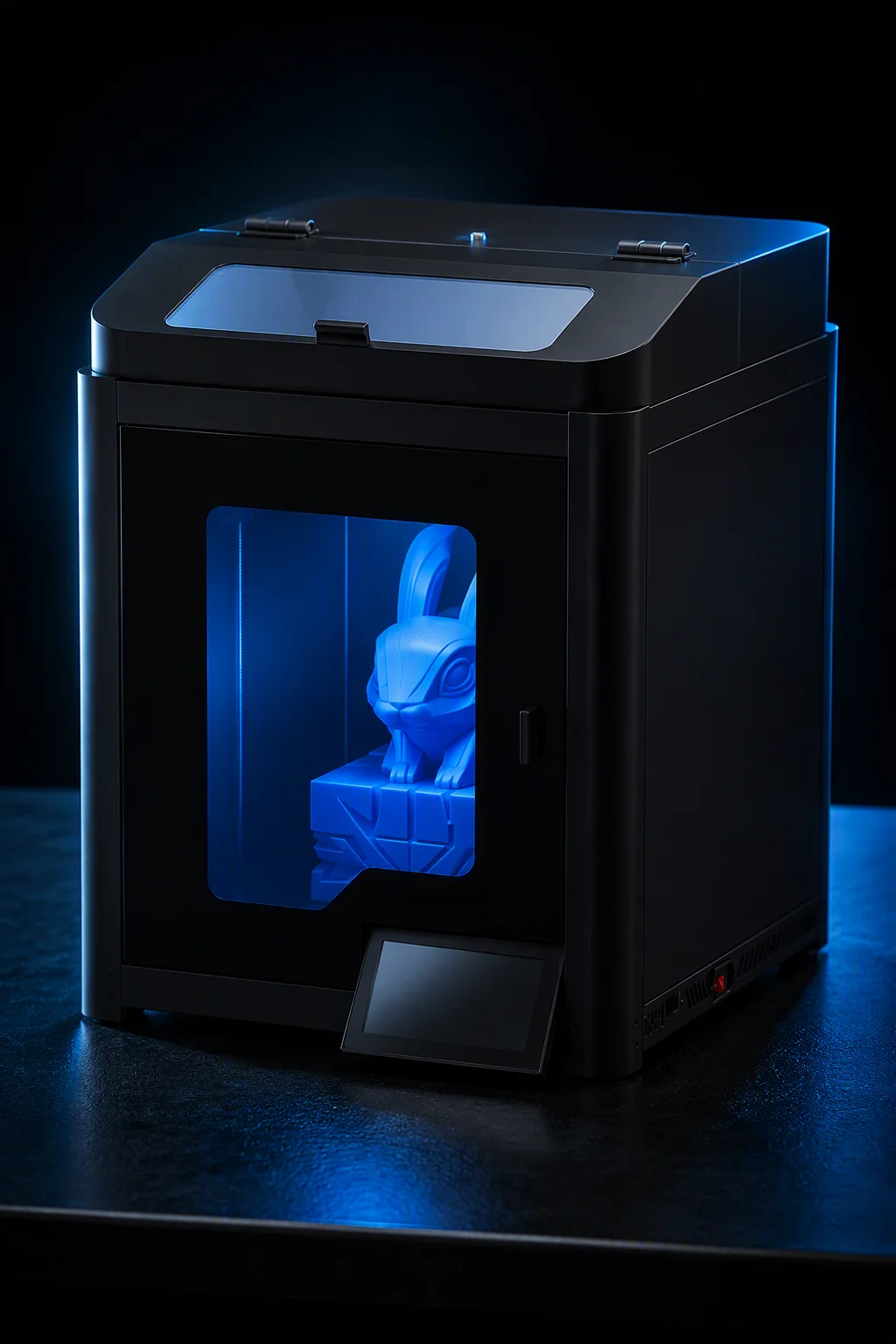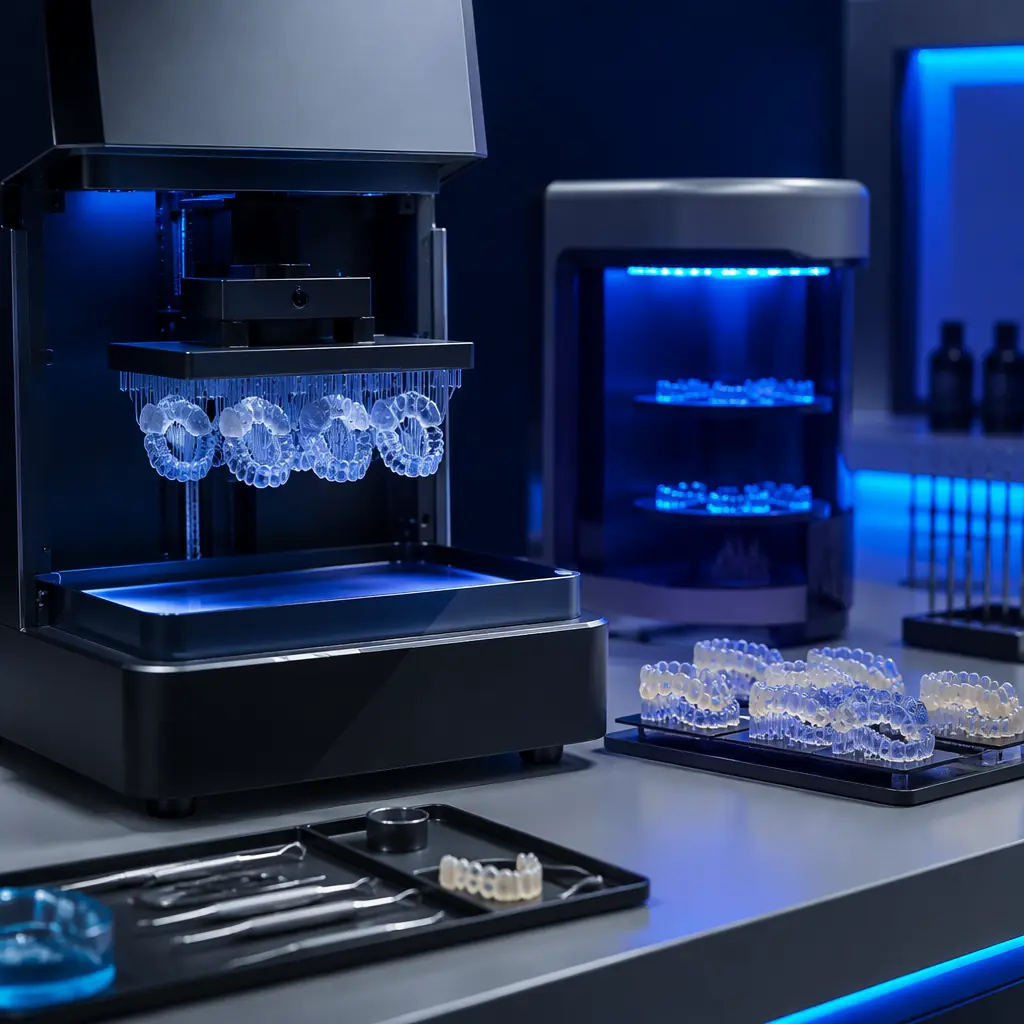
Dental labs don't buy 3D printers the way hobbyists or even engineering firms do. A hobbyist evaluates build volume and print speed. A dental lab evaluates biocompatibility certification, dimensional accuracy within 50 microns, and validated workflow integration with their existing scanner-to-print pipeline. The printer is not the product — it's one component in a regulated medical device manufacturing workflow, and the sale succeeds or fails based on whether the distributor understands that workflow. At Precise3D, we've seen resin printer unit sales to dental labs grow 3.2× year-over-year across our distributor network — faster than any other vertical — with average order values 2.5× higher than consumer-channel equivalents because each printer sale carries $800–2,500 in companion resin and post-processing equipment.
This guide covers the dental 3D printing application landscape, the resin-vs-FDM decision framework, biocompatible material certifications distributors must understand, printer selection criteria for dental labs, and the margin structure that makes dental the most profitable vertical for distributors who invest in the technical knowledge to serve it. If you're already distributing resin printers for the consumer or prototyping markets, the dental channel uses the same hardware platform — what changes is the material qualification, the workflow validation, and the sales conversation. This guide is about that conversation.
Why Dental Is the Highest-Margin Vertical in 3D Printing Distribution
The consumer 3D printer market is a race to the bottom on price. The dental 3D printer market is a race to the top on certification and workflow integration — and that structural difference creates a margin profile that no other vertical can match.
Market size and trajectory:
The global dental 3D printing market was valued at approximately $2.1 billion in 2024 and is projected to reach $5.8–7.2 billion by 2030, driven by the digitization of dental workflows, the explosion of clear aligner therapy (Invisalign alone processes 1.5+ million cases annually), and the replacement of manual analog processes — stone model pouring, wax-up fabrication, flask-and-pack denture production — with digital scan-to-print pipelines. The US market alone has approximately 12,000 dental laboratories, of which 55–65% have adopted at least one digital workflow component (intraoral scanner, CAD software, or 3D printer). The remaining 35–45% are actively evaluating adoption — and they need a distributor who can sell them a complete workflow, not a box.
Why margins are structurally higher:
A consumer buying a resin printer on Amazon compares three models based on build volume and price, picks the cheapest, and buys third-party resin from a different vendor. A dental lab buying a resin printer is buying into a validated workflow — a specific printer model with a specific resin formulation that has been tested for a specific application (surgical guides, models, splints) and carries the appropriate biocompatibility certification. Once a lab validates a printer-resin combination for their workflow, switching costs are high: re-validation requires time, printed samples sent to a testing lab, and regulatory documentation updates. The result is sticky recurring revenue: a lab that buys a $2,500 printer will purchase $300–600/month in proprietary resin from the same distributor for years. This is the opposite of the consumer printer model, where hardware margin is competed to zero and filament is a commodity. In our distributor pricing and margin guide, we break down the unit economics across printer tiers — dental occupies its own tier with margins that reflect the certification premium.
The Dental 3D Printing Application Matrix: What Gets Printed and Which Technology Prints It
Not all dental applications are printed the same way — and one of the fastest ways to lose credibility with a dental lab is to recommend FDM for surgical guides or resin for diagnostic models where FDM is sufficient. The application determines the technology, and the technology determines the printer you sell. Here is the complete matrix.
The key insight for distributors:
the high-value applications — surgical guides, crowns, splints, dentures — are 100% resin. FDM's role in the dental lab is limited to low-accuracy, non-patient-contact applications: diagnostic models for treatment planning discussions (not for fabrication), custom impression trays, and articulator mounts. This means a distributor entering the dental market must lead with resin printers — LCD or DLP technology — and build FDM as a secondary, lower-cost add-on for the model-production volume that doesn't require resin-level accuracy. Our FDM vs resin comparison guide covers the technical tradeoffs in detail; the dental-specific summary is that for anything touching a patient's mouth, resin is mandatory.
Biocompatible Resins: The Certification Barrier That Protects Margins
The single most important word in dental 3D printing sales is biocompatible. A resin printer that makes beautiful models is worth $400. The same printer, loaded with a validated biocompatible resin that carries the right certifications, is worth $3,000 — and the difference is entirely in the regulatory documentation.
What "biocompatible" actually means for 3D printing resins:
A biocompatible resin has been tested to ISO 10993 standards for cytotoxicity, sensitization, and irritation — proving it does not cause adverse biological reactions when in contact with human tissue. For dental applications, the specific standards that matter are:
Class I (short-term mucosal contact, <24 hours):
ISO 10993-5 (cytotoxicity) and ISO 10993-10 (sensitization/irritation). This covers surgical guides, splints, night guards, and custom impression trays — devices that contact oral mucosa for minutes to hours. Most dental 3D printing resins on the market target this classification. It's the minimum bar for selling into dental labs.
Class II (long-term mucosal contact, >24 hours to 30 days):
Additional testing for ISO 10993-5 with extended exposure duration. Covers temporary crowns and bridges worn for days to weeks, and indirect bonding trays. Fewer resins qualify at this level, which means higher per-liter pricing and stronger vendor lock-in — both good for distributor margins.
Class IIa/IIb (long-term, >30 days):
Full ISO 10993 panel including genotoxicity, systemic toxicity, and implantation testing. Required for permanent crowns, bridges, inlays, onlays, and denture base materials. This is the highest regulatory bar — and the resins that clear it command prices of $300–800 per liter, compared to $50–80/L for non-biocompatible standard resins. For the distributor, a single dental lab consuming 4–6 liters per month of Class IIa resin at $400/L generates $1,600–2,400/month in recurring consumable revenue at 25–35% gross margin — $480–840/month in margin from consumables alone, per lab. Our consumables bundling guide covers how to structure resin supply agreements that create predictable recurring revenue streams.
FDA 510(k) and CE marking:
In the US, dental 3D printing resins used for patient-contact applications typically require FDA 510(k) clearance as a Class II medical device material. In the EU, CE marking under the Medical Device Regulation (MDR 2017/745) is required. A distributor selling into the dental market must be able to provide the resin manufacturer's 510(k) number or CE certificate on request — dental labs are audited and they will ask. If you cannot produce these documents, the sale stops. For the compliance documentation infrastructure that supports these sales, see our certification compliance guide.
Notice the counterintuitive dynamic: as resin price per liter increases 5–10×, monthly volume decreases — but annual recurring revenue increases because the margin percentage holds and the absolute dollars per liter are higher. A lab using 4 liters/month of a $400/L Class II resin generates more annual consumable revenue than a lab using 10 liters/month of $60/L standard resin. This is the opposite of the consumer market, where volume is the only lever. In dental, certification quality drives revenue per account, not volume. For distributors, this means fewer, higher-quality lab accounts produce more revenue than a larger base of low-end users — a counterintuitive dynamic that rewards sales teams who target the right labs.
Printer Selection for Dental Labs: The 5 Specifications That Matter
Dental lab buyers evaluate 3D printers differently from any other customer segment. Here are the five specifications that actually drive purchasing decisions — and the ones that don't matter in a dental context.
1. XY resolution (pixel size), not build volume: A consumer printer markets itself as "10-inch build volume." A dental resin printer is evaluated on its LCD screen pixel size — typically 28–50 μm for dental-grade machines. The pixel size directly determines the minimum feature size the printer can resolve, which in turn determines whether surgical guide margins print cleanly, whether crown margins seat without gaps, and whether aligner models reproduce the precise tooth geometry needed for thermoforming. Dental labs don't care about printing a 200mm-tall vase; they care about printing 20 dental arches simultaneously with consistent accuracy across the entire build plate. The relevant metric is XY pixel pitch, and the dental standard is 35 μm or better. Our resin printer distribution guide covers the LCD/DLP technology landscape in detail.
2. Light source uniformity across the build plate: LCD-based resin printers use a UV LED array behind an LCD mask. If the UV illumination is not uniform — brighter in the center, dimmer at the edges — parts printed at different positions on the build plate will have different dimensional accuracy. A surgical guide printed at the center may fit perfectly; the same guide printed at the corner may not seat. The dental solution is a collimated light source (a Fresnel lens or lens array above the LED matrix that parallelizes the light rays), which delivers uniform intensity across the entire build area. This is the difference between a $400 consumer resin printer and a $2,500 dental resin printer that share the same LCD resolution spec. When auditing a printer for dental use, print identical calibration cubes at the center and all four corners of the build plate, measure with a micrometer, and reject any printer with >20 μm variation corner-to-center.
3. Heated resin vat for consistent viscosity: Resin viscosity changes with temperature — and viscosity changes affect print accuracy. A resin that flows perfectly at 25°C may become too viscous to properly recoat between layers at 18°C (a typical lab temperature in the morning before equipment warms the room). Dental-grade resin printers incorporate a heated resin vat (typically 25–35°C, thermostatically controlled) to maintain consistent resin viscosity regardless of ambient lab temperature. This is not a nice-to-have — for labs printing overnight batches of aligner models where a single failed print wastes 4–6 hours of production time, vat heating is the difference between waking up to 20 finished arches and waking up to a failed build plate. See our heated chamber guide for the temperature control technologies that apply across printer types.
4. Open material system vs locked ecosystem: Some dental 3D printer manufacturers lock their printers to proprietary resins through RFID chips or software DRM. This guarantees recurring resin revenue for the manufacturer — but it's a hard sell to dental labs, who want the flexibility to validate new resins as better materials enter the market. An open material system that accepts any 405nm UV resin is more attractive to labs and gives the distributor more flexibility in resin bundling — you can offer the printer with a starter resin kit and let the lab choose their ongoing material supplier. The tradeoff: open-system printers require the distributor to provide more technical support around resin validation (exposure time calibration, build plate adhesion testing), while locked systems offload that support burden to the manufacturer. For distributors building long-term dental lab relationships, the open-system approach wins — it positions you as a workflow consultant, not a box-mover.
5. Post-processing workflow integration: A resin print comes off the printer covered in uncured liquid resin. It needs washing (isopropyl alcohol or a dedicated wash station), support removal, and post-curing (UV or LED curing chamber) before it's ready for use. Dental labs evaluate the total workflow time, not the print time. A printer that prints a full build plate of models in 45 minutes but requires 30 minutes of manual post-processing is less productive than a printer that prints in 60 minutes but integrates with an automated wash-and-cure station that processes the build plate in 10 minutes with one button press. When selling into dental labs, the conversation must cover the complete workflow: printer + wash station + cure station + resin + IPA + disposal. Selling just the printer is selling an incomplete solution. Our post-processing guide covers the wash-and-cure equipment landscape in detail.
Entering the Dental Channel: The 3-Phase Distributor Playbook
You don't need to become a dental technician to sell into dental labs. You need to understand their workflow well enough to ask the right questions, qualify the right printer-resin combinations, and position yourself as a workflow partner rather than a hardware vendor. Here is the three-phase entry playbook that has worked across Precise3D's distributor network.
Phase 1 — Product qualification (Month 1–2):
Select 1–2 resin printer models with 35 μm or better XY resolution, collimated UV light source, and heated vat. Qualify them with 2–3 biocompatible resins — at minimum, one Class I resin for surgical guides and splints, and one model resin for orthodontic/diagnostic models. Print validation samples (surgical guide, full-arch model, crown die) on each printer-resin combination, measure accuracy with a calibrated micrometer, and document the results in a one-page validation sheet. This validation sheet is your most important sales asset — it tells the lab "we have done the homework so you don't have to." Labs buy validated workflows, not spec sheets.
Phase 2 — Pilot lab program (Month 2–4):
Identify 3–5 dental labs in your region that are early in their digital adoption journey — labs that have an intraoral scanner or are considering one, but haven't yet brought 3D printing in-house. Offer a 30-day pilot: printer on loan, starter resin kit, and one day of on-site setup and training. The pilot de-risks the purchase for the lab and gives you real-world workflow data — how many models per day they print, which applications drive the most volume, what resin consumption looks like in practice. Use this data to refine your pricing model (hardware + monthly resin subscription) and build case studies. A single successful pilot with a respected local lab is worth more than any amount of cold outreach. For foundational distributor business setup, see our distributor startup guide.
Phase 3 — Scale through industry partnerships (Month 4+):
Dental is a relationship-driven industry. The most effective channel for distributor growth is not direct sales to labs — it's partnerships with the companies labs already buy from: dental supply distributors (Benco, Patterson, Henry Schein in the US; regional equivalents in other markets), intraoral scanner manufacturers (3Shape, Medit, iTero), and dental CAD software providers (exocad, 3Shape Dental System). These companies have existing relationships with thousands of labs and a sales force that visits labs weekly. A partnership where they bundle your validated printer-resin workflow into their scanner or software sale is a force multiplier that no amount of direct sales hiring can match. The economics: offer the partner a 10–15% referral commission on hardware and a 5–10% ongoing commission on resin reorders. They monetize their existing lab relationships; you acquire customers at zero customer acquisition cost. Our portfolio strategy guide covers how to structure multi-channel distribution across verticals.
The Unit Economics: What a Dental Lab Account Is Worth
Let's put numbers on the opportunity. A mid-size dental lab serving 20–30 dentists will typically operate 2–4 resin printers and consume 4–8 liters of resin per month across model, surgical guide, and splint applications. Here is the five-year revenue projection for a single lab account.
The numbers tell a clear story: hardware is 15–20% of lifetime account value; consumables are 70–75%. A distributor with 20 dental lab accounts generating an average of $7,500/year in gross margin each is running a $150,000/year gross margin business from 20 relationships. That's the structural advantage of dental over consumer: fewer accounts, higher value per account, recurring revenue that compounds. For comparison, a consumer-focused distributor might need 200+ active accounts to generate the same margin — with 10× the support burden.
Competing Against Established Dental 3D Printing Brands
3D Systems (NextDent), Stratasys (Origin One), SprintRay, and Formlabs (Form 3B/4B) dominate the dental 3D printing market — but their position creates an opening for distributors who can offer a competitively priced, open-material alternative.
The incumbents' weakness:
Locked material ecosystems. SprintRay and Formlabs Dental require labs to use proprietary resins priced at $250–500/L, with RFID-locked cartridges that prevent third-party material use. A lab operating 3 printers and consuming 6 liters/month at $350/L spends $25,200/year on resin alone — and has zero ability to switch suppliers or negotiate pricing. This is the vulnerability that open-system printers exploit: offer equivalent print quality with an open material platform, and the lab can source validated biocompatible resin at $150–250/L from independent manufacturers — saving $7,200–14,400/year in material costs. The savings pay for the printer in 6–12 months. This is the value proposition that wins dental accounts from incumbents, and it's one that only distributors offering open-system printers can deliver.
What the incumbents still do better:
Clinical validation depth. SprintRay has published clinical studies demonstrating the accuracy of their surgical guide workflow. Formlabs has FDA 510(k) clearance for specific printer-resin combinations with documented clinical outcomes. A distributor selling an open-system alternative cannot match this level of clinical validation — but they can compete on workflow economics and flexibility. The labs that switch are the mid-tier labs that value material freedom and per-unit cost over brand-name clinical validation. The top-tier labs doing complex full-arch implant cases will stay with the incumbents. That's fine — the mid-tier market is 80% of the addressable labs, and it's growing faster as digital adoption moves downmarket.
Bottom Line
Dental 3D printing is not a side market for distributors — it's the highest-margin vertical in the industry, and it's still in the early majority phase of adoption. The 35–45% of dental labs that haven't yet adopted in-house 3D printing are evaluating their options right now. They're looking for a distributor who can sell them a validated workflow — the right printer, the right resin, the right post-processing setup, and the right certification documentation — not a spec sheet and a price.
The distributors who invest the time to understand biocompatibility classifications, qualify printer-resin combinations, and build relationships with dental supply partners now will own this channel when the remaining 5,000+ labs in the US alone — and tens of thousands globally — make the digital transition over the next five years. Each lab relationship is worth $120,000+ in lifetime revenue with 70% recurring from consumables. Twenty such relationships is a $2.5 million business built on selling a consumable that labs reorder monthly, for a workflow they cannot easily switch once validated, in a market growing at 22% CAGR. At Precise3D, our LCD resin printer platform — with 35 μm XY resolution, collimated UV light source, heated vat, and open material compatibility — is designed for the dental lab workflow: accurate enough for surgical guides, productive enough for full-arch model batches, and open enough that labs control their own material costs. Because in dental, the printer is the entry point. The resin is the business.
Reviewed by the Precise3D engineering & OEM team. Compliance files that accompany the catalog are auditable at the certification register.
Enter the Dental Market
Ready to Bring Dental 3D Printing to Labs in Your Region?
Join our network of global distributor network. Dental-qualified resin printers with 35 μm accuracy, biocompatible resin partnerships, validation documentation, and workflow training — everything you need to capture the fastest-growing vertical in additive manufacturing.