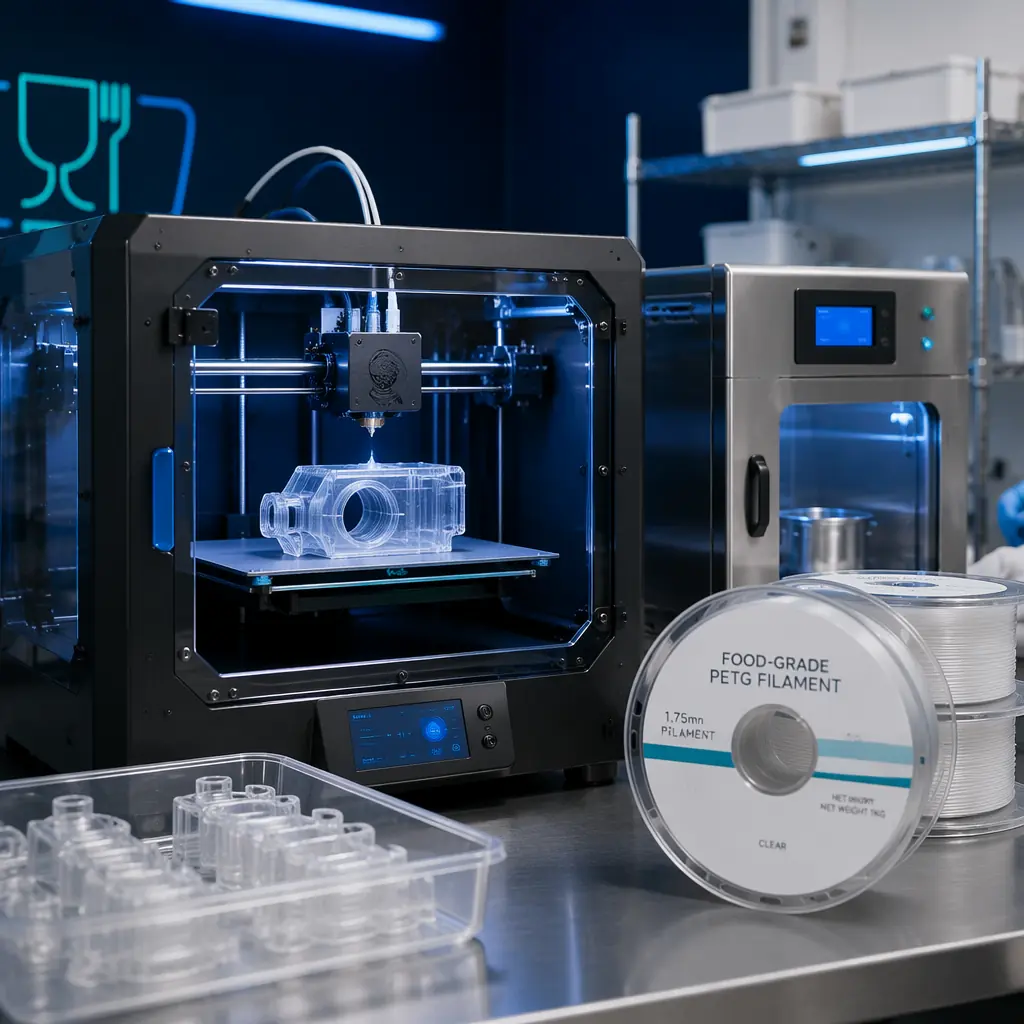
The food-contact 3D printing opportunity is invisible to most distributors because the word "food-safe" triggers immediate liability concerns — and rightfully so. An FDM 3D printed part is porous by nature: the layer lines create microscopic crevices where bacteria can colonize, moisture can accumulate, and cleaning chemicals can linger. But three developments have changed the equation: the availability of genuinely food-contact-grade filaments with FDA and EU compliance documentation, the maturation of post-processing protocols that seal FDM surfaces to a food-contact standard, and the growing body of industry-specific guidance (the EU's 2023 JRC technical report on 3D printing food-contact materials, and FDA's evolving stance on AM-produced food-contact articles). This guide is structured around the regulatory reality: every claim a distributor makes about "food-safe" carries legal weight, so precision matters more than marketing language. For the certification framework that applies across industries, see our certification compliance guide.
The Regulatory Landscape: Three Frameworks Every Distributor Must Know
Food-contact regulations are jurisdiction-specific and non-negotiable. A distributor selling printers into a US bakery chain and a German food manufacturer is operating under two different regulatory frameworks with different testing requirements, different approved substance lists, and different documentation obligations:
The distributor's liability boundary is clear: you are responsible for the claims you make about the printer-filament combination's suitability for food-contact use. If you say "this printer and this filament produce food-safe parts," you are making a representation that should be backed by the filament manufacturer's Declaration of Compliance and, ideally, third-party migration testing on parts printed with your recommended parameters. The safest position — and the most defensible one in a customer conversation — is: "Filament X has FDA 21 CFR compliance documentation from its manufacturer. When printed on Printer Y with the validated profile parameters we provide, the material properties documented in the compliance statement are preserved. Post-processing protocol Z is required to achieve a cleanable surface finish. The end user is responsible for validating the specific application under their intended use conditions." This is not weasel language — it is the accurate legal boundary. For quality systems that support this, see our factory audit guide.
Food-Safe Materials: What Actually Qualifies
The material is the starting point, not the finish line. A filament with FDA-compliant raw resin does not automatically produce FDA-compliant printed parts — because the printing process itself introduces variables: the hotend path (brass nozzles may contain lead, stainless steel is required for food contact), the extrusion temperature (which can degrade polymers and create non-compliant decomposition products), and the layer adhesion structure (which creates the porosity problem). Here is the material landscape for FDM food-contact printing:
The filament supplier's documentation is everything. A distributor should require from their filament supplier: a written Declaration of Compliance referencing the specific FDA or EU regulation, the test report showing overall migration testing results under the relevant simulant conditions (10% ethanol for aqueous foods, 3% acetic acid for acidic foods, olive oil or 95% ethanol for fatty foods), and the specific printing parameters under which the compliance statement is valid. A filament supplier that cannot provide all three is not a food-grade supplier, regardless of what their product page claims. For the complete filament evaluation framework, see our filament quality evaluation guide.
Post-Processing: The Step That Makes or Breaks Food-Safe Claims
An as-printed FDM surface is never food-safe — regardless of the filament — because it is not cleanable. The layer lines create a surface roughness (Ra) of 15–30µm with deep crevices between layers that trap food residue and resist cleaning. Making an FDM part food-contact-compliant requires post-processing to produce a non-porous, cleanable surface. The three validated methods:
1. Vapor Smoothing (for PETG and ABS-like materials)
Ethyl acetate or acetone vapor smoothing dissolves and re-flows the surface layer, reducing Ra from 20µm to 2–4µm — a smooth, non-porous finish. The process takes 15–30 minutes in a controlled vapor chamber. The critical post-smoothing step: the part must be fully degassed (minimum 24 hours at room temperature or 4 hours at 50°C with active ventilation) before food contact, because residual solvent constitutes a chemical migration risk. See our post-processing guide for the full vapor smoothing protocol.
2. Epoxy Coating (for any FDM material)
A food-grade two-part epoxy coating (certified to FDA 21 CFR 175.300 for resinous and polymeric coatings) applied at 0.2–0.5mm thickness completely seals the FDM surface. The coating must be formulated for food contact, fully cured per manufacturer specification (typically 24–72 hours), and verified as pinhole-free under inspection. This is the most robust solution because it decouples the printed material from the food-contact surface entirely — the food only contacts the epoxy, not the printed part underneath.
3. Annealing + Surface Sealing (for high-temp materials)
For PEI and PP parts, annealing at the material's crystallization temperature for 2–4 hours improves interlayer adhesion and reduces porosity. Combined with a food-grade silicone or PTFE-based surface sealant, this achieves a cleanable surface while preserving the high-temperature durability that makes these materials valuable in commercial food processing.
The Nozzle Problem: Why Brass Is Not Food-Safe
Standard brass nozzles contain 2–4% lead for machinability. At FDM extrusion temperatures (200–260°C), trace lead migration into the printed part is a documented risk — especially with acidic filaments or during prolonged contact with acidic foods. The solution is straightforward: stainless steel or hardened steel nozzles for any printer sold into food-contact applications. A stainless steel nozzle adds $15–$25 to the printer cost and eliminates the lead migration risk entirely. Distributors should stock stainless steel nozzles as a standard upsell for food-contact customers and document the nozzle material on the compliance documentation package. For the full nozzle guide, including hardened options for abrasive food-grade filaments, see our nozzle and hotend guide.
The Distributor's Food-Safe Bundle
The minimum viable food-safe 3D printing offering — what a distributor needs to sell credibly into food-contact applications:
- One enclosed FDM printer with stainless steel nozzle pre-installed, capable of PETG and PP. Retail price $800–$3,000. Enclosure reduces particulate contamination from ambient environment — a GMP consideration.
- Two filament SKUs: FDA-compliant food-grade PETG (general food contact, dry/cold) and food-grade PP (hot/liquid/wet contact, dishwasher-safe). Both with manufacturer Declaration of Compliance.
- Post-processing starter kit: Food-grade epoxy coating kit (FDA 21 CFR 175.300 certified, $40–$60 retail) or vapor smoothing chamber ($200–$400). Include printed instructions with cure time chart and verification checklist.
- Compliance documentation template: A one-page document the distributor fills out for each customer, listing the printer model, nozzle material, filament lot number, print profile parameters, and post-processing method used. This is the distributor's liability record — keep a copy for every customer transaction.
- Customer disclaimer: A written statement that compliance documentation covers the material and process, and the end user is responsible for validating the specific food-contact application under their intended use conditions and regulatory jurisdiction.
The total initial investment for a food-safe distribution line is approximately $2,000–$5,000 including demo printer, filament inventory, and post-processing supplies. Average food-contact customer order value: $3,500–$8,500 for a complete print-and-post-process workstation. Recurring revenue from food-grade filament and epoxy coating refills: $800–$2,000/customer/year. For the consumables bundling strategy that maximizes recurring revenue, see our consumables bundling guide.
Reviewed by the Precise3D engineering & OEM team. Compliance files that accompany the catalog are auditable at the certification register.
Food-Safe 3D Printing
Add Food-Grade Capability to Your 3D Printer Portfolio
Precise3D offers enclosed FDM printers with stainless steel nozzle options, food-grade PETG and PP filament with full FDA/EU compliance documentation, and post-processing starter kits — everything a distributor needs to enter the food-contact market. Request a food-safe distributor information pack.