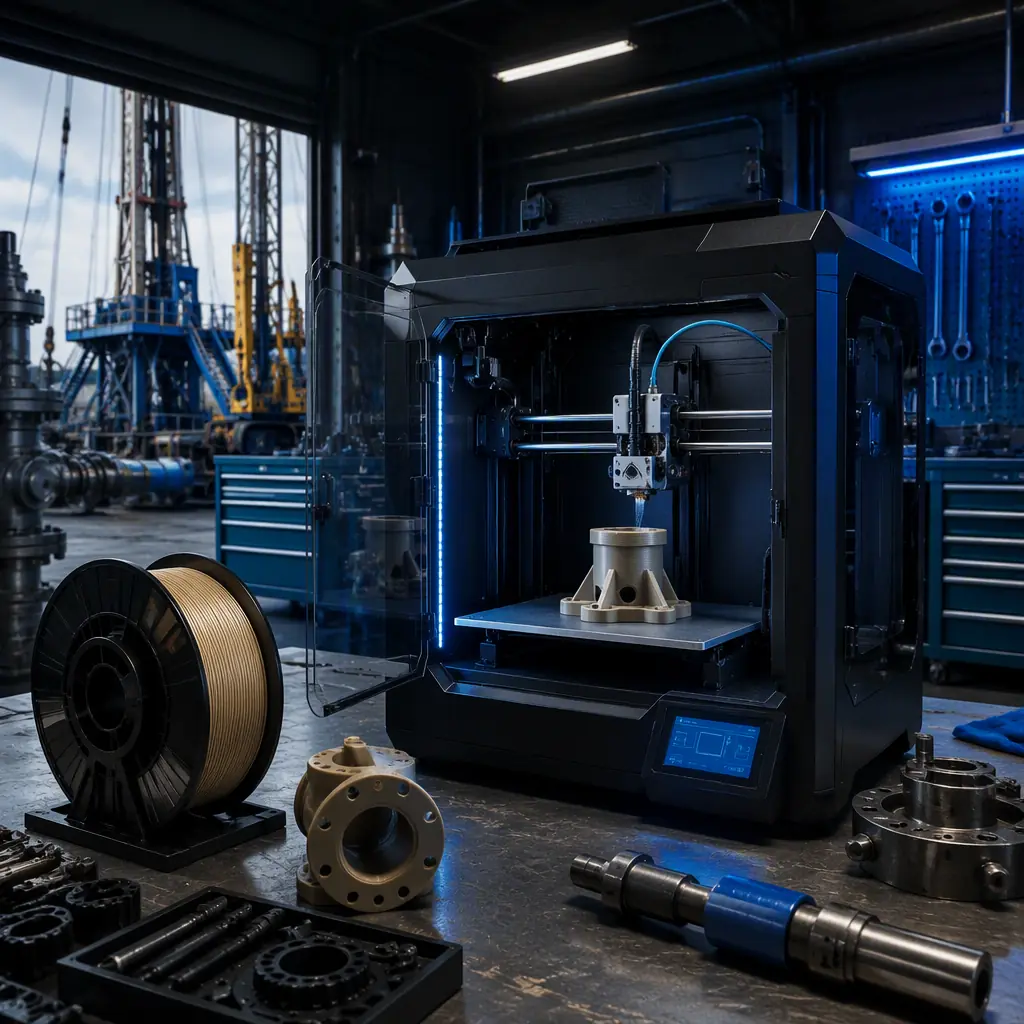
Oil and gas procurement splits into four segments with different buying behaviors. Upstream operators and oilfield service companies (the largest segment) buy for downhole tooling, drilling equipment spares, and inspection fixtures. Midstream pipeline and terminal operators buy for flow components, valve hardware, and corrosion-related replacements. Downstream refineries and petrochemical plants buy for process-critical spares, pump components, and compliance fixtures. Offshore platform operators buy for the full range, with the added constraint that every part must be producible on site or flown in at extreme cost. Each segment is a repeatable account with a different entry application and a different material conversation. For how these fit into a balanced distributor portfolio, see our portfolio strategy guide.
The Oil & Gas Customer Segments and Their Entry Applications
Upstream service companies are the highest-value segment: a drilling contractor that can print a replacement gauge adapter or a test fixture overnight avoids a non-productive day that costs $100,000-500,000. Midstream operators buy the most predictable volume because valve and flow-control spares are standardized parts that fail on a schedule tied to corrosion and erosion. Refineries buy on compliance and safety: every inspection fixture, lifting aid, and confined-space tool must be documented, and 3D printing with traceable print logs fits that paperwork culture. Offshore platforms are the urgency segment: the logistics cost of a single emergency helicopter or supply-vessel run can exceed $50,000, which makes on-site printing of brackets, guards, and tooling instantly economical. For the sales methodology that opens these accounts, see our B2B sales demo playbook.
Upstream service companies and offshore operators are the priority segments: upstream buys on the cost of a non-productive day, and offshore buys on the cost of logistics. A service company that avoids two non-productive days per year at $150,000 each has paid for a printer-and-material kit many times over. For the consumables bundling model that maximizes per-account revenue, see our consumables bundling guide.
Materials That Survive Downhole Heat and Sour Gas
The material conversation in oil and gas is about temperature, chemicals, and documentation. Downhole service means sustained heat: PEEK (glass transition ~143°C, continuous use to 260°C) is the flagship material for downhole tool prototypes and test fixtures, and it prints only on a printer with a 450°C-capable all-metal hotend and a heated chamber. PEI (Ultem-type) covers the 180-220°C range with better flow and lower cost per part, making it the workhorse for valve seats, seal carriers, and process-critical spares. PA-CF and PET-CF bring strength and chemical resistance for structural brackets and guards — PET-CF in particular resists the hydrocarbon and saltwater exposure common in production environments. For parts exposed to sour gas (H2S) or aggressive chemical service, material selection must be validated against the fluid composition and the applicable API or NACE standard, and print parameters must be logged for traceability. For the full high-temperature material lineup, see our PEEK/PEI/PPSU industrial materials guide.
What you're listening for: The lead-time number is the ROI script. If the answer is 6-16 weeks at a spread rate of $100,000+/day, the prospect is already pricing the failure. The second question is environmental: does the part see downhole heat (PEEK/PEI), hydrocarbon or sour-gas exposure (PEI, PET-CF), or only mechanical duty (PA-CF)? Shops that track downtime by root cause close fastest — they can already price the part they printed.
Printer Requirements for the Energy Environment
Oil and gas printing splits between the maintenance shop and the offshore or field environment, and the requirements differ. For shop use: an enclosed frame with an all-metal hotend rated to 450°C for PEEK, a heated chamber (60°C+) for warpage control on large PEI parts, hardened steel nozzles for carbon-fiber-filled materials, and the unattended reliability suite — thermal runaway protection, filament runout detection, power-loss recovery — because a 30-hour PEEK part is a serious capital commitment. For offshore and field use, the priority flips to ruggedness and safety: a compact enclosed printer in a protective housing, powered from the platform supply, with filtration because high-temperature polymers release emissions during printing. Space on a platform is measured in square meters, so a 300 mm-class printer that fits a workshop bench is the right form factor. For the complete printer selection criteria, see our build volume guide, the safety features guide, and the heated chamber guide.
Build volume in oil and gas splits into two tiers. Thread protectors, gauge adapters, seal carriers, and inspection fixtures fit a 256 mm cube. Valve trim parts, flow conditioner bodies, and larger tooling need 300×350 mm or bigger — and a 300 mm-class printer batches 5-15 small parts per overnight run for the repeating spare-part volume. The pilot application that opens an energy account is almost always a thread protector or gauge adapter for the shop's own equipment: zero compliance review, printable in PEI overnight, and demonstrably cheaper than the 8-week machine shop queue it replaces. For the operational scaling picture, see our print farm operations guide.
The Distributor Go-to-Market Playbook for Oil & Gas
Oil and gas procurement is dominated by approved-vendor lists and safety-critical documentation, and the distributor playbook has to respect both. (1) Enter through the maintenance and reliability organization: the shop that owns downtime gets the budget, and the thread-protector or gauge-adapter pilot is a low-risk entry that needs no compliance review. (2) Sell the documentation story: printers with loggable print profiles, material datasheets, and repeatable parameter sets make the customer's safety qualification one page instead of a research project. (3) Build the spare-parts library with the reliability team — every digitized valve seat and seal carrier is a lock-in asset that keeps reordering PEEK and PEI. (4) Sell the downtime math: "this $40 thread protector waited 8 weeks in a machine shop queue while the rig burned $150,000 a day; the file is in your library and reprints in 9 hours." Sales cycles are 6-12 months, slower than consumer segments but with the largest recurring revenue per account in industrial 3D printing. For the recurring revenue models that lock in energy accounts, see our spare parts aftermarket guide and the supply chain resilience guide.
Recurring Revenue: Downtime Consumes on a Schedule
Oil and gas consumable revenue is driven by two predictable rhythms. Upstream and offshore shops consume PEEK, PEI, and PA-CF continuously as they print spares and tooling — a service company with 4 printers runs 20-45 kg per month, and PEEK alone can exceed $300/kg, making the material ticket the real revenue engine. Refineries and midstream operators burn PEI and PET-CF on inspection fixtures and valve spares at 15-35 kg per month. Add hardened steel nozzles (carbon-fiber-filled nylons wear brass within 4-6 kg), PEI build sheets, high-temperature build plates, and spare hotends, and a single energy account becomes a $3,000-8,000 monthly revenue stream at 40-55% gross margins. The switching cost is structural: once a reliability team has qualified print profiles and a digitized spare-parts library, changing suppliers means re-qualifying every part and every parameter set. For the market sizing and trend context, see our 2026 market trends report and the energy & renewables vertical guide.
Bottom Line
Oil and gas is the vertical where downtime economics make 3D printing a strategic asset rather than a convenience. The parts that stop operations — downhole tool prototypes, valve trims, seal carriers, thread protectors, inspection fixtures — are small, polymer, and needed faster than any machine shop queue can deliver, and none of them justify a mold or a CNC run. Upstream service companies buy on the cost of a non-productive day and are the highest-value accounts; offshore operators buy on logistics cost and are the urgency segment; both consume PEEK, PEI, and PA-CF on a schedule a distributor can forecast. A distributor with 6 energy accounts averaging 3 printers each builds $90,000-160,000 in annual recurring consumable revenue at 40-55% margins — and owns the spare-parts libraries that make the accounts structural. The distributor who puts a high-temperature printer in the maintenance shop and a PEEK spool in the reliability engineer's cabinet will own the energy spare-parts pipeline before the machine shop quotes the job.
Reviewed by the Precise3D engineering & OEM team. Compliance files that accompany the catalog are auditable at the certification register.
Start Your Partnership
Ready to Bring oil gas industry to Your Market?
Our OEM program supports oil gas industry programs end to end - the product line, firmware and compliance files that travel with each shipment.