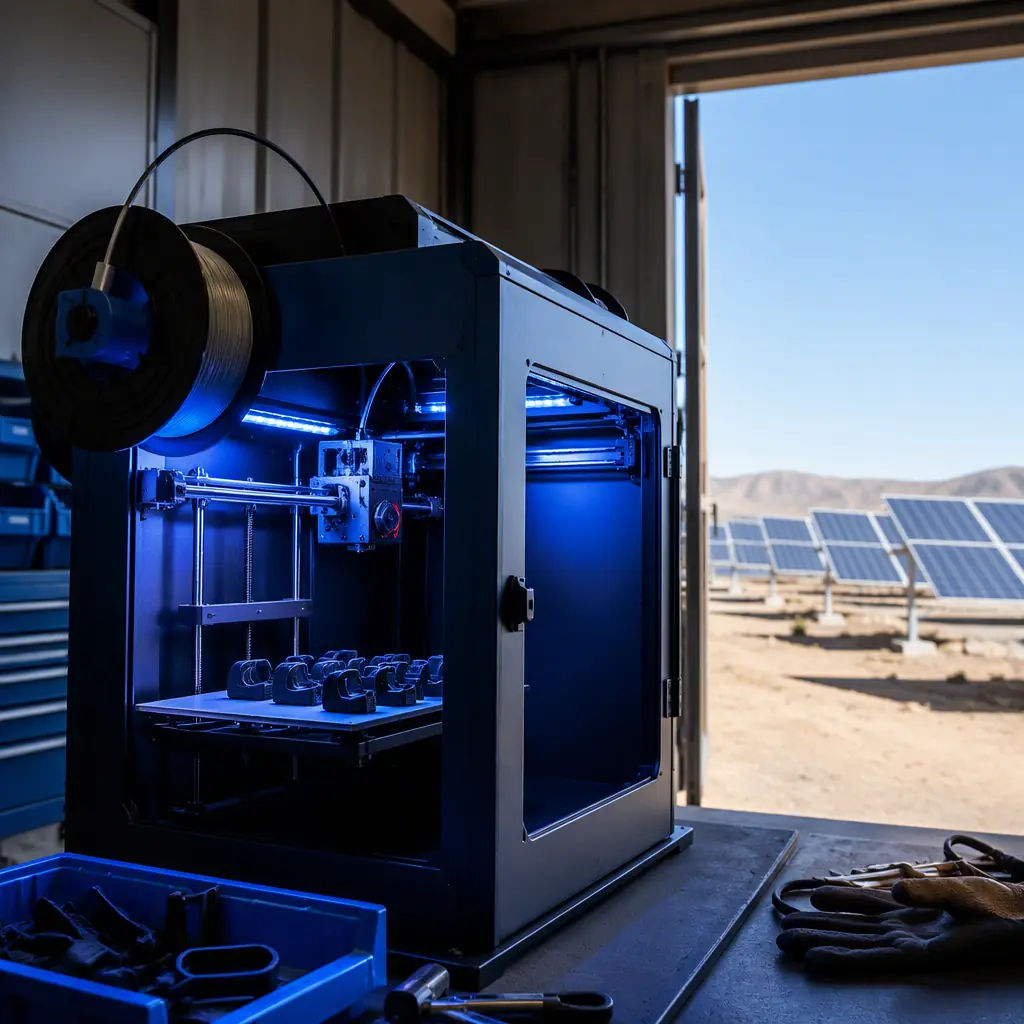
Run the numbers on a single solar farm. A 100 MW utility-scale installation has approximately 200,000-300,000 module-to-module cable clips, 8,000-12,000 junction boxes, and 2,000-4,000 inverter and combiner box enclosures with dozens of small plastic parts each. Industry operations and maintenance teams report replacing 1-3% of plastic components annually — UV embrittlement, thermal cycling, and rodent damage are the main culprits. At scale, that is thousands of small parts per year per farm, each costing $5-80 from suppliers with 2-8 week lead times. The O&M contractor who prints cable clips in ASA on-site cuts both cost and lead time by an order of magnitude — and every 100 MW farm becomes a $3,000-8,000 annual consumable account. For the framework on which verticals to enter first, see our portfolio strategy guide.
The Energy Customer Segments That Buy 3D Printers
Energy is not one market. Solar operations and maintenance (O&M) contractors, wind service providers, oil and gas facility operators, and energy equipment OEMs each have different purchasing processes, printer needs, and compliance requirements. Understanding the segment determines which printers you stock and which materials you carry.
Solar O&M contractors are the highest-value segment because their operations are distributed — one contractor manages 5-20 farms across a region, and each farm needs the same replacement parts. A contractor who standardizes on printed ASA cable clips and sensor mounts across their portfolio converts a per-farm nuisance into a per-farm monthly filament order. The consumables math is attractive: a 5-farm portfolio running 8 printers consumes 30-50 kg of ASA and PC per month at $20-35/kg — a $600-1,750 monthly account with a single purchasing decision maker. For the consumables bundling strategy that maximizes per-account revenue, see our consumables bundling guide.
What you're listening for: If the answer is more than 30 parts per month with lead times over 2 weeks, the account is ready. The breakeven for an O&M contractor is typically 3-6 months: a $200 emergency cable guide with a 6-week lead becomes a $4 print delivered same-day. If they mention UV degradation or discontinued parts as a recurring pain, you have found the trigger point for the sale.
Material Selection for Outdoor Energy Sites: UV, Heat, and Flame Ratings
Energy sites are the harshest outdoor environment after marine: full sun for 10-14 hours a day, surface temperatures on dark modules and enclosures reaching 70-80°C, thermal cycling from freezing nights to midday heat, and dust or sand in desert installations. PLA fails in weeks. The materials that survive are ASA, polycarbonate blends, and — for electrical enclosures and anything near power equipment — flame-retardant (FR) blends with UL94 V-0 ratings. Material compliance matters more in energy than in any other vertical because insurance and safety audits inspect what is installed on site.
ASA is the default for anything exposed to direct sun — it holds its mechanical properties through years of UV exposure and costs $20-28/kg wholesale, making it the volume material of the energy vertical. Polycarbonate blends handle the heat near inverters and transformers, where surface temperatures exceed what ASA can tolerate. For electrical enclosures and parts near energized equipment, flame-retardant PC/ABS blends with UL94 V-0 ratings are the compliance-safe choice — and the distributor who can explain UL94 ratings to a site manager closes deals that a commodity filament seller cannot. For the complete engineering filament selection and margin breakdown, see our engineering filaments guide and the outdoor weather-resistant printing guide.
Printer Requirements for Dusty, Remote Energy Sites
Energy sites are remote, dusty, and often staffed by technicians who are not print experts. The printers sold into this market need an enclosed frame with filtered intake, an all-metal hotend capable of 280-290°C (PC and nylon print at 260-290°C), a heated chamber or draft-free enclosure for warpage control on large ASA and PC parts, and firmware-level thermal protection — a printer running unattended in a site container workshop must fail safe. Dust is the primary killer: desert solar installations have airborne silica that abrades exposed rails and contaminates hotends; recommend printers with covered motion systems or plan quarterly maintenance. Remote operation also favors printers with network monitoring so a regional O&M manager can check a print from the office. For the complete printer selection criteria, see our build volume guide, enclosed vs open frame comparison, and remote monitoring guide.
Build volume requirements vary by part: most cable clips, sensor mounts, and covers fit in a 220×220×250 mm volume, but inverter vent grilles and large junction box covers need 300×300×350 mm. The batch economics matter more than absolute size — a 300 mm printer can produce 40-60 cable clips per build, turning a 2-hour clip-printing session into a month of replacement stock for an entire farm. For large-format considerations, see our large-format printer guide.
The Distributor Go-to-Market Playbook for Energy
Energy buyers purchase through procurement channels, not retail. An O&M contractor's regional manager approves vendor accounts; a wind service provider buys through an approved supplier list. The distributor playbook: (1) target the O&M contractors and independent service providers (ISPs) who already hold maintenance contracts — they have the part-replacement pain and the budget authority; (2) build a sample kit of printed energy parts — cable clips, sensor mounts, junction box covers, conduit fittings — and demonstrate them at industry events like RE+ (solar), the American Clean Power Association summits, and regional O&M conferences; (3) the conversation opener is not "we sell 3D printers" but "we reduce your replacement part spend by 80-95% and eliminate 6-week supplier lead times"; (4) pilot programs are the wedge — offer a 60-day trial printer to one farm or one service crew, measure parts printed and cost saved, and convert the data into a portfolio-wide order. For the complete distributor sales methodology, see our B2B sales demo playbook.
Recurring Revenue: Energy Accounts Are Built on Filament Volume
Energy accounts consume filament in volumes that dwarf consumer accounts. A utility-scale solar O&M team replacing clips, covers, and mounts across a 200 MW portfolio prints 40-80 kg of ASA and PC per year per farm — and the parts are consumables themselves, replaced on UV-degradation cycles of 3-7 years. Add hardened steel nozzles (ASA and filled blends wear brass nozzles within 4-6 kg), PEI build sheets, and dust filters, and a 5-farm contractor account generates $800-1,800 per month in recurring revenue at 40-55% gross margins. Retention is strong because switching filament suppliers mid-contract risks a batch of site-installed parts failing inspection. For the maintenance plans and extended warranty models that lock in recurring revenue, see our maintenance plans guide.
Competitive Landscape: The Gap Between Industrial AM and the Field
The energy sector has two existing 3D printing relationships, and neither serves the field technician. Industrial additive manufacturing vendors sell metal and large-format polymer systems to oil and gas majors and turbine OEMs for certified replacement parts — a high-value but slow, qualification-heavy market measured in dozens of sites. At the other end, corporate innovation teams prototype with desktop printers but never deploy them to the field. The result: the thousands of O&M contractors, wind ISPs, and facility operators who need a $4 cable clip this week have no supplier at all — they order from parts distributors at 10-50x the print cost. Desktop enclosed printers with UV-stable and flame-retardant filament stock fill that gap, and the distributor who builds the part library for common solar and wind components owns the recurring revenue. The addressable market for energy-sector 3D printing hardware and consumables in the United States alone is approximately $300-500 million annually. For the market trend analysis supporting vertical expansion timing, see our 2026 market trends report.
Bottom Line
The energy vertical rewards distributors who understand material compliance and portfolio-scale economics. The customers are not hobbyists — they are O&M contractors managing millions of dollars of assets who will pay for reliability, not for the cheapest printer. A distributor with 8 energy accounts averaging 4 printers each generates $30,000-55,000 in annual recurring consumable revenue at 40-55% margins, with the kind of contract-based retention that consumer markets never offer. The entry cost is a sample kit of printed solar and wind parts, a UL94 explainer, and a pilot program offer. The distributor who shows up at the next O&M conference with printed cable clips in hand will own the field service segment of this vertical before the industrial AM vendors even notice it exists.
Reviewed by the Precise3D engineering & OEM team. Compliance files that accompany the catalog are auditable at the certification register.
Start Your Partnership
Ready to Bring energy renewables to Your Market?
Our OEM program supports energy renewables programs end to end - the product line, firmware and compliance files that travel with each shipment.