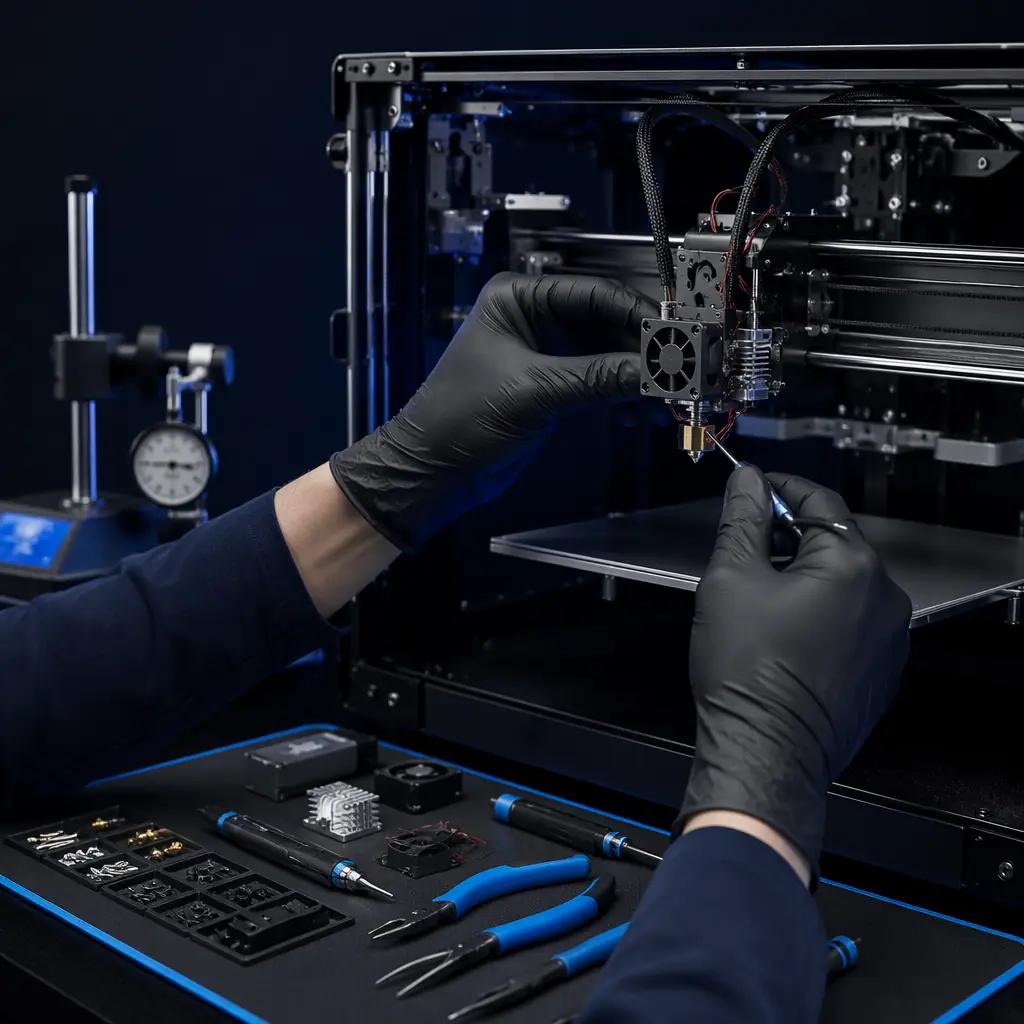
Most 3D printer distributors treat maintenance as a cost center — something they grudgingly provide to keep customers from complaining. The distributors who treat maintenance as a product line have a fundamentally different business. They have customers who pay them monthly, predictable gross margin that covers overhead before a single new printer is sold, and a relationship model where leaving creates switching costs. The economics are compelling: a maintenance plan priced at $299/year on a $1,200 printer with a 45% gross margin generates $134.55 in annual profit per enrolled customer. At 300 enrolled customers, that is $40,365 in annual profit — before selling a single additional printer, filament spool, or spare part. This guide covers the end-to-end playbook for building a maintenance plan business from zero.
The Three-Tier Maintenance Plan Model: Basic, Premium, Enterprise
The most common mistake in maintenance plan design is offering too many options. Three tiers is the sweet spot — enough to capture different willingness-to-pay segments without creating analysis paralysis. The Basic tier captures price-sensitive customers who would otherwise buy nothing. The Premium tier is where most customers should land — full coverage, attractive price, clean margin. The Enterprise tier exists primarily as a pricing anchor that makes Premium look like the obvious value choice. Here is the tier structure with actual pricing benchmarks:
The pricing multiples are deliberate. Premium is 2x Basic and Enterprise is 2x Premium — this is the classic "good-better-best" architecture that behavioral economists call extremeness aversion: when presented with three options, customers disproportionately choose the middle one because it feels like the balanced, sensible decision. At these prices, assuming a 50% blended gross margin on the plan itself (parts cost is the primary variable), Premium delivers $150–$225 in annual contribution margin per enrolled printer. For detailed guidance on building the repair infrastructure to support these plans, see our repair service center guide.
What to Include in Each Tier: Coverage Scoping That Protects Margin
The most dangerous line item in a maintenance plan is "unlimited anything." Unlimited service calls on a plan priced at $299/year will destroy margin the moment a single customer calls monthly. Every coverage item must have a defined scope, a service cap, or both. Here is the detailed scope breakdown:
The caps are calibrated so that 85% of enrolled printers will not exceed them in a given year, based on failure-rate data from our distributor network. The exclusion for "user damage" and "unauthorized modifications" is essential: without it, a customer who decides to install a third-party hotend and shorts their mainboard can claim it under the plan. Define these exclusions explicitly in the contract language. Our maintenance operations guide provides the technical procedures that underpin each covered service activity.
Service Level Agreements: Making Promises You Can Keep
An SLA is a marketing document when the customer is buying and a contractual obligation when something breaks. The key to profitable SLAs is defining response time (when you acknowledge the issue) separately from resolution time (when the printer is operational again), and using business-hours windows to avoid weekend/overnight staffing costs that destroy margin.
A well-structured SLA for Premium-tier plans reads: "Response within 24 business hours (Mon–Fri, 9am–6pm). Remote diagnosis completed within 48 business hours. On-site repair scheduled within 5 business days of diagnosis. Loaner printer dispatched within 48 hours if repair exceeds 5 business days." This provides concrete, measurable commitments without overpromising. For the support infrastructure that sits behind these commitments, see our after-sales support strategy guide.
Pricing Psychology: How to Make $449 Feel Like a Bargain
Customers do not evaluate maintenance plan prices in a vacuum — they compare them to the cost of not having one. The single most effective pricing tactic is anchoring the plan price against the à la carte cost of the same services. Create a simple comparison: one unscheduled service call at $150 (truck roll + 1 hour labor), one hotend replacement at $85, one mainboard failure at $180 — total $415 for one incident. The Premium plan at $399 covering all of that plus preventive maintenance suddenly reads as insurance that pays for itself in a single failure event.
The second pricing lever is bundling with the printer purchase. Offer a 15–20% discount on the first year of a maintenance plan when purchased with the printer. A customer buying a $1,500 printer who is offered the Premium plan at $319 instead of $399 (first-year bundle discount) has already committed to spending $1,500 — an additional $319 feels marginal. This is the same psychology that makes extended warranties profitable for electronics retailers: the incremental ask is small relative to the purchase already made. The plan renews at full price ($399) in year two, and by that point the customer has experienced the value. Our pricing and margin guide covers bundling mechanics across all product categories.
Technician Dispatch Logistics: Coverage Area, Scheduling, and Cost Per Truck Roll
A maintenance plan is only as good as the technician who shows up. The dominant cost in field service is the truck roll — the fully-loaded cost of sending a technician to a customer site, including vehicle, fuel, labor time (including travel), tools, and overhead. The key operational metrics:
The remote resolution rate is the highest-leverage metric in service profitability. Every issue resolved over a video call saves a $75–$150 truck roll. Train technicians to default to video diagnosis before dispatching: 30–40% of printer issues (filament jams, bed adhesion problems, firmware configuration errors, loose belt tension) can be diagnosed and guided to resolution remotely. This single protocol shift can improve service plan gross margin by 8–12 percentage points. The first-time fix rate also compounds: a technician who arrives without the right part and needs a return visit has doubled the cost of that service event and likely violated the SLA. Our spare parts planning guide details the inventory systems that support high first-time fix rates.
Parts Inventory for Service: What to Stock and How Much
A maintenance plan operation needs a separate service-parts inventory from the retail-parts inventory. Service parts are held in reserve for plan-covered repairs; retail parts are sold to customers. Commingling them creates two problems: (1) a walk-in customer buys the last hotend assembly you reserved for a Premium-plan repair due tomorrow, and (2) you cannot track service-parts consumption against plan profitability separately from retail parts sales.
The service parts kit per technician vehicle should include: hotend assemblies (2–3 units covering your top printer models), thermistors and heater cartridges (5–10 each), belts (GT2, 6mm, 2–3 per vehicle), build surface sheets (PEI, 2–3), nozzle assortment (brass 0.4mm × 10, hardened steel 0.4mm × 3, 0.6mm × 3), PTFE tubing (2m), silicone socks (5–10), mainboard (1 of your most common model), PSU (1), stepper motor (1), fans (hotend 4010 × 3, part-cooling 5015 × 3), wiring and connectors, and a full set of hex keys, calipers, multimeter, and laptop with firmware flashing capability. The vehicle kit value is approximately $400–$600 at distributor cost and enables a first-time fix rate above 75%.
At the depot level, stock deeper quantities of high-failure items: hotend assemblies (10–15), mainboards (3–5), PSUs (3–5), and build plates (5–10). Use a simple min-max system: when depot stock of a given part hits the minimum threshold, reorder to the maximum. Set minimums at 2× monthly consumption and maximums at 4× monthly consumption. This keeps service parts inventory lean while avoiding stockouts that delay repairs. For the broader aftermarket parts revenue opportunity, see our spare parts and aftermarket revenue guide.
Customer Onboarding to Maintenance Plans: The First 90 Days
The highest-risk period for plan cancellations is the first 90 days — before the customer has experienced a service event that justifies the plan's value. The onboarding workflow must create value touchpoints independent of breakdowns. Here is the 90-day sequence:
Day 1 (at printer delivery):
Technician performs the initial setup, calibration, and test print. This is billed as the "complimentary Professional Setup" included with plan enrollment. The customer sees a working printer producing a perfect first-layer test print within an hour of unboxing — this is the first value impression.
Day 7:
Phone or video check-in. "How are the first prints going? Any questions about materials or slicer settings?" This is not a sales call — it is a proactive support touch that demonstrates the plan is active, not dormant. Our customer training and onboarding guide provides the full onboarding curriculum.
Day 30:
Remote printer health check. If the printer has Wi-Fi/cloud connectivity, review print hours, error logs, and firmware version. Send a summary email: "Your printer has completed 47 hours of printing this month with zero errors. Firmware is current. Next preventive maintenance visit is scheduled for [date]." If no connectivity, schedule a 10-minute video call to walk through basic checks.
Day 90:
First preventive maintenance visit (Premium and Enterprise tiers). Lubricate linear rails/rods, check and adjust belt tension, clean and inspect the hotend, verify bed leveling, update firmware if applicable. The customer watches their printer get professional attention they did not have to request — this is the moment the plan transitions from "insurance I might not need" to "service I'm glad I have."
Profitability Modeling: When Does a Maintenance Plan Business Break Even?
The maintenance plan business has high fixed costs (technician salaries, vehicles, depot space, parts inventory) and strong contribution margins once the fixed base is covered. The breakeven math is straightforward but most distributors never run it:
The model reveals an uncomfortable truth: a maintenance plan business with one technician and fewer than 400 enrolled printers loses money. But the same business at 500 enrolled printers per technician generates a healthy profit that grows linearly with each additional enrolled printer above breakeven. The strategic implication is clear: do not launch a maintenance plan business half-heartedly. Either commit to reaching minimum scale (400+ enrolled printers per technician within 18 months) or do not launch at all — a sub-scale service operation bleeds cash and damages your reputation when you inevitably fail to meet SLA commitments.
Contract Renewal Strategies: Turning One-Year Plans into Multi-Year Relationships
The renewal rate is the single most important metric in a maintenance plan business. A 70% renewal rate means you lose 30% of your recurring revenue base every year and must continuously replace it with new enrollments just to stay flat — this is a treadmill. An 85%+ renewal rate means the business compounds: each year's new enrollments stack on top of the existing base, and revenue grows geometrically.
Auto-renewal with opt-out:
The single most impactful renewal tactic. Structure the contract so that plans renew automatically unless the customer actively cancels within a defined window (typically 30 days before renewal). This shifts the default from "do nothing and lose coverage" to "do nothing and maintain coverage." Across service-contract businesses, auto-renewal increases renewal rates by 15–25 percentage points compared to manual renewal. Ensure this is clearly disclosed at sign-up and complies with local consumer protection laws.
Renewal incentive ladder:
Offer a 10% discount for a 2-year renewal commitment and a 15% discount for a 3-year commitment. The discount pays for itself through eliminated annual re-enrollment costs and reduced churn risk. A customer who commits to 3 years at $339/year (15% off $399) generates $1,017 in revenue compared to $1,197 at full price — a $180 discount that saves 2 years of churn risk and sales effort.
Usage-based renewal communication:
At the 10-month mark, send a personalized renewal email: "Your Premium plan covered 2 service visits, 1 hotend replacement, and your annual preventive maintenance this year. The total value of services received was $385 — more than your plan price of $399. Your plan delivered $385 in value for $399." This reframes the renewal decision from "should I pay $399 again?" to "look at the value I received." Even for customers who used fewer services, frame it as peace of mind: "While you only needed one remote support session this year, your plan ensured that if a major component had failed, you would have been covered without paying $200+ out of pocket."
Selling Scripts: What Your Sales Team Should Say
Most distributor sales teams default to selling printers — the transaction they know and the commission they understand. Selling maintenance plans requires a different conversation, and it must happen at a specific moment in the sales process: after the customer has committed to the printer but before they have paid. Here are the scripts, structured by customer type:
"One thing I want to mention — the printer comes with a 1-year manufacturer warranty, but that only covers defects. If your hotend clogs six months in or your bed leveling drifts, that's not a defect, that's normal wear — and the out-of-pocket repair would run you about $85 for the hotend plus $150 for a service call. Our Premium Care plan covers all of that plus an annual tune-up visit for $399. I'd recommend adding it now because if you bundle it with the printer, it's $319 for the first year. That's less than what one unscheduled repair would cost you."
Key technique: Anchor against à la carte repair cost. Bundle discount creates urgency. "One repair covers the cost" is the closing frame.
"When you're running 5 or 10 printers for production, downtime isn't an inconvenience — it's lost revenue. If one printer goes down and you're waiting 5 days for a repair, that's 5 days of lost production capacity. Our Enterprise plan guarantees a 4-hour response and a loaner printer within 48 hours if we can't fix yours same-day. At $699/year per printer, you're essentially buying uptime insurance at $1.91 per printer per day. What would a day of lost production cost you?"
Key technique: Frame as uptime insurance, not maintenance. Per-day cost framing ($1.91) makes the price feel trivial. The question at the end shifts the customer from evaluating your price to evaluating their own downtime cost.
"I know your IT or facilities team will be managing these printers, and they're already stretched thin. Our Premium plan means when a student jams a printer or the bed leveling drifts after 500 hours, your staff doesn't have to drop everything — they call us and we handle it. We also do the annual preventive maintenance, which keeps the printers in calibration and reduces the number of student complaints. For 10 printers at $399 each per year, that's $3,990 — about the cost of 3 weeks of a technician's time. You'll get more value than that in saved staff hours alone."
Key technique: Position as staff augmentation, not maintenance expense. Compare plan cost to labor cost. Frame as reducing internal burden (student complaints, staff time) rather than selling a service.
Bottom Line
A 3D printer distribution business without maintenance plans is a transactional reseller — every month starts at zero revenue. A distribution business with a mature maintenance plan operation is a recurring-revenue platform — overhead is covered by plan revenue before a single new printer is sold. The path from one to the other requires discipline: designing the right three-tier structure, scoping coverage to protect margin, building the technician and parts infrastructure, onboarding customers to create value before they need a repair, and equipping the sales team with scripts that convert at the moment of printer purchase. Start with Premium as the anchor tier, use Basic to capture price-sensitive customers and Enterprise as the value anchor, and aim for 400+ enrolled printers per technician to clear breakeven. The first 100 enrolled printers will feel like work without reward. Printer 401 turns a profit. The question is whether you stay committed through the ramp. For the full strategic context behind building a service-oriented distributor business, see our after-sales support guide and our warranty and reverse logistics guide.
Reviewed by the Precise3D engineering & OEM team. Compliance files that accompany the catalog are auditable at the certification register.
Start Your Partnership
Ready to Bring maintenance plans extended warranty to Your Market?
Our OEM program supports maintenance plans extended warranty programs end to end - the product line, firmware and compliance files that travel with each shipment.