A distributor in Germany told us something that reframed how we think about 3D printer service. "I make more profit repairing printers than selling them," he said. "I sell a printer once and make 30%. I repair that same printer four times over five years and make 65% each time. The hardware sale is the customer acquisition cost for the service business." His numbers check out: a $600 printer sold at 30% margin generates $180 in gross profit one time. The same printer repaired four times over five years at $95 per repair with a 65% margin generates $247 in cumulative service profit — 37% more than the original sale, with zero customer acquisition cost. This article explains how to build that service business, whether you are a one-person distributor adding repair capability or a multi-brand distributor launching a dedicated service center.
The Service Revenue Math: Why Repairs Beat Sales
The unit economics of 3D printer service are fundamentally better than hardware sales, and the math holds across price tiers. The key metric is lifetime gross profit per customer: a hardware-only customer generates one margin event; a service-contract customer generates 4–7 margin events over the same period.
The LTV multiplier tells the story: a prosumer printer customer generates 80% of the original hardware margin in service profit over five years. For the mid-range tier — the sweet spot of the consumer 3D printer market — service profit actually exceeds hardware profit on a cumulative basis. And this analysis excludes consumables revenue, which our consumables bundling guide shows adds another $60–250 per printer per year at 60–70% margins. Hardware + service + consumables creates a customer LTV of $800–2,500 from a $400–1,000 printer customer over five years. The hardware-only view captures only the first 15–25% of that value. For more on maximizing customer lifetime value through aftermarket revenue, see our guides on spare parts strategy and upgrades and aftermarket parts.
Setup Costs and Facility Requirements
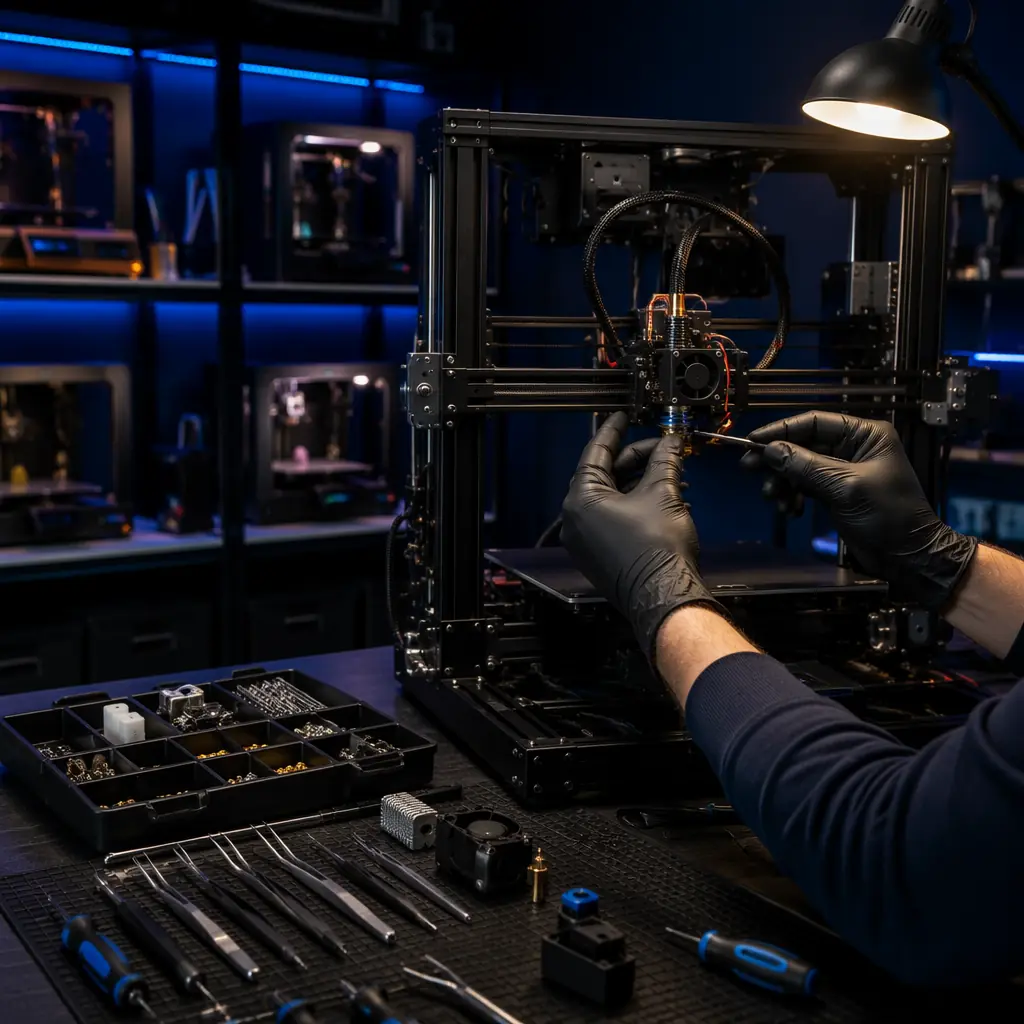
A functional 3D printer repair center requires modest investment compared to a retail showroom. The most common model is a combined showroom-and-service-center occupying 500–1,000 square feet, with the front half dedicated to product display and the back half configured as a repair workshop. Below is the capital expenditure breakdown for a 1-technician service center capable of handling 15–25 repairs per week.
The largest variable cost is spare parts inventory. A well-stocked parts inventory is the difference between a same-day repair (customer satisfaction: high) and a one-week repair (customer satisfaction: low, competitor consideration: high). The inventory strategy is to stock consumable / wear items heavily (nozzles, build plates, belts, fans — these account for 60% of repair tickets) and order major components (mainboards, PSUs, stepper motors) on-demand from the manufacturer with a 2–3 day lead time. For printers you distribute exclusively, negotiate a service parts kit from the manufacturer: a pre-assembled box of the 20 most commonly replaced components at 15–25% below retail, replenished quarterly based on consumption data. Our factory audit guide explains how to evaluate manufacturer service part programs during supplier qualification.
Technician Training: What Your Hire Needs to Know
A competent 3D printer repair technician does not need an engineering degree. The skill set is mechanical assembly and troubleshooting — closer to bicycle repair than electronics engineering. The core competencies, ranked by frequency of use: (1) mechanical disassembly and reassembly of gantry systems, linear rails, and belt drives — this is 45% of all repairs; (2) hotend and extruder diagnosis, cleaning, and replacement — 25% of repairs; (3) electrical diagnosis with a multimeter — continuity testing, thermistor resistance measurement, PSU voltage verification — 15% of repairs; (4) firmware and software troubleshooting — flashing firmware, calibrating e-steps and PID, diagnosing slicer configuration issues — 10% of repairs; (5) customer communication — explaining what broke, why, and how to prevent recurrence — 5% of the job but 80% of customer satisfaction.
Onboarding Plan: Week 1 — shadow senior technician, learn ticketing system and parts inventory. Week 2 — perform 20 supervised repairs under guidance. Week 3 — independent repairs with escalation path. Week 4 — solo with weekly quality review. Full independence at 60 days.
For distributors who do not have an existing technician to train a new hire, the fallback is manufacturer training. Reputable 3D printer OEMs offer 2–5 day distributor service training programs covering common failure modes, disassembly procedures, and diagnostic workflows for their specific models. Cost ranges from $500–2,500 plus travel. The ROI calculation: a trained technician who can diagnose and repair a hotend clog in 20 minutes versus a technician who takes 90 minutes on the same repair saves 70 minutes of labor per ticket. At $85/hour labor rate and 15 repairs per week, that is $1,487 in recovered labor revenue per week — the training pays for itself in the first month. Our troubleshooting guide covers the diagnostic framework that accelerates repair workflows for common failure modes.
Pricing Models: Hourly, Flat-Rate, or Contract
3D printer repair pricing falls into three models, each optimal for different customer segments and repair types. Most successful service centers use all three, routing each ticket to the model that maximizes margin for that ticket type.
Hourly Labor ($65–125/hour).
Best for complex, open-ended repairs where the root cause is unknown — intermittent failures, motherboard issues, firmware corruption. Bill in 15-minute increments with a 1-hour minimum. The customer pays for actual time spent, which aligns incentives for efficient diagnosis. The risk is sticker shock: a $95/hour × 3-hour repair on a $400 entry-level printer costs $285 in labor alone, which is 71% of the printer's value. Mitigate this by quoting a "not to exceed" price before starting work and offering a trade-in credit toward a new printer if the repair exceeds 60% of the printer's replacement cost.
Flat-Rate Menu ($25–200).
Best for high-frequency, well-understood repairs: nozzle replacement ($25–45), belt tensioning/replacement ($45–75), hotend cleaning/replacement ($65–125), build plate replacement ($30–60), fan replacement ($25–50), firmware update/calibration ($50–100). Flat-rate pricing is faster to quote, easier for customers to understand, and typically yields higher effective hourly rates because experienced technicians complete the job in less time than the price assumes. A hotend replacement priced at $95 that takes 35 minutes earns an effective $163/hour — nearly double the $85/hour labeled rate. Our maintenance guide identifies the top 15 predictable repair procedures that are ideal candidates for flat-rate menu pricing.
Service Contracts ($99–499/year).
The recurring revenue holy grail. A service contract bundles annual maintenance, priority repair queue access, and discounted labor rates into a single annual fee. The math: a contract customer paying $249/year who requires 2 repairs and 1 preventive maintenance visit per year generates $249 in guaranteed revenue at a 75% margin ($187 gross profit) regardless of whether the customer uses the service. For education and print farm customers who operate 10–50+ printers, multi-printer contracts at $149–299 per printer per year with volume discounts create sticky, high-LTV accounts that are nearly impossible for competitors to poach. The contract structure is covered in detail in our customer training and onboarding guide.
Warranty Management: From Cost Center to Trust Builder
Warranty repairs are the distributor's least favorite activity — free labor that eats into already-thin hardware margins. But the strategic view is different: warranty repairs are the highest-converting lead source for paid service contracts. A customer whose printer breaks under warranty and is repaired quickly, professionally, and with clear communication about what happened is 3x more likely to purchase a service contract when the warranty expires compared to a customer who never experienced a warranty claim. The warranty moment is a trust-building event. Execute it well, and you convert a cost into a future revenue stream. Execute it poorly, and you lose the customer to Amazon or a competitor for the next purchase. Our warranty and returns guide covers warranty workflow design and RMA management.
For warranty repairs on printers you distribute, negotiate a labor reimbursement rate from the manufacturer — typically 50–70% of your standard labor rate, paid upon submission of a completed warranty claim with diagnosis notes and parts consumption log. The reimbursement rate is negotiable during the distribution agreement phase. Manufacturers who refuse to offer any labor reimbursement are signaling that they treat warranty as the distributor's problem; manufacturers who offer 65%+ reimbursement are signaling partnership commitment. This is a factor we evaluate in our OEM partner assessment framework.
Marketing Your Service Center
A service center markets itself differently than a hardware business. The customer acquisition channels are: (1) existing hardware customers — every printer you sell is a service lead; send a "welcome to your warranty period" email with service center contact information, then a "your warranty expires in 30 days — lock in a service contract" email at month 11; (2) competitor printer owners — local Facebook groups, Reddit r/3Dprinting, and maker spaces are full of users whose printers have broken and whose original seller is unresponsive; post helpful troubleshooting content that demonstrates expertise, not sales pitches; (3) B2B outreach — local schools, universities, libraries, and small manufacturers with 3D printers who lack in-house repair capability; a single school with 15 printers generates $1,500–3,000 in annual service contract revenue. For more on B2B sales strategies, see our B2B sales demo playbook and small manufacturer sales guide.
Reviewed by the Precise3D engineering & OEM team. Compliance files that accompany the catalog are auditable at the certification register.
Build Your Service Revenue
Launch a 3D Printer Service Center with Precise3D Support
We provide service parts kits, technician training programs, diagnostic documentation, and warranty labor reimbursement for authorized distributors. Whether you are adding repair capability to an existing showroom or launching a standalone service center, we will help you build a profitable service operation.