When a customer returns a 3D printer, four things happen in sequence, and the first three lose you money. First, you pay return shipping ($25–80 depending on weight and distance). Second, the unit arrives at your warehouse and sits for 3–14 days while someone figures out what to do with it — during which time the customer is waiting for a resolution and getting more frustrated by the hour. Third, someone opens the box and finds that the printer was returned with missing accessories, filament residue baked onto the nozzle, and a build plate that looks like it was used to print sandpaper — 68% of returned printers have recoverable components, but most distributors scrap the entire unit because they lack a triage process. Fourth, the manufacturer warranty kicks in and reimburses part of the cost — but only if the distributor documented the failure correctly and submitted the claim within the warranty window.
At Precise3D, we analyzed return data from 50+ distributors and found that 42% of returned printers were fully functional — the customer didn't know how to calibrate the machine and assumed it was defective. Another 31% had a single failed component (hotend, thermistor, or power supply) that could be replaced for $15–50. Only 27% had genuine manufacturing defects requiring full replacement. Distributors who implemented a triage-and-recovery process saved an average of $4,200 per 100 units sold in recovered value, and distributors who paired triage with structured customer recovery retained 38% of returning customers as repeat buyers (vs. 9% for distributors who simply processed the refund and moved on). This guide covers how to build that process.
The Economics of Unmanaged Returns
Before building a returns program, you need to understand what unmanaged returns are actually costing you. Most distributors underestimate this number because they only count the refund amount — not the ancillary costs that add up to more than the refund itself.
Lost consumable sales are the silent killer.
A customer who returns a printer never buys filament from you again — and the average desktop printer customer generates $150–400 in consumable sales over their lifetime. At a 40% gross margin on consumables, that's $60–160 in lost profit per return. Multiply by 16 returns per year (8% of 200 units) and you're leaving $960–2,560 in annual profit on the table — from a cost category most distributors don't even track. Our after-sales support guide covers the customer retention framework that works alongside returns management.
The Triage Process — Stop Scrapping Recoverable Units
The single highest-ROI action in returns management is implementing a 15-minute triage process that routes each returned printer to the correct outcome: resell as refurbished, repair and resell, cannibalize for parts, or scrap. Without triage, every returned unit goes to the most expensive outcome (scrap). With triage, 73% of returned units recover value.
Step 1 — Visual Inspection (3 minutes):
Open the box. Check for: physical damage (cracked frame, bent rails, crushed enclosure), missing components (check against the packing list), and signs of misuse (melted plastic on hotend from wrong temperature, gouged build plate from nozzle collision, cut or stripped belts). If the printer passes visual inspection, proceed to Step 2. If it has physical damage, route to "cannibalize for parts" — the frame is scrap but the stepper motors, motherboard, and power supply are likely functional and worth recovering.
Step 2 — Power-On Test (5 minutes):
Plug in the printer, power on, check: LCD/screen functions, all axes home correctly (if homing fails, note which axis — likely a limit switch or stepper driver issue), hotend and heated bed heat up to target temperature (if one doesn't heat, it's a thermistor or heater cartridge failure — a $5–15 fix), and part cooling fan and hotend fan spin. If the printer passes the power-on test, the issue was likely calibration-related (bed leveling, slicer settings, filament). The printer is fully functional — it can be cleaned, recalibrated, and sold as refurbished.
Step 3 — Test Print (7 minutes):
Load filament, run a 20mm calibration cube or benchy at standard settings. Check: first-layer adhesion, layer consistency, dimensional accuracy (calipers on the XYZ dimensions of the calibration cube), and surface finish. If the test print passes, the printer is verified functional and can be sold as "refurbished — tested." If the test print fails, diagnose the specific issue using our troubleshooting guide — a single failed component can be replaced for $15–80, and the unit can then be sold as refurbished. If multiple components are failed or the frame is compromised, route to "cannibalize for parts."
Documentation is critical for manufacturer warranty recovery.
For every returned unit with a genuine manufacturing defect, take photos of the failed component, save the triage notes, and file the warranty claim within the claim window (typically 30–90 days from return receipt). At Precise3D, our distributor warranty program covers manufacturing defects for 12 months from end-customer purchase — but the claim must include triage documentation showing the defect was manufacturing-related, not customer-induced. Our certification compliance guide covers the quality documentation framework that supports warranty claims.
Building a Refurbished Sales Channel
Once you start recovering functional returned printers through triage, you need a sales channel to monetize them. Refurbished 3D printers fill a specific market niche: price-sensitive buyers who want a known-working machine but can't afford new — the same customers who would otherwise buy a used printer on eBay from an unknown seller with no warranty.
Pricing strategy:
Price refurbished units at 70–80% of the new retail price and include a 90-day warranty. This is higher than the typical 50–60% discount on used electronics because a refurbished printer from an authorized distributor has been tested, calibrated, and comes with warranty support — things a random eBay seller can't offer. Customers pay a premium for the certainty.
Warranty on refurbished units:
Offer a 90-day limited warranty covering mechanical and electronic defects (same as new, but shorter duration). This is critical — a refurbished printer with no warranty competes on price against used eBay listings and loses. A refurbished printer with a 90-day warranty competes on trust and wins. For the distributor, the warranty risk is low because the unit has been tested and any manufacturing defects would have surfaced in the first owner's use. Our hotend and nozzle guide covers the consumable components that should be replaced as part of the refurbishment process — fresh nozzle, clean build surface, new PTFE tube — which cost $15–30 and eliminate the most common refurbishment-related support tickets.
Revenue impact:
For a distributor selling 200 desktop printers/year at $300 wholesale with an 8% return rate (16 units), triage recovers 12 units (75% of returns) with an average refurbished sale price of $210 (70% of $300). That's $2,520/year in recovered revenue — plus the consumable sales from the refurbished unit's new owner. Subtract the triage labor cost ($15/unit × 16 units = $240) and replacement parts ($25/unit × 5 units = $125), and the net recovered value is $2,155/year — nearly pure profit because the original unit was already written off as a return. For prosumer printers at $1,500 wholesale, the math scales proportionally: 16 returns × 75% recovery × $1,050 = $12,600/year in net recovered revenue.
Customer Recovery — Turning Returns Into Retention
A customer who returns a printer is not necessarily a lost customer — if you handle the return well, 38% will buy from you again within 12 months. Handle it poorly and that number drops to 9%. The difference is a structured customer recovery process that runs parallel to the hardware triage process.
The Return Conversation Framework:
When a customer initiates a return, your support team should ask three questions before processing it: (1) "What specific issue are you experiencing?" — this often reveals a calibration or setup problem that can be resolved without a return. (2) "Would you be open to a video call where I walk you through the setup?" — this converts 25–35% of return requests into retained customers. (3) "If we do process the return, would you like to be notified when we have refurbished units available at a discount?" — this plants the seed for a future sale.
The Refurbished Upgrade Path:
For customers whose return was caused by buying the wrong printer for their needs (e.g., a hobbyist who bought a basic model but needs an enclosed printer for ABS), offer a trade-up credit: the customer returns their printer and receives a $50–150 credit toward a higher-tier model. This converts a return into an upgrade sale — the distributor earns margin on the upgrade, and the customer gets the right printer for their needs. In our distributor network, trade-up offers close at 22–30% conversion rate — much higher than cold sales to new customers — because the customer has already demonstrated purchase intent and the offer solves their specific pain point.
The Re-Engagement Sequence:
For customers who do complete a return and don't take the trade-up offer, add them to a re-engagement email sequence: Day 7 — "Your return has been processed, here's your refund confirmation. If you ever want to try again, we're here." Day 30 — "We just listed certified refurbished printers at 20–30% off — thought you might be interested." Day 90 — "New customer training program: free setup session with every purchase." The sequence is automated, costs nothing to send, and converts 8–12% of returned customers into repeat buyers within 12 months.
Warranty Cost Allocation — What the Manufacturer Covers vs. What You Cover
Clear warranty cost allocation between distributor and manufacturer is the foundation of a sustainable returns program. Without it, every return becomes a negotiation, and the distributor ends up eating costs that should be covered by the manufacturer warranty.
File claims promptly.
At Precise3D, distributor warranty claims must be submitted within 30 days of the return receipt date with triage documentation (photos, failure description, serial number). Claims submitted after 30 days or without documentation are processed at reduced reimbursement rates (50% instead of 100%). Build this into your returns workflow: the triage technician generates the claim documentation as part of the triage process, not as a separate administrative task. For the spare parts infrastructure that supports warranty repairs, see our stepper drivers and motherboard guide and power supply selection guide.
Implementation — 30 Days to a Functioning Returns Program
You don't need a dedicated returns department. Here is a 30-day plan that any distributor can implement with existing staff and space.
Week 1 — Set Up the Triage Station:
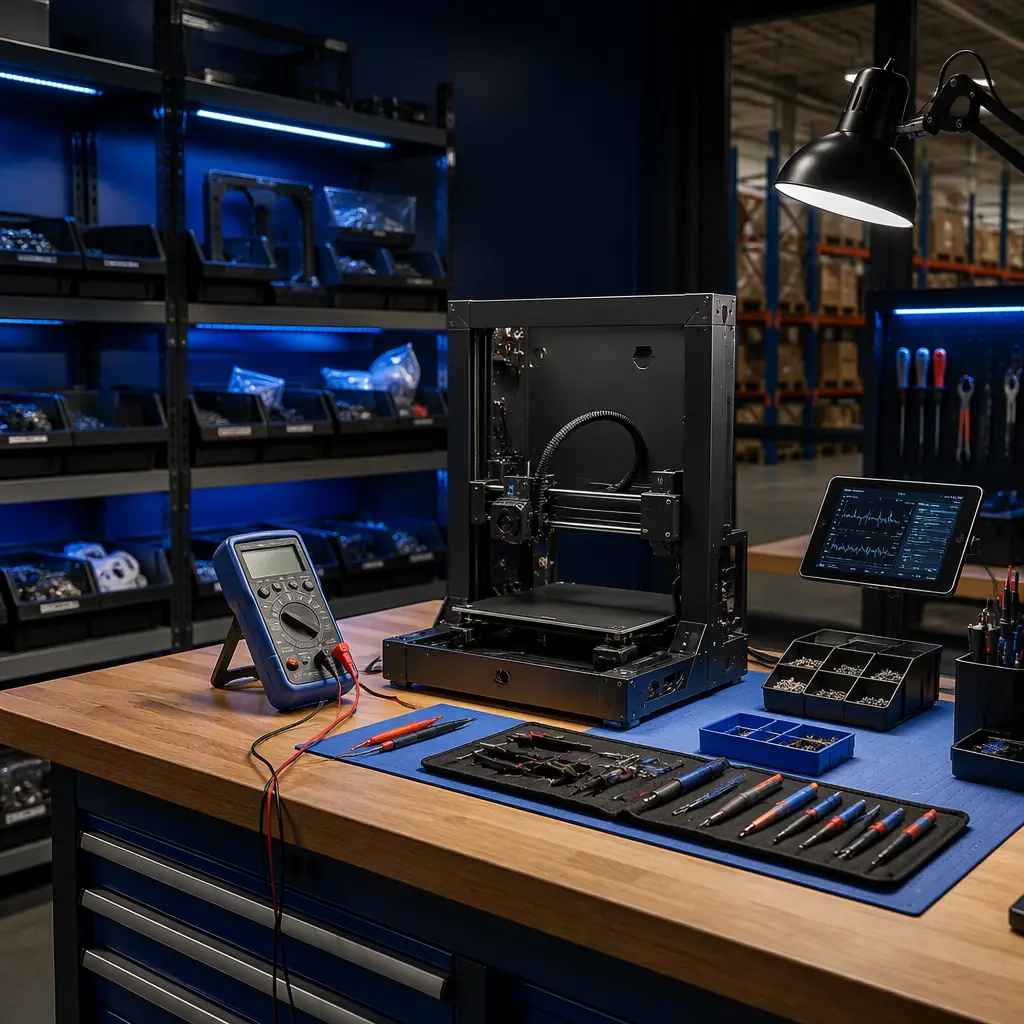
Dedicate a workbench (even a folding table in the corner of your warehouse), a basic tool kit (multimeter, hex keys, calipers, spare nozzles and PTFE tubes), and a laptop or tablet for documenting triage results. Print and laminate the triage checklist and post it above the workbench. Total investment: $200–500 if you don't already have the tools.
Week 2 — Train One Person:
Select one technician or support staff member to own the triage process. Spend 2 hours training them on the 3-step triage flow (visual inspection → power-on test → test print). Have them practice on 2–3 printers that are currently in your warehouse. The goal is not expertise — it's consistency. A technician who can reliably identify "fully functional," "single component failure," and "catastrophic damage" is sufficient to start.
Week 3 — Process Your First 5 Returns:
Run the triage process on actual customer returns. Document every outcome. If you discover that your return rate is actually higher than you thought (most distributors underestimate), adjust your warranty reserve accordingly. A good rule of thumb: set aside 3–5% of revenue as a warranty reserve until you have 6 months of actual return data to base the reserve on.
Week 4 — Launch the Refurbished Listing:
List your first refurbished unit on your website or local marketplace. Price it at 70–80% of new retail. Include photos of the actual printer (not stock photos) and the 90-day warranty terms. Track time-to-sale — if the refurbished unit sells in under 2 weeks, your pricing is right. If it sits for a month, drop the price by 10% and re-test your listing copy. For inspiration on how to merchandise the value proposition, our portfolio strategy guide covers how to position different printer tiers to different buyer segments — refurbished is a tier of its own.
Reviewed by the Precise3D engineering & OEM team. Compliance files that accompany the catalog are auditable at the certification register.
Distributor Partnership
Ready to Build a Returns Program That Recovers Value Instead of Destroying It?
Join our network of global distributor network. We provide triage checklists, warranty claim templates, refurbishment procedures, and a 12-month manufacturer warranty that covers genuine defects — so your returns program recovers value instead of writing it off.