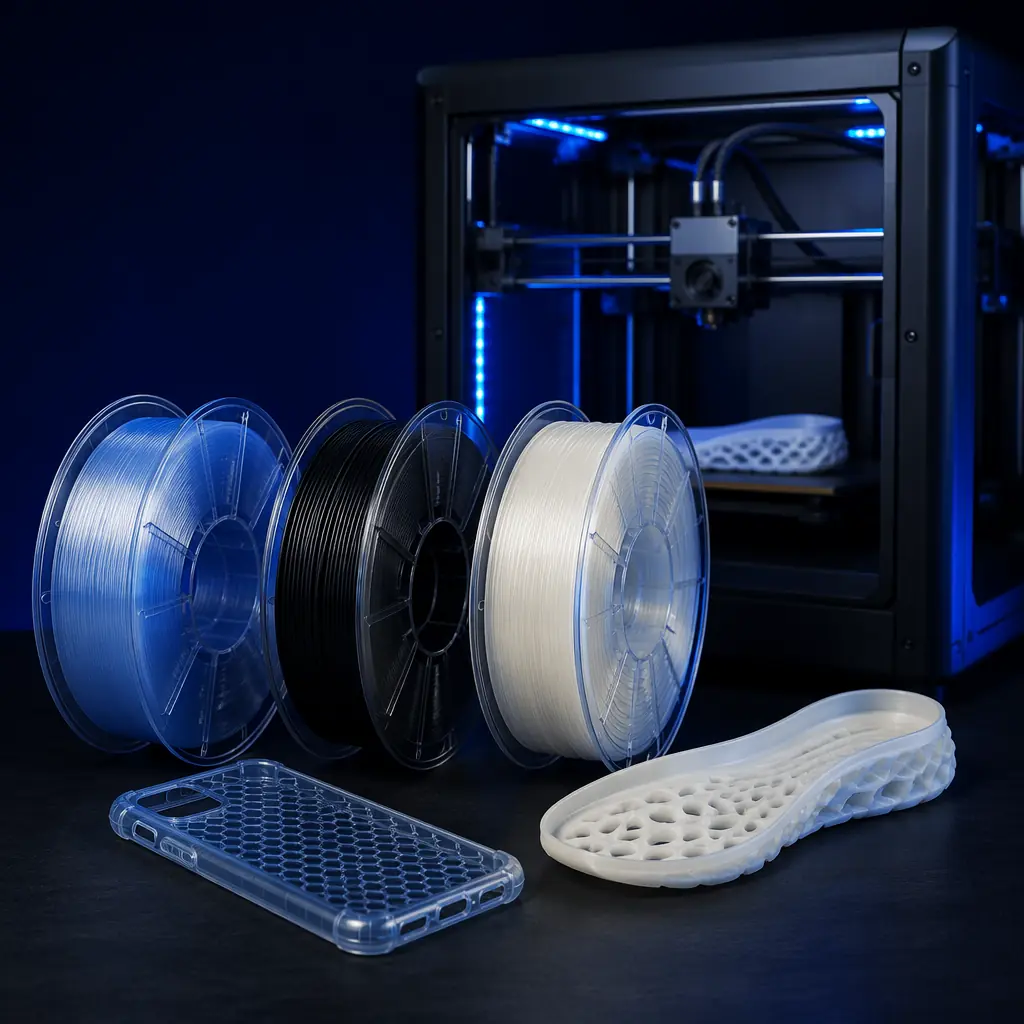
Walk into any 3D printer distributor's filament aisle and you'll find the same story: twenty SKUs of PLA in every color Pantone ever invented, a handful of PETG, and maybe — if you're lucky — one dusty spool of black TPU tucked in the corner. The distributor treats flexible filaments as an afterthought, something to have "just in case." Meanwhile, the local orthotics clinic down the street is ordering TPU from Amazon at $42/kg because nobody local stocks medical-grade flexibles. The phone case manufacturer is buying TPE by the pallet from a competitor two countries over. The running shoe prototyping studio can't find a reliable source for TPC at any price.
Flexible filaments are not a niche. They're a $380 million global market growing at 14.2% CAGR — faster than PLA (7.8%) and PETG (9.1%). Every distributor who ignores flexibles is leaving the highest-margin consumables revenue on the table. This guide covers the three flexible filament families, their shore hardness ranges, which printers can run them, and the customer segments that will pay a premium for properly curated flexible material options.
The Flexible Filament Family: TPU vs TPE vs TPC — Chemistry That Determines Your Margin
Flexible filaments are not one material with different labels. They are three chemically distinct polymer families with different mechanical properties, printability characteristics, and target customer segments. Stocking the right mix — and knowing which customer needs which — is the difference between a spool that reorders monthly and one that sits on the shelf for a year.
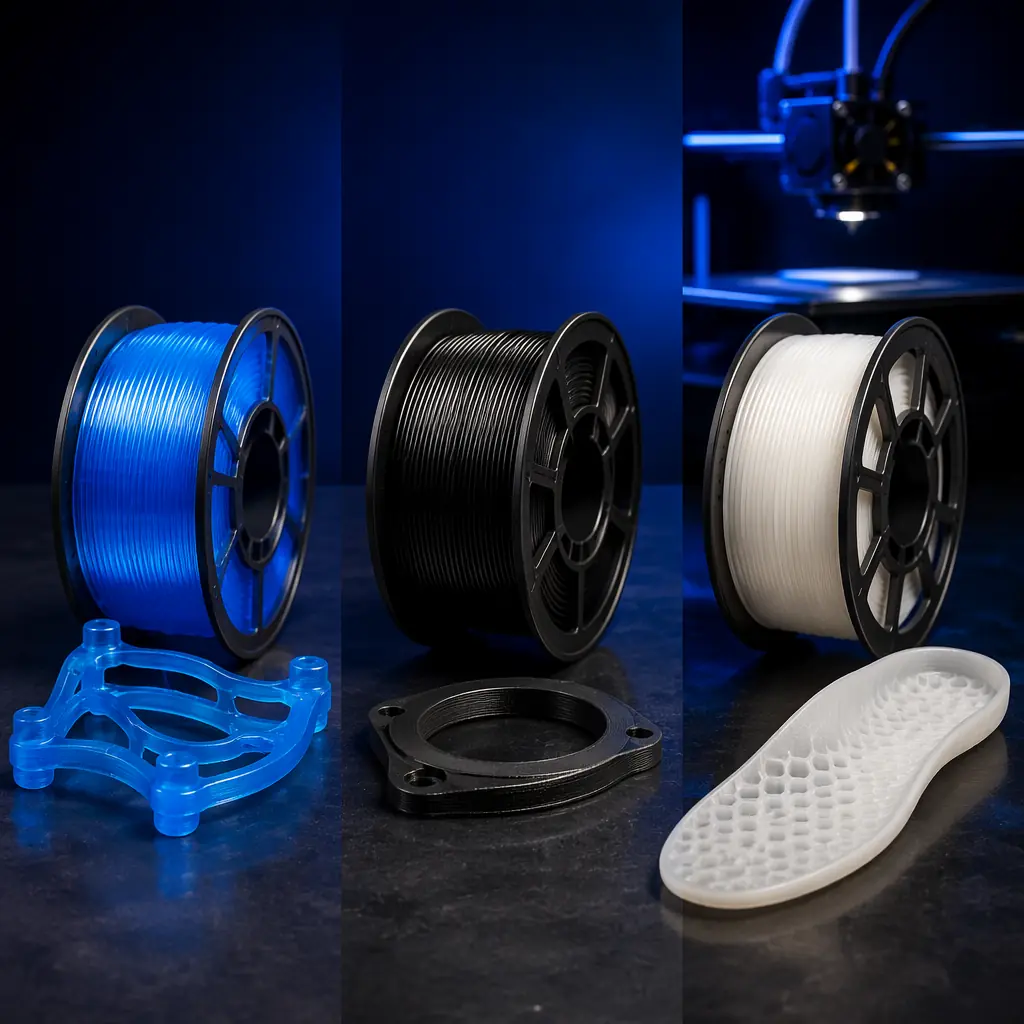
TPU is the volume leader and the easiest flexible to sell.
It prints reliably on most direct-drive printers at 220-250°C with a heated bed at 40-60°C. Shore 95A TPU — the "stiff flexible" — can even run on well-tuned Bowden setups, which means your customer base isn't limited to direct-drive users. The real money in TPU isn't the first spool; it's the color and hardness variety. A phone case manufacturer who validates TPU 85A Clear on their printers will reorder that exact SKU every month — and they'll pay a 15-20% premium over random Amazon TPU because consistency is worth more than a few dollars per spool when you're running 200 units a day.
TPE is the budget flexible — lower FOB, wider availability, but trickier to print.
TPE is more elastic (higher elongation at break — 500-700% vs TPU's 400-600%) but less dimensionally stable during printing. It oozes, strings, and requires slow print speeds (15-25mm/s max). TPE's value proposition is cost-sensitive applications: toy grips, tool handles, protective bumpers — anything where the part needs to be squishy but doesn't need medical-grade consistency. Stock TPE in black and natural; customers buying TPE rarely care about color.
TPC is the premium flexible — highest FOB, highest margin, and the strongest customer lock-in. TPC's heat deflection temperature of 150°C puts it in a different league from TPU and TPE. It can sit in a car engine bay, survive autoclave sterilization, and handle outdoor UV exposure for years without degradation. The trade-off: it's stiff for a flexible (40D minimum — about the hardness of a shopping cart wheel) and requires print temperatures of 240-270°C with a heated bed at 80-100°C. TPC customers — orthotics labs, automotive suppliers, outdoor equipment manufacturers — are the least price-sensitive buyers in the flexible filament market. Once they validate your TPC on their printers, they won't switch suppliers without a compelling reason. For more on high-performance material positioning, see our engineering filaments guide.
Shore Hardness: The One Number That Makes or Breaks a Flexible Filament Sale
If you only learn one technical concept for selling flexible filaments, make it Shore hardness. Shore hardness is to flexible filaments what melt flow index is to rigid ones — it tells you exactly how the printed part will feel and behave. Getting the Shore hardness wrong is the #1 reason flexible filament customers return spools: the part came out too stiff or too floppy for their application.
The Shore scale comes in two variants:
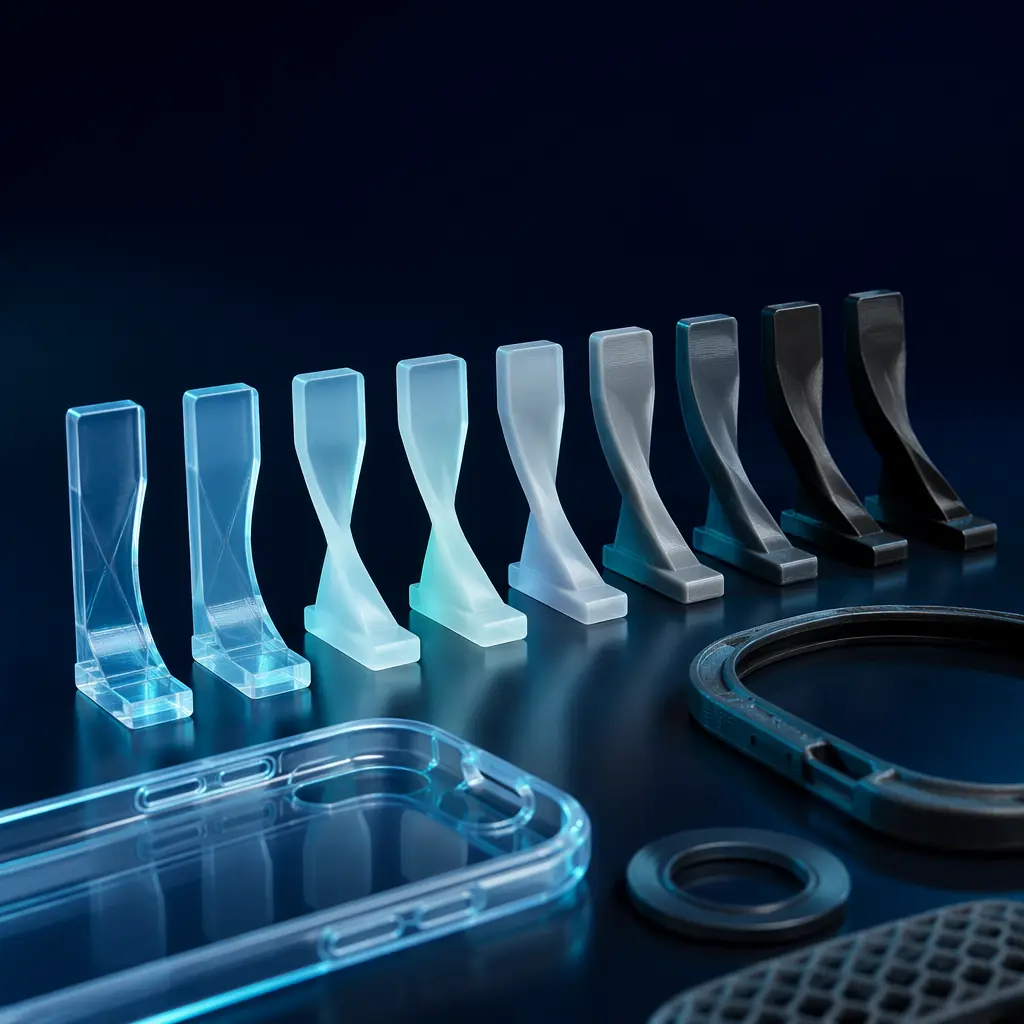
- Shore A: Softer materials — rubber bands (20A), pencil erasers (40A), shoe soles (60-70A), shopping cart wheels (95A). Most flexible filaments fall in the 70A-95A range.
- Shore D: Harder materials — hard hat (75D), solid plastic wheels. Some TPU grades and most TPC fall in the 40D-75D range.
The stocking strategy is straightforward: carry TPU in 85A and 95A as your core SKUs, add TPE in 80A for budget-conscious buyers, and stock TPC in 55D and 72D if you're serving engineering or medical customers. The 85A TPU alone will account for 60%+ of your flexible filament revenue — it's the Goldilocks hardness that works for phone cases, gaskets, drone parts, and footwear prototypes. Our filament stocking guide covers the full portfolio strategy across all material types.
Printer Compatibility: The Direct-Drive Requirement That Limits Your Addressable Market
Flexible filaments demand something from the printer that rigid filaments don't: a constrained filament path between the extruder gears and the hotend. On a Bowden setup, the filament travels through a 40-60cm PTFE tube — plenty of room for flexible filament to compress, buckle, and jam. Direct-drive extruders reduce that gap to 2-5mm, giving the filament nowhere to go but into the hotend.
But the direct-drive requirement isn't absolute. Here's the compatibility matrix that determines which of your customers can actually use flexible filaments:
The practical implication for distributors: roughly 40-50% of your existing customer base can print flexible filaments today (direct-drive owners). Another 20-25% can print hard TPU (95A+) if they're willing to slow down. The remaining 25-35% on Bowden setups need a printer upgrade before they can join the flexible filament market — which is itself a direct-drive printer upsell opportunity. When a Bowden customer asks about flexible filaments, the right answer is: "You can try 95A TPU at 25mm/s on your current machine, but here's a direct-drive printer that will print any flexible filament at normal speeds — and your existing PLA prints will look better too."
Customer Segments That Drive Flexible Filament Revenue
Flexible filament buyers fall into distinct segments with different buying patterns, price sensitivity, and reorder behavior. Here's who's buying, how much, and why:
Phone case manufacturers are your highest-volume flexible filament customers — and the easiest to win. A single mid-size case shop runs 5-15 printers 24/7 producing TPU cases. They consume 100-300kg of TPU per year per location. The key to winning this segment: color consistency batch-to-batch and diameter tolerance of ±0.03mm or better. These buyers care far more about process reliability than price — a 5% price savings means nothing if inconsistent filament causes a 2% print failure rate that wastes labor and machine time. For more on evaluating supplier quality, see our filament quality evaluation guide.
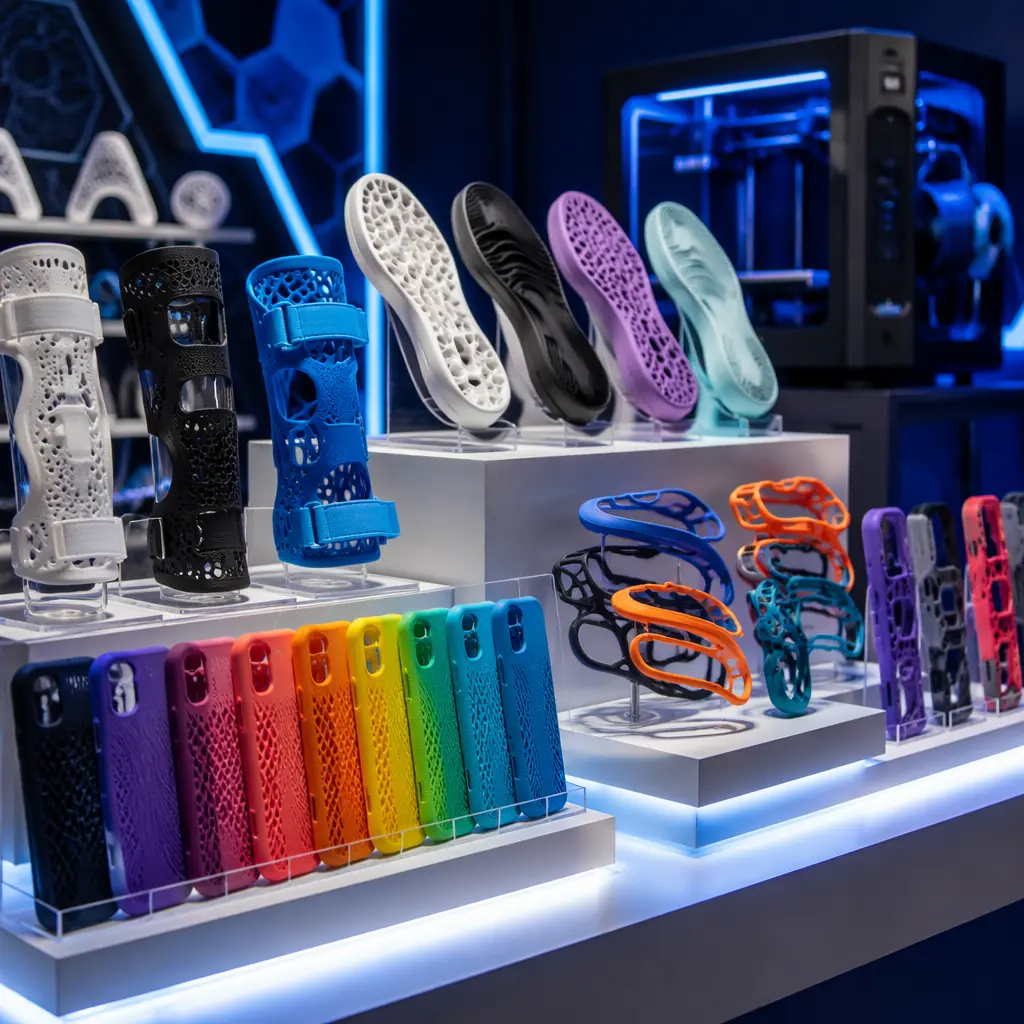
Medical orthotics labs are the highest-margin segment with the strongest lock-in.
These buyers need TPC with documented biocompatibility (ISO 10993), consistent Shore hardness (±2 Shore D across batches), and lot traceability for regulatory compliance. A medical lab that qualifies your TPC will not switch suppliers for a 15% price difference — the cost of re-qualifying a new material with their regulatory body exceeds any potential savings. The challenge is winning the first order: medical buyers typically want a sample batch and a 30-day trial before committing. The payoff: once onboarded, these customers have near-zero churn and 3-5 year supplier relationships. See our medical 3D printing guide for the full healthcare vertical strategy.
The Flexible Filament Business Model: Margins, Inventory, and the Reorder Flywheel
The financial case for stocking flexible filaments is simple: per-spool margins are 18-25 percentage points higher than PLA, and reorder rates are 3-4× higher. Here's the unit economics for a typical distributor:
The reorder flywheel is what makes flexible filaments a better business than PLA.
A PLA customer buys 3 spools, uses them over 6 months, and maybe comes back. A TPU customer buys 2 spools, dials in their settings, starts printing phone cases — and reorders 5 spools the next month. The flywheel works because flexible parts are functional: gaskets wear out, phone cases get replaced, drone bumpers break. Rigid PLA parts are decorative or structural — they don't have the same consumption cycle.
For distributors offering consumables bundling, flexible filaments are the ideal anchor product. Bundle a direct-drive printer with 2 spools of TPU 85A and 95A at a 15% discount on the filament — the customer validates both hardnesses on their new machine, and you've just created a recurring filament customer with a 50%+ reorder probability within 45 days.
Reviewed by the Precise3D engineering & OEM team. Compliance files that accompany the catalog are auditable at the certification register.
Flexible Filament Sourcing
Get OEM Pricing on TPU, TPE & TPC Filaments With Verified Shore Hardness Data
Tell us your target customer segments and volume projections. We'll provide FOB pricing on flexible filaments with documented Shore hardness, diameter tolerance specs, and color consistency guarantees — so you can sell with confidence and keep customers reordering.