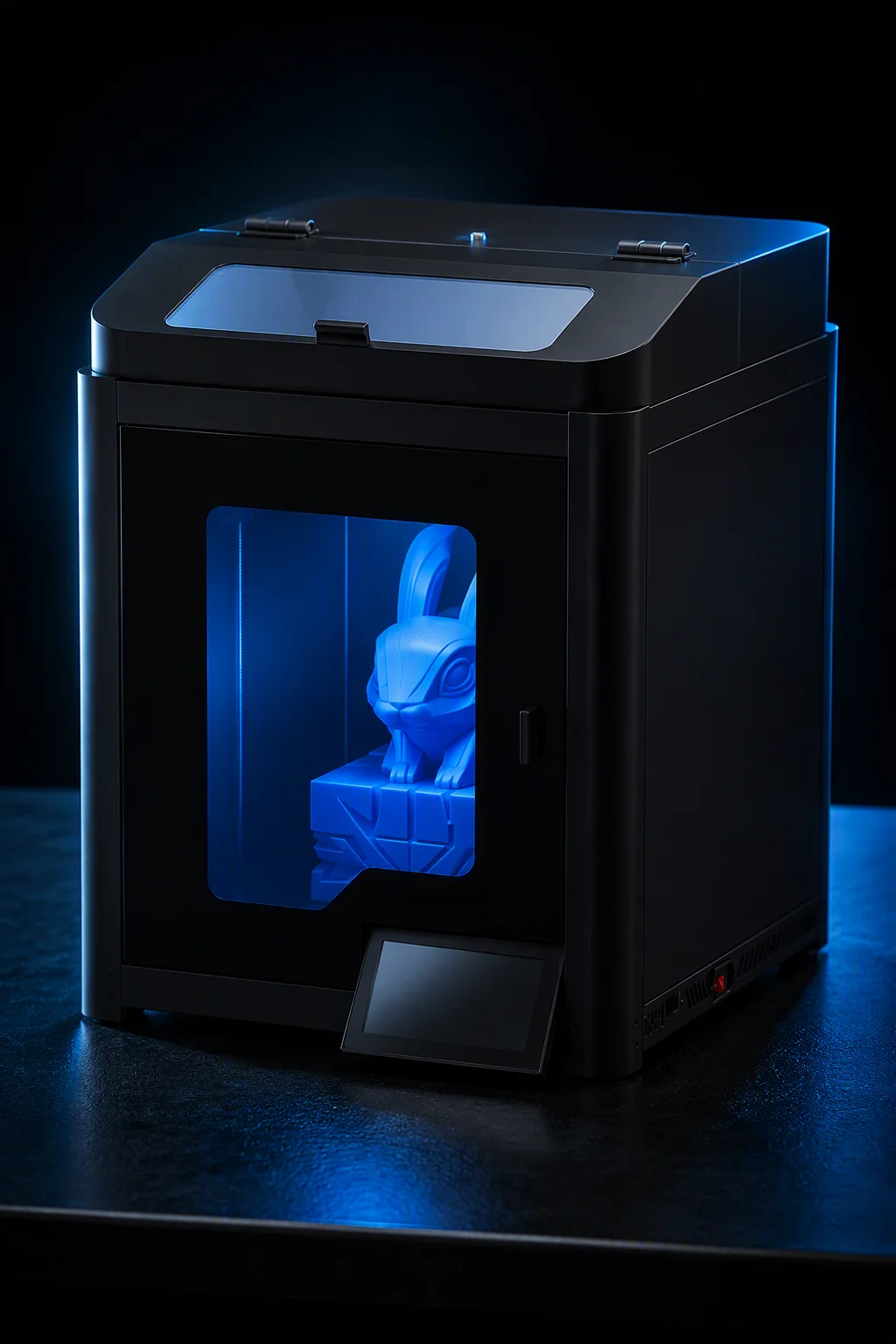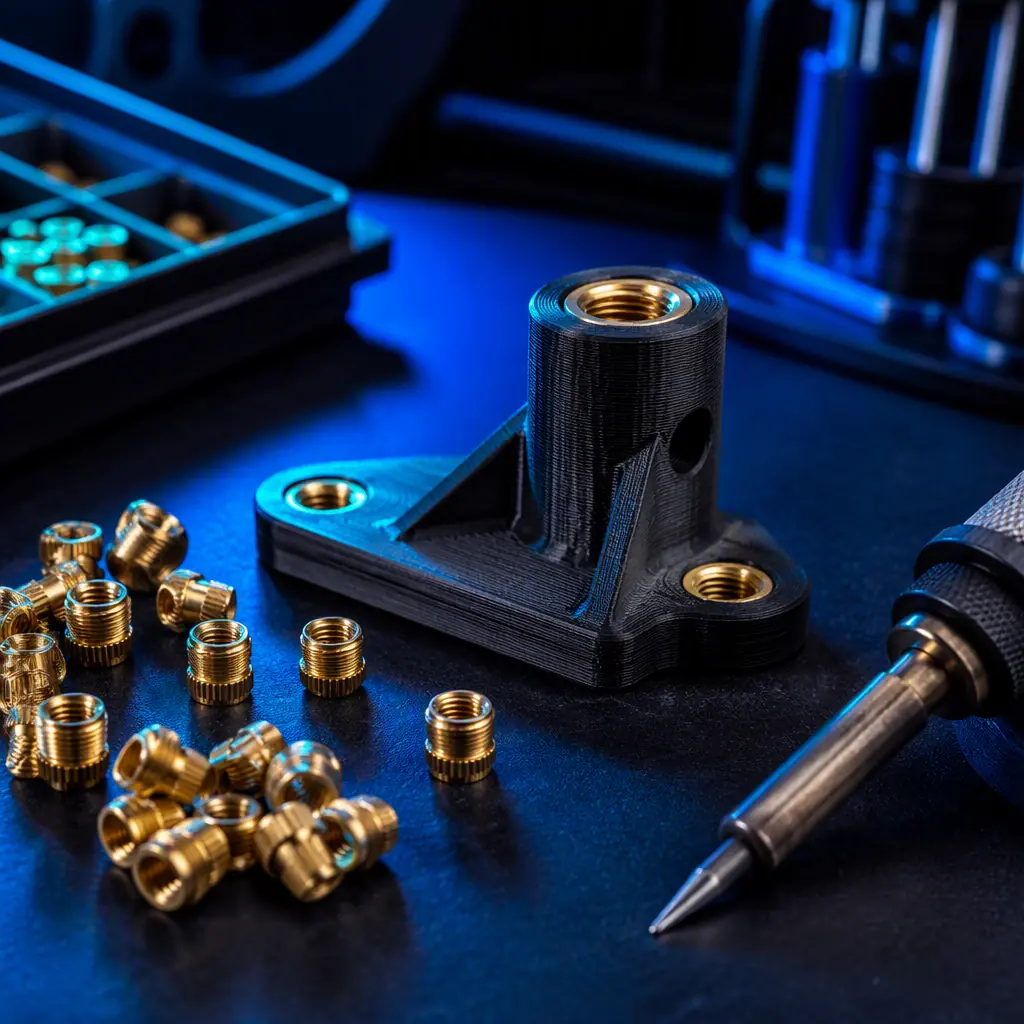
The case for heat-set inserts starts with the physics of printed plastic. A screw driven directly into a printed hole engages maybe two layers of plastic — the thread strips at 10-20 N·m of torque and the part is scrap. A heat-set insert spreads the load across a knurled cylinder that is physically fused into the part, so a 4 mm insert in PETG holds 400-600 N of pull-out force and survives repeated assembly cycles in field service. The insert is the difference between a part that is "printed" and a part that is "built." For the design-for-print context that makes insert placement reliable — wall thickness, infill, and boss design — see our post-processing and finishing guide.
Insert Types: What to Stock and Why
Four insert families cover nearly every customer application. Knurled brass inserts are the default: the diamond knurl bites into the plastic as the boss melts, producing the strongest and most repeatable hold, and they work with a simple soldering-iron tip. Self-tapping inserts (thread-forming screws) are the no-tool option: they screw into an undersized hole and cut their own threads, which suits field repairs but gives lower pull-out strength and re-torque life. Ultrasonic inserts are designed for ultrasonic horns — the fastest method at scale, ideal for production runs of 500+ parts, but requiring a $1,500-5,000 horn tool. Threaded-in (screw-in) brass inserts are the legacy option, useful when no heat source is available. For the distributor, the stock list is simple: knurled brass in M3, M4, M5, M6 and 4-40, 6-32, 8-32, 10-24, with the soldering-iron tip kit as the entry accessory. For how inserts fit into the broader consumables revenue model, see our consumables bundling guide.
Knurled brass is the family to lead with: it needs no capital tooling, works on every printer material, and produces the strongest joint, which is what engineering customers ask for first. The soldering-iron tip kit is the $15-40 accessory that unlocks the whole category — stock it next to the insert racks. For the margin and bundling structure that turns these parts into recurring revenue, see our accessories revenue multiplier guide.
Hole-Size Design Rules: The 0.2-0.3 mm Interference Fit
The single most common insert failure is a boss that cracks during installation, and the cause is almost always a hole that is too small. The rule: the hole diameter should be 0.2-0.3 mm smaller than the insert's outer diameter for standard knurled inserts — an M4 insert with a 5.0 mm OD gets a 4.7-4.8 mm hole. The boss wall needs at least 1.5-2× the insert radius of material around the hole (an M4 insert needs a boss of roughly 9-10 mm outer diameter), and the boss should be designed with a small lead-in chamfer so the insert starts straight. Infill matters: the boss must be solid (100% infill) in the region around the hole — a 15% infill interior will collapse and the insert will spin. For the material-specific behavior of these boss designs — which plastics creep, which ones crack — see our engineering filaments guide and the nozzle materials guide.
What you're looking for: A cracked boss means the hole was undersized or the boss wall too thin — the fix is design, not hardware: 0.2-0.3 mm interference, 1.5-2× wall ratio, and a lead-in chamfer. A stripped hole means the insert was undersized for the application or the material creeps (PLA under sustained load). A loose fit means the hole was oversized or the iron temperature too high, which melted the boss too far. Diagnosing the failure tells you whether the answer is a bigger insert, a different material, or a design change — and it makes you the expert the customer calls first.
Pull-Out Strength Data by Material
Pull-out strength is the number engineers quote, and it varies meaningfully by material. In PETG, a standard knurled M4 insert holds roughly 400-600 N pull-out. In ABS and ASA, expect 350-550 N. Nylon PA12 and PA-CF hold 500-800 N and are the best materials for parts that get assembled and disassembled repeatedly. PLA holds the least — 250-450 N — and creeps under sustained load, so it is the wrong material for any threaded joint under tension. PETG is the overall best value: it melts cleanly, doesn't crack around the boss, and holds enough force for 90% of enclosures, brackets, and fixtures. Torque-out strength follows the same ordering and typically runs 0.8-1.5 N·m for an M4 insert in PETG — more than enough for any M4 screw torqued to spec. For the material selection framework that matches filament to application, see our filament stocking guide and the build volume guide.
Common Failure Modes and the Fixes That Close the Sale
Every insert failure falls into five buckets, and knowing the fix is what makes a distributor the technical authority. (1) Insert spins in the boss: hole too large or boss infill too low — increase interference or print the boss solid. (2) Boss cracks: hole too small or wall too thin — open the hole to 0.2-0.3 mm interference and grow the boss to 1.5-2× radius. (3) Thread strips on re-assembly: undersized insert for the duty — step up one insert size or move to nylon parts. (4) Insert tilts during install: no lead-in chamfer — add a chamfer or use a guided insertion tip. (5) Heat damage to the part: iron too hot or dwell too long — run 240-270°C on the tip and 3-5 seconds max dwell. These fixes are cheap, printable, and demonstrable — a distributor who shows a customer the before/after on a test coupon closes the insert sale on the spot. For the troubleshooting methodology that carries over to every print-quality issue, see our print failure diagnosis guide.
The Distributor Margin Case: Inserts as the Perfect Consumable Add-On
Inserts are the highest-margin line item in the consumables catalog because they are tiny, high-velocity, and bought in bulk. A distributor buys knurled brass inserts at $0.02-0.06 per piece in 1,000+ packs and sells them at $0.06-0.20 — a 60-70% gross margin, versus 40-55% on filament. A 100-piece assortment kit (M3/M4/M5/M6 plus 4-40/6-32/8-32) sells for $20-40 at 70% margin and is the natural upsell on every printer sale, every post-processing conversation, and every engineering account. The insertion tip kit adds another $15-40. Per active engineering customer, insert and tip revenue runs $300-1,200 per year — small per account, but it rides along on every transaction with zero incremental freight cost. For the full consumables and accessories revenue architecture, see our consumables subscription guide and the spare parts aftermarket guide.
Bottom Line
Heat-set inserts are the smallest part in the 3D printing ecosystem with the largest effect on part quality — and one of the best margin lines a distributor carries. They convert the most common printed-part failure (stripped screw holes) into a non-issue, they install in seconds with a $15-40 tip kit, and they hold 300-800 N in the materials engineers actually use. The distributor playbook is simple: stock knurled brass in the six common sizes, bundle the tip kit with every printer sale, teach the two design rules (0.2-0.3 mm interference, 1.5-2× boss wall), and let the test coupon do the selling. At 60-70% margins with zero freight cost on bundled orders, inserts are the consumable that pays for the packaging on every other line item. The distributor who makes inserts part of every quote will find the customers coming back for the filament, the nozzles, and the next printer.
Reviewed by the Precise3D engineering & OEM team. Compliance files that accompany the catalog are auditable at the certification register.
Start Your Partnership
Ready to Bring heat set inserts threaded to Your Market?
Start with the heat set inserts threaded spec sheet, then validate every claim against the certification register.