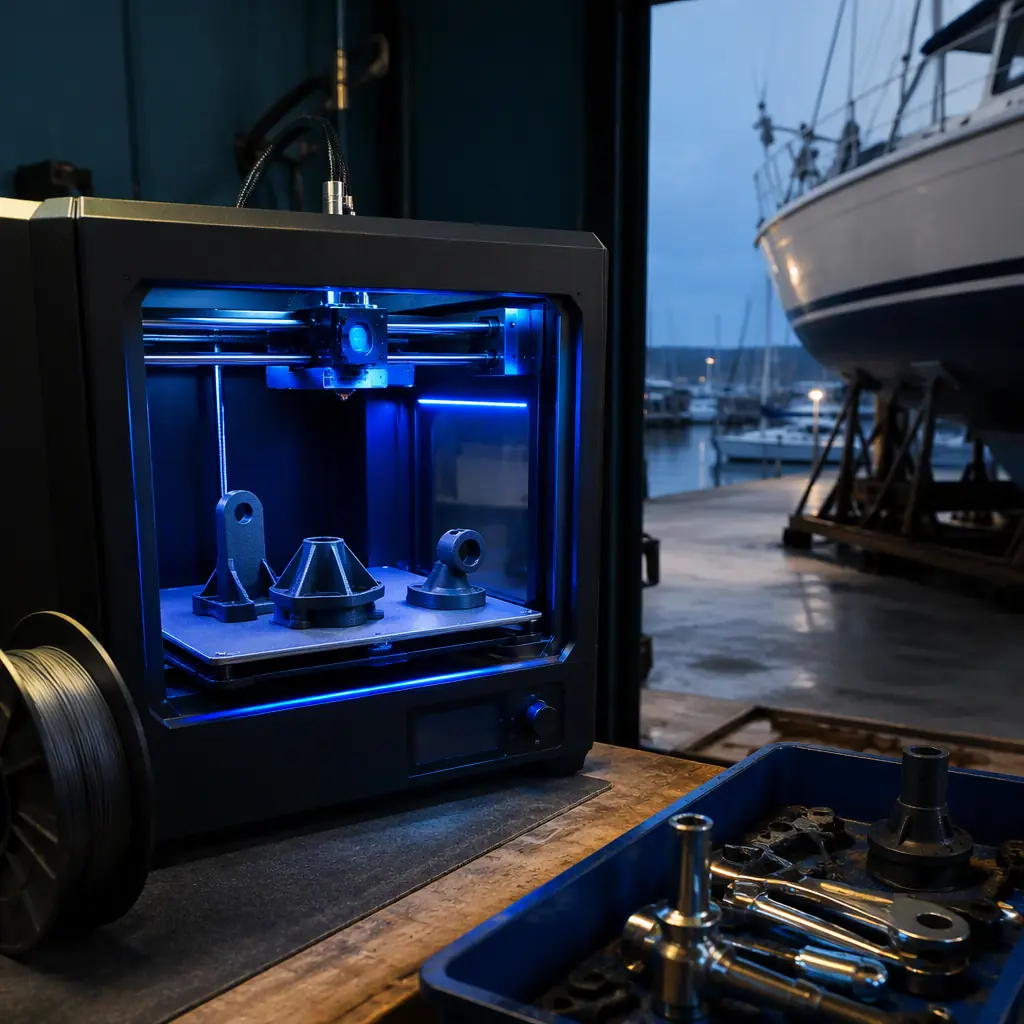
Consider the economics of a single marine repair. A 40-foot cabin cruiser needs a replacement latch for its engine hatch. The OEM discontinued the part in 2019. The boatyard quotes $220 for a custom-machined replacement with a 3-week lead time, or the owner can wait 6 weeks for an aftermarket part shipped from another country. A $700 desktop 3D printer with an enclosed chamber prints the latch in ASA in 4 hours for $6 in filament — and the boatyard can print a second one as a spare for $4. When a marina needs 40 custom cleat risers for its dock renovation, injection molding requires a $4,000-8,000 tool with a 30-day lead; printing them on two printers over a weekend costs $160 in ASA. Marine maintenance is a market built on low-volume, high-urgency custom parts — the exact conditions where desktop 3D printing beats every alternative. For the broader vertical expansion framework, see our portfolio strategy guide.
The Marine Customer Segments That Buy 3D Printers
The marine market is five distinct customer segments, each with different purchasing behavior, printer requirements, and consumable consumption. A boatyard that services 200 boats per year behaves completely differently from a pontoon boat manufacturer running production lines — and the distributor who treats them the same will misprice both.
Boatyards are the highest-value segment because they have both the volume and the urgency. A service yard handling 300 boats per season replaces hundreds of small plastic parts — hatch latches, vent covers, switch panel surrounds, wiring grommets, snap-in fasteners — and every one of those parts is a customer billing line item. When the part is printed on-site, the boatyard converts a 3-week supply delay into a same-day repair, which means the boat leaves the yard sooner and the yard collects revenue faster. A mid-size boatyard running 4 printers consumes roughly 20-35 kg of filament per month at $20-35/kg for ASA and nylon — a $400-1,200 monthly consumable account from a single customer. For the consumables bundling strategy that maximizes per-account revenue, see our consumables bundling guide.
What you're listening for: If the yard orders more than 10 unique plastic part SKUs per month or has ever paid a machine shop $100+ for a simple bracket, they are a strong candidate. The breakeven for a boatyard buying their first printer is typically 4-7 months — one discontinued latch order and one custom rod holder job covers the hardware cost. If they are already waiting 3+ weeks for aftermarket parts from overseas, the sale closes itself.
Why Saltwater Kills Cheap Filaments: Material Selection for Marine Applications
PLA is the wrong filament for marine use — it softens at 55-60°C (easily reached inside a closed cockpit in summer), absorbs moisture from humid sea air, hydrolyzes slowly in saltwater, and becomes brittle after a few months of UV exposure. A printed PLA part on a boat deck will crack within one season. The materials that survive marine environments are ASA, nylon (PA6 and PA12), polypropylene, and in specific applications, PETG and PC blends. Each has a different failure mode, and the distributor who can recommend the right material for the part is the distributor who wins the account.
ASA is the default marine exterior material: it combines UV stability with saltwater resistance and costs $20-28/kg at wholesale, making it the highest-margin mainstream filament in a marine account. Nylon PA12 is the upgrade for load-bearing parts — rod holders, boarding ladder brackets, and hinge assemblies — because its impact strength and fatigue resistance handle the constant vibration of a boat underway. For customers who need chemical and fuel resistance, polypropylene is the only common filament that withstands diesel, gasoline, and marine solvents, though it requires a textured build surface and a printer with a chamber to print reliably. For the complete engineering filament selection and margin breakdown, see our engineering filaments guide and the nylon filament guide.
Printer Requirements for Humid Marine Environments
A boatyard is one of the hardest environments for a 3D printer: 60-95% relative humidity, salt-laden air, temperature swings from freezing to 40°C, and dust from sanding and fiberglass work. The printer you sell into this market needs an enclosed frame with a sealed electronics compartment, an all-metal hotend capable of 290°C minimum (nylon prints at 260-290°C), a heated chamber or at minimum a chamber that can hold 45-55°C for ASA and nylon warpage control, and a textured or PEI build surface for polypropylene compatibility. Humidity is the silent killer: nylon absorbs moisture from the air and prints with bubbles and surface defects if not dried. The distributor who bundles a filament dryer with every marine printer sale prevents 80% of nylon print failures — and adds a $150-300 accessory to every transaction. For the full printer selection criteria, see our build volume guide and enclosed vs open frame comparison.
The build volume sweet spot for marine work is 220×220×250 mm to 300×300×350 mm. Most marine replacement parts — latches, brackets, covers, fittings — fit in a 256 mm cube; only dock fender brackets and swim platform components approach the 300 mm range. What matters more than volume is reliability over unattended overnight prints and corrosion resistance of the printer itself. A boatyard operator who starts a 16-hour nylon print at 5 PM cannot afford a failed part at 8 AM the next day — auto-bed leveling, filament runout detection, and power-loss recovery are requirements, not features, in this market. Printers with exposed linear rails and unsealed electronics fail prematurely in salt air; recommend models with covered rails or plan for accelerated maintenance intervals. For the maintenance plans and extended warranty models that lock in recurring revenue, see our maintenance plans guide.
The Distributor Go-to-Market Playbook for Marine
Marine customers do not search for "3D printer." A boatyard owner searches for "replacement hatch latch 40 foot cruiser" or "custom rod holder bracket." The distributor who wins this market is not the one ranking for "3D printer" — it is the one who walks into boatyards with a printed sample kit and says "show me the parts you ordered last month, and I will show you which ones you can print for under $10." The go-to-market sequence: (1) identify the top 3-5 marine trade events in your region — IBEX (International BoatBuilders' Exhibition), METSTRADE in Amsterdam, and regional boat & fishing expos; (2) build a sample kit of 10-15 printed marine parts — deck cleat bases, rod holder brackets, bilge pump mounts, vent covers, switch surrounds — that a service manager recognizes as parts currently on their order desk; (3) at the booth, the opener is not "we sell 3D printers" but "we help boatyards eliminate 3-week part delays and $200 one-off machining bills"; (4) the follow-up is a yard visit to identify the 5-10 highest-frequency replacement parts, printing them on-site as a demonstration, and leaving them with the parts and a quote for a printer-filament-dryer bundle. For the complete distributor sales methodology, see our B2B sales demo playbook.
Recurring Revenue: The Consumable Stream That Makes Marine Accounts Profitable
The hardware sale to a marine customer is the entry point; the recurring revenue comes from saltwater-grade filament, hardened steel nozzles, build surfaces, and maintenance. Nylon and glass-filled materials wear brass nozzles within 3-5 kg of throughput — a boatyard printing 25-35 kg per month replaces 4-6 hardened steel nozzles per year. ASA and nylon parts with large flat footprints accelerate build surface wear, and humid marine air makes filament dryers and desiccant refills a standing reorder. A boatyard with 4 printers generates $600-1,200 in monthly consumable revenue at 40-55% gross margins — and marine customers show exceptional retention because a part failure mid-season costs them a customer relationship. For the aftermarket and spare parts revenue model, see our aftermarket revenue guide.
Competitive Landscape: Why the Marine Vertical Is Undefended
The marine 3D printing market is split into two extremes with nothing in the middle. At the top, industrial additive manufacturing companies (large-format and metal AM) sell six-figure systems to shipyards, naval programs, and superyacht builders — a market measured in dozens of customers. At the bottom, hobbyists print trinkets. The tens of thousands of boatyards, marinas, and small-boat OEMs in between — the customers who need a $90 part this week, not a $90,000 system this quarter — have no dedicated supplier. Boat part distributors sell injection-molded inventory, not fabrication capability; marine hardware brands sell products, not tools. The distributor who bridges the gap with desktop enclosed printers, saltwater-grade filament stock, and same-day part replacement capability captures a market where the average customer's first purchase decision is based on one question: "can you really print a part that survives saltwater?" — and the answer, with ASA and nylon, is yes. The total addressable market for marine 3D printing hardware and consumables in the United States alone is approximately $250-450 million annually across boatyards, marinas, small-boat OEMs, and commercial fishing operations. For the market trend analysis supporting vertical expansion timing, see our 2026 market trends report.
Bottom Line
The marine vertical is one of the most defensible markets in desktop 3D printing because it punishes cheap materials and rewards domain expertise. PLA fails, consumer open-frame printers corrode, and generic distributors cannot answer the saltwater question — so the distributor who stocks ASA and nylon, bundles dryers, and speaks the language of boatyard repair owns the category in their region. A distributor with 12 marine accounts averaging 3 printers each generates $25,000-40,000 in annual recurring consumable revenue at 40-55% margins, with retention rates above 80% because switching suppliers mid-season risks part failures that cost boatyards real money. The barrier to entry is not capital or technology — it is a sample kit and a pickup truck. The distributor who walks into the next boatyard with printed parts in hand will own this vertical before the industry realizes it exists.
Reviewed by the Precise3D engineering & OEM team. Compliance files that accompany the catalog are auditable at the certification register.
Start Your Partnership
Ready to Bring marine boating to Your Market?
Distributors selling marine boating build margins with OEM & white-label hardware - request the program sheet and volume pricing.