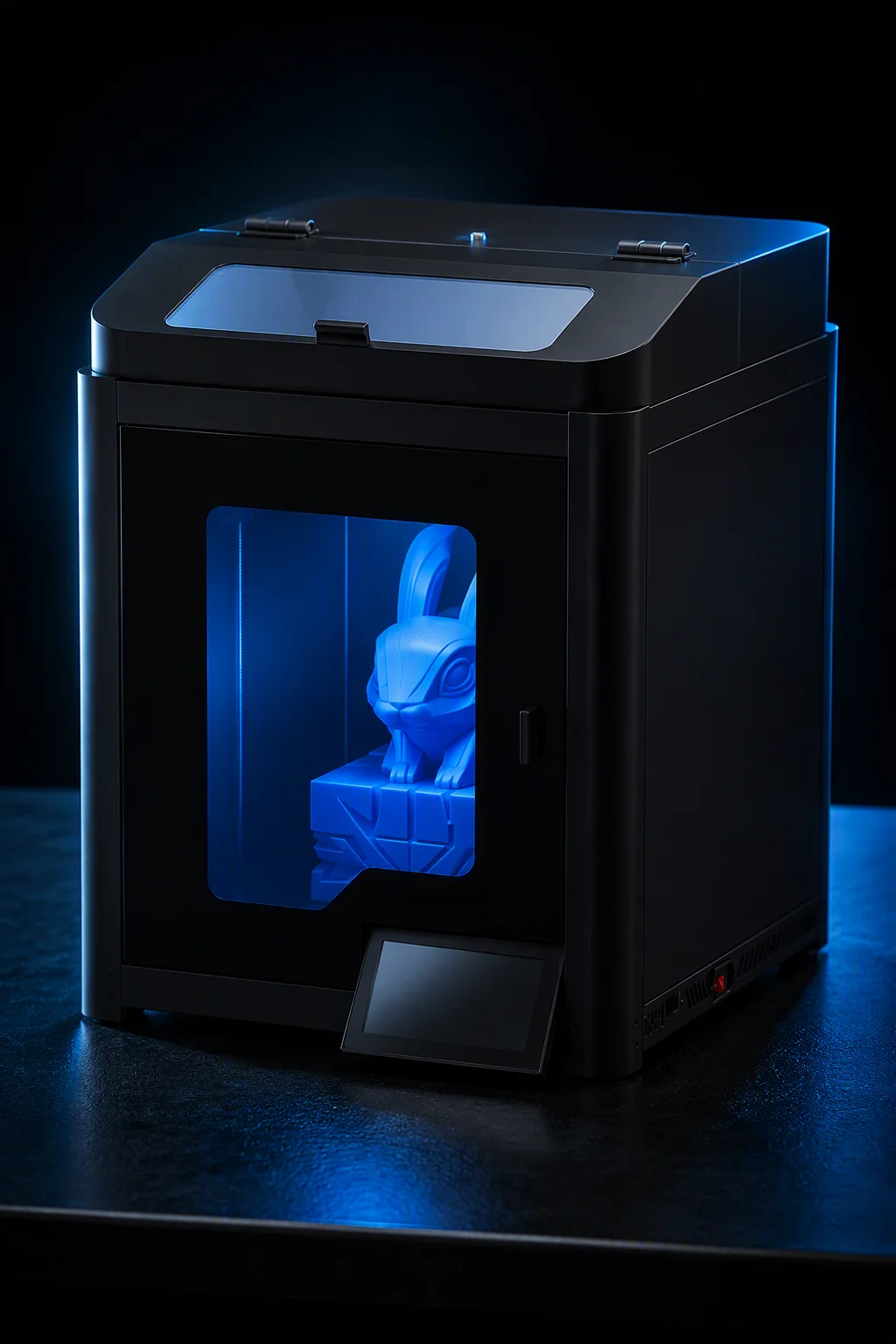
Why IDEX Matters to a Print Farm and Not to a Single Printer
Most IDEX content is written for the person buying one printer. That buyer compares architectures, reads a spec sheet, and decides. A print farm operator faces a different arithmetic: every hour a machine is not extruding is an hour of lost capacity that has to be recovered by another machine, and every hour a machine is extruding the wrong material is a scrapped plate plus a filament change plus a re-slice. On a farm, the value of independent dual extrusion is not “two colors.” It is recoverable machine-hours.
The problem is that a single-material farm with 40 machines has 40 identical capabilities. When a job is queued that needs dissolvable support, breakaway interface layers, or a production part in a material that will not tolerate a purge tower, the whole farm has a hole in it. The operator has two options: reject the job, or buy a dedicated machine and let it sit idle between those jobs. IDEX closes that hole with capacity the farm already paid for. The architecture differences are covered in depth in our IDEX dual extrusion guide, and the alternative architecture is compared in toolchanging versus IDEX.
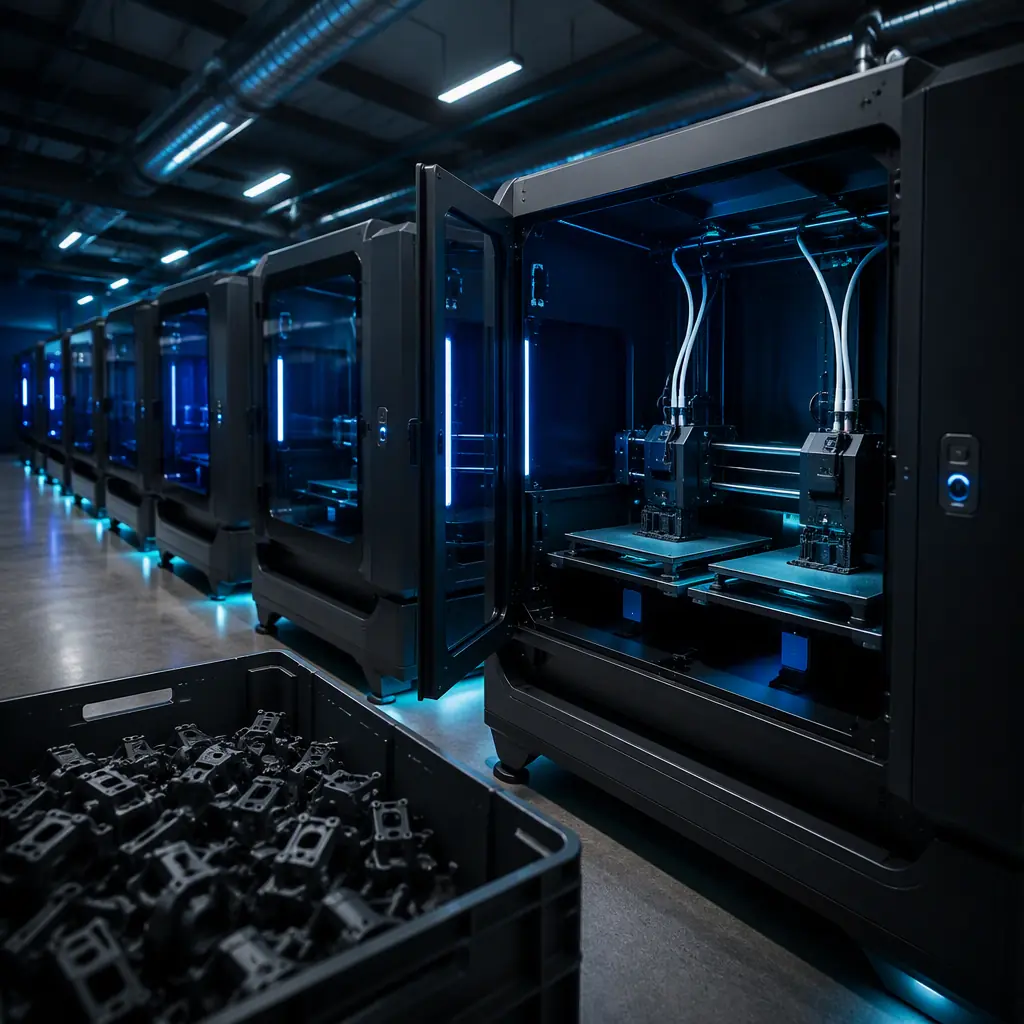
The math is straightforward. A print farm running 40 machines 22 hours a day has 880 machine-hours per day. If 15 percent of the incoming job mix involves a support-material requirement, that is 132 machine-hours per day that a single-material fleet cannot serve. Adding four IDEX machines does not displace single-material capacity — those four cover roughly 40 hours of duplex work at realistic duty cycles, and the remaining volume continues on the single-material fleet where it belongs.
The Throughput Math Nobody Runs Before Buying
The throughput argument for IDEX is usually made badly. It is not that IDEX prints faster — the motion system is the same class of hardware. The gain comes from three places, and each one is measurable.
First, the purge tower disappears from dissolvable-support jobs. A dual-material print on a shared-nozzle machine alternates materials through one melt zone, and every switch costs a purge — typically 40 to 90 mm of filament, plus tower volume, plus the time to print it. On a 300-layer part that switches 80 times, that is real time and real material. IDEX with two nozzles at independent offsets makes the switch by moving the tool, not by flushing the melt zone.
Second, the support filament is used only as support. On a purge-based system, the support material is also the purge material — it is consumed in towers and waste blocks that are not part structure. On an IDEX platform, support filament consumption tracks the actual support volume.
Third, plate-to-plate time drops. Two-nozzle machines in the 300–400 mm class are commonly built with fixed gantries and heavier frames because they are aimed at production rather than hobby use. That is a structural advantage that shows up in ringing, in acceleration limits, and in how long a large flat part takes to finish. The motion-system tradeoffs are the same ones described in our kinematics comparison and motion system guide.
The comparison that matters is cost per usable part, not cost per machine-hour. Once you subtract the purge towers, the failed duplex jobs that a single-nozzle machine cannot even start, and the reprints caused by support-interface scarring, the IDEX machine wins on jobs that a single-material fleet has to decline or farm out.
Uptime: The Real Constraint on Farm Economics
Throughput discussions usually assume the machines are running. In practice, farm output is governed by uptime, and IDEX changes the uptime profile in ways that a spec sheet will not show.
The dominant failure mode on a dual-material print with a shared nozzle is not a crash. It is a partial clog — material residue in the melt zone that degrades flow, causes inconsistent extrusion, and eventually produces a plate of parts that look acceptable at layer 50 and useless at layer 300. The operator finds out at hour nine. That is nine machine-hours and, more expensively, nine hours of occupied schedule that could have run something else.
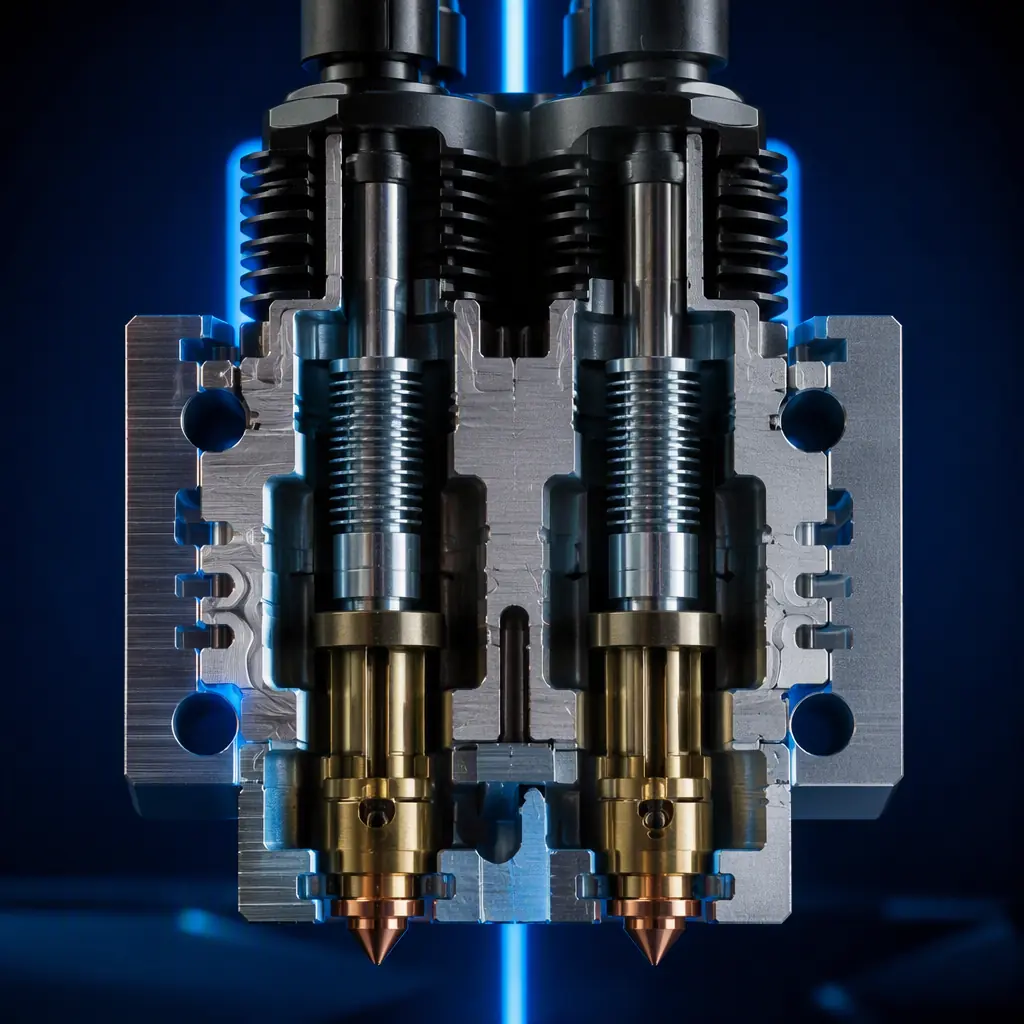
Independent dual extrusion removes the shared melt zone from the duplex equation. Each tool has its own heat break, its own melt chamber, and its own nozzle. A clog on one tool does not affect the other, so the failure is isolated to a single extrusion path and is often recoverable mid-print by redeploying the healthy tool.
What you're looking for: If one tool kept extruding normally, the machine isolates toolhead faults. If the failure propagated to both materials, the melt zone is shared and the machine will keep costing you nine-hour plates.
The maintenance consequence is that service events cluster on toolheads rather than on the whole machine, which is a better fit for farm operations. A toolhead is a subassembly that can be swapped and serviced off-machine, and the printer returns to production in minutes rather than being pulled from the schedule for a full teardown. Farms that track mean time to repair by component rather than by machine consistently find that the toolhead swap is the single largest lever on their recovery time.
What to Verify Before You Commit a Farm Bay to IDEX
Not every machine marketed as IDEX behaves like a production IDEX platform. The difference shows up in the details, and the details are checkable before purchase.
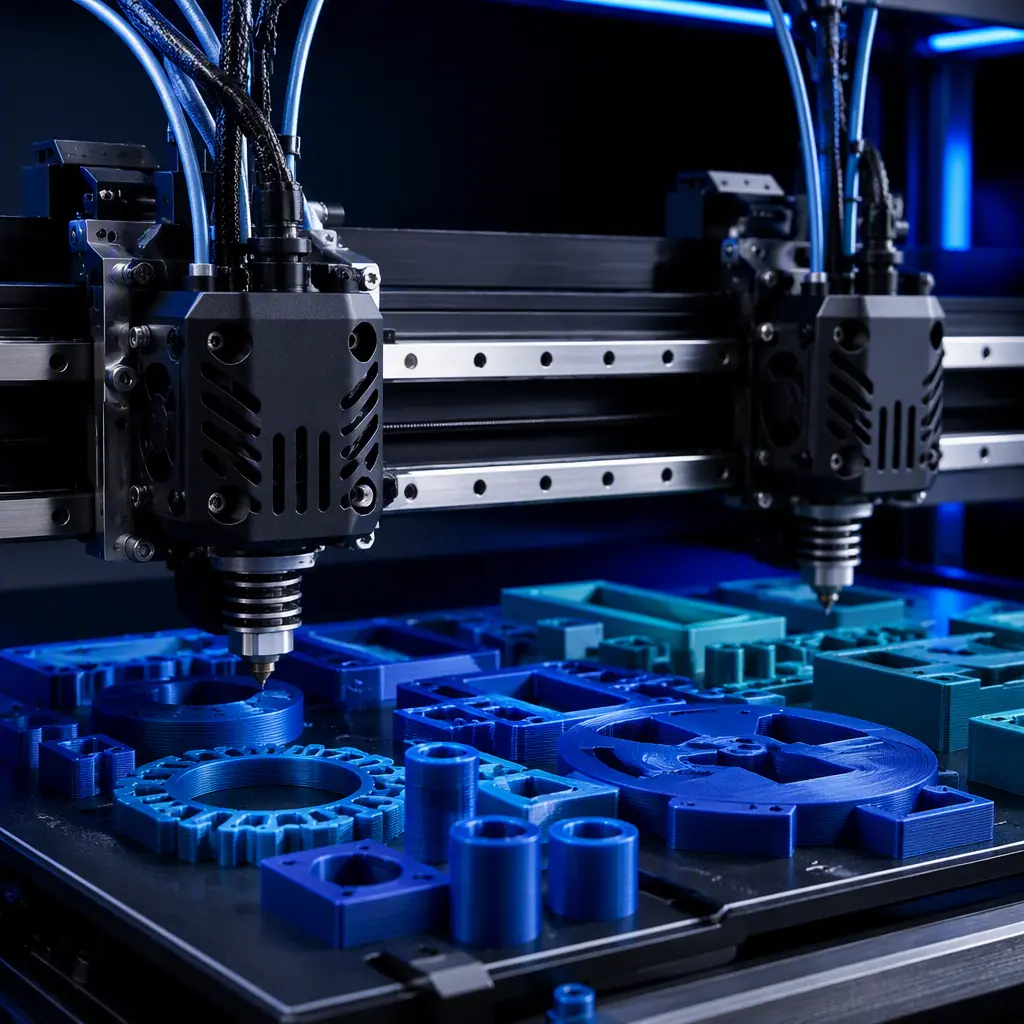
Independent motion, not just independent nozzles. The toolheads must be able to move independently in the carriage axis and hold separate offsets. A design that physically links the two nozzles with a fixed offset cannot do true independent positioning and will not deliver the alignment benefit.
Alignment that survives a production schedule. Two nozzles means two coordinate systems, and the alignment between them must be stable across thousands of tool changes. Ask for the mechanism — a mechanical datum with an adjustable nozzle plate is serviceable in the field, while a design requiring factory recalibration is not.
Tool-change time in the motion profile, not on the brochure. The switch from one tool to the other is a motion operation. It has to be fast enough that duplex prints are not slowed by tool changes, and it has to be repeatable enough that the alignment does not degrade with speed.
Ooze control on the idle tool. The second nozzle sits hot or is parked while the first prints. If the idle tool oozes, the part gets blobs from a nozzle that was supposed to be out of the way. Look for a wiping or docking strategy, not just a lift.
The failure pattern to watch for in a cheap IDEX design is a shared drive that moves both tools together with a fixed offset, plus a shared melt zone behind the two nozzles. That is a marketing IDEX, not an operational one — it delivers two colors and almost none of the farm benefit. The diagnostic question to ask is whether the machine can start a duplex print with both tools at different X positions, because that is the operation that a fixed-offset design physically cannot perform.
Slotting IDEX Into an Existing Farm Without Rebuilding the Queue
The practical objection from a farm operator is not whether IDEX is better. It is whether adopting it means rebuilding the slicing pipeline, the scheduling logic, and the material handling that took two years to stabilize. It does not, provided the machines are introduced as a capability tier rather than as a replacement fleet.
Treat IDEX machines as the farm's duplex tier. They take the jobs the single-material fleet declines, plus the jobs where a purge tower consumes more material than the part's own support structure. In practice this means routing by a rule rather than by operator judgment: any job with an assigned support material goes to the duplex tier, and anything requiring more than roughly 20 tool changes per 100 layers goes to the duplex tier because the purge savings dominate.
Material handling is the part that needs real planning. A duplex tier needs support-material inventory in spool quantities, in a dry state, at the right diameter — and it needs a policy for what happens when the support material runs out mid-plate. On a purge-based system a support-material outage means the job cannot start. On an IDEX platform, the same outage is often survivable by switching the support tool to a compatible alternative, which is a decision the operator can make at the machine rather than in the scheduler.
What you're looking for: A duplex tier that can substitute a compatible support material at the machine keeps the schedule. A tier that must abort and re-queue has just turned a material-outage event into a capacity loss.
The cost side is also more favorable than a straight machine comparison suggests. A duplex tier consolidates jobs that would otherwise be sent out, which removes the margin on those jobs from a third party and returns it to the farm. It also raises the value of the machines already installed, because single-material machines are no longer idle waiting for a job they can run.
Support-Material Selection Decides Whether the Investment Pays Back
IDEX without a disciplined support-material strategy is an expensive two-color printer. The payback comes from the support tool doing work that a single-nozzle machine cannot do, so material selection is the hinge.
Dissolvable support is the clearest case. It eliminates the manual labor of support removal, which on complex geometry is often the single largest touch-time cost in the whole job. It also removes the surface damage that comes from prying breakaway support off a face that has to be dimensionally accurate. The tradeoff is that dissolvable materials need the right thermal environment and the right nozzle pairing, and they demand a dissolution tank on the operator's side. Material storage discipline matters here more than on a single-material fleet — see our filament drying and storage guide for the moisture thresholds that ruin dissolvable supports.
Soluble-versus-breakaway is a decision that should be made per job family, not per farm. Jobs where the supported surface is non-critical can run breakaway and save the dissolution time. Jobs where the supported surface is a sealing face, a bearing bore, or a datum can justify dissolvable even at the higher material cost, because a scrapped plate costs more than the material difference.
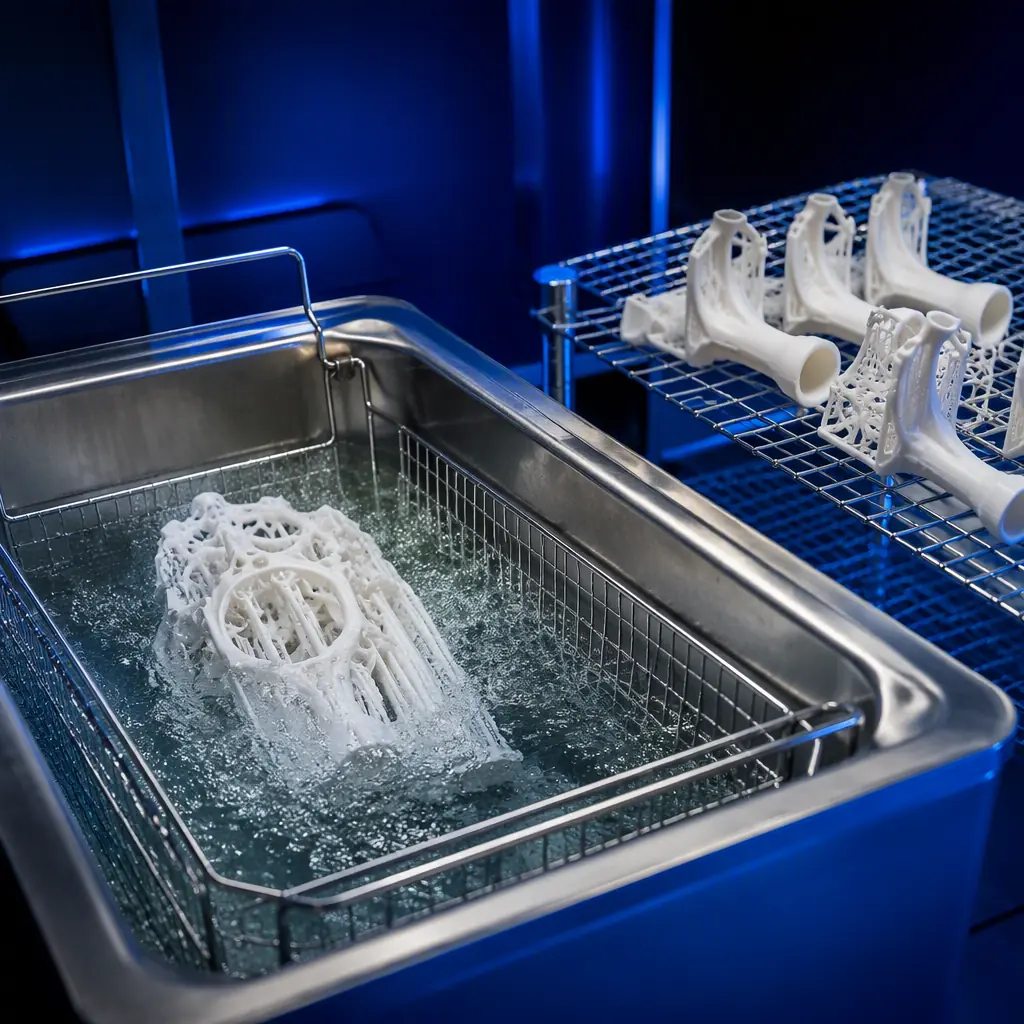
The third category is the high-temperature engineering material that is simply not printable in a shared melt zone. Some of these degrade when they are repeatedly flushed through the same channel as another polymer, and the contamination shows up as reduced interlayer strength rather than as an obvious defect. For a farm serving industrial customers, this is often the real reason to hold a duplex tier at all.
Measuring Whether the Duplex Tier Is Working
Introducing new machines without measurement produces a fleet that feels more capable and a schedule that is not obviously better. Four numbers make the case or refute it.
Declined-job rate before and after. Count the jobs that had to be refused because of material requirements. This is the cleanest signal that the duplex tier is doing what it was bought for.
Material consumed per finished part. Track support and purge material against finished-part mass. If IDEX is working, this ratio falls on the migrated jobs, and it falls by more than the material cost difference between the two filaments.
Reprint rate on duplex jobs. The toolhead isolation should show up here. A farm that migrates duplex jobs and sees print failures fall is confirming the clog-isolation argument with its own production data.
Machine-hours recovered per week. Multiply saved purge time and eliminated reprints by available machines. This is the number that connects the investment to capacity. Farm-level capacity planning is covered in more depth in our print farm economics guide, and the automation layer that makes a duplex tier schedulable is in the unattended farm automation guide.
What you're looking for: That count is the addressable volume for a duplex tier. If it is under 10 percent of declined jobs, the farm's constraint is elsewhere and IDEX will not move the number.
The framing that keeps a farm honest is that IDEX is a capacity purchase, not a feature purchase. It pays back when it converts jobs the farm could not previously quote, and it does not pay back when it is used to print two-color decorative parts on machines that were already adequate. Route duplex work onto the duplex tier, keep single-material volume on the single-material fleet, and measure the split quarterly.
Distributors who carry a duplex tier alongside a single-material fleet can quote work that a single-architecture competitor has to decline. For the machine specifications, toolhead service intervals, and support-material compatibility for the current platform line-up, see the product range or review the engineering documentation for the tool-change and alignment parameters.
Build Your Duplex Tier
Ready to Add IDEX Machines to a Production Fleet?
Precise3D supplies independent dual-extrusion platforms engineered for farm duty cycles, with field-adjustable nozzle alignment, isolated toolhead service, and support-material compatibility data for the full engineering filament range.