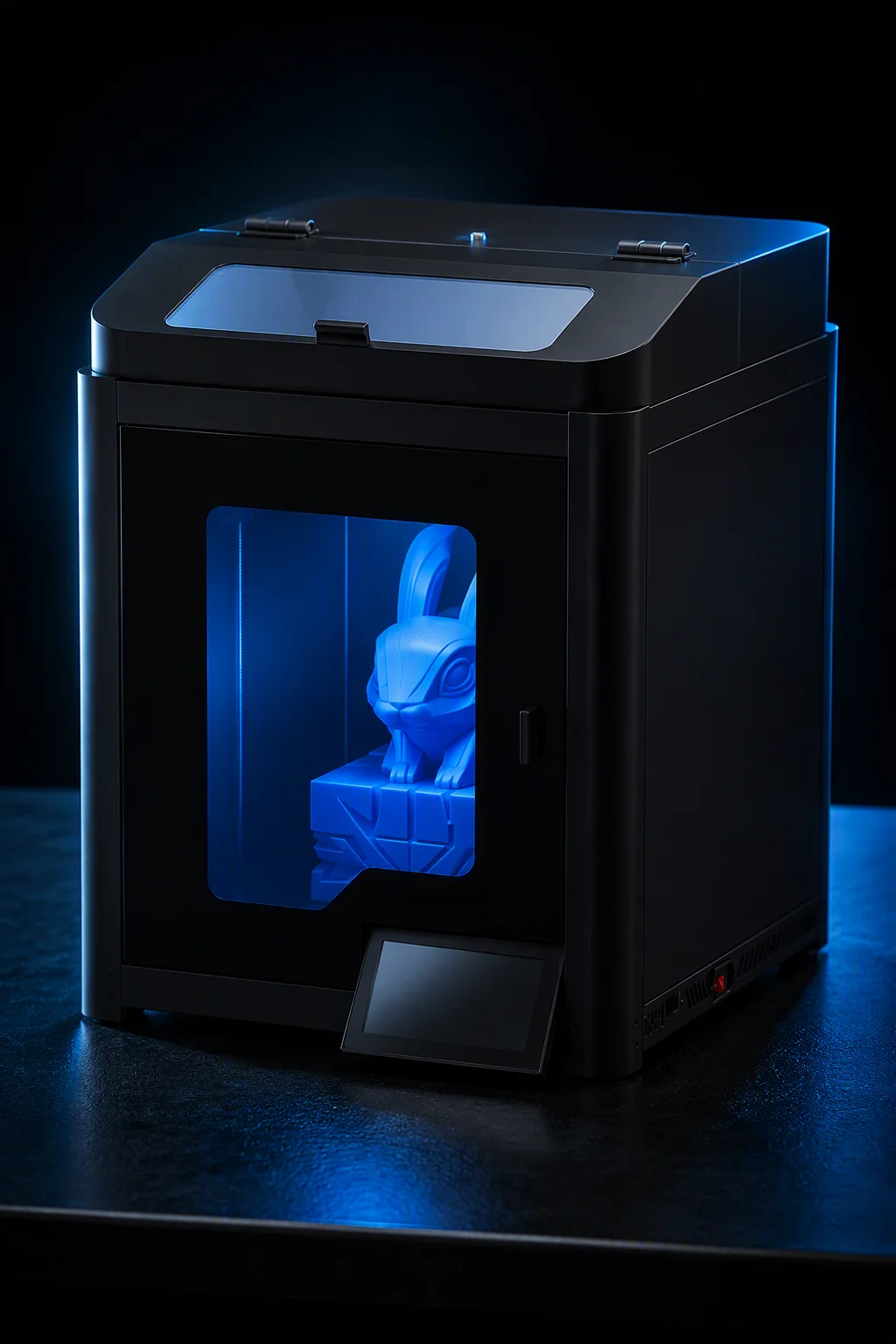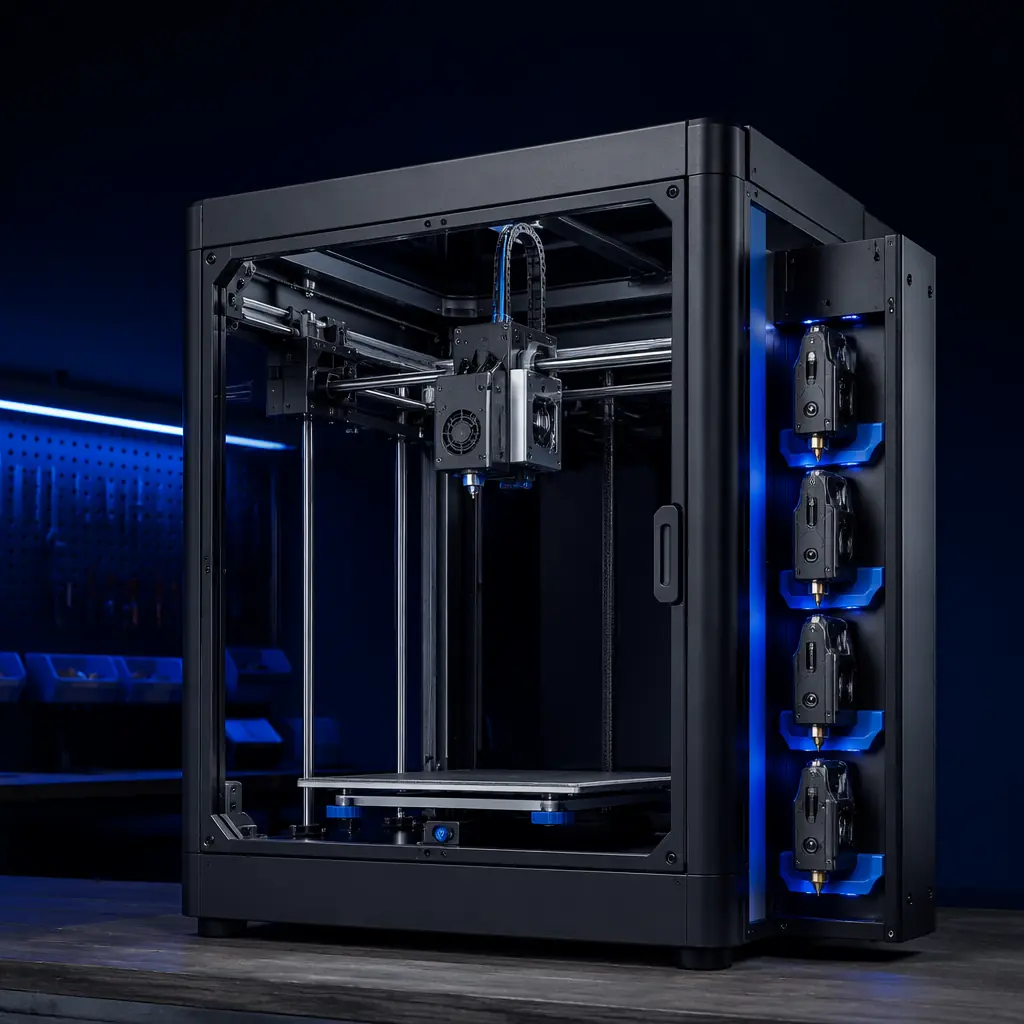
Until 2023, if a distributor wanted to sell a multi-material 3D printer, the answer was unambiguous: IDEX. The Independent Dual Extruder architecture — two print heads on independent X carriages — was the only commercially viable way to print dissolvable supports, multi-color parts, and multi-material assemblies on a single machine. Toolchanging existed in industrial CNC machining and in a handful of $50,000+ Stratasys machines, but it was not accessible to the sub-$10,000 segment. That changed with the open-source release of the E3D ToolChanger in 2019 and, more significantly, the Prusa XL's market entry in 2023 at a $1,999–$3,499 price point. Toolchanging is now a real competitor to IDEX — and for certain customer segments, it is the objectively superior architecture. The question for distributors is not whether toolchanging will matter, but when and for which customers.
The Fundamental Architectural Difference
To understand the tradeoff, you need to understand what each architecture actually does mechanically. An IDEX printer carries two complete hotend assemblies on the same gantry. The left extruder parks to the side while the right extruder prints — and vice versa. The parking position is a physical dock on the left or right edge of the build volume. When the printer switches tools, the active extruder parks, the idle extruder un-parks, and printing resumes. The tool switch itself takes 3–5 seconds for a well-tuned IDEX system running Klipper with input shaping — longer on Marlin firmware without acceleration-optimized parking macros.
A toolchanging printer — sometimes called a multi-tool system — carries only one active toolhead at a time. Additional toolheads sit in a docking station at the edge of the build volume. When a tool change is commanded, the active toolhead moves to the dock, deposits the current tool, picks up the next tool magnetically or mechanically, and returns to the print. The tool change takes 8–15 seconds depending on the system: the Prusa XL docks and undocks with a servo-actuated locking mechanism; the E3D ToolChanger uses a kinematic magnetic coupling. The critical difference: only one toolhead is ever on the gantry. This means the moving mass is constant regardless of how many tools are in the system. On an IDEX printer, you always carry the mass of both toolheads — even when only one is printing. For context on how moving mass affects print quality and speed limits, see our kinematics comparison guide.
Speed: The Toolchanging Advantage That Most Comparisons Miss
The speed comparison between IDEX and toolchanging is often oversimplified to "toolchanging is slower because tool changes take longer." That is true for the individual tool change — 8–15 seconds vs 3–5 seconds — but it misses the bigger picture. On an IDEX printer, the gantry always carries the mass of both toolheads. Even when you are printing a single-material section of a multi-material part, you are accelerating and decelerating roughly 600–800 grams of combined toolhead mass versus 300–400 grams for a single-tool system. The result: IDEX printers typically run 25–35% slower maximum accelerations than equivalent single-tool CoreXY printers. For the same frame stiffness and motor torque, a toolchanging printer achieves roughly 30% higher acceleration — and since print time scales roughly with the square root of acceleration for most geometries, this translates to about 15% shorter print times on single-material sections, which often make up 60–80% of a multi-material print.
The net effect: for a print that is 70% single-material and 30% multi-material switching, a toolchanging printer with 30 tool changes will spend roughly 300–450 seconds on tool changes versus 90–150 seconds for IDEX. But the toolchanging printer saves approximately 600–900 seconds on the single-material sections due to higher acceleration. The toolchanger comes out ahead by roughly 3–8 minutes on a 3-hour multi-material print. On prints with fewer tool changes and larger single-material sections, the gap widens. For the full picture on how acceleration limits affect real-world throughput, see our high-speed printing technology guide.
Material Compatibility and the Dissolvable Support Advantage
On paper, both IDEX and toolchanging support multi-material printing. In practice, the difference is significant when it comes to temperature-mismatched materials. IDEX printers carry both hotends at printing temperature simultaneously. If Tool 1 is printing PLA at 210°C and Tool 2 is loaded with PVA dissolvable support at 190°C, the idle hotend sits at temperature, oozing slowly. An ooze shield helps, but it wastes material and adds print time. Worse: when Tool 1 is printing ABS at 260°C and Tool 2 is loaded with HIPS support at 240°C, the 20°C temperature differential means the idle nozzle either oozes ABS residue or cooks the HIPS in the nozzle. Toolchanging systems park tools in a dock — the idle tools can be actively cooled or kept at a standby temperature below oozing threshold. This means toolchangers handle wider temperature gaps between materials without ooze artifacts. For distributors selling to customers who want to print engineering materials with dissolvable supports — the highest-margin consumables segment — toolchanging is the better architecture.
The other material advantage of toolchanging: nozzle compatibility. Because each tool is an independent extruder-hotend assembly, you can equip Tool 1 with a 0.4 mm brass nozzle for PLA, Tool 2 with a 0.6 mm hardened steel nozzle for carbon-fiber-filled nylon, and Tool 3 with a 0.25 mm nozzle for detail work — all in the same print. On an IDEX printer, both extruders are typically matched in nozzle diameter and material, because the fixed tool-to-tool offset calibration assumes identical nozzle geometry. Distributors who also stock nozzles and hotend consumables should note: toolchanging systems sell 2–5 times as many nozzles per printer because customers optimize each tool independently.
Reliability and Maintenance: The IDEX Counter-Argument
If toolchanging is faster and more materially flexible, why hasn't it already displaced IDEX? The answer is reliability, and it is the strongest argument for IDEX in the current market. An IDEX system has two hotends that never detach from the gantry. There is no dock mechanism to wear out, no magnetic coupling to misalign, no servo to fail. The tool-to-tool offset is set once during calibration and remains stable for hundreds of print hours — typically requiring recalibration only after a nozzle change or physical impact. The maintenance burden is essentially the same as a single-extruder printer with an extra hotend to clean.
A toolchanging system introduces a mechanical docking mechanism — a moving part that engages and disengages potentially thousands of times over the printer's service life. The Prusa XL uses a servo-driven locking pin that mates with a V-groove on the tool plate. E3D's ToolChanger uses three pairs of magnets and kinematic ball-and-V-groove couplings for sub-micron repeatability — but those couplings require periodic cleaning because dust and filament debris accumulate in the V-grooves. After approximately 500–1,000 tool changes, the kinematic couplings on an E3D ToolChanger benefit from cleaning with isopropyl alcohol. The Prusa XL's servo mechanism is rated for well over 100,000 cycles — Prusa's internal testing showed no measurable wear at 50,000 tool changes — but the long-term field data is limited because the platform is only two years old.
For a distributor deciding between architectures, the maintenance question comes down to the customer profile: a customer who runs 8–12 hours of print time per day, primarily single-material with occasional dual-material jobs, will find IDEX's maintenance profile nearly invisible. A customer who runs 20+ hours per day with frequent tool changes — a print farm doing multi-color production parts — will appreciate the toolchanger's speed advantage but needs to budget for dock cleaning every 2–3 weeks and potential servo replacement after 2–3 years of heavy use. Our maintenance guide for distributors covers the service cadence for both architectures in detail.
Cost Per Tool: The Portfolio Math
The purchasing math for a distributor's product line is straightforward but often miscalculated. An IDEX printer typically costs 30–50% more than the single-extruder version of the same platform. If a single-extruder CoreXY printer retails at $799, the IDEX version might retail at $1,099–$1,199. That premium buys you exactly two tools — no more, no less — and the cost per tool is roughly $150–$200 over the base machine.
A toolchanging printer has a higher base price — the Prusa XL with two tool heads starts at $1,999 — but each additional tool head costs $299–$349 and the system supports up to five tools without a gantry redesign. The cost per tool beyond the first two is lower than IDEX because you are not paying for a second complete motion system; you are paying for a hotend assembly and dock slot. At three tools, the toolchanger's per-tool cost is approximately $300 versus IDEX's implicit ~$350–$400 (since you would need to buy a second IDEX printer to get a third tool). At five tools, the toolchanger's per-tool cost drops to roughly $240. For distributors selling to customers who need more than two materials — dissolvable support plus two build materials, or multi-color with soluble support — the toolchanging architecture has a lower total cost of ownership despite the higher initial price. For a complete look at how to position different printer tiers in your product line, see our portfolio strategy guide.
Customer Profiles: Who Buys Which Architecture
The most important question for a distributor is not which architecture is technically superior — it is which architecture matches which customer. Based on direct feedback from distributors and analysis of the current market, we break the customer segments into four profiles.
Profile 1 — The hobbyist upgrading from single-extruder:
This customer has been printing PLA and PETG on a $300–500 bedslinger and wants to try multi-color. They have moderate technical skills and value plug-and-play reliability over ultimate flexibility. IDEX is the right answer here. The maintenance burden is essentially invisible, the price premium over single-extruder is manageable at $200–300, and the print quality for two-color PLA/PETG prints with purge towers is more than adequate for decorative and light functional parts. A toolchanger would be overkill and the higher price point would push this customer out of the purchase funnel.
Profile 2 — The small print farm scaling up:
This customer runs 5–20 printers and is adding multi-material capability to win higher-margin jobs — dissolvable supports for complex mechanical parts, multi-color product prototypes, or mixed-rigidity assemblies (rigid PLA body with flexible TPU joints). They care about throughput per square foot and per kilowatt-hour. The toolchanging architecture wins here because of the acceleration advantage: 15% shorter print times on the predominantly single-material sections of a multi-material job translates to roughly one extra print per day per machine. Over 10 machines running 300 days per year, that is 3,000 additional prints — enough to cover the price premium on the toolchangers within the first year. See our print farm economics guide for the full throughput calculation.
Profile 3 — The engineering/prototyping lab:
This customer prints in engineering materials — ABS, ASA, PC, carbon-fiber-filled nylons — and needs dissolvable supports for geometries that cannot be de-supported mechanically. Temperature management between build material at 260–300°C and support material at 220–240°C is a real challenge that IDEX handles poorly. The toolchanger's ability to cool idle tools below oozing temperature while maintaining active tool temperature is a genuine productivity advantage. This customer also benefits from the ability to dedicate specific nozzles to abrasive materials: hardened steel on Tool 2 for CF-nylon, brass on Tool 1 for unfilled materials, keeping abrasive wear isolated to a single inexpensive nozzle. For more on engineering materials, see our engineering filaments stocking guide.
Profile 4 — The education/STEM program:
Schools and universities buying 3D printers care about three things: reliability (because the IT department will be maintaining them, not the faculty), safety (enclosed chambers with filtration), and versatility (one machine that does everything from PLA art projects to engineering prototypes). IDEX currently dominates this segment because of its proven reliability and because most educational multi-material use cases — two-color teaching models, dissolvable supports for student projects — are well served by two tools. However, the Prusa XL's enclosed chamber with HEPA filtration and its Prusa Connect remote management make it competitive for the education segment as the installed base matures. For more on the education market, see our education market guide.
What you're looking for: If the answer is "two materials, similar temperatures, primarily PLA/PETG," recommend IDEX. If the answer is "three or more materials" or "dissolvable supports with engineering filaments," the toolchanging architecture's ooze management and wider temperature tolerance make it the objectively better choice despite higher initial cost. The follow-up question: "How many hours per day will the printer run?" — above 16 hours/day, the toolchanger's throughput advantage becomes a genuine ROI argument.
What the Next 18 Months Will Bring
The toolchanging architecture is following the same adoption curve that CoreXY followed in 2018–2020: initially perceived as niche, then embraced by the prosumer community, now the default architecture for printers above $500. Three developments suggest toolchanging will follow a similar trajectory. First, Bambu Lab is widely rumored to be developing a toolchanging system for its next-generation platform — and Bambu's supply chain scale would bring toolchanging hardware costs down by an estimated 40–60% within two years. Second, the open-source community around the E3D ToolChanger and the Voron TapChanger has produced four years of firmware optimization and reliability data, reducing the perceived risk for commercial adoption. Third, the materials market is fragmenting: PLA, PETG, TPU, ABS, ASA, PA, PC, PVA, BVOH, HIPS, and a growing array of filled composites — and no single nozzle or hotend configuration optimizes for all of them. The value of a printer that can dedicate specific tools to specific materials grows with every new filament that enters a distributor's catalog. For a look at where the consumables market is heading, see our filament stocking guide and our consumables bundling strategy.
For distributors building a 2026 product line, the practical recommendation is not "pick one architecture." It is: carry at least one IDEX printer for the $800–$1,200 segment serving hobbyists and educators upgrading from single-extruder machines, and carry at least one toolchanging printer for the $2,000–$4,000 segment serving print farms, engineering labs, and advanced prosumers who need three or more materials in a single job. The two architectures do not compete head-to-head — they serve different customers at different price points with different reliability expectations. A distributor who stocks both covers the full multi-material market from first-time dual-color printer to production-grade multi-material workstation.
Reviewed by the Precise3D engineering & OEM team. Compliance files that accompany the catalog are auditable at the certification register.
Multi-Material Product Line
Ready to Add Toolchanging or IDEX Printers to Your Portfolio?
We offer both architectures across our product line, with distributor pricing, training materials, and spare parts support. Let's discuss which models match your market.