"Medical Grade" Is a Process Claim, Not a Machine Spec
Search for a medical-grade 3D printer and you will find machines described as medical-grade because they are enclosed, or because a biocompatible material has been run on them once, or because the manufacturer's brochure says so. None of those statements means anything to an auditor, and a specification built on them will not survive a design review.
The reason is that the regulatory question is never about the machine. It is about whether the process that produced a given part was controlled, repeatable, and recorded. A printer is a component of that process. Two organisations can run identical machines and one can produce a compliant part while the other cannot, and the difference is entirely in what surrounds the machine: procedures, qualification, materials control, environment, and records.
The practical consequence for anyone specifying equipment is that you should be buying a process you can qualify, not a machine that claims a category. That means asking about documentation, material control, parameter locking, and traceability at the purchasing stage, because those are properties of the system you will have to live with. This article sets out what "medical grade" has to mean in operational terms. Where you sit in the supply chain matters for how much of it is your responsibility, which is the subject of our guide to the ISO 13485 regulatory position for distributors.
One boundary to state at the outset. Precise3D supplies machines and documentation. We do not approve devices, we are not a notified body, and nothing here is regulatory advice. The framework below is what a manufacturer or a service provider has to build around whatever equipment they choose. Specific device requirements belong with your quality function and your regulatory advisor.
The Four Things You Actually Have to Qualify
Qualification effort concentrates in four areas. Miss any one and the process is not controlled, regardless of how good the other three are.
Machine qualification is the step most often reduced to "it passed the first-article check on installation day". Properly, it is installation qualification plus a defined calibration interval plus parameter constraints that cannot be changed by an operator without a record. That last element is where many small operations fail: if the print profile lives in a folder any user can overwrite, the process is not controlled. Constraint is as important as accuracy.
Material qualification is where traceability lives. You need to know which material grade is approved for which application tier, that every spool or resin batch is recorded against the parts it produced, and that storage and expiry are managed. A biocompatible resin stored in an uncontrolled workshop is no longer a documented material.
Process qualification means the print parameters are a controlled document rather than a slicer profile someone tuned. Layer height, temperatures, speeds, and orientation rules for each approved geometry family should be fixed with justified limits, and any change should pass through the same change-control route as any other process change. Orientation in particular is a process parameter in additive manufacturing in a way it never is in machining, because it sets support placement, surface finish on critical faces, and often the strength axis. Our guide to dimensional tolerances and accuracy covers how orientation interacts with the achievable envelope.
Environment qualification is the one most often skipped and the easiest to justify. Particulate control, temperature stability, humidity, cleaning discipline for resin handling, and a defined gowning or glove policy for parts that will contact the body. Printing is a materials process and the room is part of the process.
What you're looking for: A named role and a document. If the honest answer is "whoever is running the machine," the process is not qualified no matter what the machine cost or what the brochure says.
IQ, OQ and PQ Mapped to Print Artefacts
Installation, operational, and performance qualification are standard concepts. They become concrete once mapped onto what a 3D printing process actually produces, which is what the table below does.
The OQ stage is where additive processes diverge from machining. You are not proving that the machine hits a single dimension, you are establishing that it produces repeatable results across the parameter window you intend to use, including the corners of that window. Practically this means a qualification build that exercises minimum and maximum layer heights, the material range, and the extremes of part size, with dimensional and mechanical results recorded at each point. A first-article check at nominal settings proves almost nothing about the process.
PQ then runs the real thing: production geometry, production material lot, production operators, on the production schedule. It is the stage that catches what OQ cannot, which is everything that depends on the human and environmental system, including whether an operator can actually follow the procedure and whether the parts survive the handling they will receive.
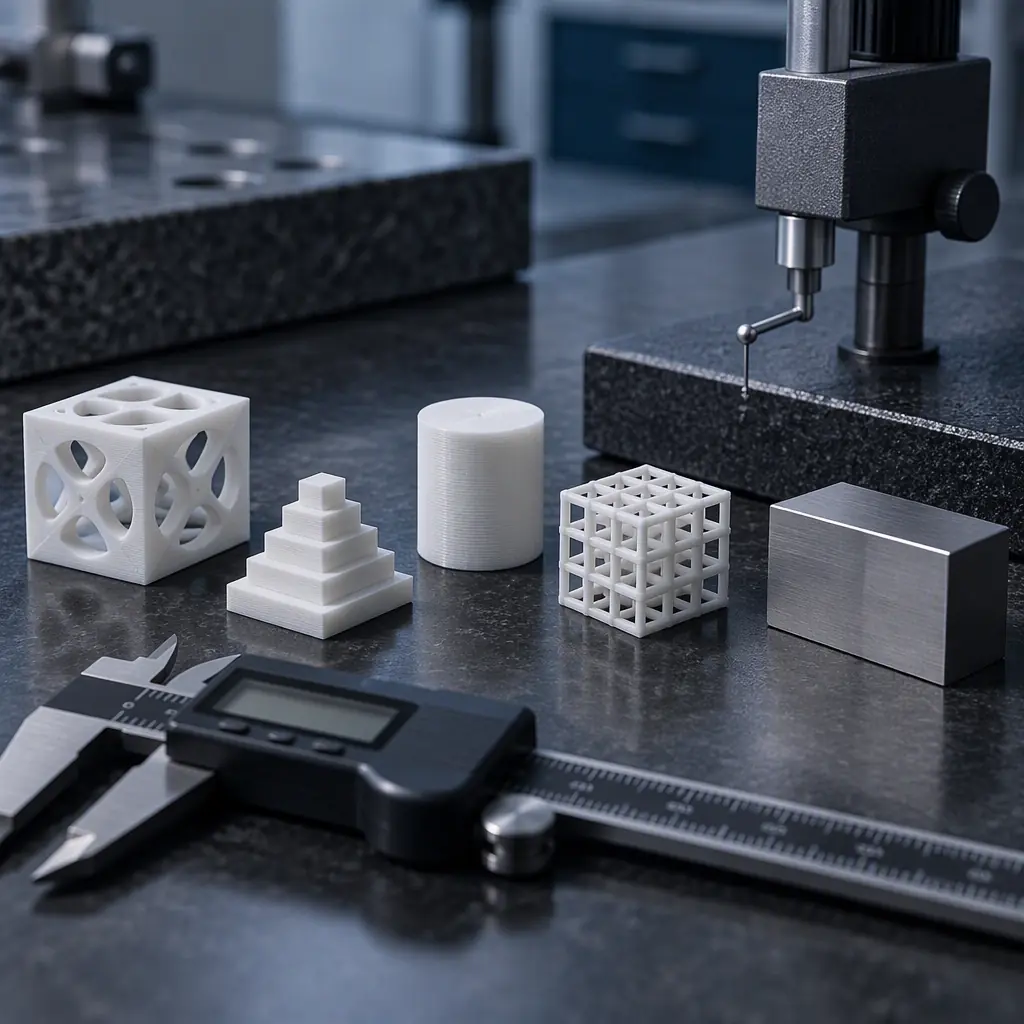
Two evidence types belong in both OQ and PQ. Dimensional capability, measured on the critical features rather than overall size, with a defined number of samples and a stated acceptance criterion. And mechanical evidence, which for most part families means coupons printed alongside the parts and tested to the applicable standard rather than testing the parts themselves. Our guide to mechanical testing to the ASTM methods covers coupon selection and what each standard does and does not tell you.
Material Lot Traceability and the Build Record
Traceability is the mechanism that turns a qualified process into an auditable one. It has two directions. Forward, from a material lot to every part that contains it, so a material problem can be contained. Backward, from any finished part to the material lot, machine, parameters, and operator that produced it, so any individual part can be investigated.
What a workable build record contains, at minimum:
- Part identity and revision of the design file actually printed, not the current one in the repository.
- Material grade and lot for every material consumed in the build, including any support material on a multi-material machine.
- Machine identifier, firmware version and calibration status at the time of the build.
- Locked process parameters as run, ideally as an exported, hashable profile rather than a screenshot.
- Operator and date, plus any deviation recorded during the build.
- Post-processing steps with the parameters that matter, such as cleaning and curing times and temperatures for resin work.
- Inspection results against the acceptance criteria for the part family, including pass or fail and the measurement method.
The point of this list is not bureaucracy, it is that every item is a question an auditor can legitimately ask, and a record that answers them in one place is far cheaper to maintain than records reconstructed from memory during an audit. The most common practical failure is the deviation case: a build where the operator noticed something off, corrected it, and did not write it down. Deviations recorded informally create a gap in the traceability chain even where the part is perfectly good. The same discipline appears in production-part approval, where the evidence package has a comparable structure, as covered in our guide to PPAP and production part approval.
Digital records help only if they are immutable in practice. A build log stored in an editable file with no version control is not evidence. Anything that will be shown to a third party should either be written once and locked, or generated by the machine management software with a timestamp, and where a regulatory system expects traceability to a defined standard, the record retention period is set by that system and not by storage convenience.
Risk Tiering: Prototype, Production, Implant-Adjacent
Not every 3D printed item in a medical context needs the same level of control, and treating them all as maximum risk wastes resources that are needed where risk is real. Tiering the applications makes the control level proportionate and defensible.
Tier A and Tier B are where most of the printing volume in a medical device organisation actually sits, and they are also where teams over-invest because the surrounding product is regulated. A jig that holds a component during assembly does not require a validated printing process; it requires a documented one, and the distinction saves significant effort. Our guide to jigs, fixtures and tooling libraries covers how to run that tier efficiently.
Tier C is where qualification genuinely begins, and the material question becomes central because the part contacts the patient. Biocompatibility of the printed article depends on the resin, the print process, the post-processing including cure, and any subsequent cleaning, which is precisely why the material alone cannot be approved in isolation from the process. Tier D is a specialist discipline with its own equipment classes, process controls, and regulatory pathways, and general-purpose printing should not be presented as equivalent to it. Being explicit about which tier a given application sits in is the single most useful governance decision a printing operation can make.
Cleaning, Sterilisation and the Validation Loop
For patient-contact parts, printing is only the first process. Cleaning and, where applicable, sterilisation are separate validated processes with their own parameters, and they interact with the materials in ways that affect both function and safety.
Two interactions deserve attention early. First, additive parts have surfaces and internal features that behave differently from machined surfaces, and cleaning efficacy depends on geometry, layer orientation, and surface roughness. A cleaning process validated on a smooth milled part is not automatically valid for a printed one with the same nominal dimensions, which is why cleaning validation should use the actual printed geometry. Our guide to surface roughness measurement covers quantifying the surface so the cleaning process can be tied to a measurable property.
Second, sterilisation methods have temperature, moisture, and pressure conditions that some printed materials do not survive without dimensional change or property loss. Method selection is therefore a materials-and-geometry decision made at design stage, not a step applied afterwards. Determining this after the process is qualified means re-qualifying it.
The validation loop closes the system: the qualified process defines the parameters, production records the actuals, inspection compares them, and any drift or change routes back through change control to a decision about re-qualification. An operation that runs the loop can demonstrate control continuously rather than only at qualification time, and that is precisely what an audit is testing for. Where the requirement is dimensional verification of production parts, our guide to part metrology and dimensional inspection covers the measurement side of the loop.
What a Supplier Must Be Able to Document
If you are buying equipment for a regulated process, the supplier's documentation burden is part of your qualification burden. The questions below determine whether a machine can be brought under control or whether it will be a permanent gap.
- Which electrical safety standard is the machine certified to, and is the certificate available?
- RoHS and material-restriction documentation for the machine itself, including the components that contact material.
- Which wear components affect build consistency, and what is the defined replacement interval or a measurable replacement criterion?
- Can print parameters be locked or exported in a form that supports a controlled document?
- What machine-side data does the system record automatically, and can it be exported with a timestamp?
- Is firmware version recorded and change-controlled, and is a firmware change documented as it is applied?
- What does the supplier state about material compatibility, and against which test methods?
The pattern worth noticing is that these are documentation and control questions, not performance questions. Performance is comparatively easy to establish with a qualification build. Control is what determines whether the process can be maintained and audited, and it is decided long before the first part ships. Precise3D supplies CE LVD (EN 62368-1) and RoHS documentation with the machines and can provide the parameter-locking and export functions these processes depend on. If you are building a qualification plan and want the equipment side reviewed against it, send us the application tier, the materials in scope, and your acceptance criteria, and we will work the documentation requirements through with you.