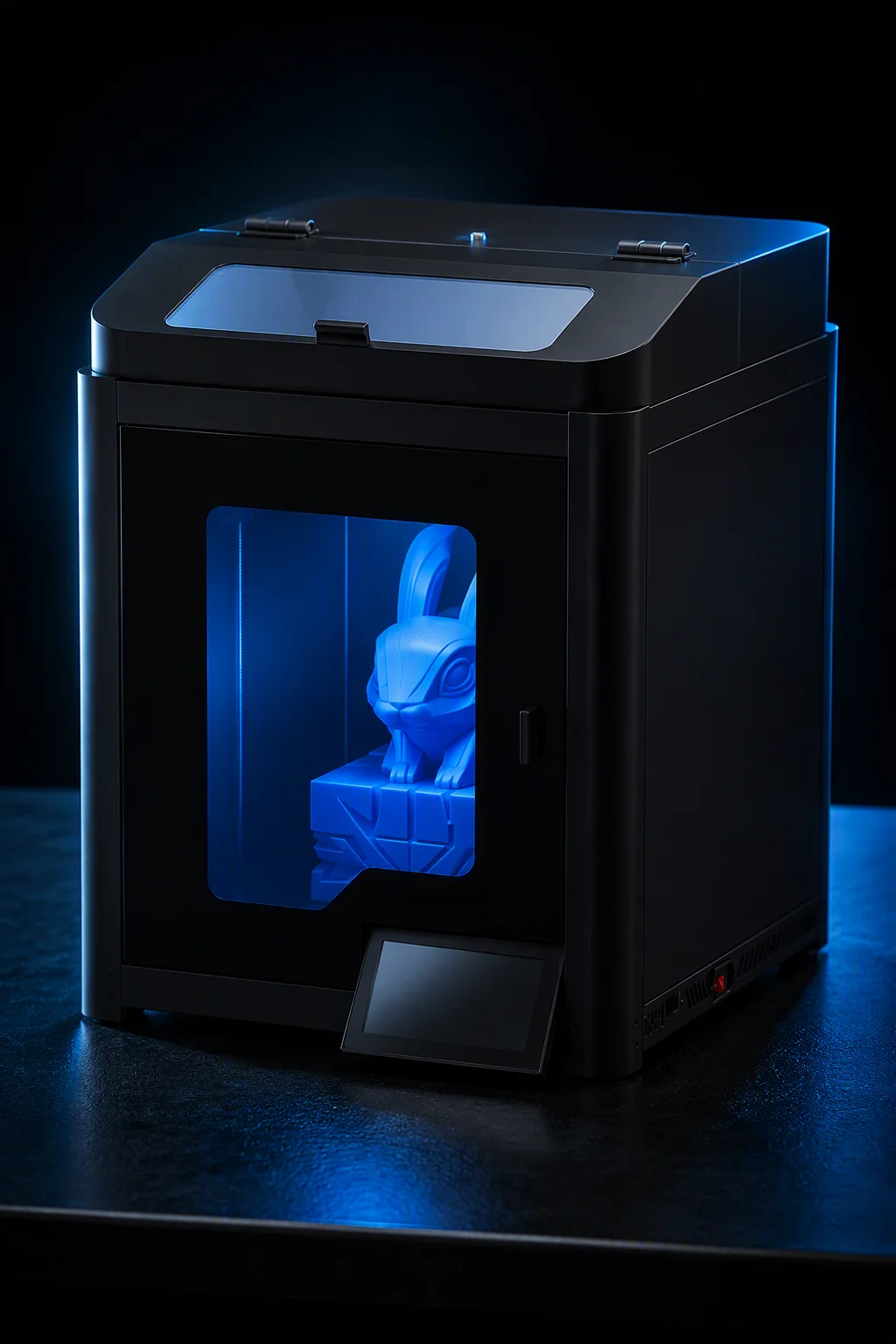
The Medium-Format Gap in Manufacturing Floor Planning
Manufacturing buyers researching additive capacity tend to be shown two extremes. At one end are desktop machines with build volumes around 250 × 250 × 250 mm, sold as prototyping tools. At the other end are large-format industrial systems measured in cubic meters, sold with a capital-committee process and a facility requirement. The band in between — roughly 300 to 500 mm in X and Y, with a usable Z of 300 mm or more — is where an enormous share of real manufacturing demand actually sits, and it is the band with the least clear guidance.
The reason is structural, not technical. Medium format is where a part stops being a model and becomes a production component, but it is not yet large enough to justify the infrastructure of a large-format installation. A 420 mm bracket for a packaging line is not a desktop part — it will not fit, and the customer cannot print it in two pieces without a joint that affects the assembly. It is also not a large-format part: it does not need a pellet extruder, a gantry the size of a room, or a dedicated facility. Medium format is the class where a manufacturer buys additive capability for real production without committing to an industrial-scale footprint.
The manufacturing consequence is that this band carries the highest density of buyable applications. Jigs and fixtures for assembly lines, EOAT components for automation cells, replacement parts for legacy machinery, and low-volume production components all cluster in the 300–500 mm envelope. These are parts with a real cost of downtime attached, which means the buyer's decision is not driven by a per-gram material price. It is driven by whether the machine can hold tolerance on a part that has to fit an existing assembly the first time.
What Actually Defines Medium Format as a Manufacturing Class
Build volume alone does not define the class. A machine with a big envelope and a light motion system is a prototyping machine with a large footprint. The distinction that matters on a factory floor is whether the machine can hold dimensional accuracy across the whole build plate, not just in the center.
Tolerance across the full envelope. Thermal expansion, frame stiffness, and gantry sag all scale with reach. A machine that holds ±0.1 mm in a 200 mm cube does not automatically hold ±0.1 mm at 450 mm. Buyers should ask for the accuracy specification at the edge of the envelope, not the center.
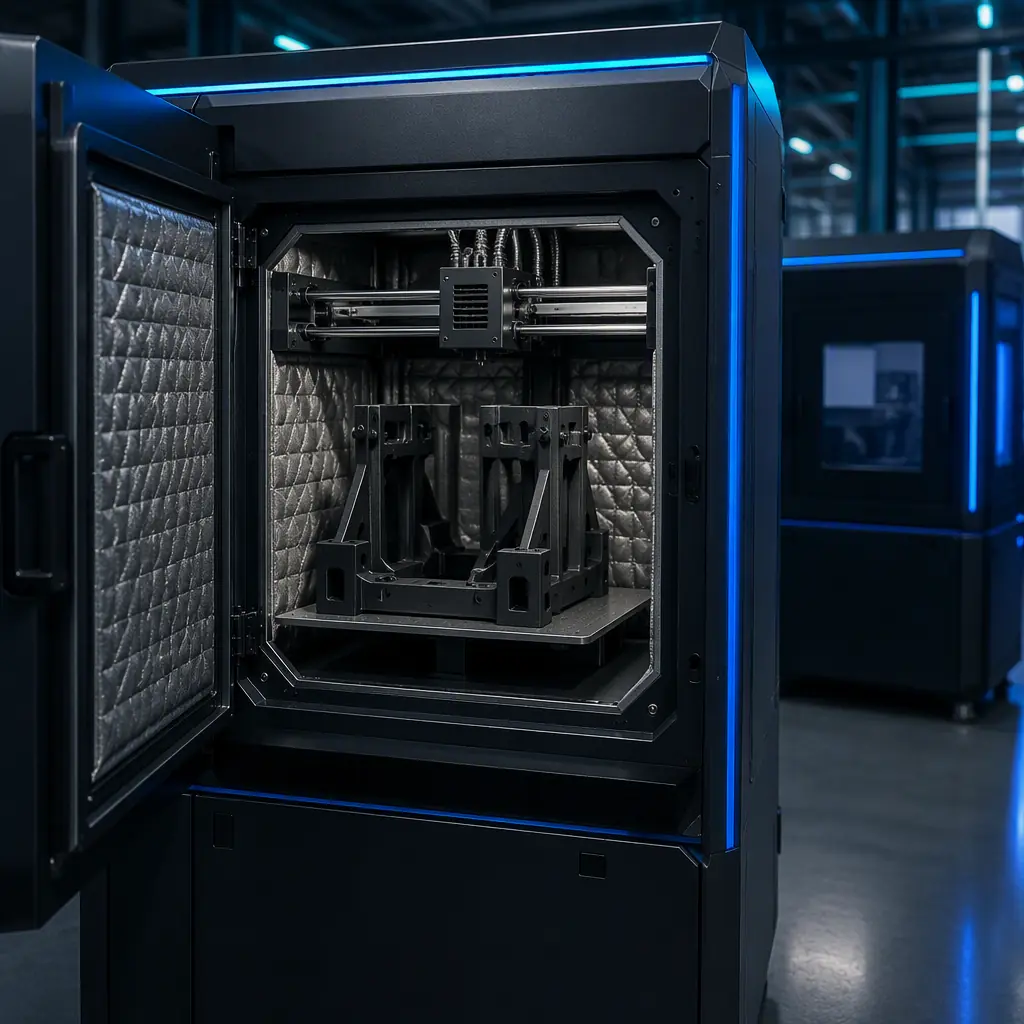
A chamber that can hold temperature. Larger parts take longer to print, which means the thermal history of the part matters more. An actively heated chamber keeps the part from warping as the build progresses, and it is what makes engineering materials viable at this size. Without it, the usable material list at medium format collapses to amorphous polymers with low warp.
Motion hardware sized for mass. A 400 mm bed with a moving part is a different dynamic problem than a 200 mm bed. Linear rails, ball screws on Z, and a frame that does not translate vibration into ringing become functional requirements rather than premium features.
Throughput that suits batch production. A medium-format machine is usually running a small batch, not a one-off. The operator needs to load a plate of several parts, run it unattended overnight, and find a full plate in the morning. That requirement drives everything from bed adhesion to the print-monitoring layer to the recovery behavior after a power event.
Where the Medium-Format Manufacturing Demand Comes From
Four application families generate most of the medium-format demand in manufacturing environments, and each has a different tolerance and material profile.
Production jigs and fixtures
Assembly fixtures, weld fixtures, and inspection gauges frequently exceed desktop build volumes because the part they locate is itself large. A fixture for a 350 mm subassembly has to span that subassembly, and the fixture body is a single printed component in most designs. This application rewards dimensional stability and stiffness over surface finish, and it rewards a chamber because a warped fixture is scrap.
End-of-arm tooling and automation components
Gripper bodies, mounting plates, and vacuum manifolds for robotic cells sit in the medium-format band because they must span the reach of the tooling they carry. These parts are load-bearing, so interlayer strength matters, and they are frequently revised, which is where additive beats machining on turnaround. Our robotics and automation industry guide covers the wider EOAT context.
Legacy machinery spares
The economics of legacy spares are the strongest argument for in-house medium-format capacity. A discontinued gear cover, a belt guard, or a bracket for a machine that is no longer supported by its OEM can carry a lead time measured in weeks and a price that reflects the scarcity. A medium-format printer turns that into a same-week part. See our parts obsolescence and end-of-life service parts guide for how that decision is framed commercially.
Low-volume production components and tooling
Parts that will be injection molded eventually often need a bridge quantity first. Medium format covers the bridge, and in some cases covers the tooling itself — printed mold inserts and forming tools fit the envelope for smaller parts. Our thermoforming and vacuum forming tooling guide covers that application, and overmolding inserts covers the hybrid-parts case.
What you're looking for: If most parts cluster well below the maximum, the application is medium format and the maximum is an outlier to be handled separately. If the distribution is flat up to the maximum, the application genuinely needs large format and medium format will under-serve it.
Chamber Temperature Is the Deciding Specification
Among all the specifications quoted for medium-format machines, chamber capability separates the ones that can do manufacturing work from the ones that can do large prototyping work. The distinction is not subtle in practice.
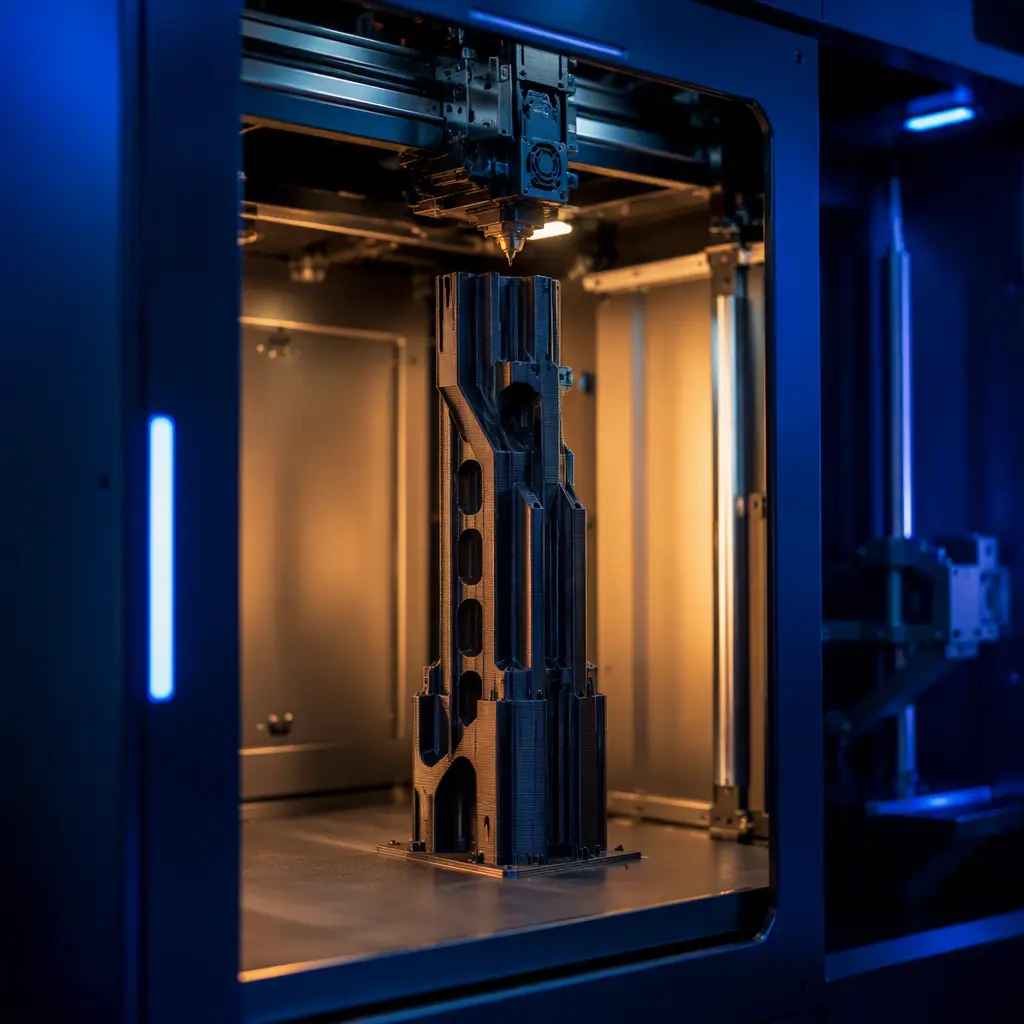
An unheated enclosure moderates drafts and slows cooling. That is useful, and it is not the same as an actively heated chamber. An actively heated chamber holds a setpoint — commonly in the 60 to 90 °C range for engineering materials — which changes the material position fundamentally. At an elevated ambient temperature, the thermal gradient between the extruded bead and the surrounding air is smaller, so the part cools more uniformly and internal stress is lower. The practical result is that large parts stay flat.
Two consequences follow for a manufacturing buyer. First, materials that are effectively unusable at scale without a chamber become available: polycarbonate blends, ABS, ASA, and the filled engineering grades all benefit, and some simply will not hold tolerance on a 400 mm part without an elevated ambient. Second, the chamber turns a size capability into a usable size capability. A machine that can physically reach 450 mm but warps every part over 300 mm has an effective build volume of 300 mm.
The chamber also changes how the operator plans the schedule. A heated chamber needs time to stabilize, so the machine is loaded and then brought to temperature before the build starts. That is a scheduling constraint, but it also means the print starts from a known thermal state, which removes a variable from the process and makes results repeatable from plate to plate. For production work, repeatability is worth more than the throughput lost to heat-up.
Matching Medium Format to a Manufacturing Floor Without Overbuying
The failure mode on the buying side is over-specification. A manufacturer buys large-format capability to be safe, then discovers that most of the intended parts would have fit a medium-format machine at a third of the floor space, and that the large machine is used at low utilization because its setup and changeover cost is higher.
The corrective is to profile the actual part population before specifying a machine. Pull the parts under consideration, measure their bounding boxes, and look at the distribution rather than the maximum.
If the ninetieth percentile of the part envelope fits inside 400 × 400 × 400 mm, a medium-format machine covers the application, and the handful of outliers are better served by splitting the part at a designed joint, by machining, or by an outsourced large-format run. Buying a large-format machine for a distribution whose tail is thin is a common and expensive mistake.
What you're looking for: A centre-only accuracy figure is a marketing number. Manufacturing work happens across the whole plate, and scale error grows with distance — the corner figure is the one that predicts whether a 450 mm part fits.
The second buying question is dimensional accuracy, and it should be asked at the envelope edge. A machine that specifies accuracy for a 100 mm test cube has told the buyer nothing about a 400 mm part. Ask for the accuracy figure across the full travel, ask what the chamber temperature was during that measurement, and ask how the figure degrades at the corners of the plate.
Qualifying Medium-Format Parts for Production Use
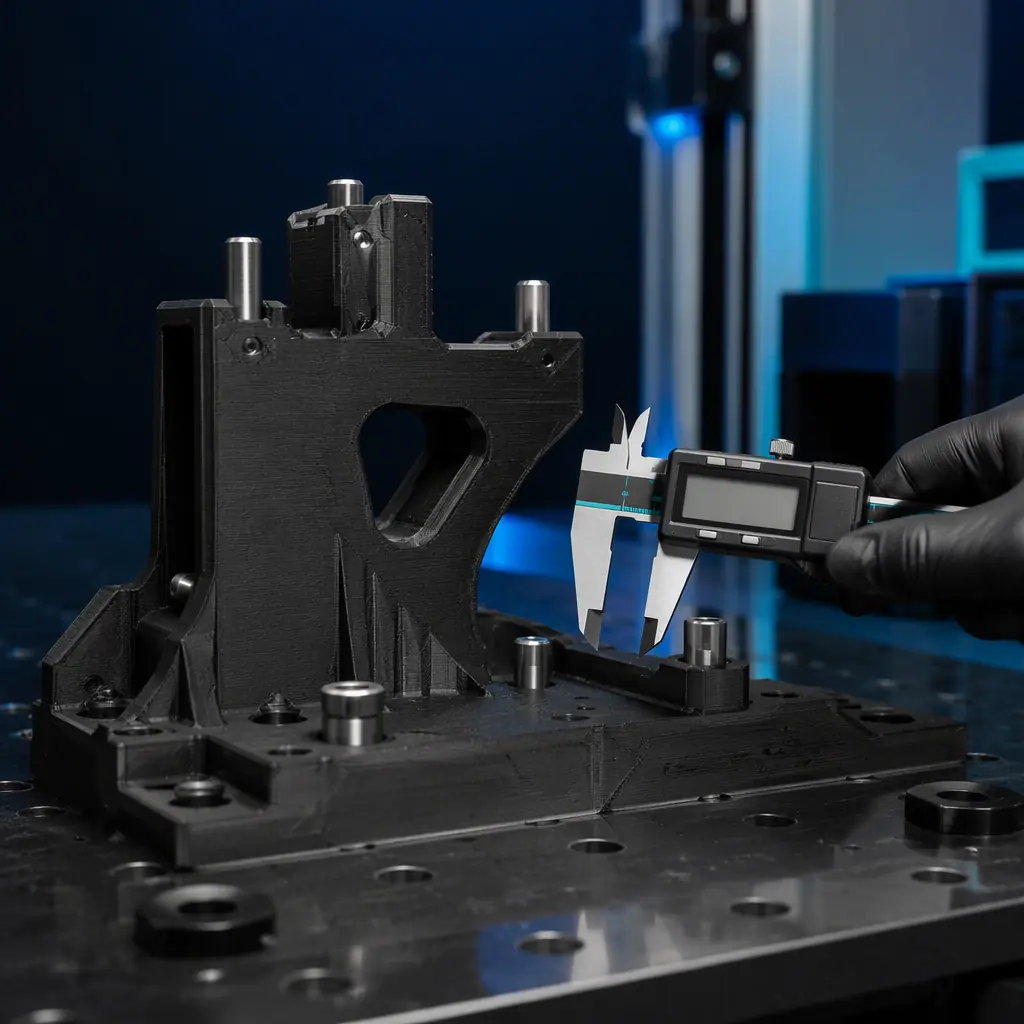
Once the machine is on the floor, the parts it makes have to pass the same acceptance criteria as any other purchased component. That requires a qualification approach, and the approach is the same one covered in our end-use component qualification protocol, applied at medium-format scale.
Dimensional first-article inspection. The first part from a new build is measured against drawing across the full envelope, not just at the features. This catches scale error, which is the failure mode most likely to appear only at medium format because it is proportional to distance.
Coupon testing for the build orientation in use. A tensile coupon printed flat does not predict the strength of a fixture printed upright. Test the orientation the part will actually be built in, and test it in the material and chamber condition that will be used in production.
Process capability over a batch, not a single part. One good part is a sample size of one. The manufacturing question is whether the tenth part matches the first, which means a short capability run with the critical dimensions measured and the spread recorded. The statistical framing is covered in production part approval and part metrology and dimensional inspection.
A documented build record. Material lot, chamber setpoint, build orientation, and the machine's maintenance state should be recorded against the part. In a manufacturing environment this is what allows a deviation to be investigated rather than guessed at, and it is what makes the printed part auditable when a customer asks.
What you're looking for: A documented build record turns that question into a specific answer — material lot, chamber setpoint, or orientation. Without it, the operator is guessing, and guessing is what makes a manufacturer abandon in-house printing.
Floor Space, Utilities, and the Real Installation Cost
Medium format is attractive partly because the installation is genuinely simpler than large format, but the comparison is only fair if both sides are counted.
Floor space. A medium-format machine occupies roughly one to two square meters, plus clearance for loading and for the material storage that has to stay dry. It fits an existing production floor without a dedicated room, which is the single biggest reason manufacturers adopt it before they adopt large format. Material handling and post-processing equipment sizing at this class is covered in our large-format industrial guide, which shares most of the same infrastructure questions.
Power and environment. Requirements are modest compared to large format — a standard industrial circuit rather than a dedicated supply, and no pellet handling or drying infrastructure. The chamber does add a continuous load during the build, so the circuit should be sized for the chamber heater plus the motion system at their combined peak, not just the motion system.
Support and consumables. A medium-format machine consumes material in batches rather than in spools-at-a-time hobby quantities, so inventory planning matters. It also generates larger parts to post-process, which puts pressure on finishing capacity. Both are manageable at this class, and neither needs the change in facility organization that large format demands.
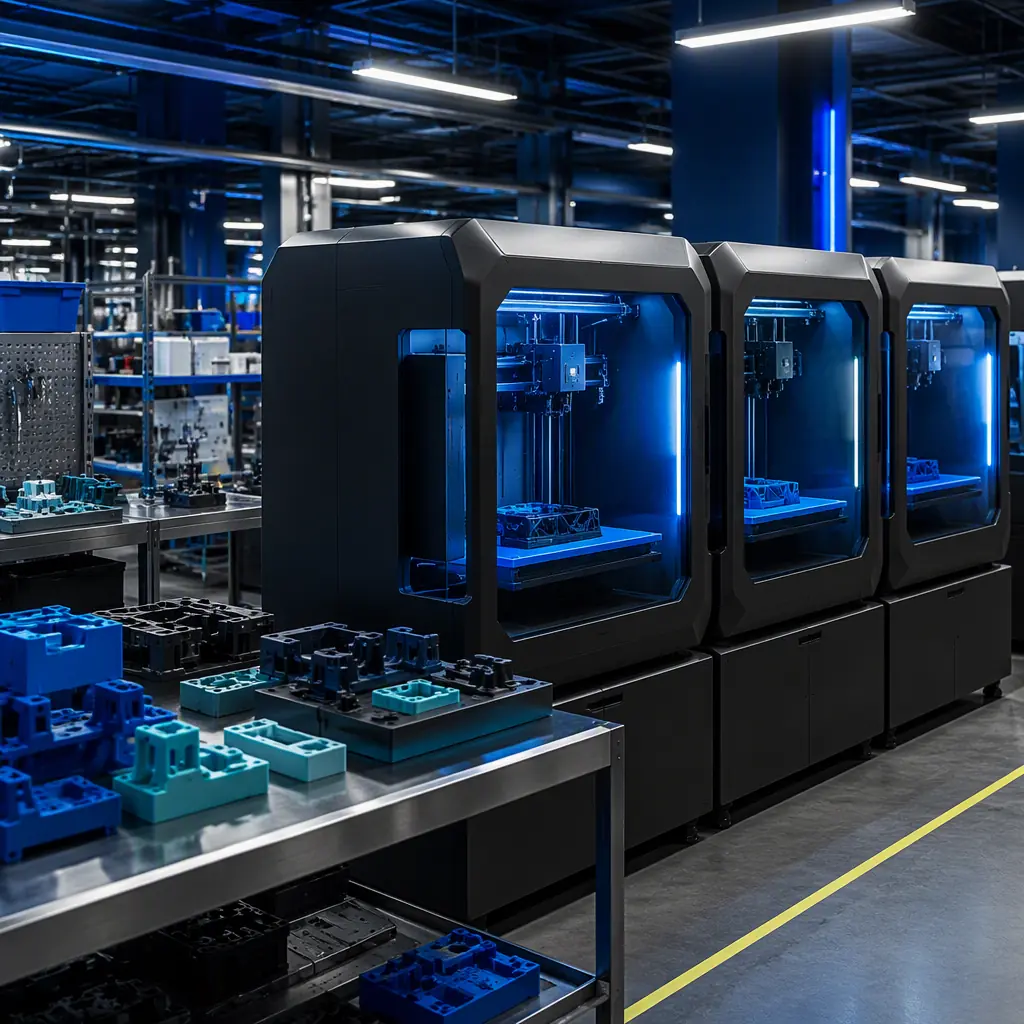
The comparison that usually decides the question is total capability per square meter. Medium format delivers the accuracy, the chamber, and the envelope that most manufacturing applications need, in a footprint that fits an unmodified production floor. That combination is why it is the most commonly specified class for manufacturers buying additive capability for the first time.
To review the build envelopes, chamber specifications, and accuracy figures at the edge of the plate for the current platform range, see the product line or the engineering documentation. Distributors carrying this class can also review the distribution program for the medium-format segment.
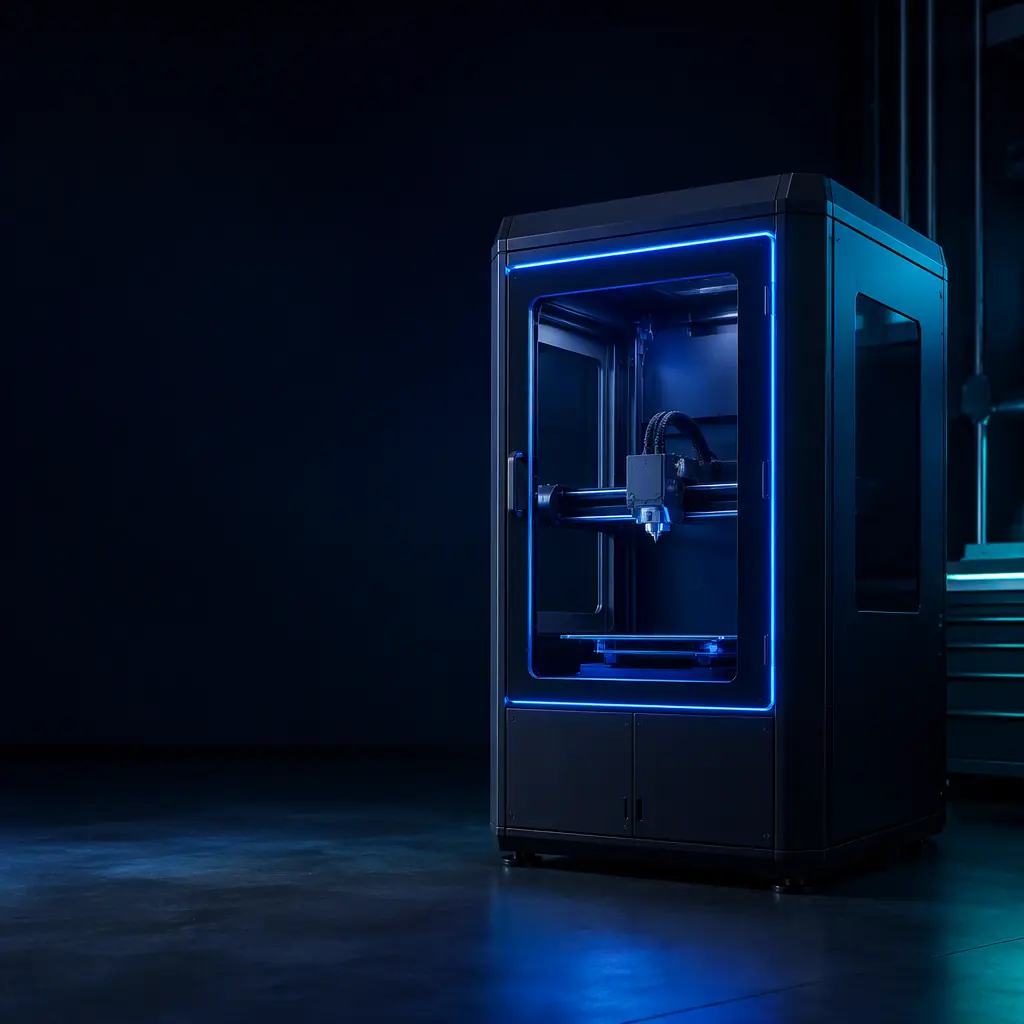
Medium-Format Platform Range
Ready to Put Medium-Format Capacity on a Production Floor?
Precise3D builds 300–500 mm class platforms with actively heated chambers, ball-screw Z axes, and accuracy specifications quoted across the full plate — sized for jigs, EOAT, legacy spares and bridge production rather than for prototype models.