
What a Service Bureau Actually Sells
A service bureau does not sell printing time. It sells a promise that a customer's geometry will come back as a part that fits, on a date that holds, at a price that was quoted before the file was ever opened. Everything about the business model — the machine mix, the quoting method, the post-processing bench, the shift pattern — exists to make that promise survivable at volume.
This distinction matters to distributors because bureaus are one of the few customer segments that buy repeatedly, buy accessories, and buy consumables in predictable quantities. A single bureau running a dozen machines may consume more filament, nozzles and build plates in a year than twenty hobbyist customers combined. Understanding how the bureau makes its money is what makes it possible to sell to one without guessing.
The model has three revenue layers, and bureaus fail most often when they only run the first one.
- Machine time. The visible layer: the hourly or per-gram rate the customer sees on the quote. Margin here is thin and directly exposed to machine utilisation.
- Engineering labour. File repair, orientation, support strategy, tolerance adjustment. Often unbilled, which is why so many quotes lose money on complex parts.
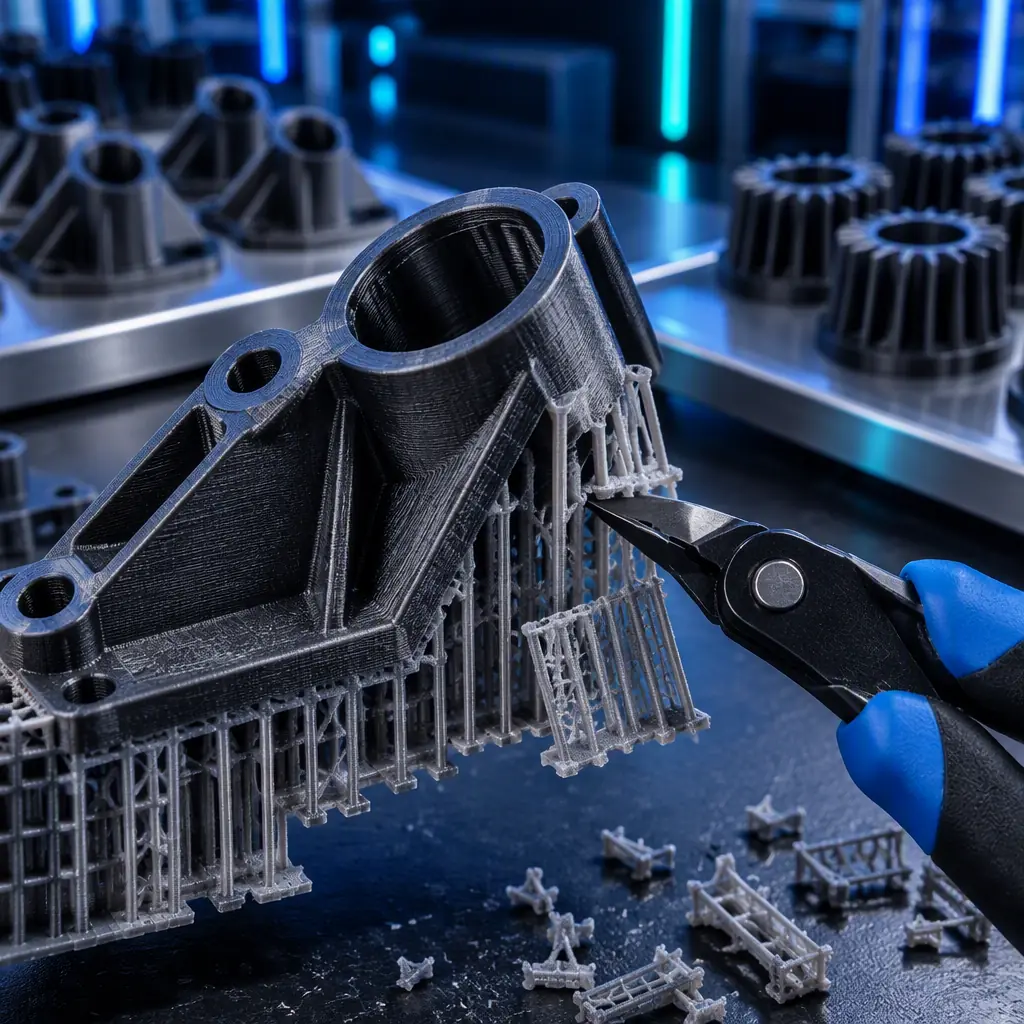
- Post-processing and finishing. Support removal, vapour smoothing, dyeing, annealing, insert fitting, inspection. This layer carries the highest margin per hour and needs almost no capital equipment.
A bureau that quotes only on machine time is competing on the one variable every competitor can also lower. A bureau that prices the other two layers is selling something harder to compare and much easier to defend.

The Cost Structure Behind an Hourly Rate
An hourly rate is a conclusion, not an input. Before a bureau can price a job it has to know what an hour of that machine costs, and the number is larger than most operators assume once everything is loaded in.
Two consequences follow. First, a bureau's margin is more sensitive to failed prints and idle machines than to the price of filament, which is why reliability specifications move the profit line more than a cheaper spool does. Second, adding the fourteenth machine to a fleet that is only 40% utilised makes the business worse, not better — every additional unit raises the fixed cost base while the revenue line stays flat.
What you're looking for: Below roughly 55–60% on the bottleneck machines, the bureau's problem is order intake, not throughput, and selling it another printer will not fix it. Above 80%, the machine is genuinely the constraint and an equipment conversation is worth having.
Quoting: Where Most Bureaus Quietly Lose Money
The quoting step is where a bureau either protects its engineering labour or gives it away. A quote built only from model volume and a material rate ignores the work that actually consumes the day: repairing non-manifold geometry, rotating a part so it prints without supports, splitting a model that exceeds the build volume, and inspecting a functional part before it ships.
A defensible quote separates the work into line items the customer can see and choose between.
- Build cost — material mass, support mass, purge volume and machine time at the loaded hourly rate.
- File preparation — charged when the geometry needs repair, splitting, or orientation work beyond a default slice.
- Finishing — support removal, surface treatment, post-cure, annealing, inserts, and dimensional inspection.
- Rush premium — a real cost, because a rush job displaces scheduled work and re-sequences a shift.
- Minimum order value — protects against jobs whose paperwork costs more than the part.
The minimum order value line is the one bureaus most often resist adding, and the one that most reliably improves profitability, because it forces small enquiries either to consolidate into a larger order or to price at a level that covers their handling.
Machine Mix: Why One Platform Never Covers the Whole Business
The order book of a working bureau is not uniform. It contains a large volume of small, fast, tolerance-loose jobs, a smaller volume of large parts, and a thin slice of high-temperature or engineering-material work. Trying to serve all three from a single machine type means every job is either mispriced or mis-equipped.
A practical fleet structure reflects that distribution.
The engineering tier is where distributors add the most value and capture the most attachment, because a bureau that buys a high-temperature machine also needs the matching chamber management, the higher-temperature sensors, the annealed-material workflow and the inspection equipment. That cluster is described in our heated chamber guide and the material side in our engineering filament guide.
Post-Processing Is the Margin the Bureau Forgets to Charge For
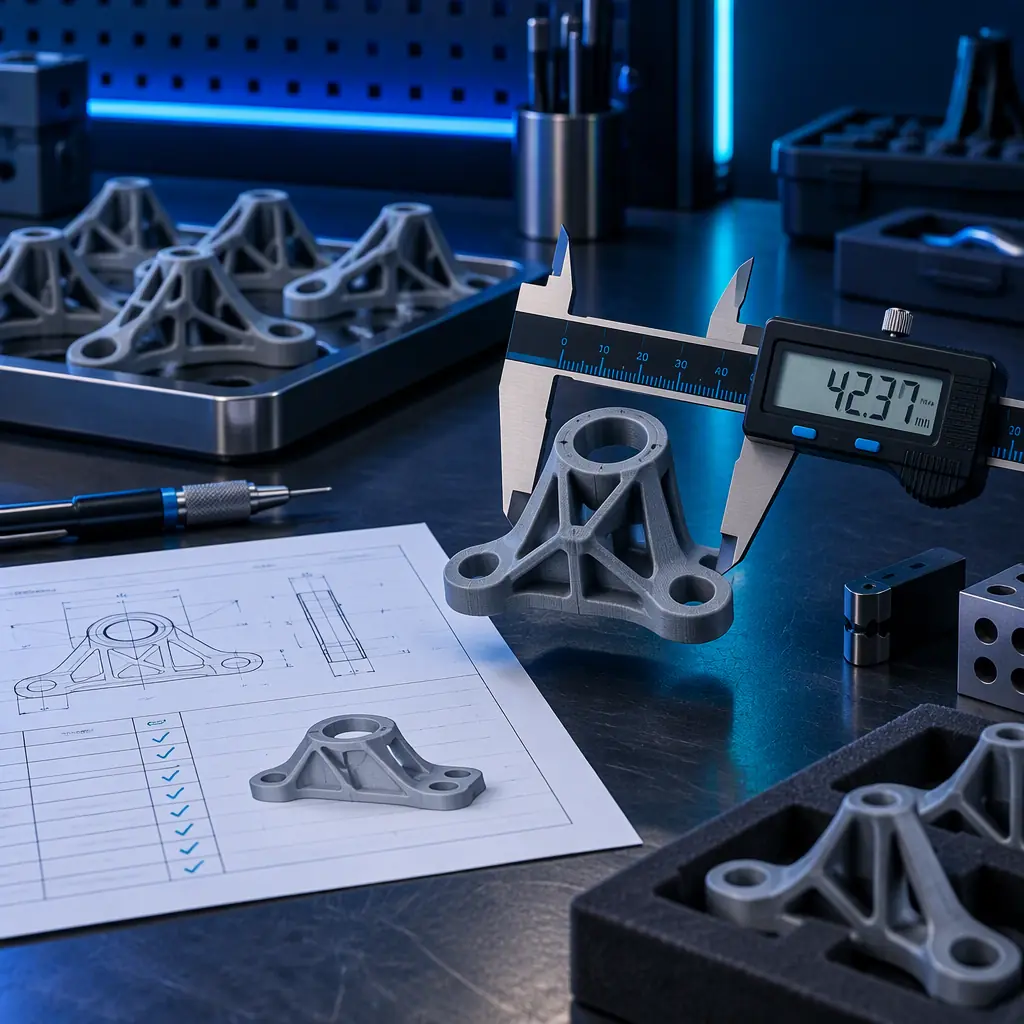
Two bureaus with identical printer fleets can have very different profitability based purely on how they handle finishing. Support removal, dimensional verification, surface treatment and assembly are labour-intensive, low-capital activities, which is exactly the profile of work that carries a healthy hourly rate — provided it is quoted as a service rather than absorbed as goodwill.
The finishing capability also determines which markets the bureau can serve at all. A bureau that can anneal parts unlocks functional and load-bearing work; one that can hold tolerances and document them unlocks industrial and regulated customers; one that cannot do either is limited to visual and fit-check models, which is the most price-sensitive segment in the market.
Our annealing and heat treatment guide covers the equipment and workflow side of that upgrade, and it is a natural attachment sale whenever a bureau adds an engineering-material machine.
What you're looking for: Very low percentages mean the finishing work is being done and not billed. That is the fastest available margin improvement in the business, and it requires no new equipment — only a change to how quotes are structured.
Capacity Planning Without Buying a Machine for Every Peak
Bureau demand is lumpy. Deadlines cluster, customers all need the same week, and a fleet sized for average demand will miss peaks while sitting idle between them. There are only three levers, and successful bureaus use all three rather than defaulting to the first.
- Schedule to a queue, not to a promise. Publishing a realistic lead time turns peak demand into an ordering incentive instead of a crating emergency.
- Oversubscribe the format tier. Large-part capacity is the hardest to rent externally and the most expensive to own, so it pays to hold slightly more than average demand requires.
- Subcontract the overflow tier. Small volume parts can be placed with a partner bureau when demand exceeds capacity; the margin is thinner but no capital is committed.
The third lever is where distributor relationships pay off in both directions. A bureau that knows which partner to route overflow to protects its delivery promises without adding fixed cost, and it is far more willing to invest in its own engineering tier once the overflow problem is solved.
What a Bureau Buys, and When
Selling into the segment is easier once the purchase triggers are understood. Bureaus buy in response to a constraint, and the constraint is visible in the operational signals rather than in a budget cycle.
The spares and service angle is worth its own note, because bureaus feel unplanned downtime as lost revenue rather than as a repair cost. A stocked spares kit plus a scheduled maintenance plan is a genuine profit improvement for them, and it is the same model described in our maintenance plan guide.
Precise3D on Production Reliability
At Precise3D, the sales conversation with a service bureau starts with uptime because that is what the bureau's economics actually depend on. Our Pro X1 and OpenSource1 platforms pair a 320°C hotend with an actively controlled heated chamber, a rigid frame designed for large single-piece parts, and an electronics bay that stays inside its thermal envelope during long unattended runs.
Every unit ships with CE LVD (EN 62368-1:2014+A11:2017) and RoHS (EU 2015/863) documentation, and our 3,500 sqm Shenzhen production network applies a documented control plan at incoming and outgoing QC. For distributors, we provide the fleet-level service documentation — spares lists, sensor and consumable mappings, and maintenance intervals — that turns a printer sale into an ongoing supply relationship.
Reviewed by the Precise3D quality and engineering team. Cost shares, utilisation thresholds and rate structures described here are industry-typical ranges provided for guidance and are not a guarantee of performance for any particular business. Verify your own equipment costs and market rates before setting prices.

Serving Service Bureaus?
Want the Fleet Configuration Guide for Print-on-Demand Operations?
Tell us what your order book looks like. We will send a machine mix recommendation, the spares and consumables list that matches it, and the service intervals that keep utilisation high instead of paying for downtime.