
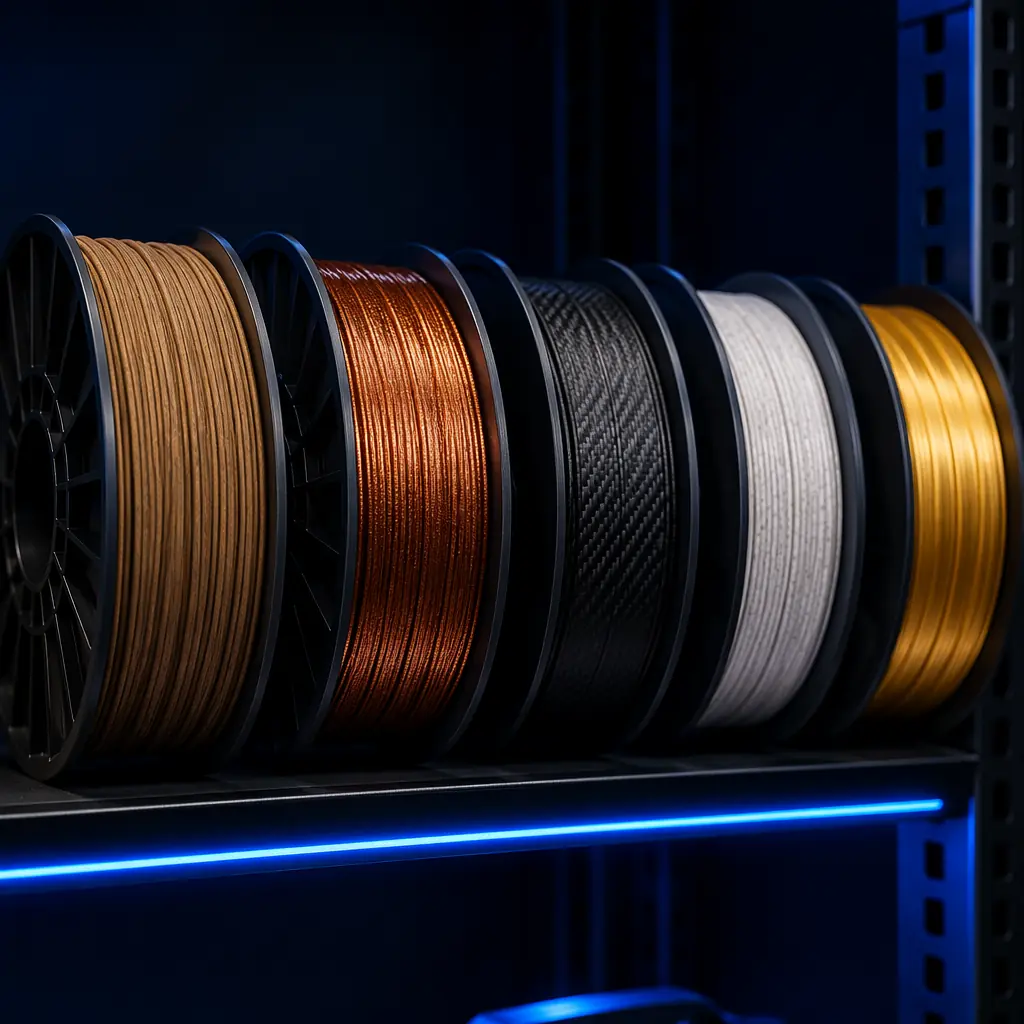
Walk into a well-run 3D printer distributor and count the shelf space. Eighty percent is PLA and PETG in standard colors — black, white, gray — selling at $18-25/kg with competitors everywhere offering the same thing. The remaining 20% is where the business makes money: engineering filaments at $45-80/kg and exotic filaments at $35-60/kg. The distributors who dominate their markets win by stocking materials nobody else carries — and exotic filaments are the most accessible premium category you can add today.
Exotic filaments are a rapidly growing segment projected to reach $480 million globally by 2028, driven by three trends: boutique Etsy-style 3D printed goods where material novelty IS the product, expanding 3D printing into K-12 and university maker spaces where "wow factor" drives engagement, and the cosplay and prop-making community that pays premiums for materials mimicking wood, metal, or stone. This guide covers the eight specialty filament categories, the nozzle and hardware upsells each creates, the margin breakdown, and a launch strategy for adding exotic SKUs without overcommitting inventory capital.
What Makes a Filament "Exotic"?
In the 3D printing consumables industry, "exotic" doesn't mean rare or hard to manufacture — it means any filament that delivers a visual, tactile, or functional property beyond what homogeneous thermoplastics can achieve. An exotic filament is a composite: a standard polymer base (usually PLA, sometimes PETG or ABS) loaded with 15-40% by weight of filler particles — wood fiber, metal powder, phosphorescent pigment, thermochromic dye, carbon fiber strands, or powdered stone. The base polymer provides printability. The filler provides the exotic property.
This composite nature creates the margin opportunity. A spool of wood-filled PLA contains roughly $0.80 of wood fiber mixed into $3.50 of PLA resin — total material cost around $4.30 — yet retails for $35-55. The value isn't in raw materials; it's in the manufacturing precision needed to compound fillers uniformly, pelletize without clogging, and extrude with consistent diameter. That complexity creates a natural moat: hundreds of factories extrude pure PLA. Perhaps two dozen globally can reliably extrude wood-filled PLA with ±0.05mm tolerance and consistent wood-grain aesthetics.
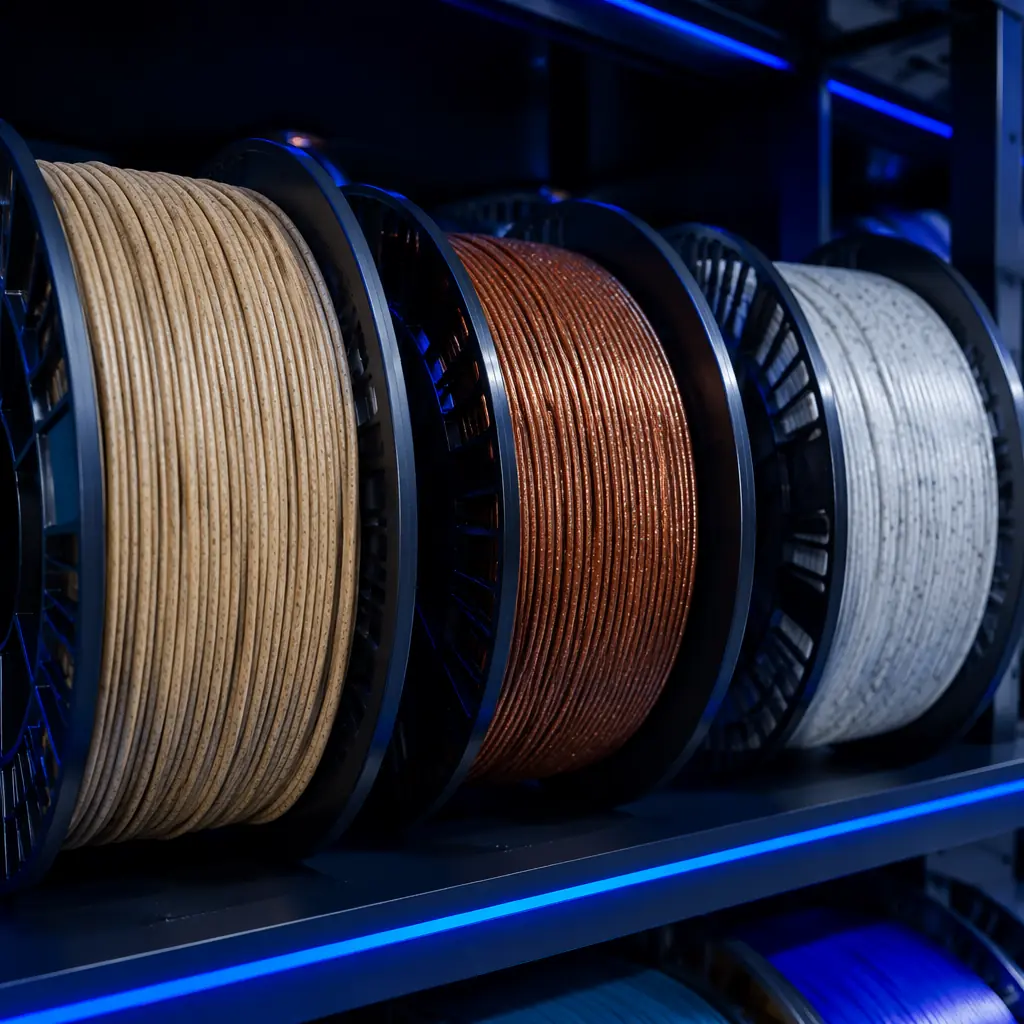
The exotic filament buyer is fundamentally different from the standard filament buyer. Standard PLA buyers treat filament as a commodity — they comparison-shop on price, switch suppliers freely, and see no meaningful difference between brands. Exotic filament buyers treat filament as a creative material — they're looking for a specific aesthetic effect (wood grain, metallic sheen, glow intensity), they'll pay premiums for consistency, and once they find a supplier whose "wood" actually looks and feels like wood, they won't risk switching to save $3/spool. For a deeper look at positioning standard and premium materials across your product line, see our standard filament stocking guide.
The Top 8 Specialty Filaments and Their Target Buyers
Not all exotic filaments deliver equal margin or equal volume. The smart stocking strategy picks 3-5 categories that maximize revenue per square foot of shelf space. Here are the eight categories ranked by distributor profit potential, with specific buyer profiles for each:
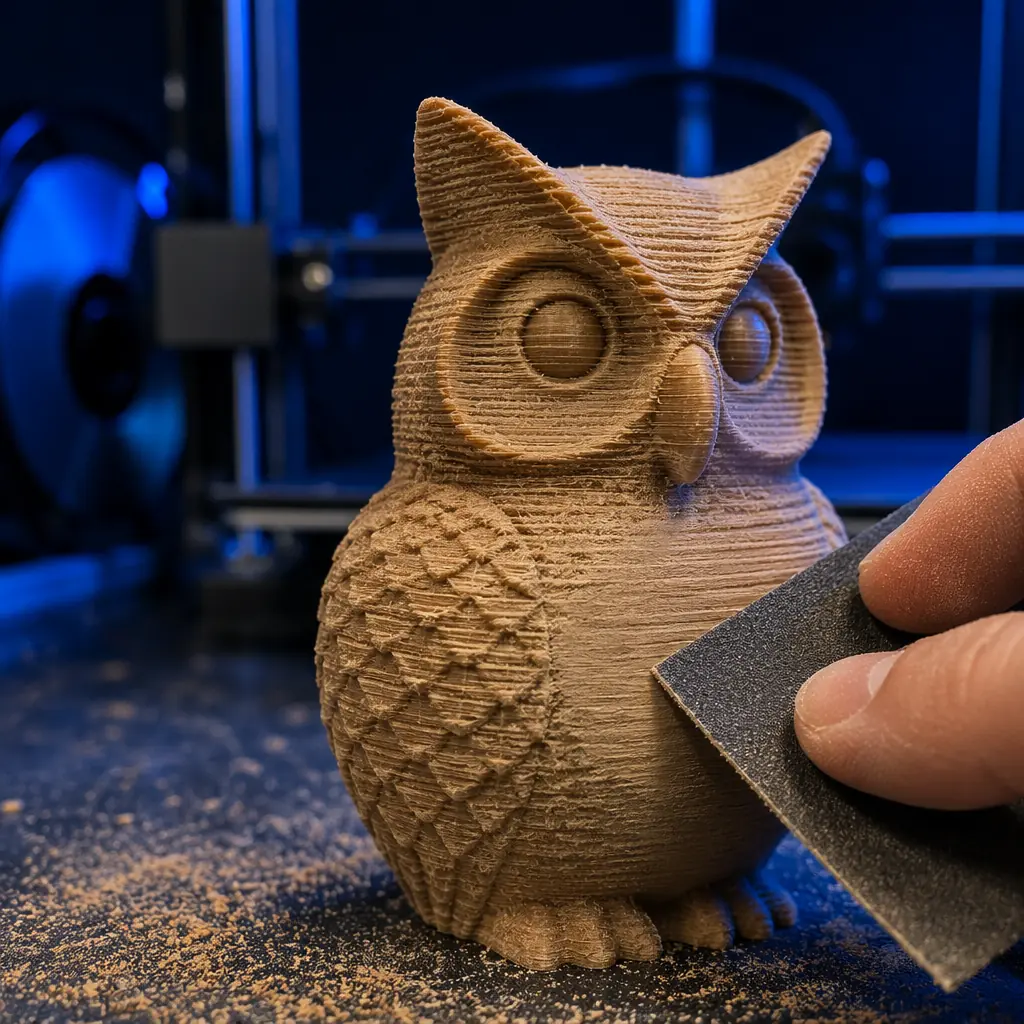
Wood-filled PLA is the #1 seller in the exotic filament category, accounting for roughly 35% of all exotic filament revenue. Wood-filled prints come off the bed with a matte, slightly rough texture that hides layer lines better than any other material. Post-processing — sanding with progressively finer grits (120 to 400), then staining with wood stain or Danish oil — transforms a 3D print into something indistinguishable from carved wood. The temperature range is forgiving at 190-220°C, and while a 0.5mm hardened nozzle is recommended, many users successfully print with standard 0.4mm brass at slightly elevated temperatures. Stock wood-filled PLA in at least three wood tones: light (birch/pine), medium (oak/walnut), and dark (ebony/mahogany).
Metal-filled filaments command the highest margins in the exotic category — 50-60% gross — and create the strongest customer lock-in. A 1kg spool of copper-filled PLA is physically smaller than standard PLA because 40-80% of the weight is metal powder. After sanding and polishing with steel wool or a rotary tool with buffing compound, parts develop a genuine metallic sheen. Post-processing turns a $0.50 print into an object that sells for $15-25 on Etsy as a "hand-finished metal sculpture." For more on how these materials compare to true engineering-grade filaments, see our engineering filaments guide.
Marble PLA is the sleeper hit — low cost, high perceived value, and no special hardware requirements. Marble PLA's filler (calcium carbonate) is non-abrasive and prints through standard 0.4mm brass nozzles. The speckled, stone-like finish hides layer lines exceptionally well, making it ideal for architectural models and decorative objects. FOB pricing is only $2-4/kg above standard PLA, yet retail commands a 50-80% premium — the widest margin spread in the entire exotic category.
Glow-in-the-dark and color-changing filaments are the gateway to schools and STEM programs. A school buying glow-in-the-dark PLA isn't buying filament — they're buying student engagement. Teachers report interest increases of 40-60% compared to standard colors. The catch: strontium aluminate pigments are extremely abrasive and destroy a standard brass nozzle in 200-300 grams. Every spool should trigger an automatic recommendation for a hardened steel nozzle — adding $8-15 of revenue and preventing the headache of returned clogged printers.

Nozzle and Hardware Requirements — The Upsell You're Missing
Every exotic filament creates at least one hardware upsell. Distributors who sell exotic filament without also selling the hardened nozzle, drying solution, or direct-drive extruder needed to print it are leaving 30-50% of the transaction value on the table — and creating a support headache. Here's the hardware requirement matrix:
The bundling math is compelling. A customer walks in wanting one spool of wood-filled PLA at $42. They also need a hardened steel 0.5mm nozzle ($12), and since wood-filled PLA is hygroscopic, they need a dry box or desiccant pack ($15-25). The $42 spool sale becomes a $69-79 transaction — and the customer gets prints that actually work, so they come back for more. Bundle all three as an "Exotic Filament Starter Kit" at $59 (15% off the bundle) and you've just turned a one-time spool buyer into a recurring customer who now owns the hardware to print any abrasive filament you stock. For the full strategy on packaging hardware with consumables, see our consumables bundling strategy.
Another critical upsell: filament drying and storage. Wood-filled, metal-filled, and carbon-fiber-filled filaments are significantly more hygroscopic than standard PLA. Wood fiber absorbs moisture within 24-48 hours in humid environments. Carbon-fiber nylon variants become unprintable within hours without active drying. Every exotic filament sale should include a conversation about filament drying and storage — it prevents returns and adds $20-40 of accessory revenue per sale.
Pricing and Margin Breakdown
Exotic filaments don't just sell at higher prices — they sell at higher absolute dollar margins per spool. A distributor making $9 margin on a $20 spool of PLA needs to sell 11 spools to match the profit from selling 3 spools of metal-filled filament at $30 margin each. The math favors exotic filament SKUs even at much lower unit volumes:
The key insight: exotic filament customers are worth 2-4x more in annual revenue than standard PLA customers, even buying fewer spools. Each spool carries higher dollar margin and exotic customers reorder at nearly double the rate — they find a wood or metal filament they like and stick with it, whereas PLA customers price-shop and brand-hop. This reorder behavior makes exotic filaments the ideal anchor for strategic SKU planning — fewer exotic SKUs generate higher total consumables profit than a wall of PLA colors.
Minimum order quantities for exotic filaments are higher than standard PLA — typically 50-100 spools per SKU vs 20-50 for PLA — because the compounding and extrusion setup is more complex. However, the inventory turnover math still works: a distributor selling 8-12 spools of wood-filled PLA per month with a 50-spool MOQ carries roughly 4-6 months of inventory, which is manageable given the 18-24 month shelf life of properly sealed PLA-based filaments. Metal-filled filaments have even longer shelf life (24+ months) because the high metal content inhibits moisture absorption. For detailed guidance on balancing exotic SKU breadth against inventory carrying costs, see our inventory SKU planning guide.
How to Launch an Exotic Filament SKU Line
Launching exotic filaments isn't about ordering one of everything and hoping it sells. The distributors who succeed with exotic filaments follow a three-tier launch sequence that minimizes inventory risk while maximizing the data needed to scale confidently:
Tier 1 — The Safe Bets (Month 1): Start with wood-filled PLA in 2-3 tones and marble PLA in white. These two categories account for over 50% of exotic filament sales and require the fewest support interventions. Combined inventory: $800-1,200 landed cost for 40-60 spools. Expected sell-through: 8-12 weeks. This establishes demand appetite and builds the reorder data for Tier 2.
Tier 2 — The Margin Multipliers (Month 2-3): Add glow-in-the-dark PLA (1 color) and silk/shiny PLA (2-3 jewel-tone colors). Glow-in-the-dark anchors hardened-nozzle bundling. Silk PLA prints like standard PLA with no special hardware and commands a 40-60% price premium. Combined inventory: $600-900 landed cost. Sell-through: 10-14 weeks.
Tier 3 — The Premium Lock-In (Month 4+): Add metal-filled PLA in copper and bronze, plus carbon-fiber filled PLA. These are highest-margin SKUs with strongest retention. Metal-filled requires the most customer education — create a one-page "Getting Started" card for every spool. Inventory: $1,000-1,500 landed cost. Sell-through: 14-20 weeks.
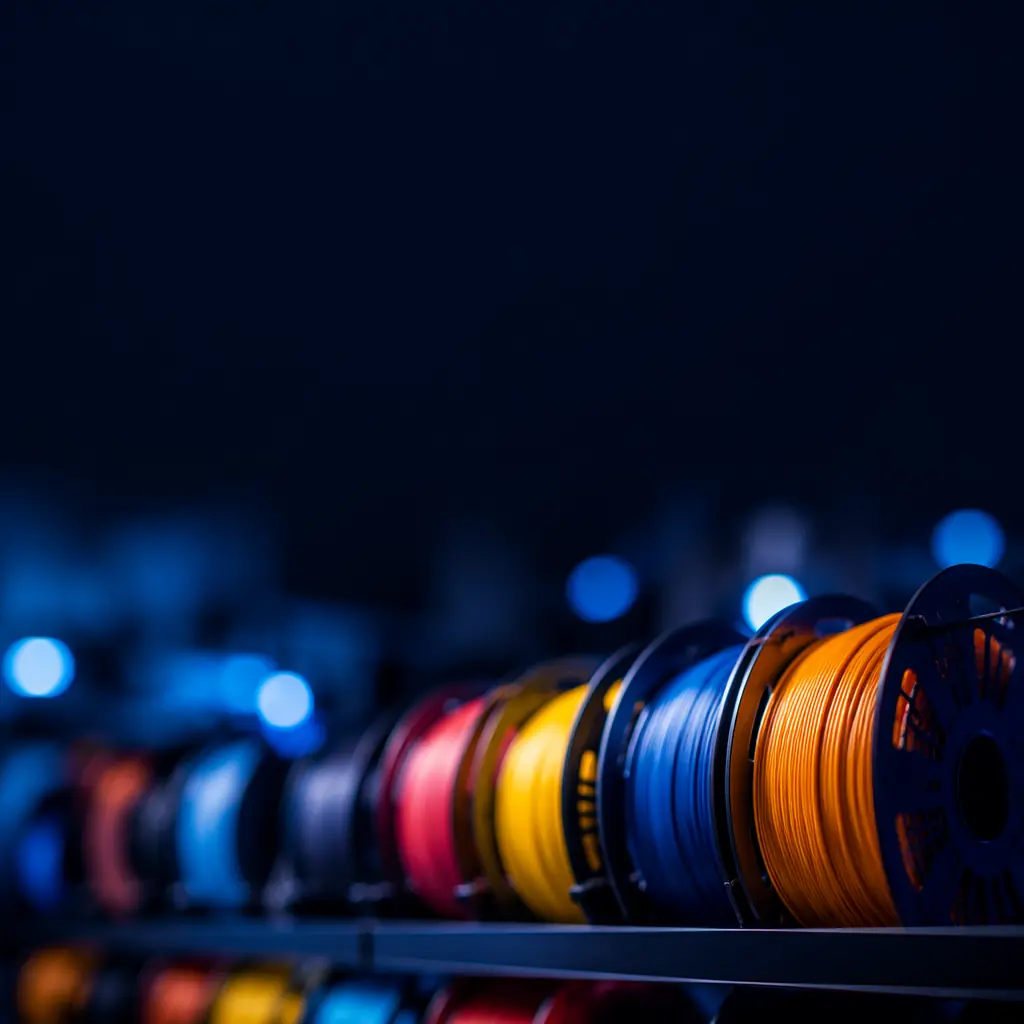
The exotic filament sample pack is the highest-ROI marketing investment you can make. Create a 6-pack of 200g mini-spools covering wood, marble, silk, glow, metal, and carbon-fiber filaments, bundled with one hardened steel 0.5mm nozzle. Retail it at $49-59 with a landed cost of $18-22 — a 55-65% margin product that also functions as a lead generation tool. Every sample pack sold generates data on which exotic filaments your specific customer base is most interested in, and 30-40% of sample pack buyers return within 60 days to purchase full 1kg spools of their favorite from the sampler. The sample pack is also the perfect upsell at the point of printer purchase: "Your new printer comes with 500g of standard PLA. Add this exotic sampler for $49 and unlock six premium materials."
The final piece of the launch strategy is display and education. Exotic filaments sell on visual appeal — put finished prints on your counter, not just spools. A polished copper-filled geometric sculpture sells more spools than any spec sheet. A wood-filled elephant figurine customers can touch, feel the grain, and see the stain finish sells itself. Train your staff to hand customers the finished print while they're looking at the spool — the conversion rate from "looking" to "buying" doubles when the customer is holding a finished print made from that material.
Exotic Filament Sourcing
Stock Premium Specialty Filaments With Verified Manufacturing Quality
Tell us your target customer segments and volume projections. We'll provide FOB pricing on wood-filled, metal-filled, marble, glow-in-the-dark, and specialty filaments — with documented diameter tolerance, filler consistency, and batch-to-batch color matching guarantees. Plus hardened nozzle bundling options to maximize your per-transaction revenue.