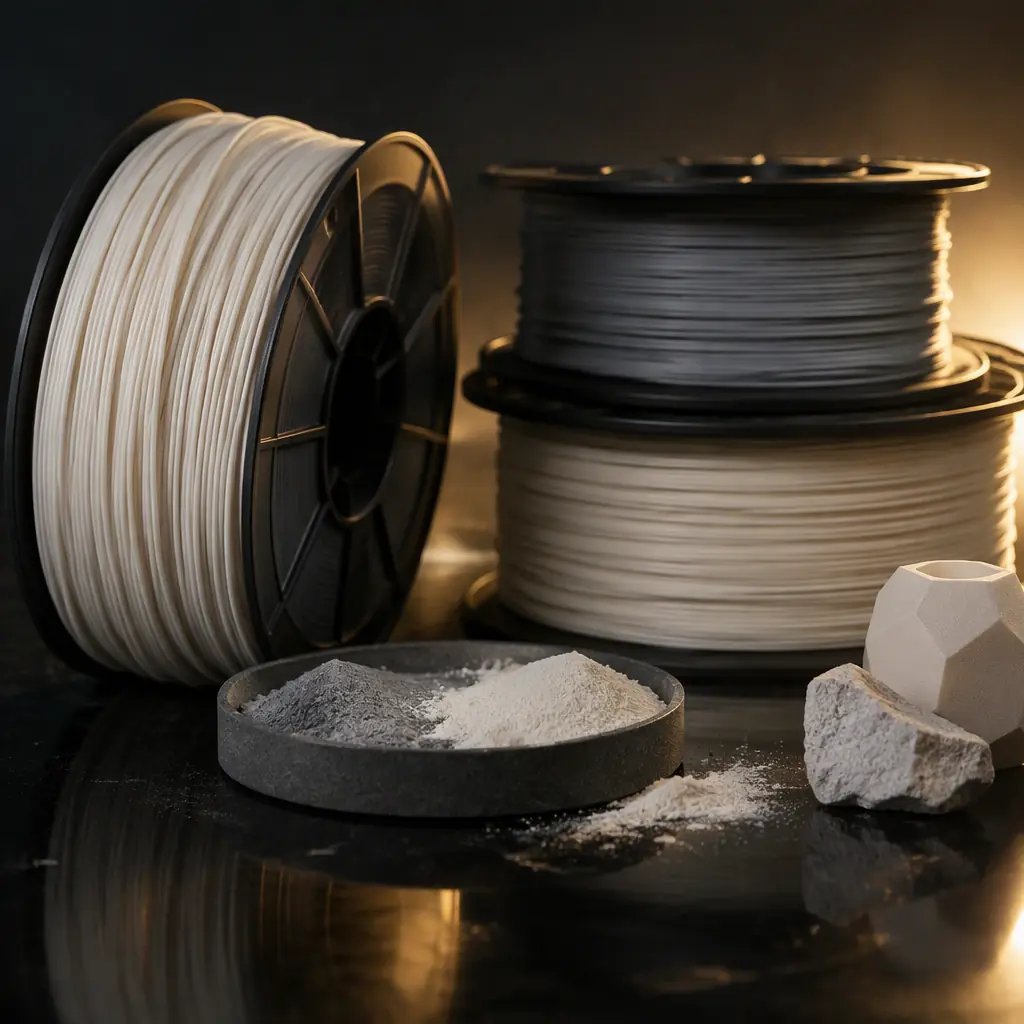
Fillers are not a defect. Every commercial polymer contains some additive package, and mineral fillers are legitimate in injection moulding, where they reduce cost, raise stiffness, and improve dimensional stability. The problem is that a property that helps an injection-moulded part does not automatically transfer to a fused-deposition print, and a market segment has grown up around selling filler-heavy spools to buyers who cannot tell the difference until the part fails. A distributor who understands the difference can sell filled filament honestly and profitably. A distributor who does not will field the returns.
The starting point is to know what is in the spool. For the unfilled side of the catalogue, our carbon-fibre and glass-fibre filament guide covers the reinforcing fillers, which behave very differently from the cheap mineral ones this article deals with.
What Mineral Fillers Actually Do to a Print
Calcium carbonate (CaCO3), talc, and to a lesser extent mica and glass microspheres are the common cheap fillers. At loadings of 15-40% by weight they change the material in four measurable ways, and only one of them is good for the customer.
- Cost per kilo falls. Filler costs $0.10-0.40/kg against $2-4/kg for base polymer, so a 30% loading cuts the compound cost by roughly 20-30%. This is the only benefit the buyer sees on the invoice.
- Tensile strength and elongation fall. Filler does not bond to the polymer matrix at the interface, so it acts as a stress concentrator. A 30% CaCO3 PLA can lose 30-40% of its tensile strength and most of its elongation, becoming noticeably brittle.
- Density rises. CaCO3 has a density around 2.7 g/cm3 against PLA's 1.24 g/cm3. A filled spool is heavier for the same volume, which matters for anyone buying by volume and printing by length.
- Nozzle wear accelerates sharply. Mineral particles are abrasive. A hard filler through a brass nozzle can wear the orifice from 0.4 mm to 0.6 mm in a few hundred grams, changing flow, wall thickness, and dimensional accuracy without any visible warning.
The brittleness and the wear are the two that generate support calls. A customer who replaces a filament with a cheaper one and then cannot understand why their functional bracket splits along a layer line has been sold filler they did not need.
How to Identify a Filled Spool Without a Lab
Buyers rarely get a filler loading printed on the label, and "$9.99 PLA" is a strong hint but not proof. Three tests a distributor can run in a demo room, in order of reliability:
- Weigh a known length. Extrude or cut exactly 1 m of filament, measure its diameter, and weigh it. Unfilled PLA at 1.75 mm is about 3.0 g/m. The same length at 30% CaCO3 is roughly 3.8-4.0 g/m. A cheap digital scale is the whole apparatus.
- Burn test. Heat a few centimetres over a flame. Mineral filler does not burn and leaves a white-grey ash residue proportional to the loading. Unfilled polymer burns away almost completely. Do this outdoors and for comparison only, never as a routine.
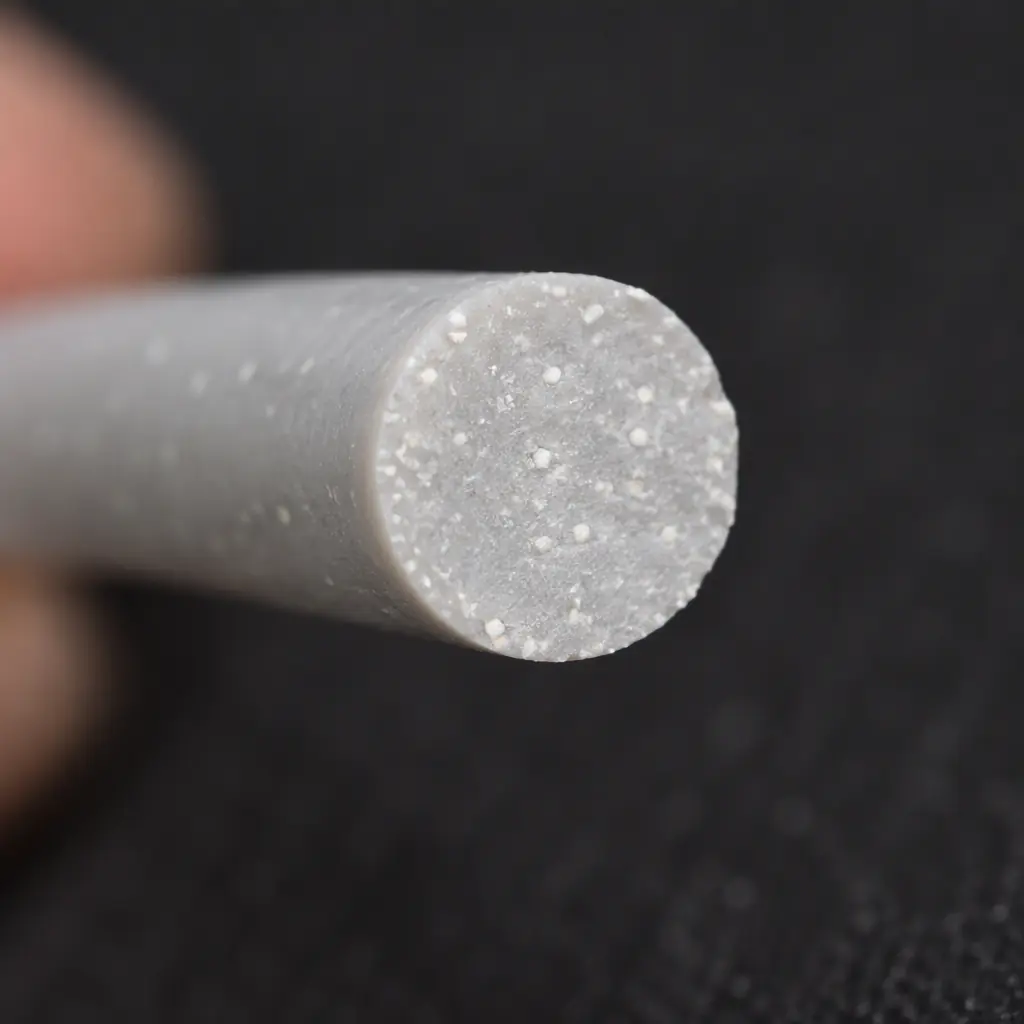
- Snap and inspect. A filled strand fractures with a ragged, chalky edge and little necking. Unfilled PLA necks and stretches slightly before it breaks. Under a loupe the filled fracture shows dispersed white specks in the matrix.
None of these is a substitute for a datasheet, but they are enough to tell a customer that the "$9.99 PLA" in the basket is not the same material as a branded unfilled spool, and that is the conversation that prevents the return.
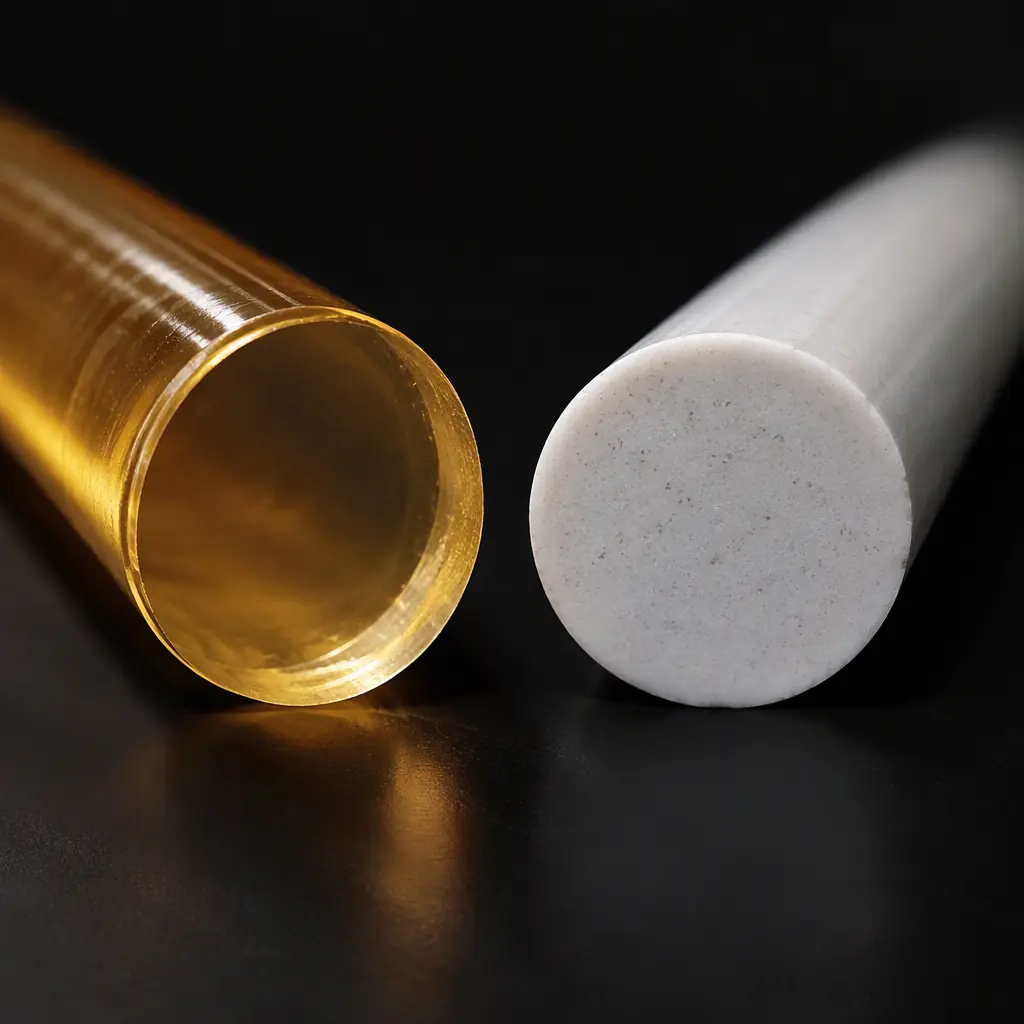
The Real Cost Per Kilo Once Wear Is Counted
The sticker price is misleading because the filler destroys the nozzle. Run the numbers on a customer printing 1 kg a month of a functional part on a $20 brass nozzle.
Suppose unfilled PLA costs $22/kg and prints 1 kg/month, so the material cost is $22/month, and a brass nozzle lasts 400 kg, so the nozzle adds about $0.05/month. Suppose the filled spool costs $16/kg, a saving of $6/month, but the same nozzle now lasts only 40 kg, so the customer replaces it ten times per 400 kg, adding roughly $0.50/month in nozzles. The direct saving is still real, $5.45/month, which is why the filler sells. The cost only inverts when you price in the parts that fail, the customer's time chasing dimensional drift as the nozzle wears oversized, and the loss of function.
The honest framing for a distributor is that filled filament trades material cost for process cost. It is a good trade for a customer who prints non-structural, decorative, or jig parts where brittleness does not matter and who runs a hardened steel or ruby nozzle. It is a bad trade for a customer printing functional parts on a brass nozzle with no idea why their dimensions are drifting. The fix on the hardware side is covered in our nozzle and hotend technology guide; the fix on the sales side is to sell the filled spool bundled with a hardened nozzle, not alone.

Where Filled Compounds Are the Right Recommendation
Fillers are not always a trap. There are customer profiles where a mineral-filled filament is exactly the correct product, and a distributor should recognise them.
- Dimensional stability and low warpage: talc-filled polypropylene and CaCO3-filled grades shrink less than unfilled polymer, which reduces warping on large flat parts. A customer printing large panels benefits from the lower shrinkage even though strength falls.
- Non-structural signage and display parts: parts that are seen and not loaded, where the matte finish is acceptable and the cost saving compounds over high volume.
- Jigs and fixtures that are not load-bearing: a fixture that locates a part and is never stressed does not need the tensile strength it gives up.
- Educational bulk printing: schools printing high volumes of teaching models on wear-resistant nozzles get more parts per dollar, and the brittleness of a classroom model is irrelevant.
In each case the customer is buying dimensional stability or cost, not strength, and the failure mode of the material does not intersect with the job. Sell those customers filled filament with a hardened nozzle and you have a profitable, honest recommendation.
What to Stock and How to Label It
A distributor's catalogue decision is straightforward once the mechanics are clear. Stock filled filament as a clearly-labelled commodity tier, separate from the engineering tier, and never let a customer mistake one for the other. The label should state the base polymer, the filler type, and the filler loading. If a supplier will not disclose the loading, that is itself information. Pair every filled SKU on the shelf with a hardened steel or ruby nozzle, because the customer who buys one without the other is the customer who generates the complaint.
The margin logic also shifts. Filled filament has thinner material margin but pulls nozzle and hotend consumables, which are high-margin repeat items. For how the filled tier sits alongside the bread-and-butter grades, our PLA, PETG, ABS and TPU stocking guide maps the whole catalogue. Sold as a bundle, the pair is more profitable than an unfilled spool alone, and the customer's parts work. Our consumables bundling strategy guide covers how to structure the price so the bundle beats the components. Our filament quality evaluation guide gives the incoming-inspection steps that catch a mislabelled spool before it reaches a customer.
What you want to hear for filled: a non-structural, decorative, dimensional-stability or cost-driven application, a hardened steel or ruby nozzle, and a willingness to accept a matte finish. What you want to hear for unfilled: load-bearing parts, thin walls, anything that flexes, and a customer on a brass nozzle. When the customer has a brass nozzle and a structural part, the filled spool is the wrong answer and the recommendation is a standard unfilled grade.
Reviewed by the Precise3D engineering & OEM team. Compliance files that accompany the catalog are auditable at the certification register.
Consumables Program
Building a Filament Line Your Customers Can Trust?
We supply filament, nozzles and hotends as a matched range, with distributor pricing and the datasheets to back every SKU. Let's structure a catalogue where the consumables sell each other.