The Eighteen Minutes Nobody Bills
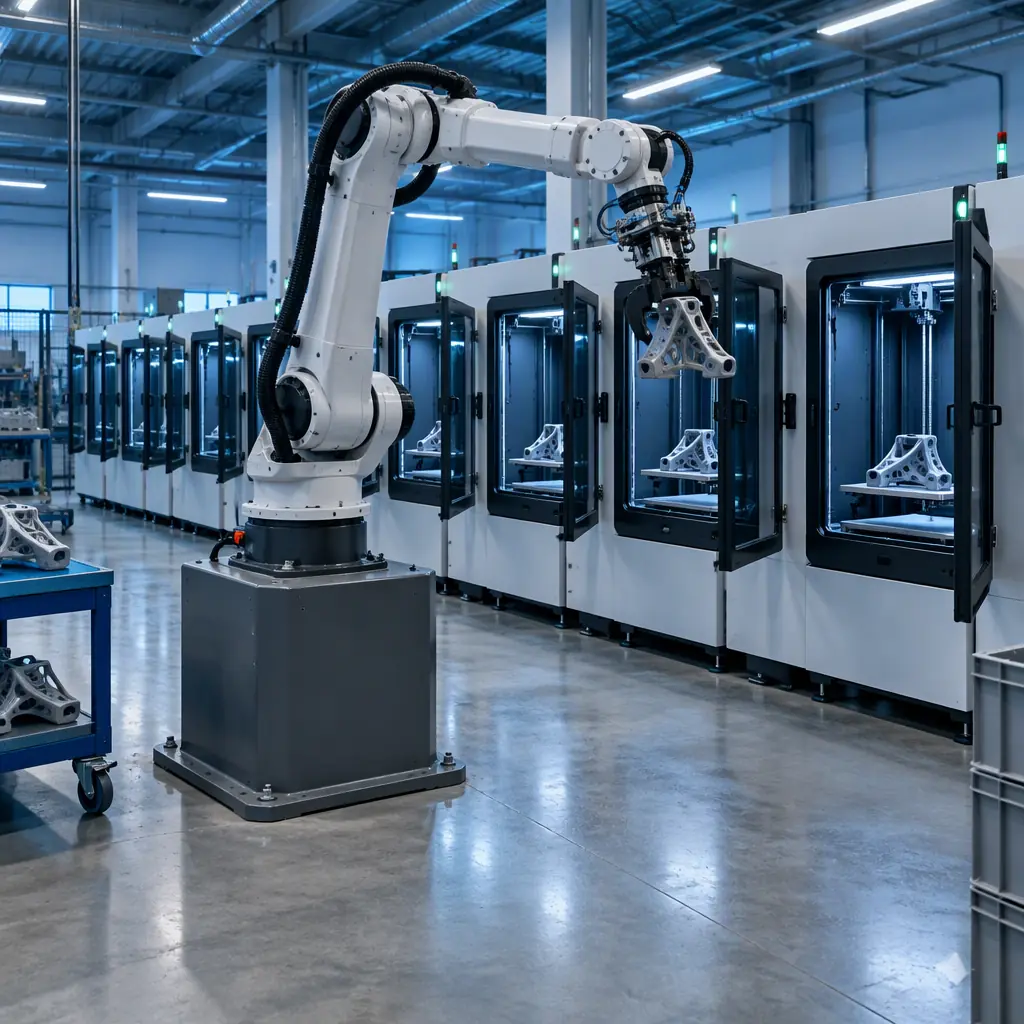
A print farm running forty machines completes a plate roughly every twenty minutes during a busy week, and every one of those completions is a small manual interruption: the operator walks to the machine, waits for the bed to cool or forces it, scrapes the part off, reloads the plate, restarts the job, and walks back. Measured honestly across a shift, the handling and restart choreography on a mid-format printer takes four to eight minutes of direct attention plus travel, and it repeats between thirty and sixty times a day. On a forty-machine farm that is somewhere between three and five full-time equivalents whose entire job is to be a very slow, very reliable robot.
The arithmetic that makes automation worth discussing is therefore not about labour savings in the abstract. It is about what those minutes cost when the machine is idle at the end of a completed job, which is the most expensive kind of idle time in the plant because the machine has already consumed its warm-up, its material and its scheduled slot. A machine that finishes at 02:15 and waits until 06:40 for the morning shift has lost four and a half hours, and at a loaded hourly rate of USD 3 to 6 for that class of hardware the loss is larger than the salary of the operator who would have unloaded it. This guide is about the decision layer: when to automate plate handling, what the three practical routes cost, and what a distributor should sell into each one. The wider economics of machine count and uptime are covered in our guide to print farm economics.
Three Routes, Three Different Customers
Automation in a print farm is not one product. The three routes in use today are separated by how much of the choreography they remove, and by how much of the existing fleet they can be fitted to, which is the decisive question for a buyer who already owns machines.
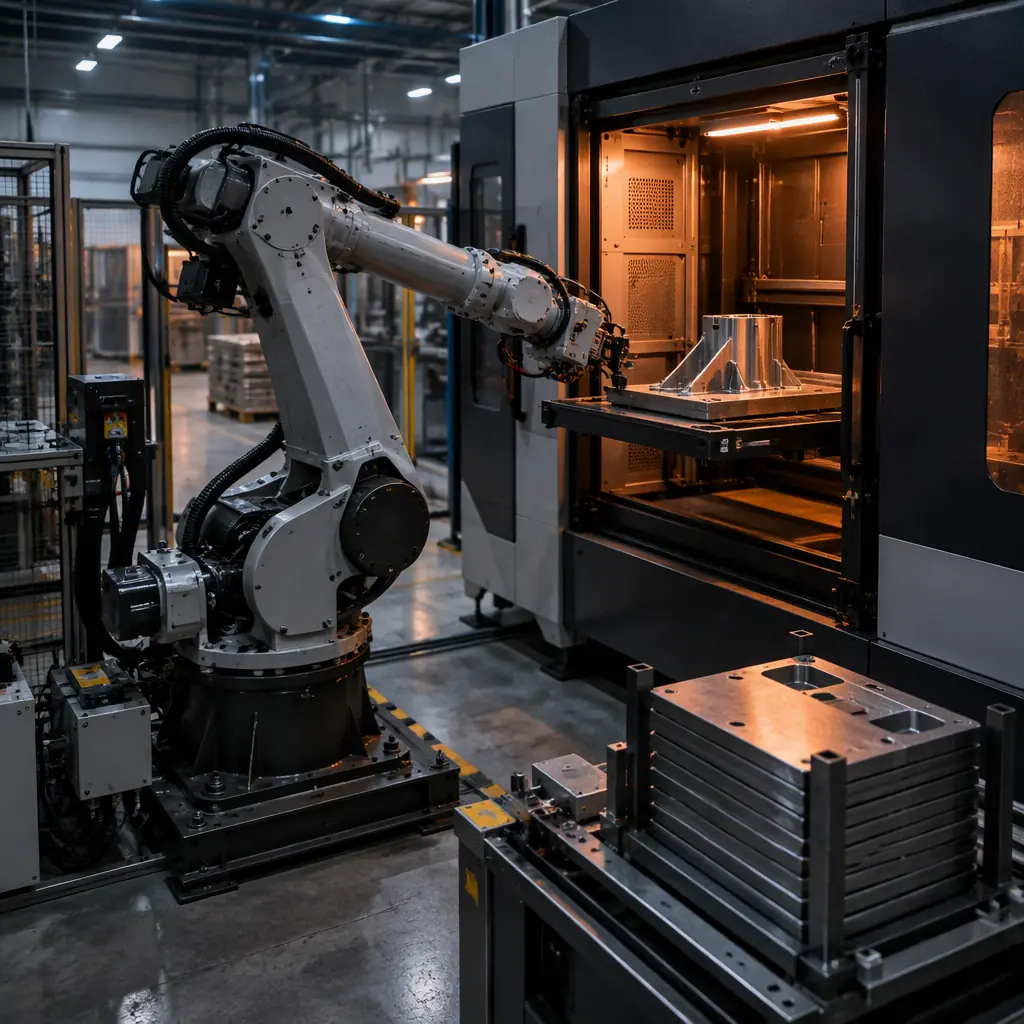
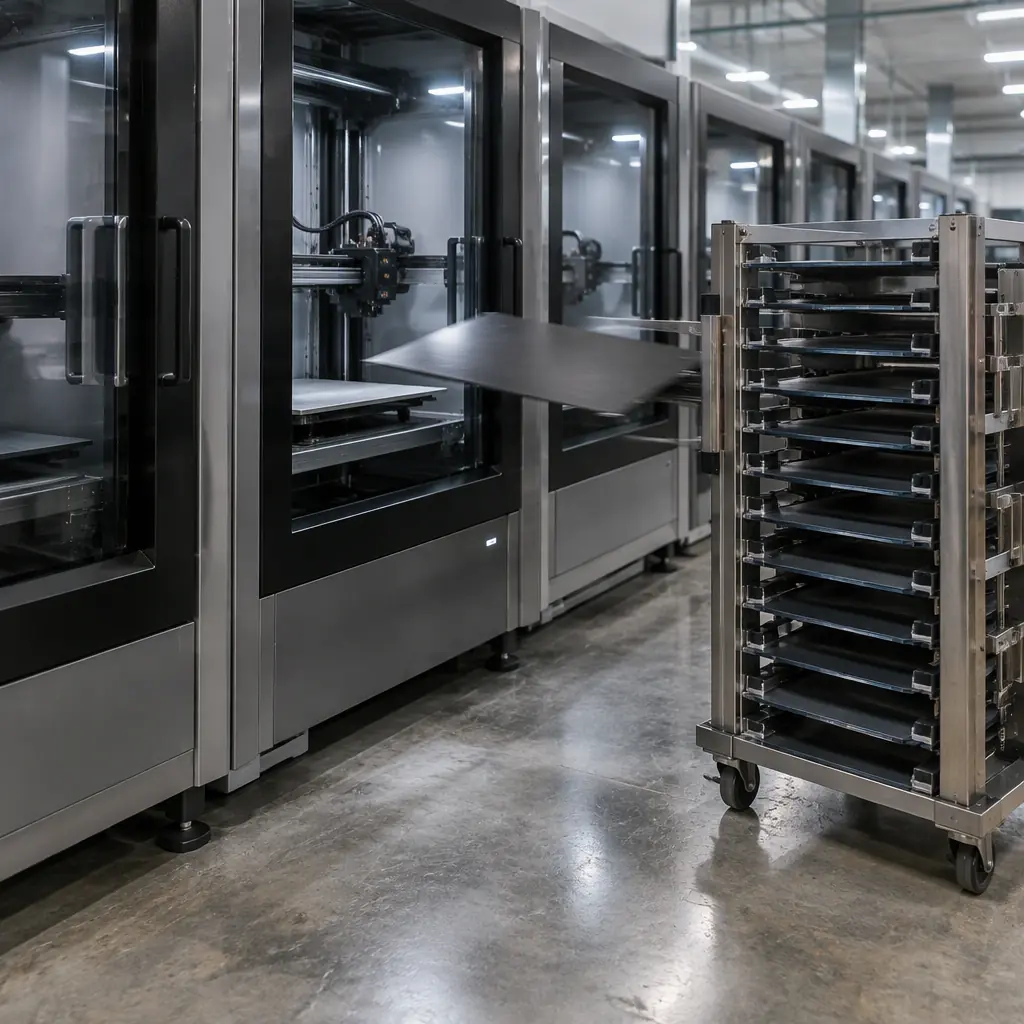
Automated build plate exchange replaces the scrape and the reload. A magazine of prepared plates sits beside the machine, and after a job the finished plate is transferred out and a fresh one is swapped in, so the next job starts within minutes. Handling the part off the plate still requires a human, but that work can be batched into a single pass at the end of a shift. This route is the cheapest per machine and the easiest to retrofit, and it removes perhaps sixty percent of the handling interruption.
Robotic machine tending removes the operator entirely from the loop for simple parts. A six-axis arm with an end effector sized to the part family opens the door, removes the finished part or the plate, moves it to a finishing or packing station, loads a fresh build surface, and issues the next job. This is the route that makes unattended overnight production real, and it is also the route that fails most often in practice, because a printed part that sticks to the bed with a 30 N adhesion force is not a predictable pick and an arm that cannot measure that force will either leave the part or launch it across the cell.
Conveyor and pallet transfer sits between the two. Parts are released onto a belt, carried to a single inspection and packing point, and the machine is reloaded by a plate changer in parallel. This is the classic high-volume layout and it suits farms that run the same part family for weeks rather than fifty different jobs per week.
The Gripper Is the Whole Problem
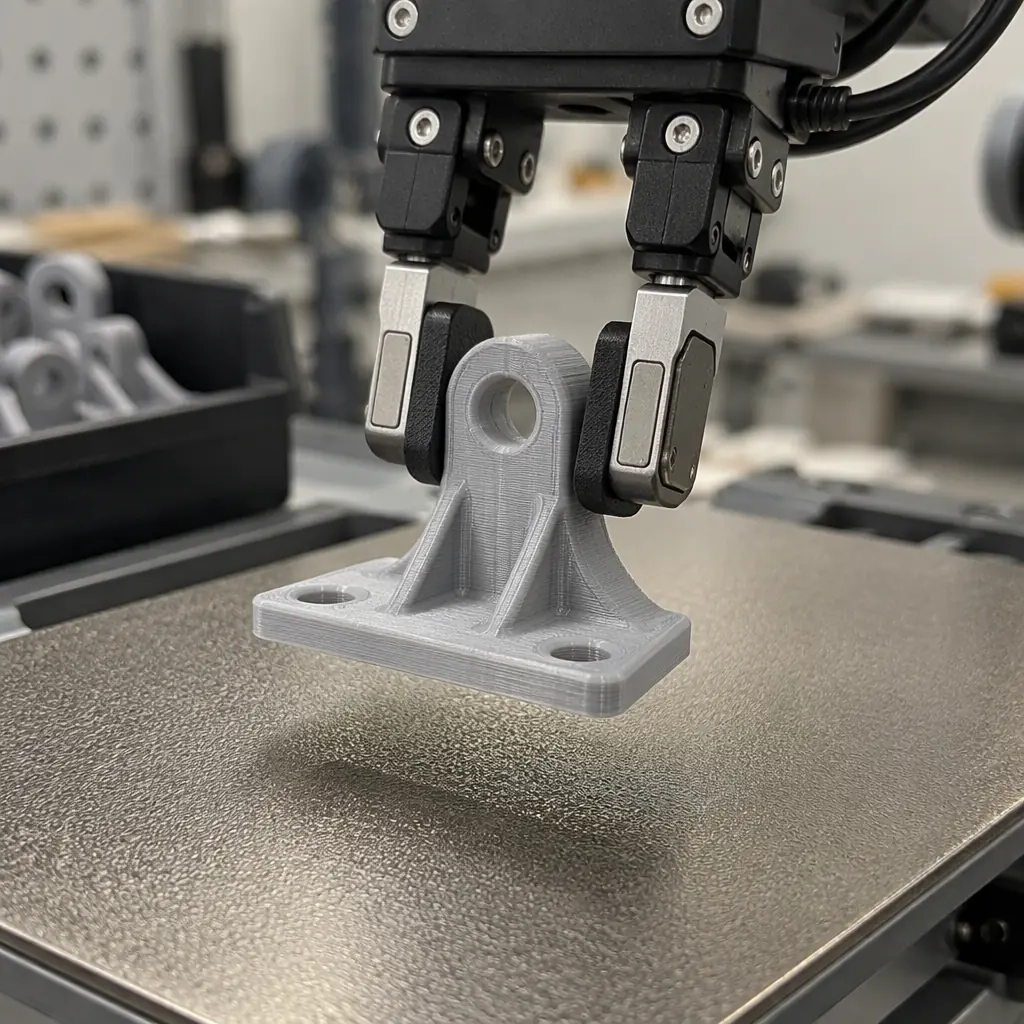
Everything difficult about robotic tending concentrates in the last twenty millimetres of the motion. A human operator knows without thinking whether the part will pop free or whether it needs a chisel; a robot has to be told. The three mechanisms that make a pick reliable are a compliant gripper with force sensing, a controlled release of the part from the build surface, and a verification step that confirms the pick actually happened before the machine is asked to start the next job.
Force sensing is what converts a brittle sequence into a robust one. A gripper with a 5 to 20 N force window, backed by a current-limit on the wrist axes, can pull a part free within a known envelope and stop when it does not move, rather than continuing until something breaks. Controlled release is usually achieved with a flexible build sheet that can be peeled with a low and repeatable force, a plate coated for 10 to 25 N adhesion, or a thermal release triggered by cooling the plate a few degrees below the material's glass transition from the underside. Thermal release is the most elegant and the slowest; mechanical peel is the fastest and needs the plate consumable to be designed for it.
What you're looking for: A pick verification step, either a vision check, a vacuum or force signature, or a plate weight measurement, that gates the next job start.
If it fails: One missed pick produces a collision, a damaged end effector and a scrapped plate, and the failure repeats every shift because nothing in the sequence knows it happened.
Boundary Condition: The cell needs a stated intervention protocol for the case where a part is fused to the plate. A robot that cannot report "I cannot remove this" is a safety hazard, not an automation.
What Automation Does Not Fix
Automating the handling of a print farm exposes every other source of downtime, and buyers are routinely surprised by how little throughput improves in the first month. A robot that unloads perfectly still cannot unclog a nozzle, recover from a filament tangle, replace a worn sheet, or decide that a part failed halfway through and should be abandoned. The dominant remaining stops in an automated farm are material faults, mechanical wear and print failures, which is why the automation investment typically needs to be paired with the reliability work described in our guide to MTBF, MTTR and uptime.
The practical sequence is to instrument before automating. A farm that does not know its current uptime percentage, its mean time between failures, and its top five stop reasons cannot tell whether an automation cell delivered the promised hours. Two weeks of stop logging with a reason code and a duration is enough to build the baseline, and it usually reveals that twenty to thirty percent of the lost time is not handling at all. Our guide to print queue failure triage describes the recovery loop that automation has to sit inside.
- Baseline first. Log every stop with a reason code and duration for two weeks before quoting a cell.
- Stabilise adhesion. A plate consumable with a repeatable release force is a prerequisite, not an accessory.
- Constrain the part family. Pick strategy works for a defined family; it does not generalise to every job in the queue.
- Keep a manual lane. One unautomated machine lets the farm run odd jobs without stopping the cell.
- Design for a pick point. A flat, accessible surface on the part is a design decision the customer can make for free.
- Plan the intervention. A cell that requires an engineer at 3 am is worse than a shift operator at 7 am.
Safety and the Unattended Shift
An automated farm runs unattended, which changes the risk profile rather than reducing it. The cell needs a physical guard or a certified safety scanner, an interlock on every access door, and an emergency stop reachable from outside the hazard zone. The printers themselves introduce fire risk: a thermal runaway on a machine running overnight with nobody in the building is the scenario that fire underwriters ask about first, and the answer has to be hardware, not firmware alone. Our guide to enclosure fire suppression covers detection and clean-agent options, and the emissions audit guide covers the air-quality side of an unattended room.
Remote monitoring closes the loop. A cell that reports job state, plate state and pick success to a dashboard lets one person supervise forty machines from a laptop, and the same data feeds the maintenance schedule. The failure mode to design out is the silent stop: a machine that has been idle since 23:40 and nobody notices until the morning. Alarm on the absence of progress, not only on the presence of an error.
What a Distributor Should Actually Sell
The commercial opportunity for a distributor is not a robot. It is the package that makes automation survive contact with a real farm: a release-force specification on the plate consumable, a gripper and end effector matched to the customer's part family, a plate magazine sized to the shift, the stop-logging and monitoring layer, and the service contract that keeps the cell calibrated. Customers who buy a robot and nothing else are the customers who call in month three to say it does not work, which is a support cost rather than a revenue line.
The recurring revenue is in the consumables and the service. Automated cells consume plates, sheets, nozzles and filament at a higher rate per machine-hour than manual farms because they run more hours, and they require scheduled calibration of force sensing and repeatability checks that a manual farm never needed. A distributor who prices the cell at cost and the consumables and calibration at margin builds a durable account; one who sells the cell at a premium and leaves the consumables to the open market builds a one-off sale. Our guide to spare parts aftermarket revenue sets out the attach-rate logic.
Bottom Line
Robotic tending and automated plate handling pay back in a mid-sized farm when the baseline is measured rather than assumed, when the plate release force is specified as an engineering number, and when the pick is verified before the next job starts. Choose the route by what the customer already owns: plate exchange for retrofits, a tending cell for a defined part family running overnight, and conveyor transfer for a stable high-volume line. Price the cell honestly and put the margin in the consumables, the calibration and the service contract. The farm that automates without fixing adhesion and reliability simply converts a labour problem into a capital problem, and pays interest on it every month. Where the next constraint appears after handling is solved is in our guide to line balancing and bottleneck analysis.
Automation & Fleet Programs
Specify the Cell Around the Part Family
Precise3D works with farm operators and integrators on plate consumables, gripper requirements and monitoring layers that make an automated cell survive a real production week.