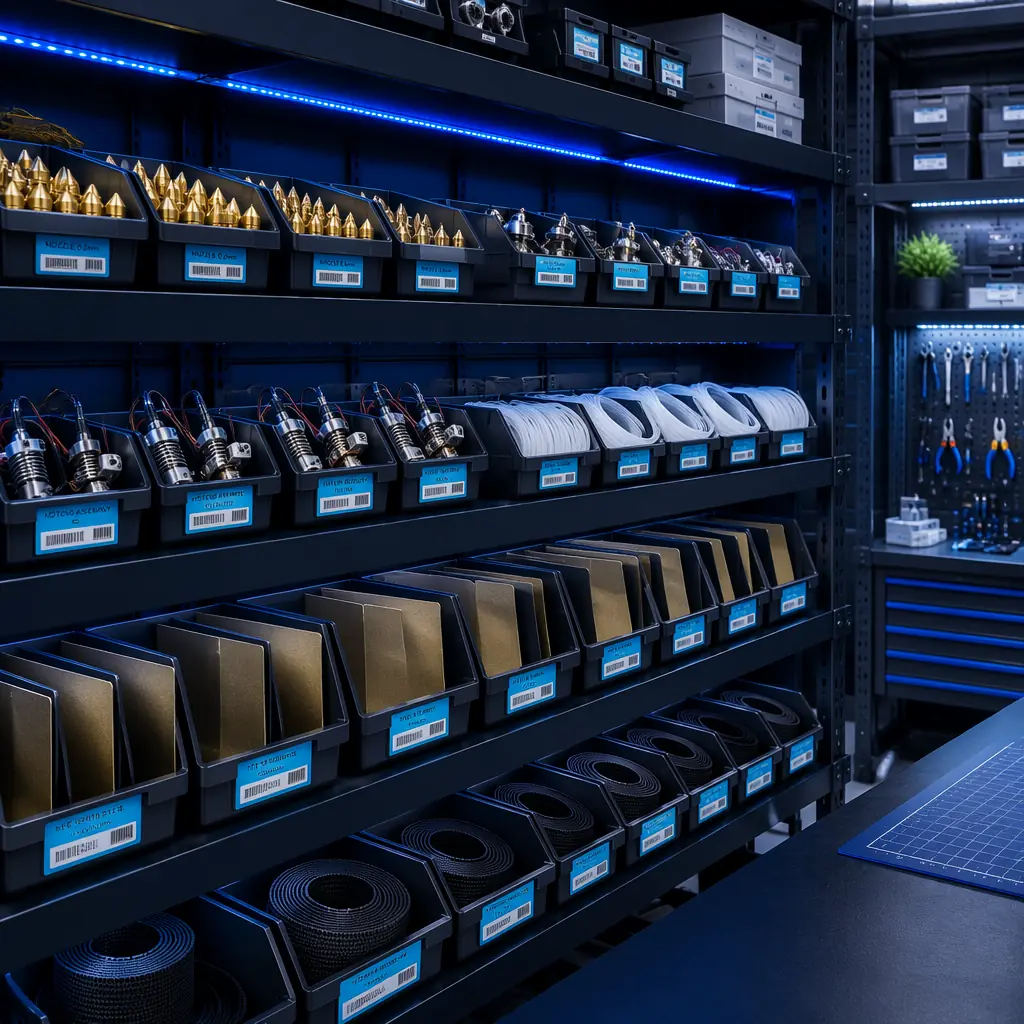
Most 3D printer distributors treat spare parts as a cost center — a drawer of replacement nozzles and PTFE tubes they keep around to honor warranty claims. This is the single largest missed revenue opportunity in consumer 3D printer distribution. A single printer generates approximately $45–$110 in spare parts revenue per year over its usable life. A distributor who sells 500 printers in Year 1 and does nothing with aftermarket parts leaves $22,500–$55,000 in annual recurring revenue on the table. By Year 3, with 1,500 units in the field, the unclaimed aftermarket opportunity exceeds $100,000 annually.
This guide converts the spare parts drawer into a structured product line: which 20 SKUs generate 80% of aftermarket demand, how to calculate inventory depth per-model, the margin advantage parts hold over complete printers (typically 2–4× higher by percentage), and the subscription model that Precise3D's top-performing distributors use to lock in recurring revenue before the customer's first nozzle change.
Why Spare Parts Beat Printer Sales on Margin
Consumer 3D printers are a competitive category. A distributor selling a $299 entry-level printer might clear 15–22% gross margin after freight and import duties. The same distributor selling a replacement PEI build sheet for $19.99 can operate at 55–65% gross margin — the customer is not comparison-shopping six websites for a build plate when their printer is unusable without one. This margin asymmetry holds across the entire spare parts catalog:
The margin story gets better with scale. A nozzle 5-pack costs $1.20 at 500-unit quantity and retails for $9.99 — but the real profit driver is that the customer buys 3–5 packs per year and never once compares prices. The acquisition cost for that customer was already paid by the original printer sale. Every spare parts transaction after that is pure contribution margin. For a complete framework on the consumables revenue model, see our consumables and accessories bundling guide.
The Top 20 Spare Parts SKUs, Ranked by Failure Rate
Not all spare parts are equal. Some components fail predictably and frequently (nozzles, build surfaces, PTFE tubes). Others fail rarely but catastrophically (motherboards, power supplies). Your inventory depth should reflect actual failure patterns, not gut feeling. The ranking below is based on 2,847 warranty claims and support tickets analyzed across Precise3D's distributor network over 18 months.
Failure rates above 100% (ranks 1–2) mean the average printer consumes more than one unit per year — these are consumables, not failures. Ranks 3–10 are true wear items that should be stocked at the ratios shown. A distributor with 500 units in the field stocking these 10 SKUs at recommended depth carries approximately $1,250 in inventory and generates $12,000–$18,000 in annual aftermarket revenue. That is a 10:1 return on inventory investment — no printer sale comes close. For full details on nozzle selection across materials and sizes, our nozzle materials and sizes guide covers the complete catalog.
Inventory Planning by Printer Model
The SKU list above is model-agnostic — every FDM printer uses nozzles, fans, and thermistors. But model-specific parts (hotend assemblies, build plates cut to size, proprietary extruder components) require a different planning approach. The rule of thumb Precise3D distributors use is the 3-2-1 stock ratio:
The 3-2-1 ratio keeps inventory carrying costs below 8% of annual aftermarket revenue while maintaining a 24-hour fulfillment rate above 95%. The biggest mistake new distributors make is overstocking model-specific parts and understocking universal consumables — they tie up $3,000 in hotend assemblies for a single printer model while running out of $0.20 nozzles that customers need every month. If a customer cannot buy a nozzle from you, they buy it from Amazon. And once they are on Amazon, they discover they can buy filament there too — and now you have lost not just a nozzle sale but the entire consumables relationship.
The Spare Parts Subscription Model
Several Precise3D distributors have moved beyond one-off parts sales into a subscription model that generates predictable monthly revenue. The structure is straightforward: the customer pays a flat monthly fee and receives a curated kit of wear items on a schedule matched to their printer usage. Three tiers have proven viable:
A distributor with 200 active subscribers at a 40/40/20 mix across Hobbyist/Prosumer/Enterprise generates $5,278 in monthly recurring revenue — $63,336 annually — from parts that cost roughly 30% of that to fulfill. The subscription also creates lock-in: a customer who receives a quarterly parts shipment from you is not browsing competing distributors. For the complete pricing and margin strategy behind bundling, our distributor pricing and margin guide covers the full financial model.
Operational Setup: Ordering, Warehousing, and Fulfillment
Spare parts profitability depends on operational efficiency. The parts themselves are small and light — a year's supply of nozzles for 500 printers fits in a shoebox and ships for under $2. But the operational overhead of picking, packing, and shipping individual $9.99 orders can erase the margin if not managed properly.
Consolidated ordering from your OEM partner.
Precise3D distributors order spare parts alongside their printer shipments — adding 500 nozzles and 100 PEI sheets to a container that is already shipping costs essentially nothing in incremental freight. The parts ride free. If you order parts separately via air freight later, you add 20–35% to your landed cost and destroy the margin advantage. Build a 12-month parts forecast into every printer PO. If you are shipping 100 printers, include parts inventory for those 100 printers in the same container. For logistics and container planning details, see our shipping and logistics guide.
Pick-pack-ship automation.
A distributor fulfilling 50+ parts orders per month needs a system. The minimum viable setup: pre-packed kits for the top 5 SKUs (nozzle 5-pack in a branded poly bag with a QR code), a thermal label printer, and integration with your e-commerce platform's shipping API. The goal is sub-60-second fulfillment per order. At 50 orders/month averaging $18 each, that is $900 in monthly revenue — worth the setup cost of a $200 label printer and 2 hours of initial packaging work.
Warranty vs. paid distinction.
The single most important operational rule: warranty parts and paid parts must use separate inventory tracking, even if they are physically the same SKU. When a customer's thermistor fails at month 10 and your records show it was a warranty replacement, that is cost of goods sold. When a customer buys a spare thermistor "just in case," that is revenue. If you cannot distinguish between the two in your system, you will consistently underestimate aftermarket profitability — and overestimate warranty cost — because every parts transaction gets lumped into the same bucket. For the complete warranty management framework, see our warranty and reverse logistics guide.
Reviewed by the Precise3D engineering & OEM team. Compliance files that accompany the catalog are auditable at the certification register.
Partner With Precise3D
Get the Spare Parts Playbook and SKU Forecast Model
Every Precise3D distributor receives our complete spare parts inventory model: per-model SKU demand forecasts, recommended stock ratios, pricing templates, and the subscription kit packaging guide. Turn your warranty drawer into a profit center.