
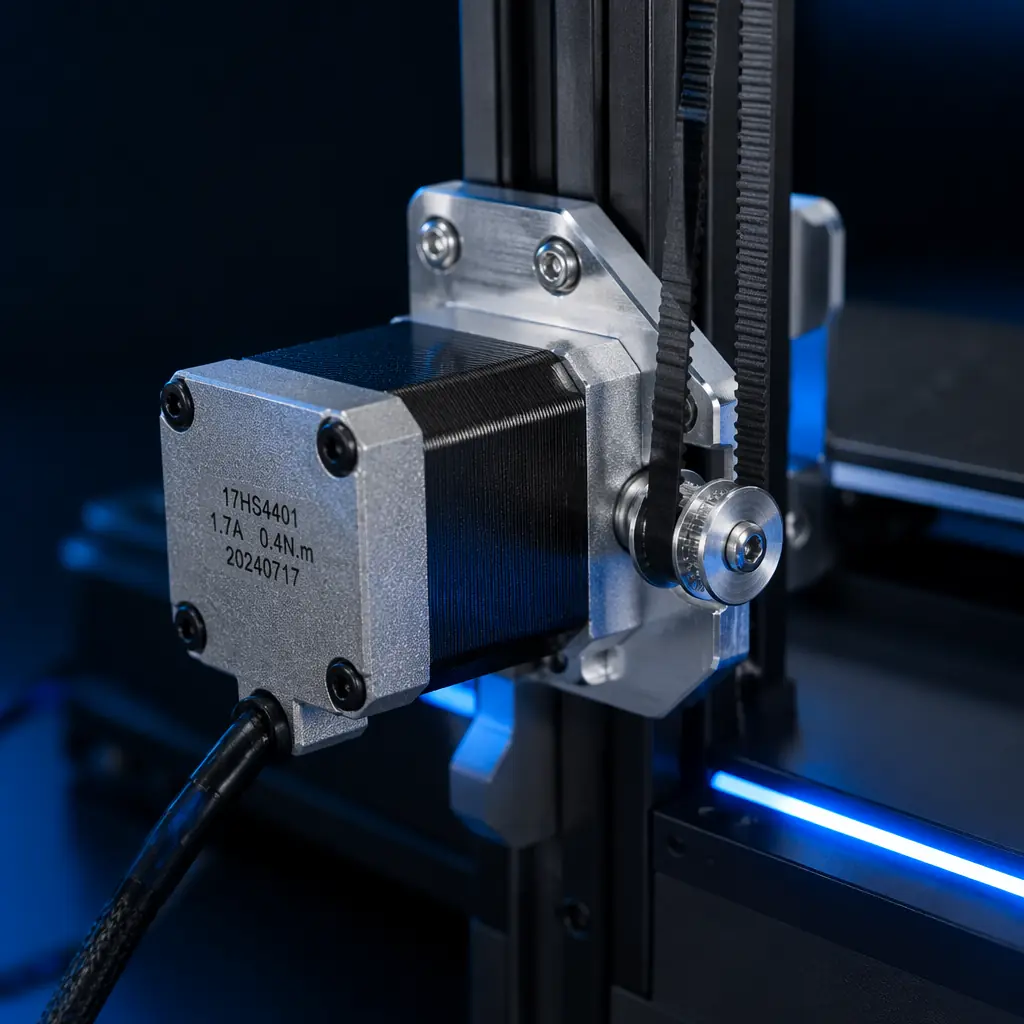
Every 3D printer distributor knows the support ticket: "The print shifted halfway through." The customer sends a photo of a model with a clean horizontal offset — sometimes 2mm, sometimes 20mm — and the printer otherwise functional. The root cause, in nearly every case, is a stepper motor that lost position without knowing it. The motor kept spinning; the controller kept sending step pulses; but the rotor didn't move. The printer has no way to detect this failure because standard stepper motors are open-loop: they receive commands but never report back what actually happened. Closed-loop servo motors change this architecture entirely — and for distributors, they represent the next meaningful step-function in product differentiation since silent stepper drivers went mainstream five years ago. This guide covers how the technology works, what it means for return rates and margins, and which printers and upgrade paths make sense for your market.
What's the Difference Between Stepper and Servo?
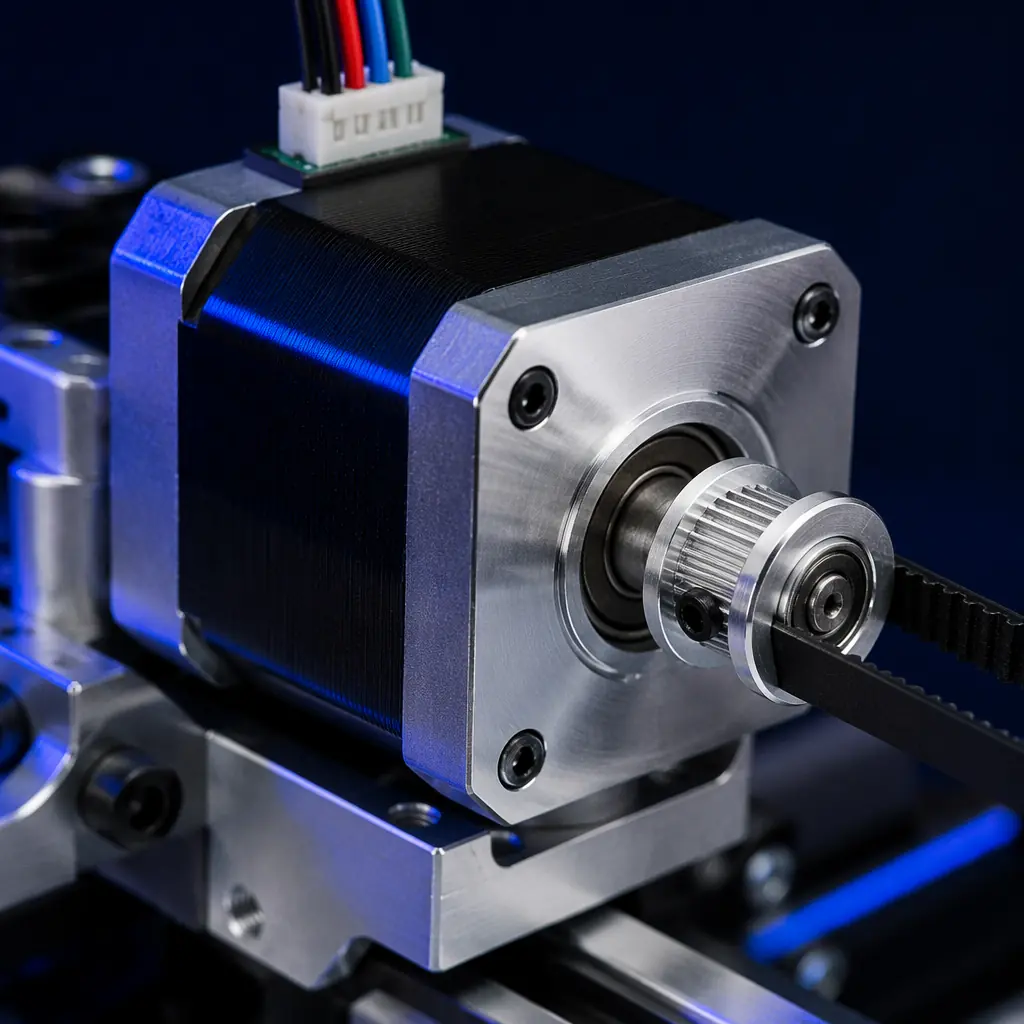
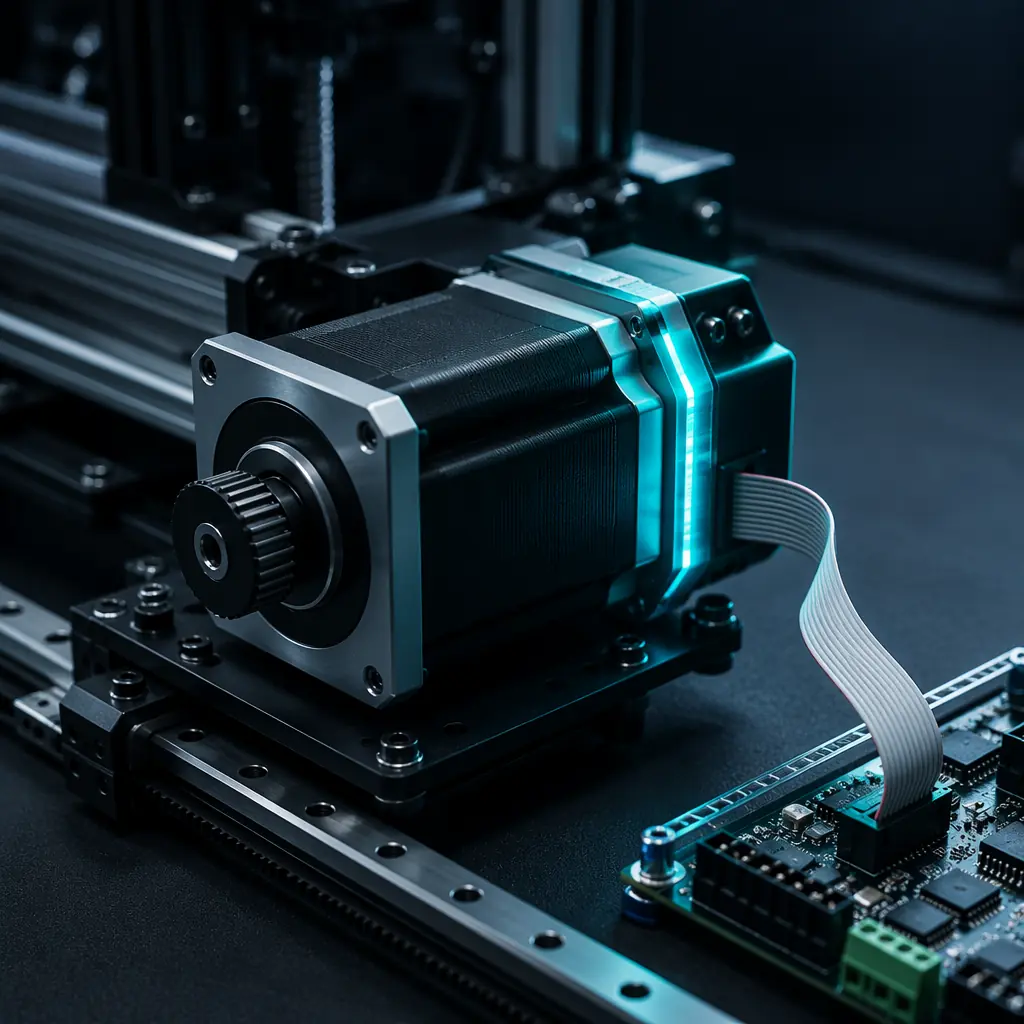
The distinction between stepper and servo comes down to one word: feedback. An open-loop stepper motor receives step and direction pulses from the stepper drivers and motherboards that control it, and the controller assumes the motor executed every step perfectly. It has no way to verify this assumption. A closed-loop servo motor adds a rotary encoder — typically a magnetic Hall-effect sensor or optical encoder disk — mounted on the rear shaft of the motor. This encoder measures the actual angular position of the rotor in real time, typically with resolution of 0.1° or better. The servo driver compares commanded position against measured position on every control cycle (often 10–20 kHz) and applies corrective current if the motor has fallen behind.
In practice, an open-loop stepper operates with a built-in safety margin. The controller runs the motor at currents and accelerations well below the motor's theoretical stall point, because the system cannot detect or recover from a stall. This margin is wasted performance — the motor is capable of more, but the architecture won't allow it. A closed-loop system eliminates this margin. The servo driver can push the motor closer to its physical limits because it monitors position in real time: if the rotor begins to lag, the driver increases current to catch up. If the lag exceeds a configurable threshold — typically 0.5° to 2.0° — the driver triggers a fault and pauses the print. This is the critical difference between open-loop and closed-loop failure modes: an open-loop stepper fails silently and produces a ruined print; a closed-loop servo fails loudly and preserves the print.
Why Layer Shifts Happen (and How Servos Prevent Them)
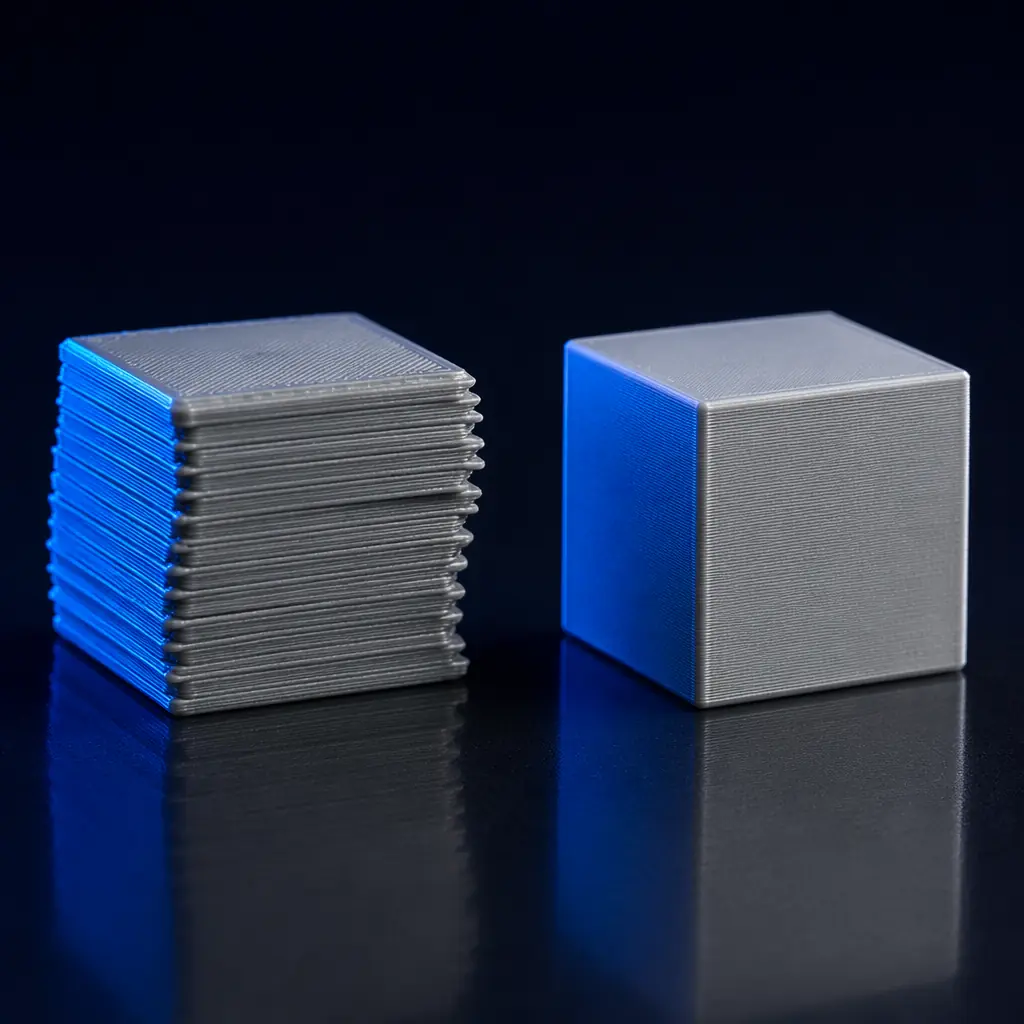
Layer shifts are the most frustrating print failure because they are unpredictable. Unlike stringing or warping — which have visible early warning signs — a layer shift happens in a single moment and the printer has no idea it occurred. Understanding the failure mechanism is essential to understanding why closed-loop control is the only architectural solution, not a firmware patch.
A stepper motor produces torque proportional to the current flowing through its coils. At a given current, there is a maximum torque the motor can produce before the magnetic field can no longer hold the rotor in position. When external forces exceed this holding torque — even for a few milliseconds — the rotor jumps to the next magnetic pole position. The controller, sending step pulses on a separate circuit, never detects this event. The print continues from the new, incorrect position. Common triggers include: the nozzle catching on a curled-over edge of printed material (particularly with ABS and PETG), a sudden mechanical bind in a linear rail or V-wheel that increases friction momentarily, belt resonance at specific speeds that produces transient torque spikes, and insufficient motor current for the acceleration values configured in the slicer. Our print failure diagnosis guide covers how to distinguish layer shifts from other failure modes in support tickets.
Action: When a customer reports a layer shift on a long print, the solution is not "buy a more expensive printer" — it's "buy a printer with closed-loop control." This reframes the upgrade conversation from price to architecture.
A closed-loop servo motor solves the layer shift problem at the hardware level. When the nozzle snags on a curled edge, the encoder detects the rotor deceleration within 50–100 microseconds and the driver increases current to push through the obstruction. If the obstruction is too severe, the driver triggers a fault and the printer can pause — preserving the completed portion of the print instead of wasting the entire job. For a distributor, this single capability converts the most common cause of long-print failure into a recoverable event. The support ticket changes from "your printer ruined my 30-hour print" to "the printer paused — how do I resume?" That is a fundamentally different customer relationship.
The Business Case for Selling Servo-Driven Printers
The economics of closed-loop motors in 3D printing are straightforward once you look past the BOM cost. A standard NEMA 17 stepper motor costs $8–12 at wholesale volumes. A closed-loop NEMA 17 servo with integrated encoder and matching driver board costs $35–55 — roughly a $30–45 delta per axis. For a CoreXY printer with four motors (XYZE), the total BOM increase is approximately $120–180. This is the cost side. The revenue side is where the distributor case becomes compelling.
Price premium capture: Printers equipped with closed-loop servo motors consistently sell at a 30–50% premium over their open-loop equivalents with otherwise identical specs. A printer that would retail at $599 with standard steppers can command $799–899 with closed-loop servos. The incremental BOM cost of $120–180 is recovered at wholesale margin, and the additional $200–300 at retail flows directly to the distributor's bottom line. For a pricing strategy that positions servo-driven printers at the premium tier without cannibalizing the mid-range line, the key is clear segmentation: the servo model is not a replacement for the stepper model — it is a parallel product for a different buyer.
Return rate reduction: The single largest driver of 3D printer returns in the $400–1,000 segment is "print quality inconsistent." Layer shifts account for approximately 20–25% of these complaints based on Precise3D's warranty data analysis across distributor partners. Eliminating layer shifts as a failure mode reduces the return rate by an estimated 1.5–2.5 percentage points. At a 5% industry-average return rate, that represents a 30–50% reduction in return volume. Each avoided return saves the distributor $40–80 in shipping, inspection, refurbishment, and restocking labor — plus the cost of a lost customer. For a distributor selling 500 units per year in the mid-to-premium segment, closed-loop motors across the product line could prevent 8–13 returns annually, saving $3,200–10,400 in direct costs and preserving customer lifetime value.
Upsell pathway: The closed-loop upgrade kit is a natural upsell for existing stepper-driven printer customers. Aftermarket servo kits for popular models like the Ender 3 and CR-10 series retail for $120–180 for a full XY upgrade and install in under an hour with basic tools. For a distributor selling printers, offering a servo upgrade kit at the point of sale — "Add closed-loop accuracy for $149" — converts 8–15% of mid-range printer buyers into a higher-margin transaction. The aftermarket upgrades revenue guide covers the full accessory upsell strategy, of which servo kits are the highest-value line item.
Quieter operation as a secondary benefit: Closed-loop servo drivers use sinusoidal current control (field-oriented control, or FOC) rather than the chopper-based control of standard stepper drivers. FOC drives the motor with smooth sine waves that produce significantly less audible noise — typically 5–10 dB quieter than the same motor running on a TMC2209 in SpreadCycle mode. For distributors selling into markets where printer noise is a purchase consideration — education, office prototyping, dental labs — the combination of zero layer shifts and quieter operation is a two-part value proposition that justifies the premium. Our silent printing guide covers the full noise reduction toolkit, of which closed-loop motors are the newest addition.
Which Printers and Upgrade Kits Support Closed-Loop?
The closed-loop ecosystem in 3D printing is still fragmented, but it is consolidating around a few clear standards. For distributors evaluating which products to add to their line card, here is the current landscape as of mid-2026.
Upgrade kits for popular platforms: The aftermarket closed-loop ecosystem has matured rapidly. BTT (BigTreeTech) offers the S42B closed-loop stepper motor series specifically designed as drop-in replacements for standard NEMA 17 motors on Creality Ender 3, CR-10, and Sovol SV06 platforms. The S42B integrates a magnetic encoder on the rear shaft and communicates with a dedicated driver board over SPI. Installation requires swapping the motor, mounting the driver board, and flashing firmware with closed-loop support — total time under 60 minutes for an experienced user. MKS offers the SERVO42 series with similar compatibility and slightly lower cost. For CoreXY platforms, the Voron community has standardized on the BTT S42B for A/B motors and the MKS SERVO57 for builds using larger NEMA 23 motors on the Z axis. For a distributor offering high-speed printing printers, bundling a closed-loop upgrade kit at point of sale is a natural upsell: the customer who buys a CoreXY kit printer for speed is the same customer who will pay $150 extra to guarantee those fast prints don't shift.
Factory-integrated servo printers: At the premium end, several manufacturers now ship printers with closed-loop motors from the factory. The Rat Rig V-Core 4 offers closed-loop as a factory option on the A/B motors; Prusa's XL uses closed-loop servos on all five tool-changer axes; and a growing number of industrial desktop printers ($2,500+) ship with full closed-loop architectures. For a distributor positioning themselves at the professional/prosumer tier, carrying at least one factory-integrated servo printer is becoming table stakes — it signals that the product line includes the technology that serious buyers are searching for.
Action: Add at least one closed-loop upgrade kit SKU to your accessory catalog. Position it on the product page as "Eliminate layer shifts permanently" with a before/after print quality comparison image. Track attachment rate as a KPI.
When Stepper Motors Are Still the Right Choice
Closed-loop servo motors are not a universal upgrade. There are multiple scenarios where standard stepper motors remain the correct engineering and commercial decision, and pushing servos into the wrong segment will erode margin without delivering customer value.
Sub-$299 printers: At this price tier, the $120–180 BOM increase for closed-loop servos represents a 40–60% cost increase. The customer buying a $199 printer is price-sensitive and unlikely to value layer-shift prevention over, say, a larger build volume or a direct-drive extruder. The standard stepper with TMC2208/2209 drivers — delivering silent operation at the price point — remains the correct spec for entry-level printers. The value equation shifts at $399 and above, where the incremental cost of closed-loop drops to 20–30% of the retail price and the average customer is running longer, higher-stakes prints.
Printers with low mechanical load: A small-format bedslinger with a lightweight Bowden toolhead, printing PLA at 60 mm/s, generates minimal mechanical stress on the stepper motors. The stall margin on a standard NEMA 17 running at 0.8–1.0A with TMC2209 drivers is more than sufficient for this use case. Adding closed-loop servos to this printer adds cost without addressing a real failure mode. The value of closed-loop scales with print speed, toolhead mass, and print duration — the heavier and faster the motion system, the more likely a stepper motor is to lose steps, and the more valuable the encoder becomes.
Direct-drive extruders on the X axis: Some direct-drive configurations add enough mass to the toolhead that the X-axis stepper operates closer to its torque limit, especially during travel moves at 300+ mm/s. This is the specific scenario where closed-loop provides the highest ROI: a heavy toolhead on a fast printer. Our extruder comparison guide covers the toolhead mass implications in detail.
When the stepper driver quality reduces the need: The combination of TMC5160 drivers with high-quality NEMA 17 motors — running SpreadCycle mode with properly tuned current — can achieve reliability levels where layer shifts drop below 1% even on long prints. The stepper driver selection guide covers which driver chips deliver enough control authority to reduce the need for closed-loop feedback.

The Distributor's Servo Strategy: Where to Start
The closed-loop transition doesn't require a full product line overhaul. Start with one upgrade kit SKU compatible with your best-selling mid-range printer — BTT S42B or MKS SERVO42 at $139–169 retail achieves 40–50% margin on a $65–80 wholesale cost. Then add one factory-servo printer at the $1,200–2,500 price point for professional buyers who search for "layer shift free" as a purchase criterion. Finally, ask your OEM partner about next-generation mainboard support for closed-loop servo communication (CAN bus or SPI). A mainboard with plug-and-play encoder connectors eliminates installation friction and lets you offer servo-equipped SKUs at a $150–250 premium. Precise3D's next-generation platform integrates closed-loop servo support directly on the mainboard — distributors who join the partner program now will have first access to servo-equipped models at launch.
Start Your Partnership
Ready to Bring Precision Printing to Your Market?
Join our network of 200+ global distributors. Competitive pricing, dedicated support, and fast fulfillment.