Every 3D printer distributor who has been in business for more than twelve months has a story. The customer who bought a Pro X1 on a Friday, printed parts for a weekend trade show booth, then initiated a return on Monday claiming "print quality issues." The customer who returned a printer in the original box — except the serial number on the chassis didn't match the serial number on the invoice because they'd swapped in their broken unit. The customer who bought an S1 starter printer every 80 days, returned it on day 79 of the return window, and repeated the cycle indefinitely. These are not edge cases. According to the National Retail Federation, return fraud affects 13.7% of all returns across consumer electronics categories — and 3D printers, with their combination of moderate-to-high price points and steep learning curves, are disproportionately targeted. This guide is the countermeasure manual. For the broader returns infrastructure that supports this framework — including reverse logistics, warranty claims processing, and OEM coordination — see our warranty and reverse logistics guide.
The Five Most Common Return Fraud Patterns in 3D Printer Distribution
Return fraud in 3D printer distribution follows five recurring patterns. Each targets a different vulnerability in the standard returns process, and each requires a different countermeasure. A distributor who designs their RMA workflow to block one or two of these patterns but leaves the others open is still losing margin — just on a different vector. The five patterns, ranked by frequency:
Pattern #1 — buyer's remorse disguised as a defect claim — accounts for roughly half of all fraudulent returns. The customer buys a printer, realizes it requires more skill or time than they expected, and instead of accepting that they made a bad purchasing decision, they claim the printer arrived with a defect. The distributor pays return shipping, inspects the unit (which works perfectly), and loses approximately $85–220 in shipping, handling, and restocking costs. Multiplied across dozens of incidents per year, this pattern alone can consume 1–2 percentage points of net margin. Our troubleshooting and print failure diagnosis guide provides the diagnostic scripts that can intercept many remorse-return claims before they reach the RMA stage — a well-trained support agent who can resolve a "defect" over a 10-minute phone call saves the distributor the entire return cycle.
Pattern #2 — switch fraud — is the most damaging per incident. The customer owns a broken or out-of-warranty printer, purchases an identical model from the distributor, then returns their broken unit in the new box claiming it arrived defective. The distributor refunds the purchase price and is left holding a non-functional printer worth zero. On a $1,200 professional printer, that is a full-value loss. The defense is deceptively simple: log the serial number of every printer at the point of shipment (photograph it next to the shipping label) and require photographic evidence of the serial number on any return. A mismatch triggers an automatic denial. The difference between a distributor who serial-logs at shipment and one who doesn't is approximately $8,000–15,000 per year in prevented switch-fraud losses at a regional-scale operation. For the full after-sales infrastructure that prevents these scenarios from becoming customer escalations, see our after-sales support strategy guide.
Pattern #3 — wardrobing — is the gray-area fraud that blurs the line between a legitimate return and an intentional exploit. The customer buys a printer for a specific project (a convention display, a prototype run, a seasonal production surge), uses it intensively for 2–4 weeks, then returns it within the return window. The printer is not defective — it has 200+ print hours on the clock and the build plate shows visible wear. The distributor cannot resell the unit as new, and the customer effectively rented a $600–1,800 machine for the cost of return shipping. The countermeasure is a print-hour audit: most modern 3D printer firmware logs total print hours accessible through the LCD menu or M27 command. If a returned printer shows more than 10–15 hours of runtime, the unit is classified as used and subject to a higher restocking fee — regardless of the customer's stated reason for return. This distinction (defect return vs. used return) is the single most important concept in return fraud prevention and forms the backbone of the restocking fee policy discussed in the next section.
Restocking Fee Policy Design: The Lever That Changes Customer Behavior
A restocking fee is not a punishment. It is a price signal that changes customer behavior before the purchase is made. A customer who knows they will pay a 15% restocking fee on a returned printer is more likely to research the product properly before buying, more likely to accept troubleshooting help when they encounter an issue, and more likely to be a genuine buyer rather than an opportunistic returner. The key design question is not whether to charge a restocking fee — it is how to structure the fee tiers so that legitimate defect returns are processed at zero cost to the customer while fraudulent or used returns carry a meaningful financial penalty.
This tiered structure accomplishes three things simultaneously. First, it protects legitimate customers who receive a genuinely defective unit — they pay nothing and get a prepaid return label. Second, it discourages casual returners who have buyer's remorse — the 15% fee on a $1,200 printer is $180, which is enough to make most customers think twice about returning a functional unit. Third, it creates a documented, objective framework for evaluating returns that eliminates subjective judgment calls by support staff. The print-hour counter is the key: it is stored in the printer's firmware, cannot be reset by the customer without specialized tools, and provides an irrefutable usage record. A support agent no longer has to decide whether a return "seems reasonable" — they read the print-hour counter, apply the tier, and communicate the fee. For distribution startups building their first operational policies, our distributor startup guide provides the full operational blueprint including returns policy templates.
Customer Screening Checklist: Stop Fraud Before the Printer Ships
The most cost-effective fraud prevention happens before the package leaves the warehouse. Screening orders for red flags takes 2–3 minutes per suspicious transaction and costs nothing — compared to $85–220 in losses from processing a fraudulent return. The screening checklist below is designed for a distributor processing 10–50 orders per day. A single staff member can review flagged orders in 15–20 minutes daily.
Phone verification is the highest-ROI screening tool available. A 60-second call — "Hi, this is [Name] from [Distributor], just confirming your order for the Pro X1 shipping to [City]. Everything look correct?" — deters approximately 40% of fraud attempts because fraudsters using stolen payment information typically cannot answer a phone associated with the billing address. The call also creates a timestamped record of customer contact that is admissible in chargeback disputes. For orders flagged by two or more red flags, require a photo of the customer's government-issued ID next to the credit card used for purchase (with the middle 8 digits obscured). Legitimate customers understand this is fraud prevention; fraudsters disappear. For the complete framework on building customer relationships that reduce fraud risk naturally, see our pricing and margin strategy guide which covers customer qualification as part of the broader margin-protection framework.
Photographic Evidence Requirements: Building an Irrefutable Paper Trail
Photographic evidence is the backbone of chargeback defense. A distributor who fights a chargeback without photos loses approximately 80% of disputes. A distributor who submits a complete photographic evidence packet — shipment photos, return photos, serial number documentation, and condition assessment images — wins approximately 65–70% of disputes. The difference is worth tens of thousands of dollars annually to a mid-size distributor. The photographic evidence requirements should be built into two points in the workflow: shipment and return receipt.
At shipment, photograph:
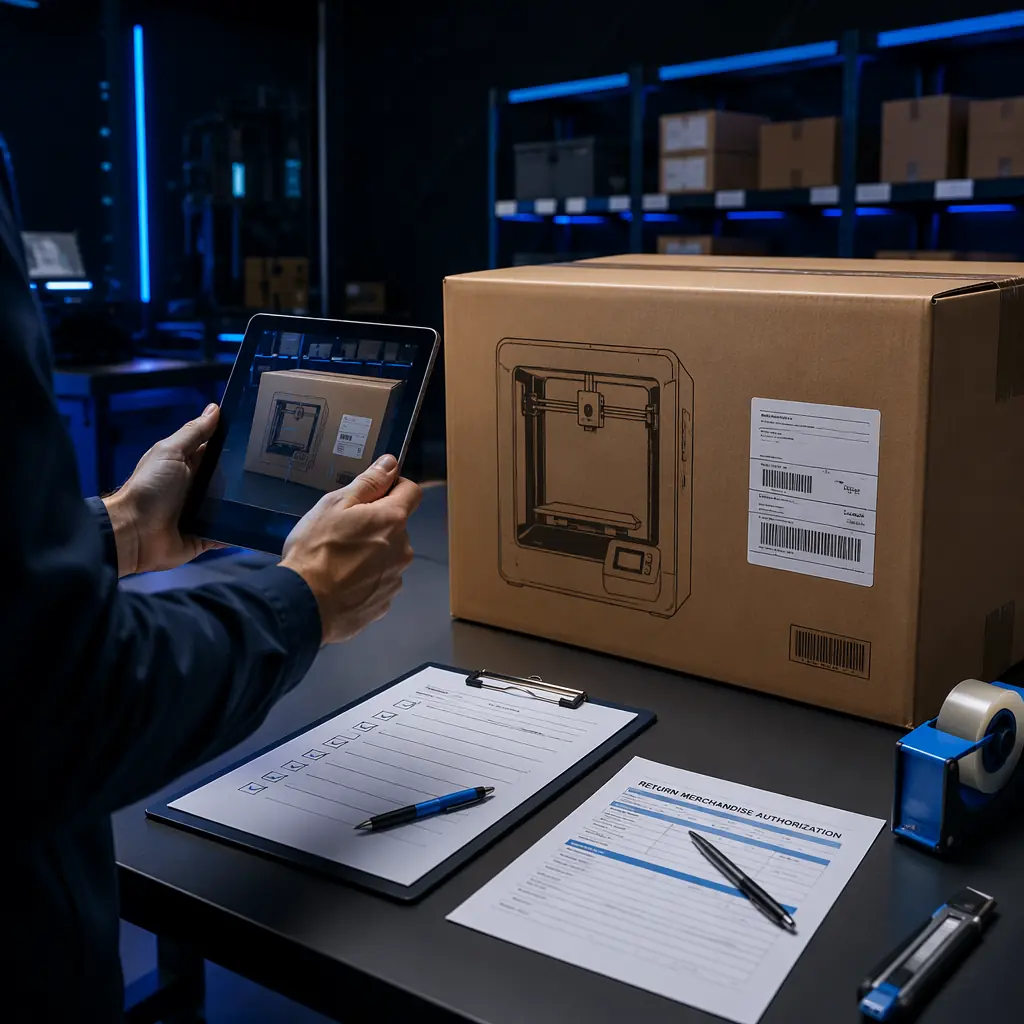
(1) The printer's serial number sticker, clearly legible, next to the printed shipping label showing the order number and destination address — both in a single frame. (2) The sealed box from two angles showing the factory tape intact and no visible damage. (3) The printer powered on and displaying the main menu screen, proving it was functional at the time of shipment. (4) All accessories and included items laid out on the packing surface. This entire set takes under 90 seconds to capture and should be uploaded to the order record in your CRM or ERP before the package leaves the dock.
At return receipt, photograph:
(1) The unopened return package as received from the carrier, showing the return shipping label and any external damage. (2) The serial number sticker on the returned unit, in the same orientation as the shipment photo, for immediate side-by-side comparison. (3) The print-hour counter on the LCD screen (navigate to Menu → About Printer → Statistics, or equivalent on your model). (4) The build plate surface, nozzle tip, and extruder gear — these are the wear indicators that confirm usage. (5) Any damage, missing accessories, or discrepancies from the original shipment photo. Our inventory management guide covers the warehouse workflow and serial number tracking systems that integrate with this evidence-collection process.
The RMA Workflow: Process Design That Separates Legitimate Returns from Fraud
A well-designed RMA workflow does two things: it processes legitimate warranty returns quickly and efficiently — typically within 48–72 hours from claim to resolution — and it creates friction at the specific points where fraudsters abandon the process. The goal is not to make returns difficult for everyone. It is to insert verification steps that a legitimate customer passes without effort and a fraudulent customer cannot pass at all.
Step 1 — Online RMA request form (friction for fraudsters, convenience for customers):
Require the following fields: order number, serial number of the printer, detailed description of the issue, and two photographs showing (a) the serial number sticker and (b) the issue or error being reported. A legitimate customer with a genuine problem can complete this form in 3–4 minutes. A fraudster who doesn't have the printer, has a different printer, or is making up a defect cannot produce the serial number photo or the issue photo — and typically abandons the claim at this step. Approximately 25–30% of fraudulent return attempts are eliminated by requiring serial number verification before the RMA number is issued.
Step 2 — Tier-1 support triage (deflect resolvable issues):
Before issuing an RMA number, a support agent reviews the submitted photos and issue description. If the issue is a known configuration problem, slicer setting error, or user-adjustable calibration — which collectively account for 35–45% of "defect" claims according to distributor support data — the agent provides troubleshooting guidance via email or phone. Resolution at this step eliminates the return entirely, saving shipping costs both ways and preserving the sale. For the diagnostic scripts that make this triage step effective, our troubleshooting guide provides tiered diagnostic workflows for the 15 most common customer-reported issues.
Step 3 — RMA issuance with clear terms:
If the issue cannot be resolved remotely, issue an RMA number with an email that explicitly states: the RMA number, the return shipping address, the deadline for return shipment (typically 14 days from issuance), the restocking fee tiers that apply if the unit is found to be functional or used, and a reminder that the serial number will be verified against the original shipment record. This email serves as the customer's acknowledgment of the return terms and is admissible as evidence in chargeback disputes.
Step 4 — Receiving inspection and disposition:
Within 24 hours of receiving the return, complete the photographic evidence capture described above, check the serial number against the shipment record, record the print-hour counter value, and classify the return into one of the restocking fee tiers. Communicate the determination to the customer within 48 hours of receipt. Speed matters: a customer whose legitimate defect claim is processed and refunded in 72 hours becomes a loyal repeat buyer. A customer whose fraudulent claim is detected and denied with photographic evidence in 72 hours cannot successfully dispute the chargeback.
Blacklist Management: Network-Level Fraud Prevention
Individual distributor blacklists are useful. Shared distributor blacklists are transformative. A fraudster who is blocked by Distributor A in Manila will attempt the same scheme with Distributor B in Bangkok, Distributor C in Jakarta, and Distributor D in Kuala Lumpur — using the same name, address, or payment method. Without a shared blacklist, each distributor independently loses money to the same bad actor. With a shared blacklist, the fraudster is blocked at the first attempt and locked out of the entire network.
A blacklist entry should include: the date of the incident, the fraud type (remorse-return, switch fraud, wardrobing, chargeback abuse), the evidence summary (serial mismatch documented, print-hour counter at 187 hours claimed as "defective out of the box"), and the monetary loss incurred. This data supports two use cases: automated order screening (an incoming order is checked against the blacklist before payment is captured) and manual review escalation (an order that partially matches — same city, different name — is flagged for phone verification). For distributors in the Precise3D partner network, maintaining and contributing to the shared blacklist is a standard operating procedure that reduces fraud losses by an estimated 35–50% compared to operating with an isolated blacklist. For the full relationship-management framework that includes customer qualification and trust-building, see our distributor startup guide.
Chargeback Defense Documentation: Winning the Dispute After the Fraud Occurs
Chargebacks are the last line of defense — and the one where most distributors lose because they are unprepared. When a customer files a chargeback claiming "item not as described" or "item not received," the card network gives the merchant 7–21 days to respond with evidence. A distributor who submits a complete evidence packet within 48 hours wins approximately 65–70% of disputes. A distributor who submits nothing because they don't have the documentation organized loses 100% of disputes by default.
The chargeback defense packet — what to compile for every disputed transaction:
1. Proof of delivery: Carrier tracking showing delivered status with signature (if required), delivery date, and delivery address. If signature-on-delivery was required and the carrier obtained one, this alone wins most "item not received" disputes.
2. Order documentation: The original order confirmation showing the product description, quantity, price, billing and shipping addresses, and the customer's IP address and timestamp at checkout. Include screenshots of the product page as it appeared at the time of purchase to counter "not as described" claims.
3. Shipment photos: The four photographs captured at shipment: serial number with shipping label, sealed box from two angles, powered-on printer display, and accessories layout. These prove the correct item was shipped in functional condition.
4. Return photos (if applicable): The serial number comparison (shipment vs. return), the print-hour counter reading, and the build plate/nozzle wear photographs. These prove the unit was used or that a different unit was returned.
5. Communication history: All emails, support tickets, and call logs between the distributor and the customer regarding the order. If the customer never contacted support before filing a chargeback, highlight this — it undermines the credibility of their claim.
6. Return policy acknowledgment: The timestamped record of the customer checking the "I agree to the return policy" box at checkout, with the full policy text that was displayed. This is the single most important piece of evidence in "not as described" disputes because it proves the customer was informed of the terms before purchase.
The ROI on chargeback defense is straightforward. A regional distributor processing $1.5M in annual revenue at a 32% blended margin, with a 1.2% chargeback rate ($18,000 in disputed transactions), who wins 65% of disputes instead of 0% recovers approximately $11,700 annually. The time investment to compile evidence packets for ~18 chargebacks per year is roughly 15–20 hours — yielding an effective hourly ROI of $585–780. For the broader financial framework that this margin protection feeds into, including gross margin targets and operating expense ratios, see our financial KPI benchmarking guide.
Implementation Roadmap: The 90-Day Fraud Prevention Rollout
Return fraud prevention is not a project that requires a technology budget, a consultant, or a six-month implementation. The highest-impact measures can be implemented with existing staff and tools in 90 days, following a sequenced rollout that addresses the largest loss vectors first.
Days 1–15: Serial number logging at shipment.
This is the single highest-ROI action. Assign one shipping team member to photograph the serial number sticker next to the shipping label for every outgoing printer and upload the photo to the order record. Equipment needed: any smartphone. Time per order: 30 seconds. Impact: eliminates 100% of switch fraud on logged units. Cost: $0.
Days 16–30: Restocking fee policy publication and checkout integration.
Draft the tiered restocking fee policy, publish it on your returns page, add it to the checkout terms checkbox, and train support staff on the print-hour-based classification system. Impact: reduces remorse-returns and wardrobing by an estimated 40–60%. Cost: 4–6 hours of staff time for drafting and web updates.
Days 31–45: RMA form with serial number and photo requirements.
Update your RMA request form to require the serial number photo and issue photo before an RMA number is issued. Impact: eliminates approximately 25–30% of fraudulent claims at the intake stage. Cost: 2–3 hours for form modification; 15 minutes of staff training.
Days 46–60: Customer screening checklist integration.
Train order-processing staff on the 7-point red flag checklist. Create a simple spreadsheet or CRM tag for flagging suspicious orders and tracking review outcomes. Impact: prevents an estimated 30–40% of fraud attempts from ever shipping. Cost: 2 hours of training; 15–20 minutes daily for order review.
Days 61–90: Chargeback defense packet template and blacklist participation.
Create a standard chargeback evidence packet template (the 6-category framework above) and set up a shared folder or CRM record type for each dispute. Begin contributing to and querying the Precise3D distributor network blacklist. Impact: increases chargeback win rate from near-zero to 60–70%; reduces cross-distributor repeat fraud. Cost: 3–4 hours for template creation; ongoing 1–2 hours per chargeback for packet compilation.
Bottom Line
Return fraud in 3D printer distribution is not an inevitable cost of doing business — it is a process failure that can be systematically reduced. A distributor who implements serial number logging eliminates switch fraud. A distributor who publishes a tiered restocking fee policy based on print-hour counters reduces remorse-returns by 40–60%. A distributor who requires serial number photos on the RMA form stops one-quarter of fraudulent claims before they receive an RMA number. A distributor who builds chargeback defense packets and wins 65% of disputes instead of 0% recovers $12,000–18,000 annually on a $1.5M revenue base. These are not theoretical projections — they are outcomes observed across Precise3D's distributor network. The framework is in this guide. The implementation takes 90 days. The margin protection compounds every year the policies remain in place.
Reviewed by the Precise3D engineering & OEM team. Compliance files that accompany the catalog are auditable at the certification register.
Start Your Partnership
Ready to Bring return fraud prevention to Your Market?
Start with the return fraud prevention spec sheet, then validate every claim against the certification register.