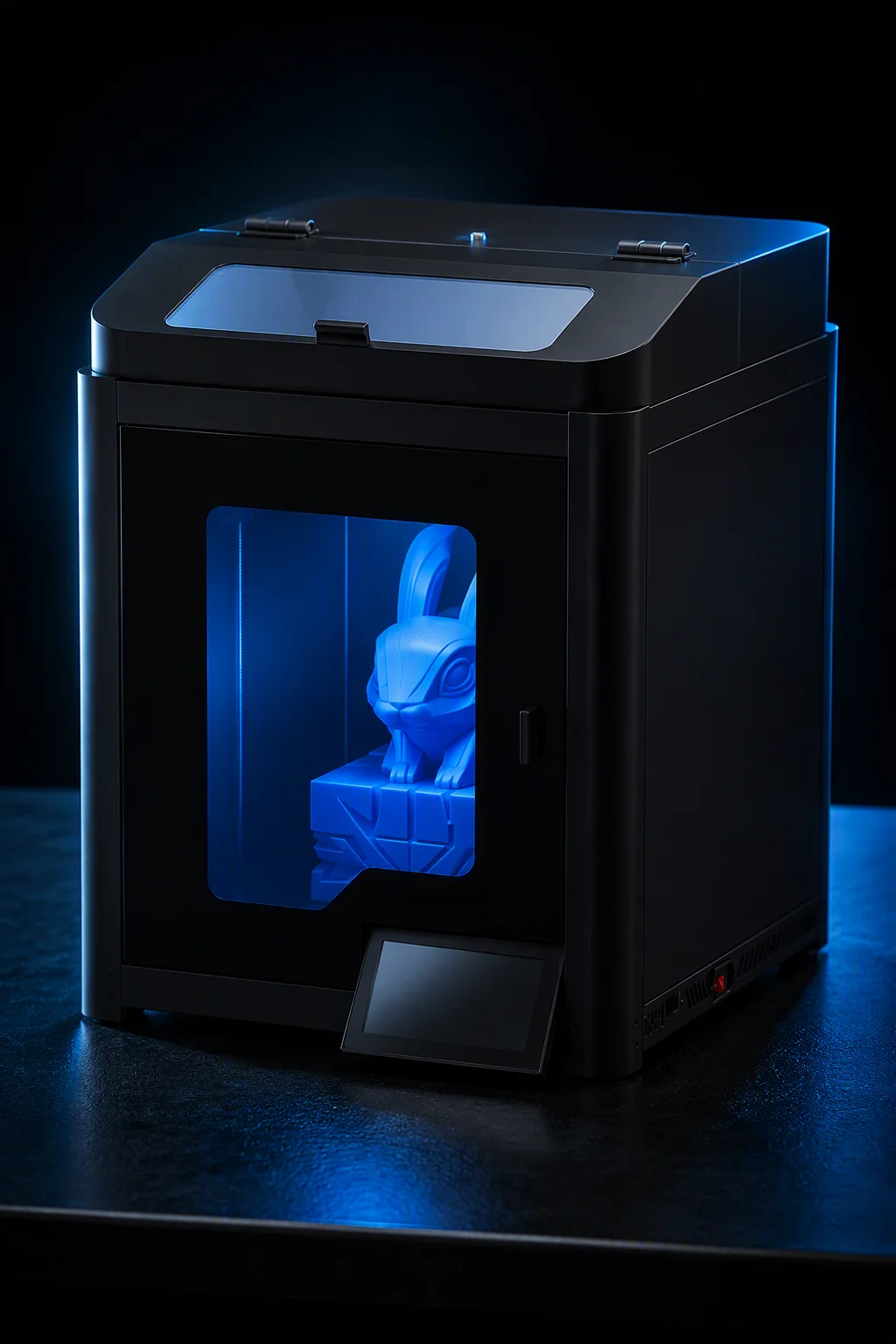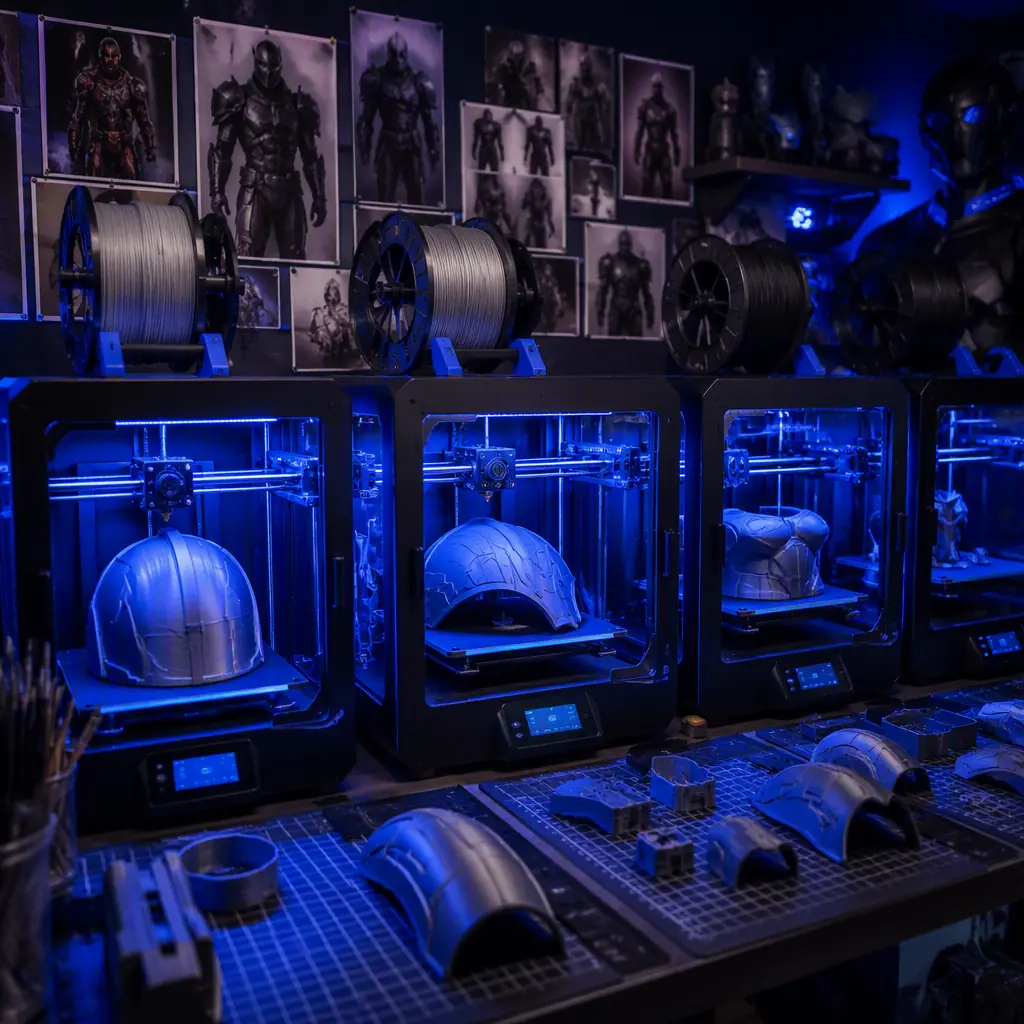
The economics of cosplay and prop-making are unlike any other 3D printing vertical. A hobbyist cosplay maker spending $1,500 on their first printer will purchase $800-1,200 in filament, $300-500 in post-processing supplies (sanding, priming, painting), and $200-400 in replacement parts (nozzles, build plates, PTFE tubing) within their first year — a 1:1 consumable-to-hardware spend ratio that is 3-5x higher than the education market and 10x higher than the casual hobbyist. The professional prop studio that charges $5,000-15,000 per commission and runs 8-12 printers continuously spends $3,000-8,000 annually on filament alone. These are not customers who buy one spool at a time — they buy by the case. For the consumables bundling economics that apply across verticals, see our consumables bundling guide.
The Creative Customer Segments: Who Buys What, and Why
The creative 3D printing market spans three distinct customer segments, each with different purchasing patterns, printer requirements, and lifetime values. Understanding which segment a customer belongs to determines the printer configuration you recommend, the filament SKUs you stock, and the post-processing upsells that maximize transaction value.
The key insight for distributors is that creative customers do not buy one printer — they buy a printer, then a second printer six months later, then a third. Cosplay armor sets require printing parts that do not fit on a single build plate: a Mandalorian helmet prints in 8-12 pieces across 40-60 hours of total print time. Running one printer means the helmet alone takes 2-3 days. Running four printers simultaneously means the helmet finishes overnight. The customer who starts with one printer will buy a second — and if you sold them the first one, you should be selling them the second, third, and fourth. For the printer portfolio strategy across customer segments, see our portfolio strategy guide.
What you're listening for: A customer who says "I need a full Iron Man suit for a convention in 8 weeks" needs a minimum of 3-4 printers running simultaneously — and they will consume approximately 30-45 kg of filament to print all parts plus test prints and failed pieces. This is a $2,500-3,500 transaction: $1,200-1,800 in printers, $600-900 in filament, $300-500 in post-processing supplies, and $200-300 in replacement parts. The customer who says "I just want to print small prop accessories for my desk" needs one printer and buys 2-4 kg of filament per year — a $400-600 transaction. Both are valid customers, but the sales approach and printer configuration recommendation are completely different.
Printer Selection for Cosplay: Build Volume, Reliability, and Multi-Material
The printer requirements for cosplay and prop-making are defined by three factors that differ from every other vertical: part size (helmets require 250×250×250 mm minimum; chest armor benefits from 300×300 mm), multi-day print reliability (a 60-hour helmet print that fails at hour 55 wastes 3 kg of filament and a day of production time), and the option to print flexible materials for costume components that need to bend (TPU for boot soles, joint covers, and armor straps).
The minimum viable printer for a serious cosplay maker is a 256×256×256 mm enclosed CoreXY with auto-bed leveling, filament runout detection, and power-loss recovery — these three reliability features are non-negotiable for multi-day prints. The ideal first-printer recommendation for a cosplay customer is not the cheapest model in your lineup — it is the most reliable mid-range enclosed printer, because the cost of a failed 50-hour print (wasted filament + lost production time + convention deadline risk) far exceeds the $200-300 price difference between a budget open-frame printer and a reliable enclosed machine. For the enclosed vs open-frame analysis, see our enclosed vs open frame guide.
For professional prop studios and film production workshops, the printer fleet should include at least one multi-material system — IDEX dual extrusion or multi-filament unit — for printing water-soluble support interfaces (PVA or BVOH) on complex organic shapes. A prop with internal cavities and intricate overhangs that would take 40 hours to print with standard supports and require 8 hours of post-processing cleanup can be printed in 24 hours with soluble supports and require 30 minutes of post-processing. The multi-material printer pays for itself on the first five complex prop commissions that would otherwise require a week of manual support removal. For the IDEX and multi-material technology comparison, see our IDEX dual extrusion guide and multi-material systems guide.
Specialty Filaments for Cosplay: The Consumable Categories With 50-80% Margins
Standard PLA at $18-22/kg retail generates $8-12 in gross margin — acceptable but not exceptional. The cosplay market supports specialty filament categories with significantly higher margins because the value proposition is not price-per-kilogram but the finished aesthetic result. A customer who spends 200 hours building a costume will happily pay $35/kg for silk gold PLA that eliminates 20 hours of sanding and painting work compared to standard gray PLA that requires 5 rounds of filler primer and wet sanding to achieve a metallic finish.
A cosplay customer buying one spool each of silk gold, silk silver, PLA+ black, wood-filled brown, and flexible TPU black to build a single costume — a typical first-order basket — generates $140-190 in retail revenue at $70-95 in gross profit. And they will reorder the PLA+ black and flexible TPU for their next project within 6-8 weeks. This is consumable revenue with hobbyist purchase frequency at professional margin levels. For the complete filament stocking strategy, see our filament stocking guide.
Post-Processing: The Revenue Category Distributors Completely Overlook
The single largest revenue opportunity in the cosplay vertical is not printers or filament — it is post-processing consumables. A cosplay maker spends approximately 50-70% of their total project time on post-processing: sanding, filling, priming, painting, and finishing. The tools and materials for this work — sandpaper in grits 120 through 3000, automotive filler primer, Bondo body filler, epoxy putty, acrylic paints, clear coat, and weathering powders — are purchased from hardware stores and hobby shops, not from 3D printer distributors. This is a $300-500 annual spend per active cosplay maker that currently goes to Home Depot and Michaels, not to the 3D printing channel.
A distributor who stocks a curated post-processing starter kit — 12 sheets of sandpaper (120/220/400/800/1500/3000 grit), one can of filler primer, one tube of spot putty, one set of acrylic paint brushes, and a guide to painting 3D printed props — creates a new revenue category at 40-50% margins and, more importantly, becomes the single-supplier solution for the cosplay customer. The customer who buys filament from you and post-processing supplies from Home Depot is a filament customer. The customer who buys everything from you is a partner. For the complete accessories bundling and customer retention strategy, see our consumables bundling guide.
Community-Driven Marketing: Why Cosplay Customers Sell Your Printers for You
The cosplay vertical has a marketing dynamic that no other vertical offers: every completed costume is a public demonstration of your product's capability that is shared to audiences of 50,000-500,000 on Instagram, TikTok, YouTube, and at convention floors. When a cosplay maker posts "Built this entire Mandalorian suit on my [your brand] printers — 45 kg of filament, 1,200 print hours, zero failed prints," they have just delivered a testimonial with more credibility than any paid advertisement. The marketing investment required to capture this organic promotion is: sponsor 3-5 prominent cosplay makers with free filament and printer discounts in exchange for honest documentation of their build process; attend 2-3 major comic and anime conventions per year with a booth displaying costumes printed entirely on your printers; and maintain a community Discord or Facebook group where cosplay customers share print settings, support strategies, and finished projects.
The ROI on community sponsorship is direct and measurable. Sponsoring five cosplay makers with $200 each in free filament and a 20% printer discount ($1,000 total investment) generates 15-25 social media posts with product visibility to a combined audience of 2-5 million followers — a $0.04-0.07 cost per thousand impressions that is 100x cheaper than paid social media advertising for the same demographics. And unlike paid ads, these impressions come with genuine enthusiasm and product-in-use proof that converts at 3-5x the rate of generic 3D printer advertising. For the complete distributor marketing and community strategy, see our digital marketing guide and YouTube content guide.
Convention Season: The Inventory Planning Cycle That Nobody Talks About
Cosplay filament demand is seasonal and predictable — and distributors who do not plan for it leave 30-40% of potential annual revenue on the table. The convention calendar drives cosplay purchasing in predictable waves: January-March (preparation for spring conventions like WonderCon and Anime Boston), May-July (peak season for San Diego Comic-Con, Anime Expo, and summer conventions), and September-November (New York Comic Con, Halloween, and holiday cosplay events). Filament demand doubles during the 6-8 weeks leading up to each major convention window, and the cosplay makers who need 30 kg of PLA+ black for a SDCC build do not have time to wait for a backorder — they will buy from whoever has stock. A distributor who pre-orders 20% additional inventory 8 weeks before each convention window captures the demand spike. A distributor who runs out of PLA+ black in June misses $2,000-5,000 in revenue from a dozen customers who buy $150-400 each. For the seasonal inventory planning methodology, see our seasonal inventory guide.
Bottom Line
The cosplay and entertainment prop vertical is the most underserved high-volume customer segment in desktop 3D printing. A professional prop studio running 10 printers consumes 100-150 kg of filament annually at $22-38/kg retail, generating $2,200-5,700 in filament revenue alone — plus $1,500-3,000 in post-processing supplies, $500-1,000 in replacement parts, and $3,000-8,000 in additional printer purchases as the fleet grows. The customer acquisition cost is near-zero because the community markets itself — every completed costume is a product demonstration that reaches audiences of hundreds of thousands. The barrier to entry is cultural: 3D printer distributors have historically marketed to engineers and makers, not to the creative community that runs printers harder than any engineering lab. The distributor who sponsors a few cosplay makers, stocks silk and specialty filaments, and shows up at a comic convention with printed armor on display will capture a customer segment that generates $5,000-15,000 in annual recurring revenue per professional account — with zero competition from traditional 3D printing channels. For the complete vertical market expansion strategy, see our 2026 market trends report and portfolio strategy guide.
Reviewed by the Precise3D engineering & OEM team. Compliance files that accompany the catalog are auditable at the certification register.
Start Your Partnership
Ready to Bring cosplay props entertainment to Your Market?
Distributors selling cosplay props entertainment build margins with OEM & white-label hardware - request the program sheet and volume pricing.