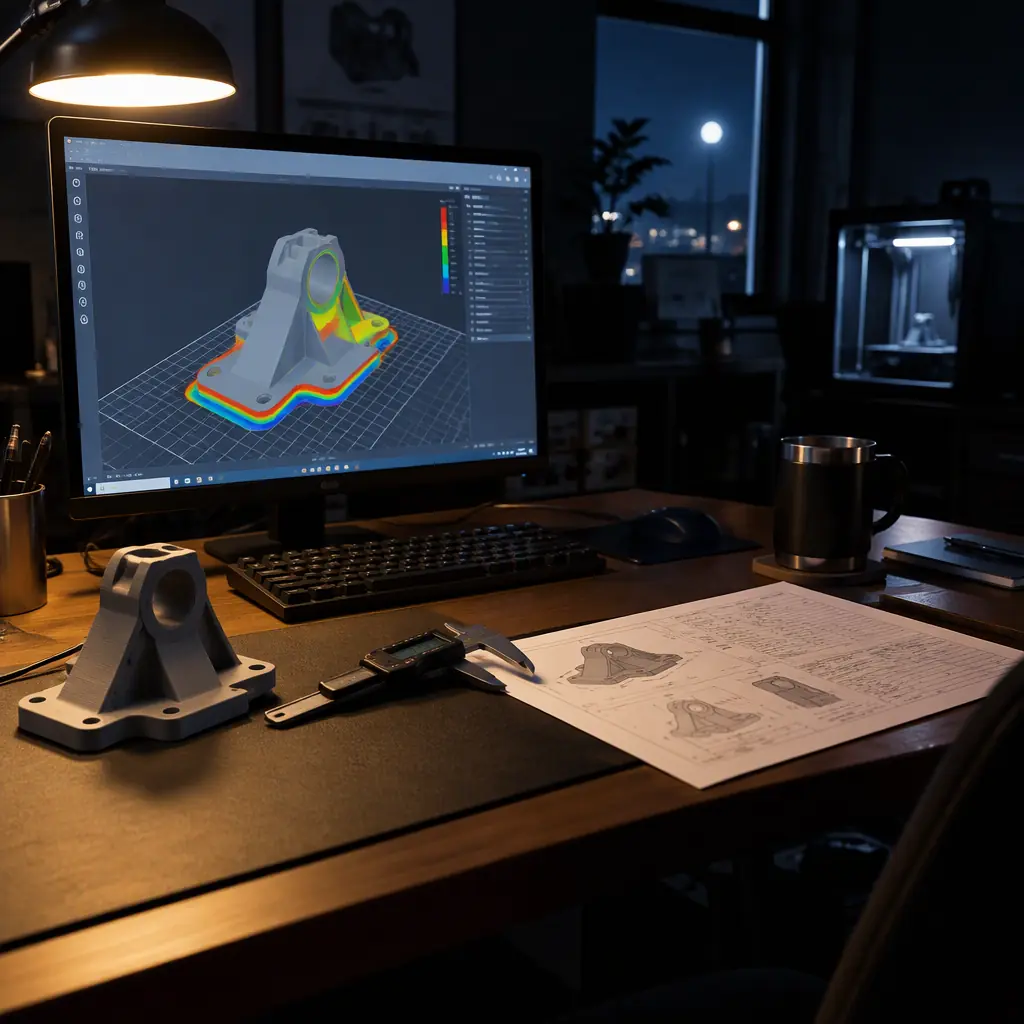
The Quote Is the First Production Step
In a print service, the customer's experience of the supplier is decided before a single layer is extruded. A buyer who sends a STEP file on Monday and receives a priced, dated, risk-annotated quote on Tuesday has learned three things about the supplier: that someone read the file, that the shop knows what it is doing, and that the promised date is probably real. A buyer who waits six days for a number that arrives without assumptions has learned only that the shop is busy, which is not a reason to place a second order.
Quotation throughput is therefore a revenue constraint disguised as an administrative one. For a shop processing fifty to two hundred RFQs a month, the difference between a 1.8 day and a 5 day median turnaround is worth more in won business than a two percent change in machine rate, because the buyers who send the most work are the ones who cannot wait. This guide covers the estimation stack that produces fast, defensible quotes at this scale: the routing decision, the time model, the margin structure, and the failure modes that make a quote wrong even when the arithmetic is right.

The Routing Decision Comes Before the Price
Every quote begins with a routing decision that the estimator often makes unconsciously: which process, which machine, which orientation, and which post-processing path. Making that decision explicit is what makes the rest of the estimate defensible, because a quote is only as good as the process it assumes. A part quoted for FDM that should be SLS is not a pricing error, it is a routing error, and it is the most expensive kind because it survives the customer's acceptance and fails in production.
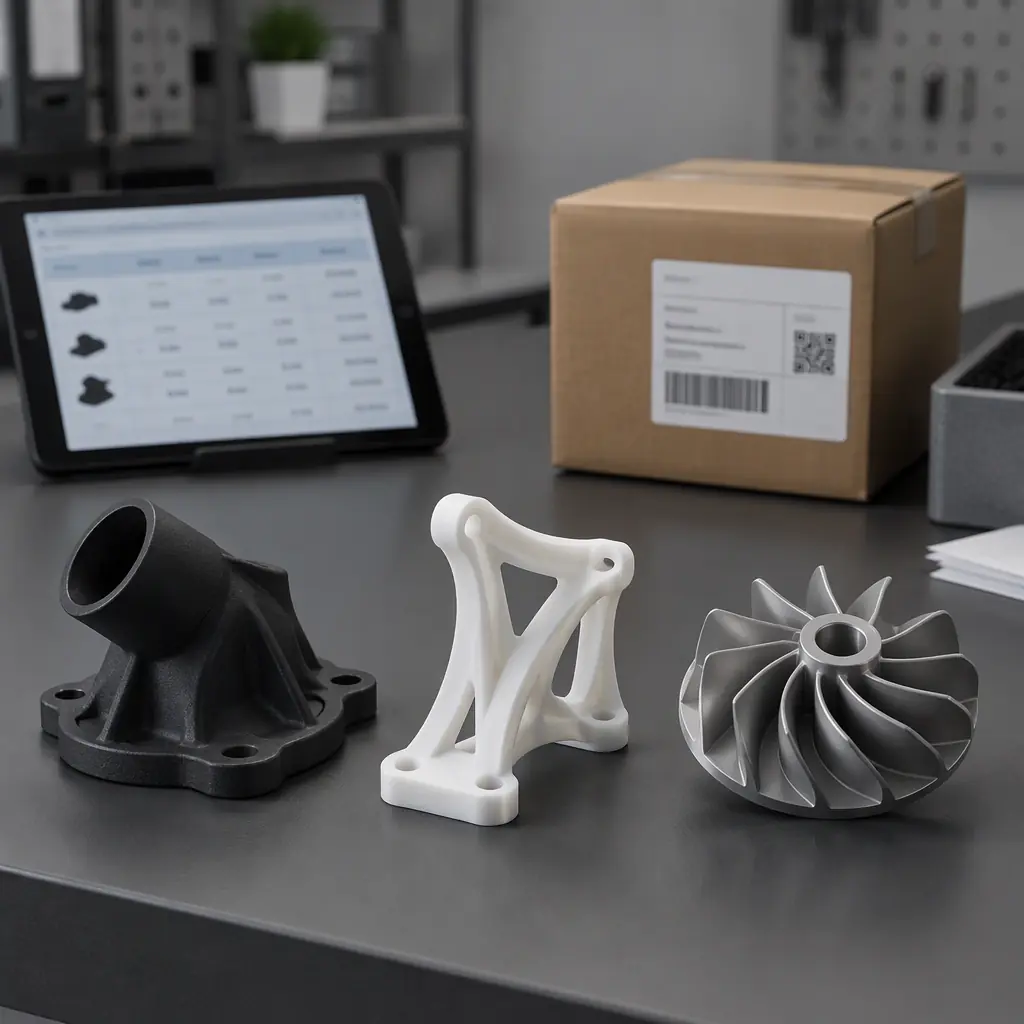
The routing rules that matter are process capability, geometry and quantity. Thin walls under 1.2 mm, internal channels, snap fits that need anisotropic toughness, and surfaces that will be visible to an end user all push away from a basic FDM route. Quantity pushes the other way: below roughly twenty units, tooling-free processes dominate; above a few hundred units a printed mould for injection or urethane casting starts to win on piece price, as set out in our guide to vacuum casting and bridge tooling. The estimator's job is to make that trade visible in the quote rather than silently picking the machine that happens to be free.
Building a Time Model That Survives a Second Look
A print service quote has four cost blocks, and only one of them is usually estimated with any rigour. Machine time is the one everyone measures, because the slicer hands over a number. Material, labour and risk are the ones that decide whether the job makes money, and they are the ones most often entered as a flat percentage.
Machine time from the slicer is a good start but should be adjusted for two things: the difference between slicer time and observed time on that machine class, which is typically five to fifteen percent on a mid-format machine, and the amortised non-print time of the plate, nozzle changes, warm-up and cool-down. Material cost should be computed from the sliced mass, not from the model volume, and should carry a purge and support allowance rather than a round number. Labour is the block that a shop can actually control, and it is the block that determines the minimum viable order size.
The Cost of Quoting Is the Cost of Selling
Quotation labour is a real cost that most shops never measure. At four to eight minutes per simple part and twenty to forty-five minutes for a multi-part assembly, a shop answering a hundred and fifty RFQs a month spends between one and three full working weeks of engineering time on quoting alone, and wins perhaps twenty to thirty-five percent of them. If the estimating function is not measured, it is also not managed, and the predictable outcome is that the most complex, least winnable RFQs consume the most attention because they are the most interesting.
The discipline that fixes this is tiering. Simple parts, meaning a single file, a known material and no assembly, should be quoted from a parametric model with a fixed turnaround and no engineering review. Standard projects with two to ten parts and one material should get a reviewed quote within one working day against a checklist. Complex or novel work should be identified within the first ten minutes and routed to a scheduled engineering slot with a stated response date, so the buyer is never left guessing. The buyer experience is better in all three tiers because the date is promised deliberately rather than missed accidentally.
What you're looking for: A measured number, not an impression, plus a split between the time the shop spent and the time the RFQ sat in a queue waiting for someone to open it.
If it fails: The queue time is almost always the larger component. Fix the intake and the routing rule before hiring an estimator.
Boundary Condition: Speed without assumptions is a faster way to lose money. Every quote must state the orientation, the material grade, the tolerance assumption and what is excluded, or it will be argued about at invoice.
Where Quotes Go Wrong
The majority of unprofitable jobs were mispriced at the quotation stage for one of five reasons, and none of them is arithmetic. The first is an unstated tolerance: the customer's drawing says +/- 0.1 mm on a feature that FDM cannot hold, and the estimator prices the geometry without pricing the rejection risk. The second is orientation and support burden, where the quote assumes a support-free orientation that the part cannot actually be printed in without a warp. The third is post-processing scope, where the buyer expects a painted and assembled part and the quote reflects an as-printed one. The fourth is quantity assumption, where the price breaks are quoted at volumes the customer never reaches. The fifth is lead time, where a queue-loaded shop quotes a date based on machine time alone.
Each of these is closed by a single line in the quote document. State the tolerance the process holds and the inspection level included. State the orientation assumed and that re-orientation is a change order. State the finish level in words a buyer can see, and list what is excluded. State the volume the price breaks apply to and when they expire. State the date the job will actually start, not only the duration. Our guide to tolerances and dimensional accuracy sets out the numbers for the first of these, and the PPAP and FAI guide covers the inspection evidence a buyer may later require.
Systems, Templates and the Automation That Actually Helps
Estimating software earns its cost when it removes the manual transcription between the file, the slicer and the quote, and it fails when it is installed before the routing rules are documented. The realistic automation sequence is: a documented routing rule set, a parametric cost model in a spreadsheet that the estimator trusts, a quote template that carries the assumption block, and only then a system that connects them. Shops that buy the software first tend to produce confident, fast, wrong quotes.
The highest-leverage automation is the cheapest one: a pre-sliced cost per cubic centimetre and per machine-hour, maintained monthly, that lets an estimator price a simple part in two minutes with a part-specific adjustment. That single table converts the quoting function from an artisanal activity into a repeatable one and lets a shop train a second estimator in a week rather than a year. The same logic underpins the job-cost arithmetic in our guide to cost per part and unit economics.
- Rule set first. Write down which geometry goes to which process, and update it quarterly.
- One cost table. Cost per machine-hour and per cubic centimetre, refreshed monthly from actuals.
- Assumption block. Five fixed lines in every quote: tolerance, orientation, finish, volume, start date.
- Tiered turnaround. Parametric for simple parts, reviewed for standard projects, scheduled for novel work.
- Win-loss log. Record the price and the reason for the last fifty decisions; the pattern will be obvious.
- Expiry date. Every quote carries a validity window matched to material and machine rates.
Connecting the Quote to the Line
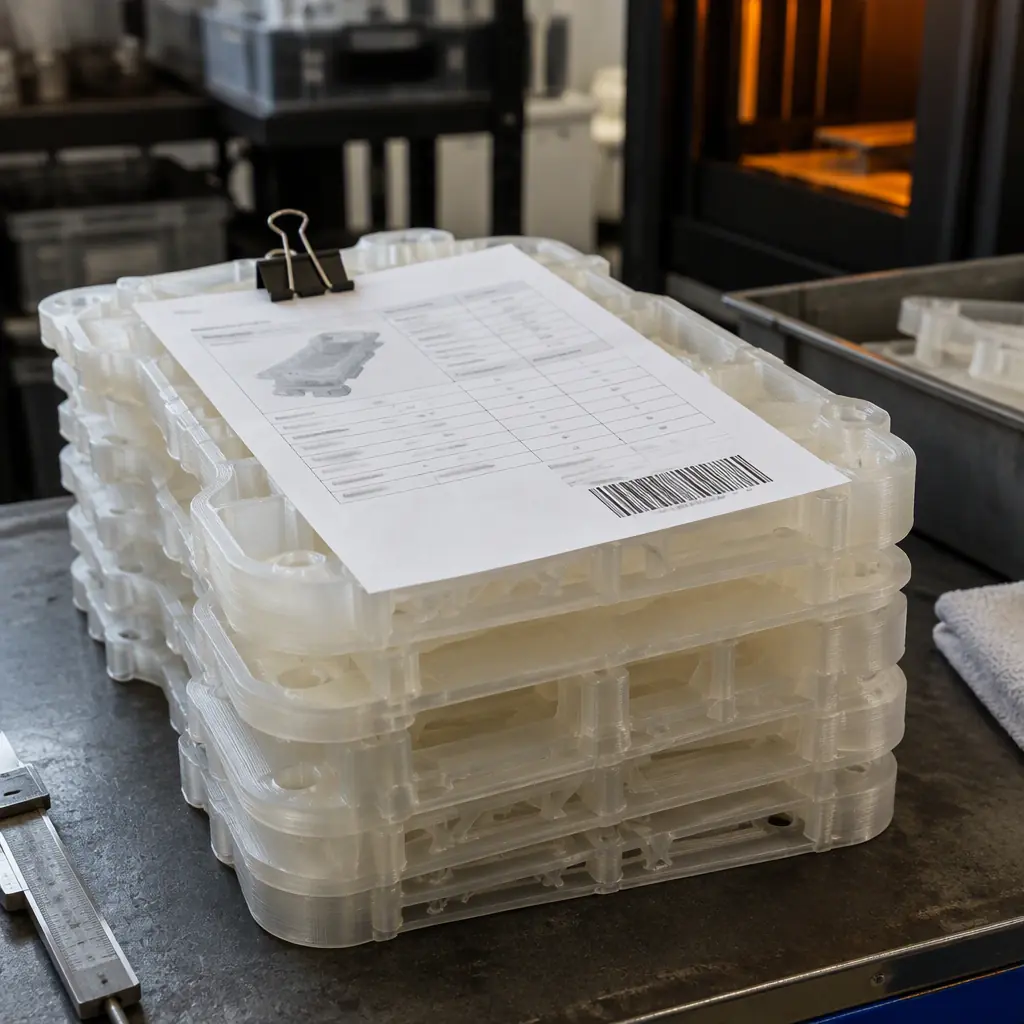
A quote that cannot be produced as priced is a future margin loss. The connection between estimating and production is the job traveller, which should carry the same assumptions the quote carried: material grade, orientation, post-processing scope, inspection level and promised date. When the shop floor receives a traveller that is silent on these points, it makes its own choices, and those choices are the ones that turn a profitable quote into a loss. Our guide to work orders and job travellers describes the fields that close this loop.
The measure of a healthy quoting function is not quote volume, it is the variance between quoted cost and actual cost per job, tracked monthly. A shop holding that variance inside ten percent is pricing from knowledge. A shop that has never measured it is pricing from hope, and the customer who places the largest order is the one who discovers the gap.
Bottom Line
Fast, defensible quotations are a production capability, not paperwork. Decide the routing explicitly, model machine, material, labour and risk with observed rather than assumed factors, tier the estimating effort to the value of the RFQ, and put five assumptions in every quote so the buyer and the shop floor are working from the same document. Then measure the variance between quoted and actual cost, monthly, and measure median turnaround from receipt rather than from when someone finally opened the file. A shop that can quote in a day and produce to the quote wins work from buyers who are tired of the alternative, and it keeps the margin that the alternative quietly gives away. What happens to the margin after the order is placed is in our guide to nonconformance and MRB disposition.
Print Services & Job Shops
Quote Faster Without Giving Away Margin
Precise3D supplies print services and job shops with the equipment, consumables and process data behind a cost model that holds its margin from quote to delivery.