The Cash Sits in the Port, Not in Your Warehouse
A distributor lands its first container of thirty printers and pays duty and import VAT at clearance, because that is what the forwarder's invoice says to do. The cash leaves the account on day 3 after arrival. The machines sit in a rented warehouse for five months before they are sold, and in that time the duty and the VAT have been funded by the distributor's own working capital, at a cost that never appears on any invoice as a line item.
Nothing about this is illegal or even unusual. It is simply the default, and the default leaves money on the table for any distributor whose stock turns slower than its cash cycle can afford. The instruments that fix it are well established, cheap at the low end, and understood by very few distributors of capital equipment.
This guide covers what a bonded warehouse actually suspends, how it differs from a free zone and from a duty deferment account, the arithmetic that tells you when each becomes worth the administration, and the specific reason a deferment account is usually the right first step rather than a bonded facility.

What Does a Bonded Warehouse Suspend?
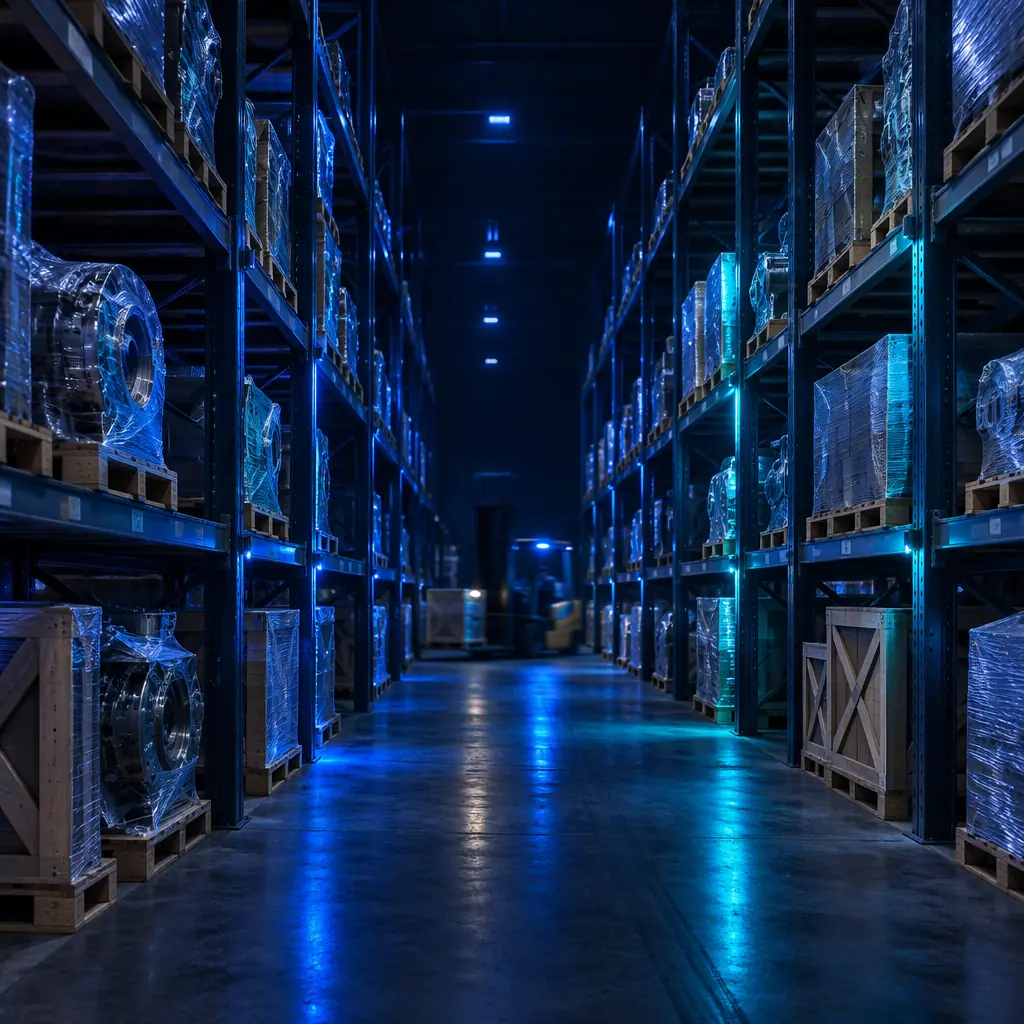
A customs bonded warehouse is a storage facility where imported goods may be held without payment of customs duty and import VAT. The goods are in the customs territory but not in free circulation, so the duties that would normally arise at import are suspended until the goods are released into free circulation or re-exported, and duty is owed only on the quantity actually released.
For a distributor the practical effect is straightforward. Instead of paying duty and VAT on a full container in one cash event at clearance, you pay on each machine as it is sold and released. The cash that would have been tied up in duty and VAT stays in the business, and the exposure to unsold stock is reduced to the storage and handling cost of holding it.
The second effect is less obvious and often more valuable. If the goods are re-exported rather than sold domestically, no duty or import VAT is paid at all, and the drawback route applies to any duty already paid. A distributor using a bonded facility as a regional hub can hold stock against multiple destination markets and only incur duty on the portion that stays, which is a materially different commercial model from a warehouse that requires full clearance at arrival.
Three Instruments That Are Not the Same Thing
Bonded warehousing, free zones and duty deferment accounts are routinely treated as variations of one idea. They are not, and choosing the wrong one is a common and expensive mistake.
| Instrument | What it does | Where the goods are | Typical fit |
|---|---|---|---|
| Customs bonded warehouse | Suspends duty and import VAT until release, duty paid per unit as released | Inside the customs territory, under customs supervision | Slow-moving or multi-market stock |
| Free zone / free port | Goods treated as outside the customs territory until entry for free circulation | Inside a designated zone | Processing, consolidation, transhipment hubs |
| Duty deferment account | Postpones payment of duty and import VAT by a fixed period after release, without changing where the goods are | Anywhere, in free circulation | Fast-moving stock with predictable cash flow |
The distinction that matters most is the last two rows. A bonded warehouse changes when duty is owed, tying payment to the sale. A deferment account changes when payment is made, shifting it by a fixed period but keeping the amount unchanged. A distributor with fast-moving stock gains almost nothing from a bonded facility, because the goods are released within weeks and the duty would have been paid anyway. A distributor with a slow, multi-market inventory gains a great deal, because the deferral period extends until the goods leave.
The Break-Even Arithmetic
Whether a bonded facility pays for itself is a calculation, not a judgement. Work it on per-machine figures.
Take a printer with a customs value of US$1,450, a duty rate of 3.7 percent, and a destination market with a 20 percent import VAT rate. Duty per machine is about US$54. Import VAT is about US$301. The total cash tie-up is roughly US$355 per machine, or about US$10,650 on a thirty-machine container.
The comparison is between the carrying cost of US$355 per machine and the bonded storage cost of roughly US$4 to US$7 per machine per month. At a working-capital cost of 9 percent a year, carrying US$355 for one month costs about US$2.66. Carrying it for twelve months costs about US$32. Bonded storage for twelve months costs US$48 to US$84.
That arithmetic says something most distributors find counter-intuitive: at a 9 percent cost of capital, a bonded facility does not pay for itself through interest saving alone until stock age exceeds roughly 18 to 30 months. The instrument is not a pure financing play. Where it earns its cost is elsewhere, in the re-export case where the duty is never paid at all, and in the working-capital relief of not funding duty on stock that will not sell for several months. A distributor whose stock sits for four months should not expect a bonded warehouse to show a clean return on the interest calculation alone, and should size the decision on the re-export volume and the cash-flow relief instead.
What you're looking for: A number for each. If the slow-moving share is below about 20 percent and re-export is negligible, a bonded facility is unlikely to earn its administration. If a meaningful share of stock is held against multiple destination markets or may be redirected, the facility is worth costing properly, because the re-export case is where the instrument produces its strongest return.
Why a Deferment Account Comes First
For a distributor with ordinary stock turn, the cheaper and faster improvement is a duty deferment account, which postpones the payment of duty and import VAT by a fixed period after release without changing where the goods are held. The account is typically secured by a bank guarantee or a cash deposit with the customs authority, calculated against expected monthly duty liability.
The advantage is administrative rather than structural. There is no new facility, no change to warehouse operations, and no per-unit release process. The distributor continues to clear goods at arrival as it does today, and gets a predictable period of additional cash headroom on every import. For a business importing steadily, the effect on working capital is immediate and the set-up cost is low.
The limitation is equally clear. Deferral shifts the payment date, not the obligation, so it does nothing for stock that never sells or that is re-exported. It is a liquidity instrument, not a duty-avoidance instrument, and distributors who expect it to reduce the duty bill are misunderstanding the mechanism.
The Operational Requirements Nobody Mentions
Bonded storage introduces obligations that are easy to underestimate when the decision is made on cost grounds.
- Record-keeping per unit, not per consignment. The facility must be able to account for every machine held, released, or re-exported, and reconcile that against the customs declaration. A distributor with loose inventory records will fail the first reconciliation audit.
- Physical segregation. Bonded stock must be identifiable as bonded, which in practice means a segregated area within the warehouse rather than mixed shelving. For a distributor renting third-party space, this may require a dedicated facility rather than a shared one.
- Release documentation per sale. Each release into free circulation requires its own declaration. The administrative load scales with units sold, not with containers imported, which is the opposite of how most distributors' back offices are organised.
- A guarantee or bond. The facility itself is bonded, and the operator will require security, which is a cost that must be included in the storage rate being compared.
- Time limits. Bonded storage is not indefinite. Most regimes impose a maximum period, commonly two to five years depending on the jurisdiction, after which the goods must be released or re-exported.
For a distributor moving a few containers a year, the record-keeping requirement alone frequently outweighs the financial benefit. This is the honest reason most small distributors end up with a deferment account rather than a bonded facility, and it is a defensible conclusion rather than a failure to optimise.
Where the Structure Fits in the Wider Import Decision
Bonded storage is one decision inside a chain that starts with the customs classification and ends with the customer's payment terms. It rarely makes sense to optimise it in isolation.
The classification determines the duty rate, and a rate that is being applied at the wrong tariff heading will cost more than any storage structure will save. Distributors should confirm the classification against the actual machine specification before designing a facility around the duty figures, because a reclassification changes every number in the break-even arithmetic. The same applies to origin: goods that qualify under a preferential arrangement may attract a lower or zero rate, in which case duty deferral has nothing to defer.
Downstream of the facility, the cash released by deferral or suspension only helps if the working capital it frees is actually put to work rather than absorbed by slower collection from dealers. A distributor whose receivables cycle is 90 days and whose deferral gain is 30 days has improved a number without improving the business, unless the freed cash funds something specific.
The Decision in Sequence
For a distributor evaluating whether to restructure how duty is paid, the order that produces a defensible answer is:
- Confirm classification and duty rate first. Every downstream number depends on it, and a wrong rate makes the entire comparison meaningless.
- Measure the slow-moving share and the re-export share of inventory. These two numbers decide whether a bonded facility can ever earn its cost.
- Cost a deferment account as the baseline improvement. It is cheaper, faster and administratively lighter, and for most distributors it captures the bulk of the available benefit.
- Only then evaluate a bonded facility, and evaluate it on the re-export case and the cash-flow relief rather than on interest saved alone.
- Confirm the record-keeping capability exists before committing. Per-unit reconciliation is the requirement that most often turns out to be the real barrier.
The pattern across all of them is the same: the instrument that sounds most sophisticated is rarely the one that fits. A deferment account, applied consistently, will outperform a bonded facility that the business is not operationally ready to run, and it costs a fraction of the effort to put in place.
Reviewed by the Precise3D commercial team. Duty rates, VAT rates and deferral periods vary by jurisdiction and change; the figures used here are illustrative and should be replaced with the rates applicable to your own classification and destination market. Confirm bonded facility requirements, guarantee terms and storage time limits with your customs broker or the relevant customs authority. This is not tax or legal advice.
Duty deferral shifts the payment date; bonded storage ties payment to the sale. The two solve different problems and are frequently confused.
Import Structure Support
Need Landed-Cost and Release Documentation You Can Model?
Per-unit landed-cost schedules with duty and VAT broken out, HS classification confirmation against the actual machine specification, and the release documentation format your bonded facility or broker will ask for.