Every 3D printer distributor knows the frustration: a customer returns filament, complaining about brittle PLA or stringy PETG, convinced the material is defective. In over 70% of cases, the problem isn't the filament — it's moisture absorption during storage at the customer's site. For distributors, this isn't just a support headache; it's a missed revenue stream. Every spool you sell is an opportunity to sell the storage products that keep it printing perfectly.
At Precise3D, we ship filament from Shenzhen in vacuum-sealed packaging with desiccant. But once that seal is broken, the clock starts ticking. This guide explains the material science of hygroscopic filaments, the economics of proper storage, and how to build a bundled consumables strategy that generates $8–15 in additional revenue per printer sold — every month, indefinitely.
The Science: Why Filament Absorbs Moisture
Most FDM filaments are hygroscopic — they pull water molecules directly from the air. The polymer chains in PLA, PETG, ABS, Nylon, and TPU each have different affinities for moisture, but the mechanism is the same: water molecules bond to the polymer structure, weakening intermolecular forces.
The absorption rates vary dramatically by material:
Nylon is the worst offender — left out overnight in a humid environment, it can absorb enough moisture to become unprintable. PLA is the most forgiving, which is why many newcomers never learn about moisture management until they graduate to engineering materials. This knowledge gap is your sales opportunity: every customer who upgrades from PLA to PETG or Nylon is a customer who needs a dryer.
For a deeper dive into how different materials behave, see our engineering filaments guide for distributors, which covers PA-CF, PC, and other high-performance materials that are especially moisture-sensitive.
How Moisture Destroys Print Quality — The 5 Failure Modes
Moisture doesn't just cause one problem; it creates a cascade of failures that customers often misdiagnose. Training your sales team to recognize these symptoms turns support calls into upsell opportunities:
The critical insight for distributors: when a customer complains about "bad filament," they've already attributed the problem to your product. By proactively including a moisture management starter kit with every printer sale, you prevent these complaints entirely — while earning margin on the accessories.
Regular printer maintenance routines should include filament storage checks. Just as you'd train customers to clean their build plate, train them to store their spools properly.
Storage Solutions: From Budget to Professional
Not all storage solutions are equal, and your customers span a wide range of price sensitivity. A hobbyist printing PLA in a dry climate needs far less than a print farm running Nylon in coastal humidity. Here's how to structure your storage product tiers:
The margin structure here is compelling. A $50 heated dry box at 40% gross margin generates $20 per unit. If just 1 in 4 of your printer customers buys one, that's $5 in incremental margin per printer — without any increase in customer acquisition cost.
Compare this with standard printer margins: accessories consistently outperform printers on margin percentage, especially at the Tier 2–3 level where perceived value is high but COGS is low.
Active Drying: When to Deploy Heat
Storage prevents moisture absorption; active drying reverses it. For distributors, understanding the drying parameters for each material is essential for recommending the right equipment:
Critical sales insight:
The drying temperature window is narrow. PLA deforms at 55°C but needs 45°C minimum to dry effectively — a 10°C working window. Cheap dryers with poor temperature control overshoot and ruin spools. This is your value proposition for carrying a quality dryer: precision temperature control isn't a luxury; it's a requirement for multi-material users.
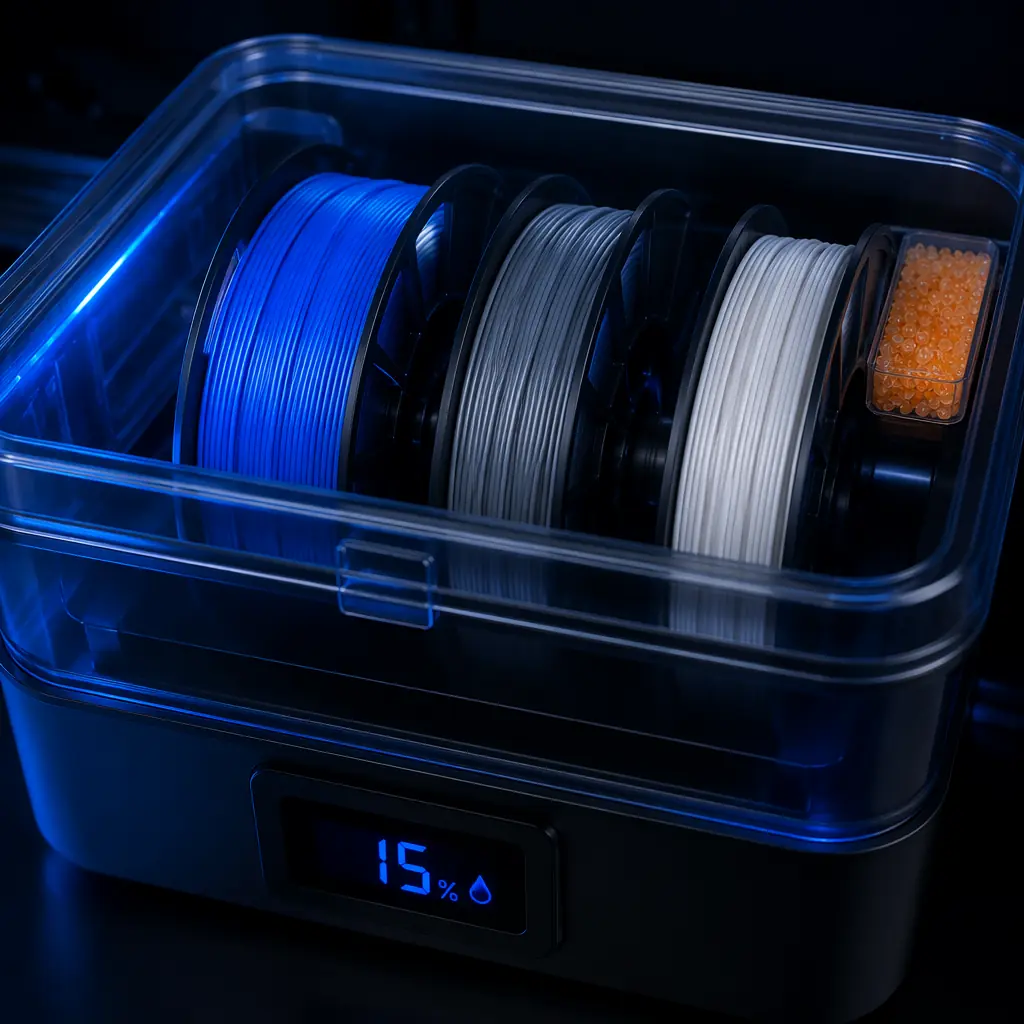
A heated dry box with a PTFE tube feeding directly into the extruder solves both drying and printing: the filament stays at <15% relative humidity throughout the print. This is the configuration you should recommend for customers printing Nylon, PC, or TPU — and it's the configuration that commands the highest accessory margin.
The Distributor's Bundling Formula: Recurring Revenue from Consumables
The most profitable 3D printing distributors don't just sell printers — they sell the ecosystem of consumables that keep printers running. Filament storage products represent one of the highest-margin, highest-repeat-purchase categories in that ecosystem. Here's the math:
The bundled approach:
Include a $15 vacuum storage kit and a $12 humidity monitor with every printer sale — cost to you is roughly $10.80. Increase your printer bundle price by $25, and you've added $14.20 in pure margin while giving the customer tools that prevent returns and support calls.
For a distributor moving 200 printers per month, that's an additional $2,840/month in accessory margin — over $34,000 annually — from two products that cost nothing in additional shipping volume and require zero technical support.
This strategy works because it aligns incentives: the customer gets better print quality, and you get higher margin and fewer returns. The print surfaces consumables guide applies the same logic to build plates, and the filament stocking guide covers spool inventory management — together, these three categories form a complete consumables ecosystem.
How to Test If Filament Is Wet — A 60-Second Field Test
Your customers need a quick way to diagnose moisture issues before they waste print time. Train your support team to walk customers through these three checks:
1. The bend test (PLA only): Bend the filament 90 degrees. Dry PLA snaps cleanly at a sharp angle. Wet PLA bends farther before breaking, and the break surface looks fibrous rather than glassy. This test takes 5 seconds and requires no equipment.
2. The extrusion test (all materials): Extrude 50mm of filament at normal printing temperature. If you hear popping, see steam, or notice the extruded filament has a rough, bubbly surface, the filament is wet. Dry filament extrudes smoothly with a glossy surface.
3. The weight test (precision): Weigh an opened spool, dry it fully, and weigh again. A weight loss of more than 1% confirms moisture absorption. A 1kg spool losing 10g+ of water weight needs drying. This method is especially useful for print farms managing bulk inventory.
Regional Considerations: Climate Dictates Strategy
Your storage recommendations should vary by your customer's geography. A distributor in Singapore needs a completely different moisture management strategy than one in Colorado:
For distributors operating in tropical climates, every printer sale should include a heated dry box. The humidity is high enough that passive desiccant alone won't keep Nylon and PETG printable. Position the dry box not as an accessory but as required equipment — just like a power supply.
Conclusion: Moisture Management Is a Revenue Engine
Filament drying and storage is one of the few categories in 3D printing where the customer's problem is your profit opportunity — and solving it genuinely improves their experience. Unlike aggressive upselling tactics that damage trust, bundling storage products with printers and filament prevents the #1 cause of customer complaints while generating high-margin recurring revenue.
The strategy is simple: every printer ships with a moisture management kit; every filament reorder prompts a desiccant refill. Execute this consistently, and you'll add $8–15 in monthly recurring consumables revenue per active customer — revenue that competitors who only sell printers are leaving on the table.
Precise3D supports our distribution partners with OEM filament programs, co-branded storage accessories, and technical documentation that makes moisture management easy to sell. With Shenzhen-based manufacturing, 200+ R&D engineers, and logistics reaching 50+ countries, we provide the supply chain reliability you need to build a consumables business at scale.
Ready to add filament storage products to your distribution lineup? Contact our B2B team for bulk pricing on dry boxes, vacuum kits, and co-branded desiccant programs.
Reviewed by the Precise3D engineering & OEM team. Compliance files that accompany the catalog are auditable at the certification register.
Start Your Partnership
Ready to Bring filament drying storage to Your Market?
Start with the filament drying storage spec sheet, then validate every claim against the certification register.