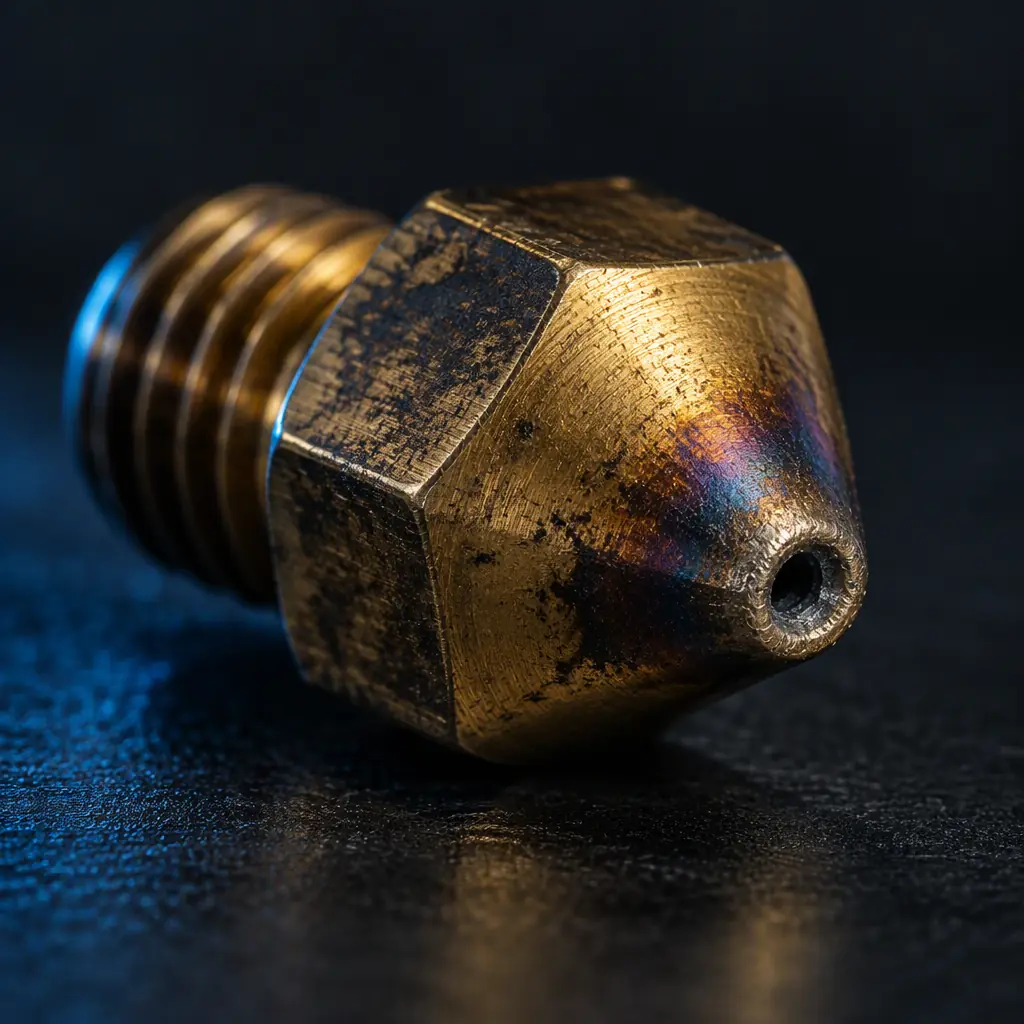
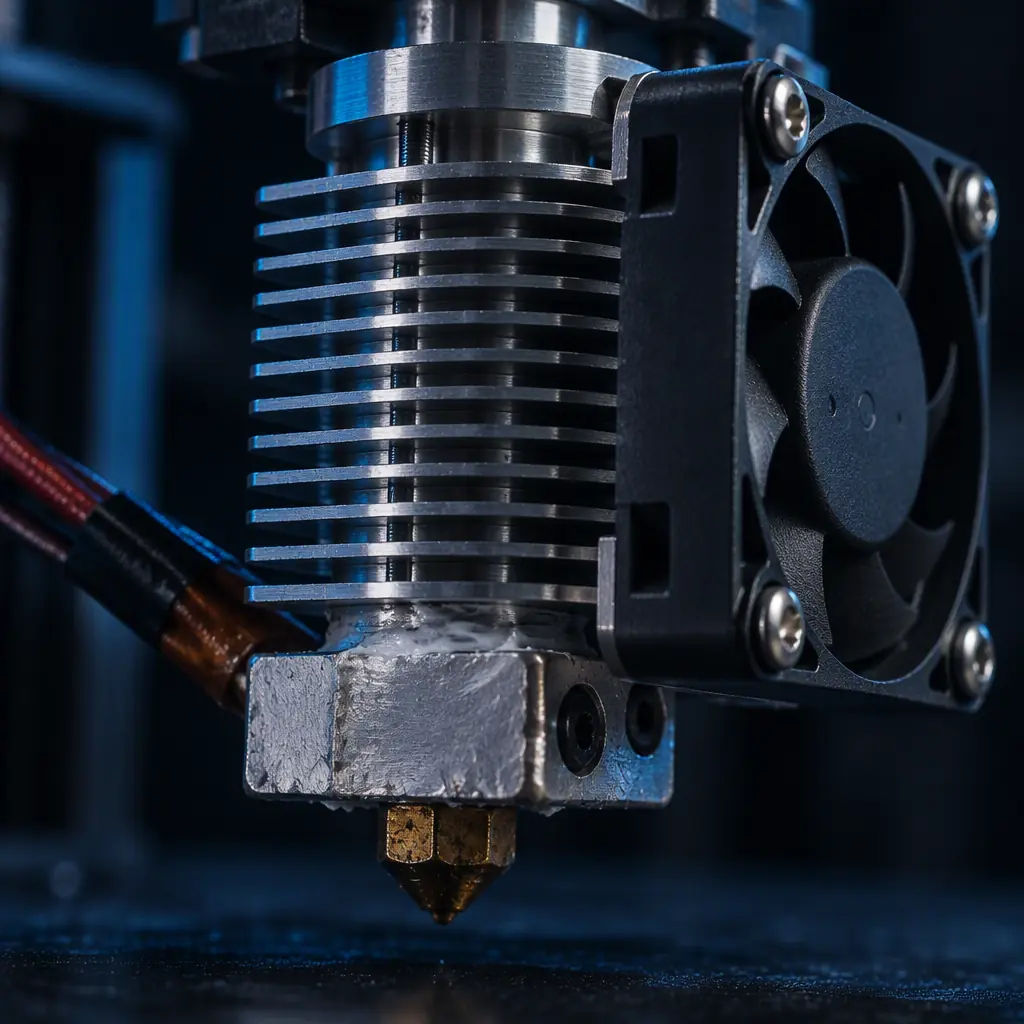
A distributor who cannot tell a worn nozzle from a heat creep clog from a failed heater cartridge ends up shipping three wrong parts before the customer fixes the printer. Each wrong shipment costs a return, a support call, and a slice of credibility. The printers themselves do not fail randomly: they fail in a predictable sequence, and each stage in that sequence has a different part number attached to it. This guide walks the escalation ladder the way a service bench actually sees it, so your support team can name the failing part on the first call. For the full spare parts catalogue logic behind it, see the aftermarket parts guide and the critical spares kit design.
Stage 1: Nozzle Wear, the Slow Failure Nobody Reports
Nozzle wear does not stop a print. It degrades it. A hardened steel nozzle running abrasive carbon-fibre-filled filament loses roughly 0.02-0.05 mm of bore diameter per 1 kg of abrasive material; a brass nozzle on the same material loses 0.1 mm or more. Extrusion width quietly grows, dimensional accuracy drifts outside tolerance, and the customer blames the slicer profile. By the time they call you, they are often on their third failed calibration attempt.
The diagnostic that settles it in under a minute is an extrusion-width check on a known profile. Have the customer print a 40 mm single-wall cube at their normal settings and measure the wall with calipers. A 0.40 mm nozzle that prints a 0.46-0.50 mm wall has worn well past the point of a simple flow correction. The wholesale cost difference between the brass nozzle you shipped and the hardened steel or ruby-tipped replacement they now need is $1.20 versus $9-22, and the margin on the upgrade is one of the highest in the consumable category. For the full material hierarchy that drives this decision, see the nozzle materials and sizes guide.
Stage 2: Heat Creep and the Clog That Comes Back
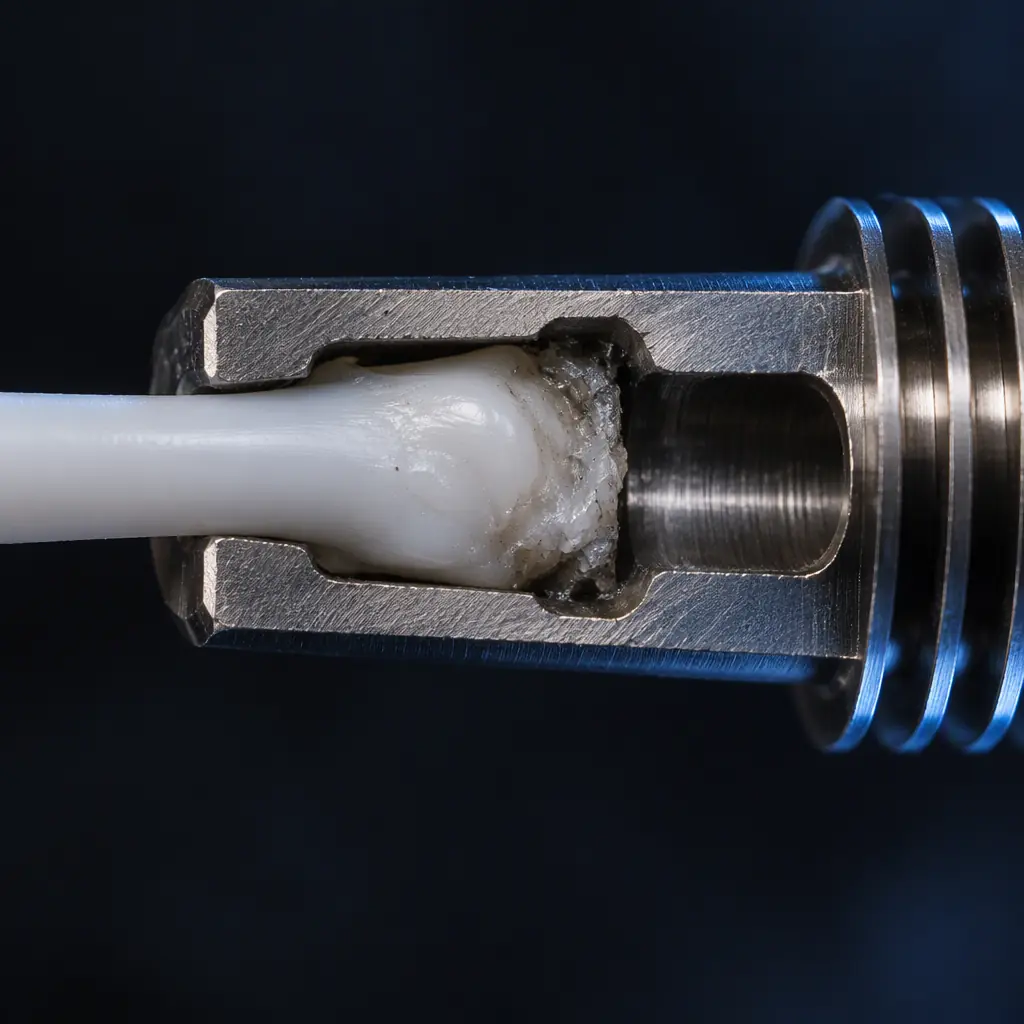
Heat creep is the most frequently misdiagnosed hotend failure. The customer reports a clog, you ship a new nozzle, they install it, and the same clog returns within 30-60 minutes of printing. That repeat pattern is the signature: a genuine debris clog does not recur at the same print duration every time.
What is happening is that heat travels up the heat break faster than the heatsink and fan can remove it. Filament softens 10-15 mm above the melt zone, swells, and jams. The causes divide cleanly into three, and each points at a different part:
- Degraded heatsink fan (the most common). Fan speed drops as bearings wear. Sleeve-bearing fans commonly lose 30-40 percent of airflow after 2,000-4,000 hours. Part number: the fan, not the hotend.
- Heat break with a thin or damaged thermal barrier. All-metal heat breaks rely on a thin stainless section to choke heat transfer. A scratched or corroded barrier passes more heat. Part number: heat break or complete hotend.
- Enclosure temperature above the printer's rating. A printer rated for 40 degC chamber temperature run at 55 degC will heat creep on every long print regardless of parts. No part fixes this.
Stage 3: Heater Cartridge and Thermistor Drift
Once the melt zone is correct, the next failure class is the heating loop. Heater cartridges degrade in a characteristic way: the ceramic insulation cracks, the internal resistance element partially fractures, and the cartridge draws current intermittently. The printer compensates by holding the heater on longer, which ages it faster. From the customer's seat this looks like prints taking longer, surface finish getting worse, then a thermal runaway error.
The thermistor side is covered in depth in our temperature sensor guide, but the escalation rule is simple: the heater cartridge and the thermistor are both wear items on the same schedule, and shipping one without the other produces a callback within weeks. Bundle them. A two-part sub-kit priced at $18-26 wholesale sells more readily than either part alone and halves your return rate on this failure class.
Stage 4: When the Whole Hotend Should Be Replaced
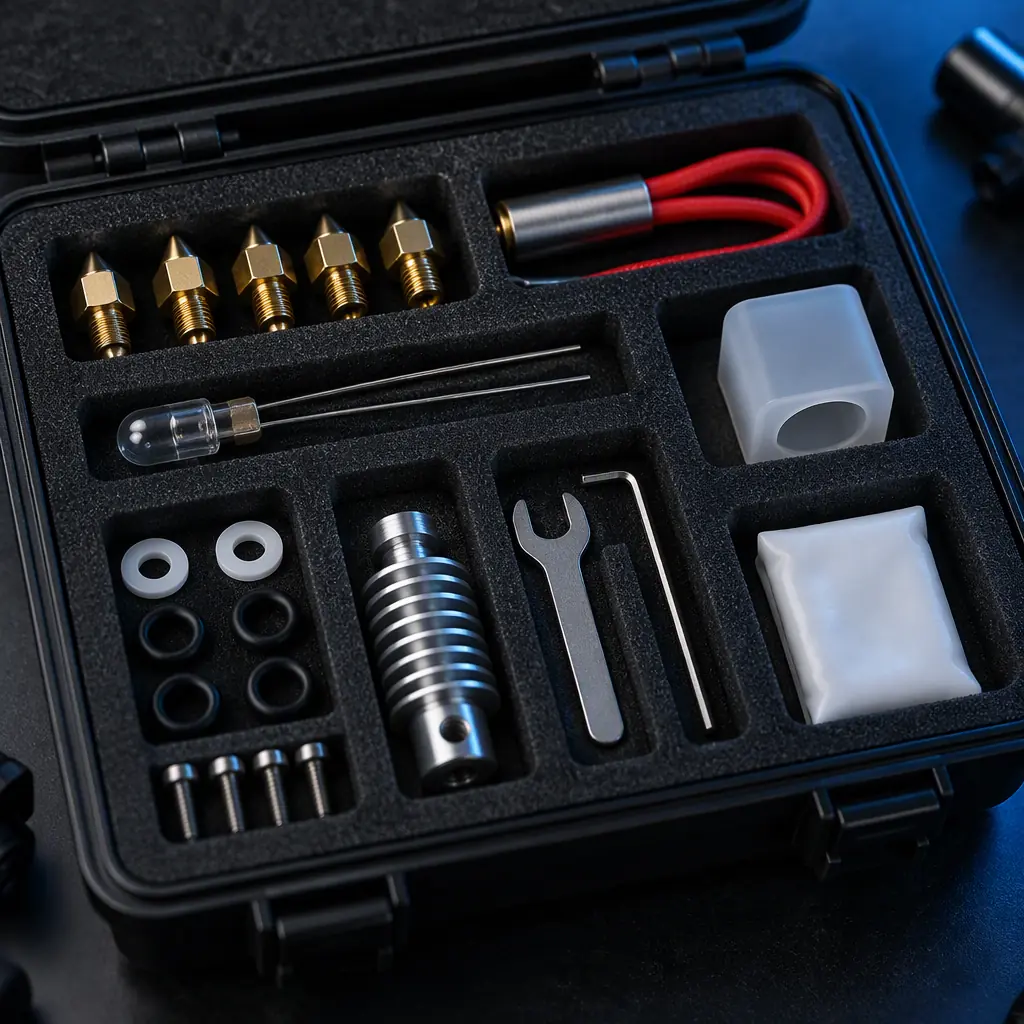
There is a point where quoting individual parts costs the customer more in labour than a complete assembly. The decision rule that holds up across prosumer and light-industrial printers is the 60 percent threshold: if the sum of the individual parts needed exceeds roughly 60 percent of the wholesale price of a complete hotend assembly, quote the assembly.
Two more conditions push the answer to a full replacement regardless of arithmetic. First, a hotend that has suffered a serious blob failure (a molten mass encasing the heater block) has usually damaged the heat break threads and the heater cartridge wiring insulation, and partial replacement leaves latent faults. Second, any printer running in a production or farm setting should never be repaired at component level on the machine: swap the whole assembly, then refurbish the removed unit on the bench and return it to spares stock.
For distributors this is a margin argument as much as a service argument. A complete hotend assembly typically carries 38-45 percent gross margin against 25-32 percent on individual nozzles, and it removes the callback risk entirely. Pair the sale with a maintenance schedule so the customer knows the next replacement window rather than discovering it in the middle of a job.
The Escalation Ladder as a Support Script
Turned into a first-call script, the four stages become a decision tree your support team can run without an engineer in the room. This is the version that has held up on distributor service benches because every branch ends in a part number rather than in a question.
- Print completes but dimensions drift → nozzle wear. Quote a hardened nozzle and a flow recalibration.
- Clog returns at the same print duration → heat creep. Quote heatsink fan and heat break.
- Clog returns irregularly → debris. Quote nozzle and a cold pull procedure.
- Thermal runaway, temperature reads wrong at ambient → thermistor. Quote sensor sub-kit.
- Heating is slow, finish degrades, then runaway → heater cartridge. Quote cartridge with thermistor.
- Blob failure or two or more stages failed → full hotend assembly.
The commercial value of the script is not the parts revenue on any single call. It is that a distributor who names the right part from a phone description gets the reputation that survives a price comparison, and that reputation is what protects your margin when a marketplace seller undercuts you by four dollars on a nozzle. Stock the sub-kits, train the script, and log which stage each customer reached. That log becomes your forecast for next quarter's spare parts order. For how those spares fit into a complete distributor service offer, see after-sales support strategy.
Bottom Line
Hotend failures escalate in a fixed order: nozzle wear, then heat creep, then the heating loop, then full assembly replacement. Each stage has a distinct signature and a distinct part number, and the signature is usually available from the customer on the first call. Distributors who diagnose by stage convert a frustrating support call into a same-day part sale at 38-45 percent margin on assemblies and higher on sub-kits.
Reviewed by the Precise3D engineering & OEM team. Compliance files that accompany the catalog are auditable at the certification register.

Start Your Partnership
Ready to stock a hotend spares ladder for Your Market?
Distributors who supply staged hotend sub-kits resolve support calls in one shipment. Request the OEM & white-label program sheet and volume pricing on nozzle, heat break, cartridge and thermistor sub-kits.