
The Two Prices: Convenience Cost vs Raw Material Cost
The fastest way to understand pellet extrusion is to separate the two prices of the same polymer. A spool of generic PLA sells at retail-ish ranks of roughly $20–$28 per kilogram, and engineering grades push well above that. The pellet form of that same polymer, bought in bag or octabin volume, trades at single-digit commodity pricing. That spread is not free value being unearthed — it is the margin you pay for someone to compound, extrude, spool, label and ship a finished good to your door.
For a print farm burning through material weekly, that spread is the single largest lever on cost of goods. Filament is priced per spool and sold on convenience; pellet is priced per tonne and sold on chemistry. A distributor who understands both can sell the product that fits the customer’s volume. For the broader economics of running a scaled machine park, our print-farm economics guide and our print-farm operations at scale guide are the core reads.
What Direct Pellet Extrusion Actually Changes
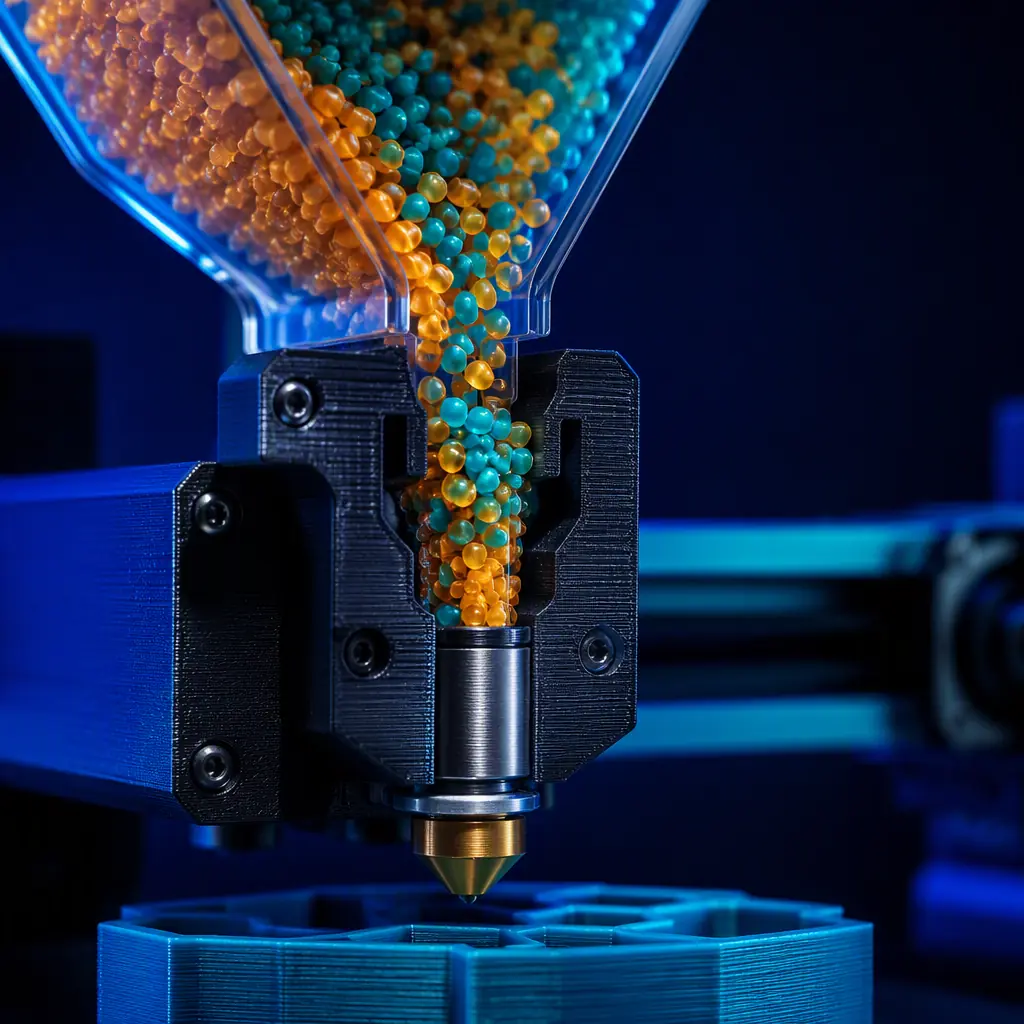
Direct pellet extrusion replaces the filament spool and extruder input with a hopper of pellets and a feed-screw mechanism that meters and melts granules into the nozzle. You skip the intermediate step where pellets are melted, drawn into a thin strand, coole down, spooled and then re-melted again by the printer. Doing away with that step is where both the cost saving and the flexibility come from.
For a distributor the important consequence is that the material cost becomes close to raw commodity. That matters when you quote long-run jobs, when you want to blend your own compounds, or when you want to feed recycled or regrind feed. Bulk sourcing also cuts the shipping and handling cost per kilogram, because you move dense granules rather than bulky spools. Our TCO & ROI guide is the reference for working the full cost-per-part number, and our pricing & margin guide shows how the saved input cost flows into your quote.
The Custom-Compound and Regrind Upside
The second big advantage is no longer paying for a fixed catalogue. With a pellet feed you can blend a specific ratio for a job — a filled resin, a colour match, a recycled content fraction — instead of hunting for a filament that approximates it. This is often where the value story actually exceeds the raw price saving, because a custom compound can be the difference between a part that works and a part that is only close.
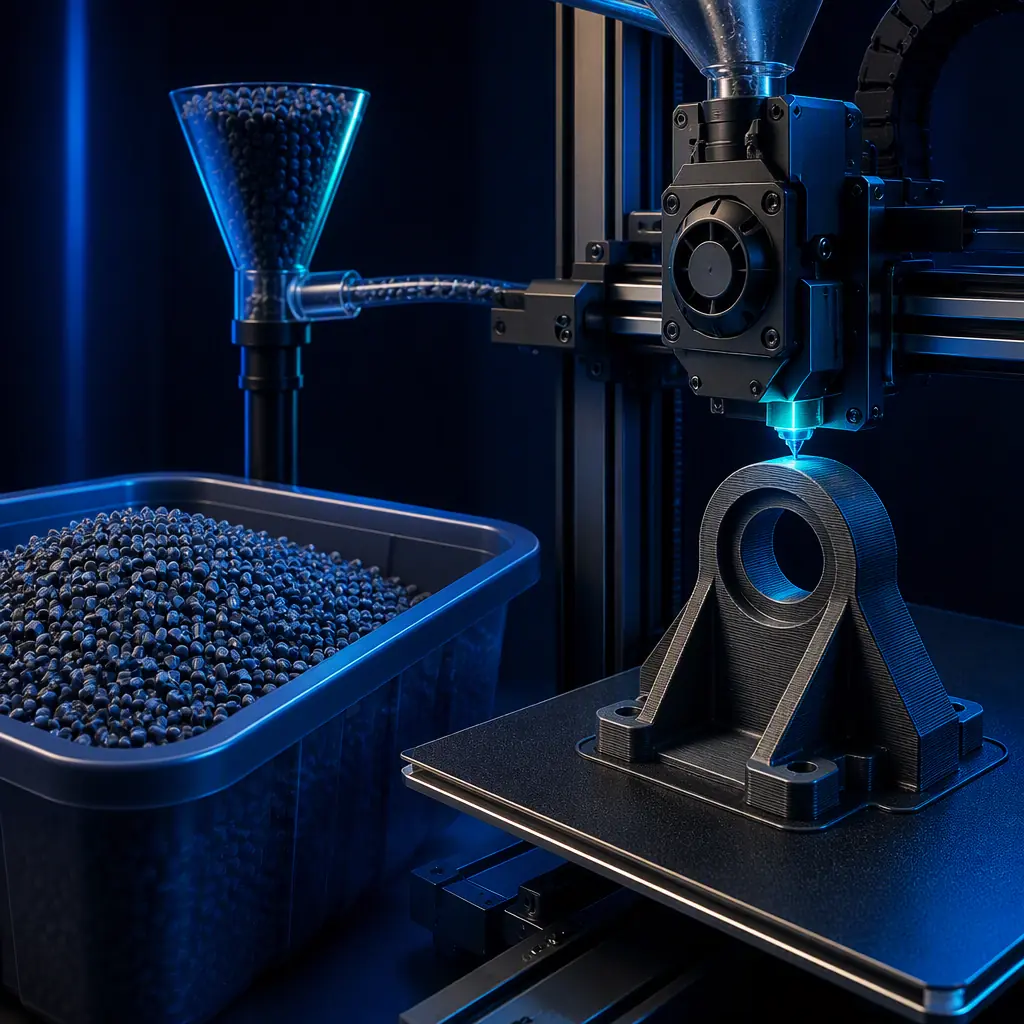
Recycled and regrind feed is the sustainability angle that resonates with buyers. Industrial scrap, purge waste and even failed printed parts can be granulated back into the hopper. A print farm that recycles its own waste and buys pellet rather than virgin spool dramatically lowers both its waste stream and its material bill — a story that lands well with environmentally-conscious buyers. For that recycling positioning, our sustainable & recycled filament guide and our filament waste reduction guide are the natural reads.
What you're looking for: A print farm or service bureau running hundreds of kilograms a week → pellet extrusion is a real cost lever and a custom-compound story; a low-volume or single-printer hobbyist or prototyping buyer → stick with filament, the equipment complexity and drying burden are not worth it at their scale.

The Trade-Offs Nobody Mentions in the Marketing
It would be dishonest to present pellet extrusion as a free win. There are real costs that only emerge at scale, and a distributor who sells a pellet system without flagging them is inviting a support headache.
- Consistency control. Filament is produced to a tight diameter tolerance by a specialist. Pellet feed relies on your screw metering and melt consistency, so dimensional consistency is more operator-dependent.
- Drying burden. Many engineering polymers are hygroscopic. Pellet in bulk form absorbs moisture and needs real drying before it prints well — and a bulk bag is much harder to keep dry than a sealed spool.
- Equipment & maintenance. A pellet feed screw, a drier and a more robust melt system add capital and upkeep, and they fail differently than an extruder.
- Small-batch handling. A granular bag is awkward for occasional jobs; filament wins at low volume.
For the material-consistency question that sits behind these trade-offs, our filament quality evaluation guide and our engineering filaments guide cover the specifications a buyer should hold a feed supply to, whichever form it takes.
How Pellet Feed Changes Your Quote and Gross Margin
This is where the economics becomes a sales weapon. If a distributor buys a spool of generic filament at roughly $25 per kilogram and resells it at $55, the gross margin is $30. If the same distributor buys pellet at about $5 per kilogram and runs it through a pellet feed, the per-kilogram input cost collapses — and even after accounting for the equipment and the operator time, the margin per kilogram is dramatically higher. The honest caveat is that the equipment is not free and the savings only fully materialise at volume, so the pellet story is a tool for winning the high-volume account rather than a blanket discount.
The strategic use of this is to segment your funnel. Lead into print-farm and service-bureau accounts with the pellet cost story to win a relationship, then anchor the precision and low-volume work in filament where the equipment burden is lower and the pricing can stay premium. For the inventory and consumables mechanics that make a hybrid material line profitable, our consumables subscription guide and our PLA/PETG/ABS/TPU stocking guide are the two references that frame the recurring-material revenue.
Where Each Feed Wins: A Distributor's Decision Framework
The right answer to “pellet or filament?” is almost never a universal claim. It is a function of volume, material mix and who the customer is.
For the distributor, the sweet spot is usually a hybrid line: carry a premium filament range for accuracy-sensitive and low-volume buyers, and introduce pellet extrusion for the print-farm accounts where volume justifies the equipment. For the operating mechanics of scaling a machine park, our print-farm automation guide and our dealership scaling roadmap are the two references that frame the growth path.
Reviewed by the Precise3D engineering & OEM team. Material and cost data reflect typical open-market ranges for classification and planning purposes; the certification register holds the auditable quality backing.
Win the Volume Account
Ready to Supply a Print Farm With the Right Feed?
Join our network of global distributors. High-accuracy printers that run filament or pellet feed, plus an engineering workcell that supports the custom-compound and accuracy story — everything you need to win the high-volume and the precision account.