The 3D printer market in 2026 is split into two worlds. On one side: closed-ecosystem machines — Bambu Lab, Prusa, UltiMaker — that deliver a polished out-of-box experience. On the other: open-source kits — Voron, RatRig, Annex Engineering — that offer unprecedented performance-per-dollar for enthusiasts and professionals willing to build their own machine. RatRig's V-Core 4 sits at the intersection of these worlds: an open-source design with industrial-grade components, community-driven development, and a price point that leaves 35–50% margin for distributors who can manage the support economics.
But open-source isn't for every distributor. This guide gives you the complete picture: RatRig's product line, the real support burden, margin structures, and a framework for deciding whether open-source kits belong in your portfolio or whether you should stay with proprietary brands.
The RatRig Product Line — What Distributors Need to Know
RatRig (ratrig.com) is a Portuguese company that designs and sells open-source 3D printer kits. Unlike Voron — which is purely community-driven with no central vendor — RatRig manufactures and ships kits directly, making them a genuine OEM partner for distributors.
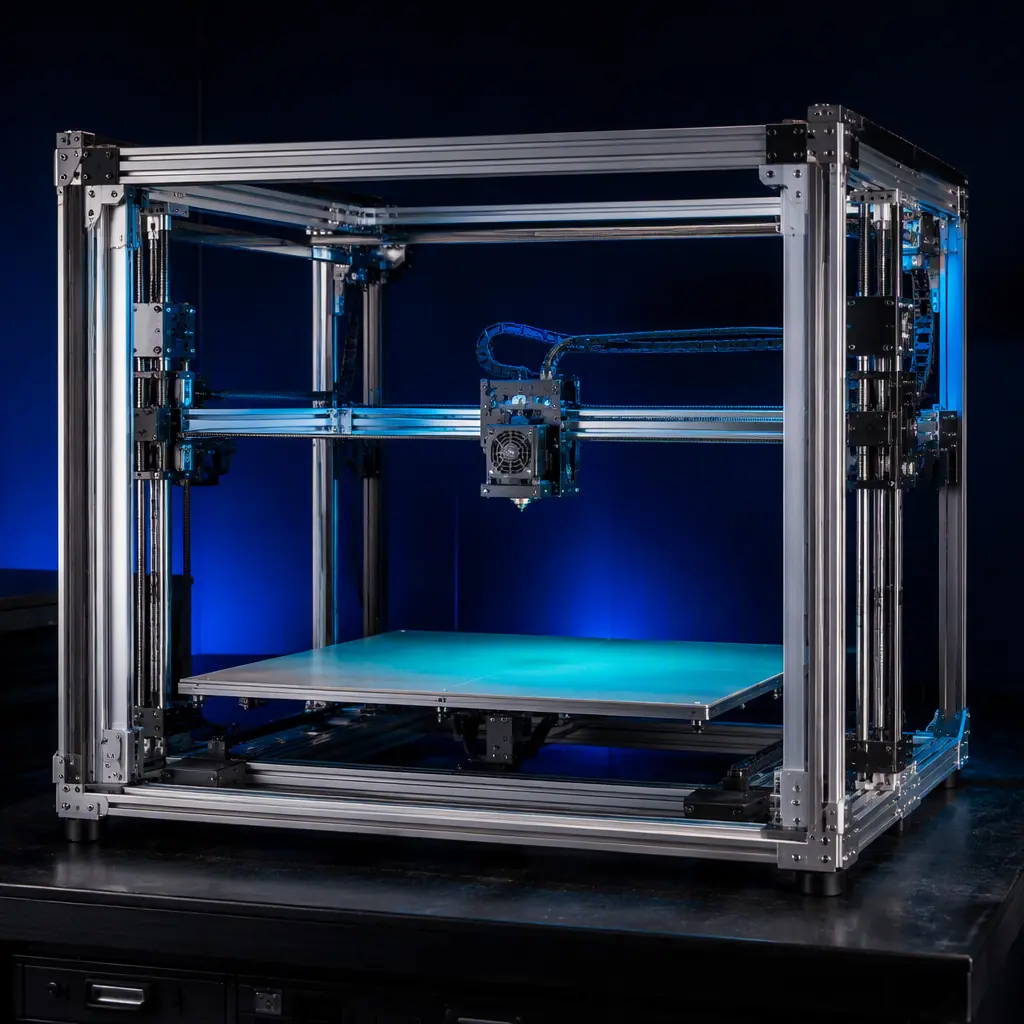
The V-Core 4 uses a cast aluminum tooling plate bed (not PCB heater), genuine Hiwin linear rails (not generic clones), and Gates GT2 belts as standard — component choices that place it firmly in the premium segment. For a comparison of linear motion quality, see our linear rails vs V-wheels guide, which covers why Hiwin-spec rails matter for print consistency.
Open-Source Kit vs Assembled Printer — The Margin Equation
The financial case for open-source kits is compelling on paper: lower landed cost, no assembly labor at the factory level, and customers who self-select for lower support needs. But the real numbers tell a more nuanced story.
Kit model (V-Core 4 400 example):
Assembled printer at equivalent spec:
The counterintuitive result: despite lower gross margins on assembled printers, open-source kits deliver higher net margin per unit for distributors who build an efficient support infrastructure. The key is to charge for premium support — offering a "build assistance" package at €150–300 that covers the 1.8 average support hours with margin to spare. For guidance on pricing structures, see our distributor pricing and margin strategy guide.
Customer Profile — Who Buys Open-Source Kits?
Not every customer is a RatRig candidate. The data from existing RatRig distributors shows a clear customer profile:
The unifying characteristic:
these buyers have prior 3D printing experience and value performance-per-dollar over out-of-box convenience. They understand that building a kit takes 8–15 hours and that they'll need to tune the machine themselves. This self-selection is the reason open-source kit customers generate fewer "this printer doesn't work" tickets — they expected to tinker.
What you're looking for: First-time printer buyers should almost never be sold an open-source kit. The return rate for first-timers on kit printers is 4–6× higher than for experienced users. Qualify the customer before recommending open-source.
Competitive Positioning — RatRig vs Bambu Lab vs Prusa vs Creality
The open-source kit occupies a unique market position that no proprietary brand can match. Here's how to position RatRig against the dominant brands in your sales conversations:
vs Bambu Lab (X1/P1 series):
Bambu wins on out-of-box experience and multi-material. RatRig wins on build volume, repairability, and total cost of ownership. A Bambu X1E with 256³ mm build volume at €2,499 vs a RatRig V-Core 4 400 at €1,899 with 400³ mm — that's 3.8× the build volume for €600 less. For customers who print large functional parts, the volume argument is decisive. See our Bambu Lab closed ecosystem analysis for the full competitive landscape.
vs Prusa (MK4/XL):
Prusa's brand trust and support ecosystem are unmatched. But Prusa's pricing — €1,099 for a 250³ mm bedslinger — makes RatRig look like a bargain for customers who need CoreXY speed and larger volume. The Prusa XL at €3,499 is a toolchanger; the V-Core 4 Hybrid with IDEX at €2,200 covers 80% of multi-material use cases at 63% of the price.
vs Creality (K1/K2 series):
Creality wins on price alone. A K1 Max at €899 is hard to beat for budget CoreXY. But the component quality gap is real — Creality uses generic linear rods and single-sided belts; RatRig uses Hiwin rails and genuine Gates belts. For distributors, the higher RatRig margin (42% vs ~25% on Creality) and lower warranty return rate (3% vs ~8%) more than compensates for the higher sale price. For more on brand positioning, see our competitive brand landscape analysis.
Support Infrastructure — What You Actually Need
Supporting open-source kits requires a different playbook than supporting assembled printers. The good news: RatRig provides detailed build documentation, an active Discord community (50,000+ members), and a growing knowledge base. The bad news: your support team needs to understand Klipper firmware, printer.cfg configuration, and mechanical assembly troubleshooting — skills that aren't needed for Bambu Lab or Creality support.
Minimum support capability:
- 1 technician per 50 kit sales per month who can read and modify Klipper config files
- Pre-built Klipper configs for common RatRig configurations (provided by RatRig, but your team should validate them)
- A "build check" service — customer sends photos at 3 build milestones, your technician reviews them (15 min per check, chargeable at €50/check)
- Spare parts inventory: belts, linear rail carriages, hotend components, stepper motors (€2,000–3,000 initial stocking cost)
For distributors who already support Klipper-based machines, adding RatRig is straightforward — the firmware and electronics are identical to what you'd find on any Klipper machine. See our Klipper firmware distributor guide for a deep dive on supporting Klipper-based printers.
Decision Framework — Should Your Distribution Business Carry RatRig?
Answer these five questions. If you score 4+ "yes" answers, RatRig is a strong fit:
- Do you already sell ≥1 Klipper-based printer? If your support team knows Klipper, the learning curve for RatRig is near zero.
- Does ≥20% of your customer base own multiple printers? Multi-printer owners are the core RatRig demographic.
- Can you offer 2-day spare parts shipping in your region? Open-source kit customers value parts availability above all else.
- Do you have technician capacity for 1.8 support hours per unit per year? If your support desk is already overwhelmed, don't add kits.
- Is the 400 mm+ build volume segment growing in your market? RatRig's sweet spot — large-format CoreXY — is a segment where proprietary brands are weak.
If you scored 2–3 "yes" answers, consider starting with the V-Minion (€600, 180³ mm) as a pilot. It's a lower-risk entry point: smaller investment, simpler build (4–6 hours), and a clear customer segment (experienced users who want a compact second printer). For more on portfolio strategy, see our distributor portfolio strategy guide.
Reviewed by the Precise3D engineering & OEM team. Compliance files that accompany the catalog are auditable at the certification register.
Expand Your Portfolio
Add Open-Source Performance to Your Product Line
Precise3D's open-source platform delivers RatRig-compatible performance with full factory assembly and support. Get the margin advantage of open-source without the support burden of customer-built kits. Contact us for distributor pricing and sample unit availability.